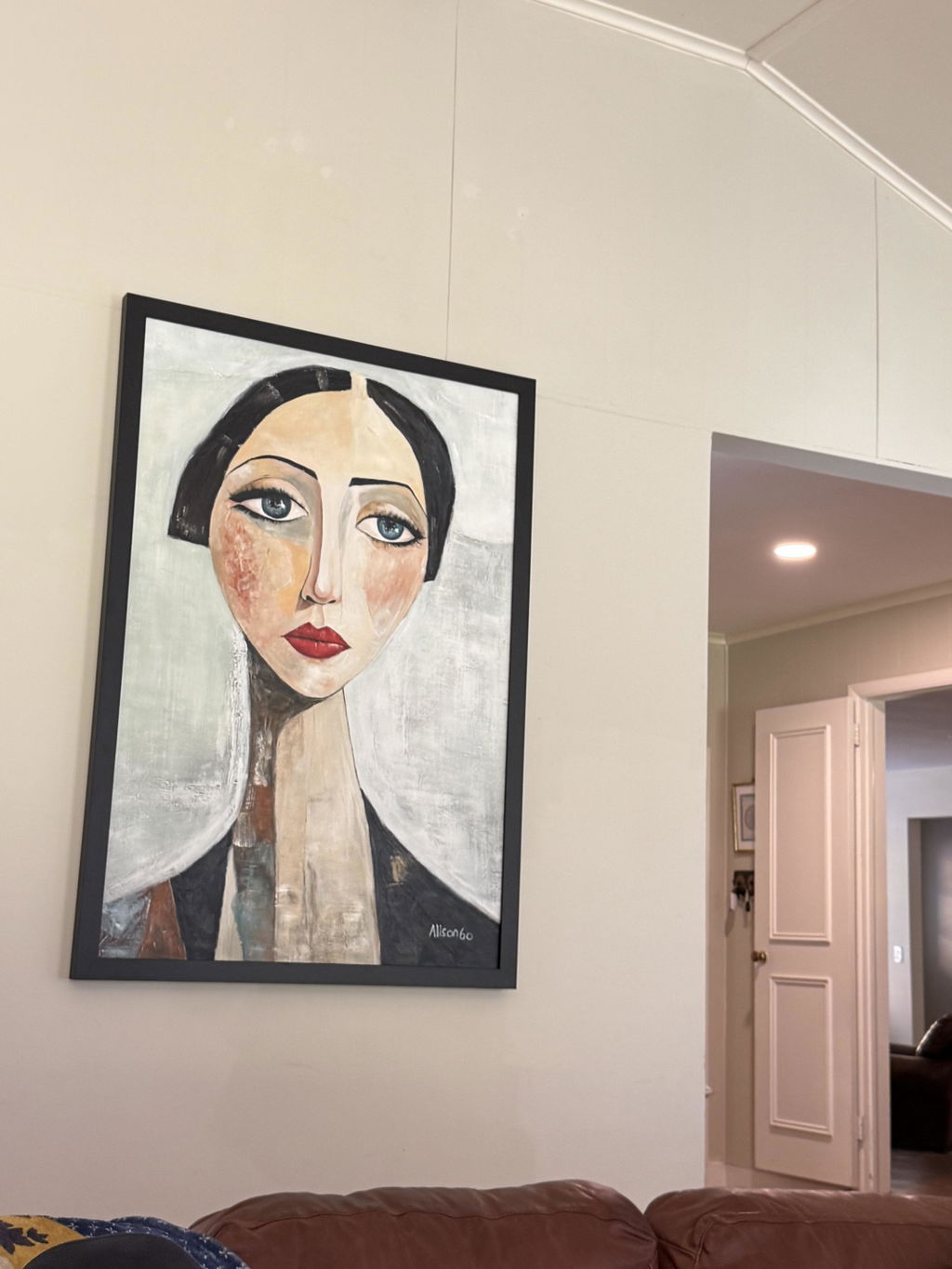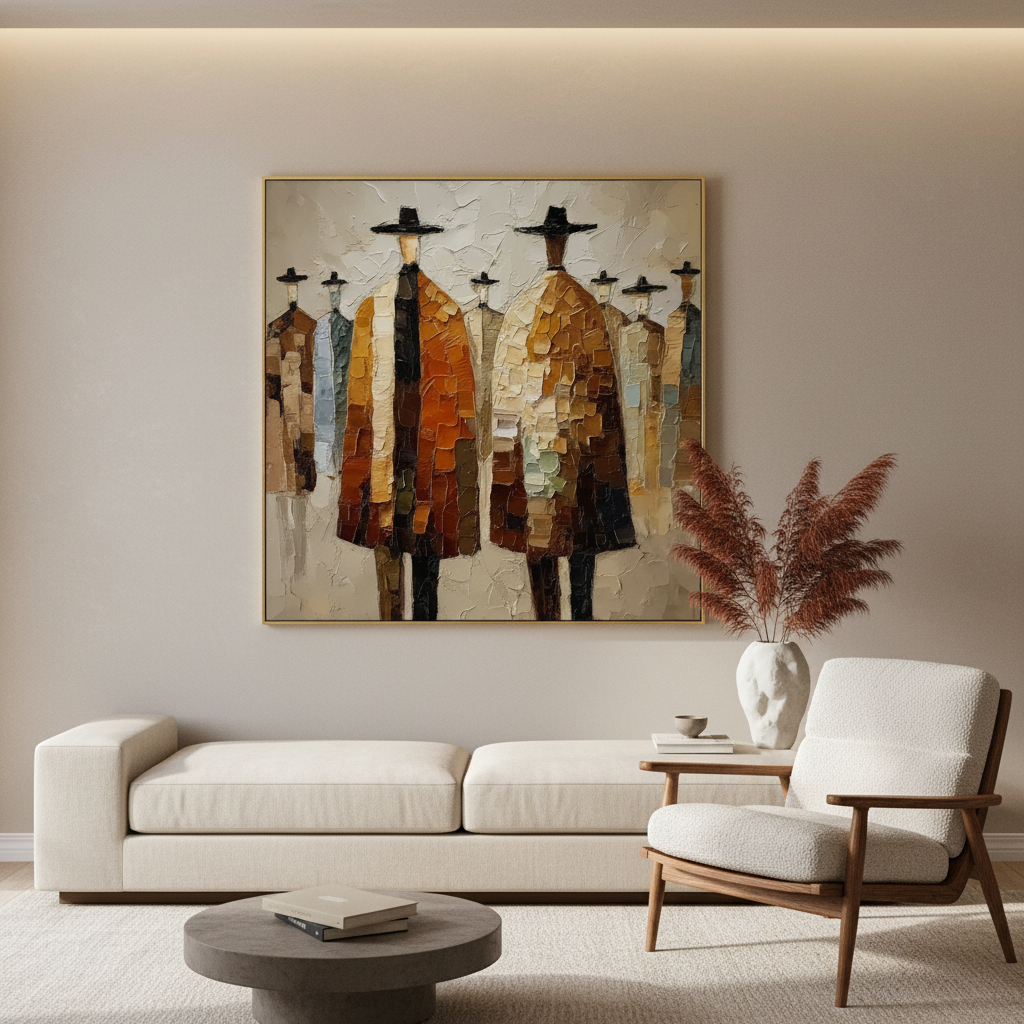
Studio Designation vs. Master Artist: Value Implications in Made-to-Order Art
The global art market is undergoing a structural correction. While high-end auction sales for pieces exceeding $10 million plummeted 44% year-over-year in 2024, the broader market remains a stable $65 billion powerhouse, according to the Art Basel and UBS Art Market Report 2024. This shift signals a retreat from purely financial "vanity" assets toward what we define as 'performative authenticity'—art that offers real emotional value and physical presence within a lived environment.
For the modern homeowner and interior designer, the primary challenge is no longer finding art, but navigating the hierarchy of its production. In the made-to-order sector, two designations dominate the conversation: Studio Signed and Master Artist. Choosing between them is not merely a matter of price; it is a strategic decision involving provenance, narrative, and risk management.

The Human Premium: Why "Hand-Painted" Still Commands the Market
In an era of generative AI, the value of the "human hand" has transitioned from an aesthetic preference to a quantifiable economic premium. A study conducted by Columbia University confirmed that consumers value artwork labeled "human-created" 62% higher than identical pieces labeled "AI-generated."
This is not merely sentimentality. Research from the University of Chicago suggests that digital replicas and AI art lack an "essential identity"—a metaphysical soul that viewers perceive in physical, hand-painted works. When you choose a hand-painted piece, you are acquiring the biochemical crystallization of apex human attention.
Methodology Note (Heuristic Valuation Model): Our analysis of the "Signature Premium" is based on common industry heuristics where an individual master's signature typically increases primary market price by 25–40% over a studio-branded piece of equal scale.
Parameter Studio Signed Baseline Master Artist Variable Rationale Experience Brand Standard 10–15 Years Specialization Expertise threshold Labor Time Collaborative/Efficient Individual/Deep Work Invisible labor costs Price Premium 0% (Baseline) +25% to +40% Provenance & Narrative Consistency High (Brand Controlled) Variable (Artist Style) Production method Resale Potential Decorative Value Collectible Value Market-based valuation
1. Studio Signed: The Collective Excellence Model
The "Studio Signed" designation (sometimes referred to as "Studio Branded") represents a collaborative output. In this model, the brand’s quality control is the primary guarantee. For many collectors, this is the "predictability" of ecommerce meeting the "prestige" of art.
Why Designers Prefer Studio Designations
Interior designers often prioritize Studio Signed works for high-traffic commercial projects or hospitality environments. The reasoning is grounded in brand liability and consistency. When a boutique hotel commissions fifty murals, they require a unified aesthetic that a single master artist might struggle to deliver within a tight timeline.
Furthermore, according to the 2025 Hospitality Design White Paper, integrating local artist-led studio works provides travelers with "scarce authenticity" that mass-produced prints cannot replicate.
The "Reliability" Factor
- Consistency: Studio works are governed by a brand's specific "style guide," ensuring the final piece matches the online preview.
- Scale: Studios can handle massive physical dimensions, such as "Panoramic Hand-Painted Murals," which are currently a dominant trend in high-end powder room design according to NKBA 2025 awards.
- Safety Standards: Large studios are more likely to adhere to strict Indoor Air Quality (IAQ) protocols. For example, using low-VOC paints is a prerequisite for LEED certification in commercial developments.

2. Master Artist: The Signature Vision
A "Master Artist" designation typically implies a minimum of 10–15 years of specialized experience. This artist has developed a signature style—a "visual fingerprint"—that is difficult for others to replicate.
The Narrative Value
In residential design, the Master Artist designation is the gold standard for focal points. Provenance adds to the home's narrative. When a guest asks about the art, the answer isn't just "I bought it online"; it's "This is a signed piece by a master who specializes in [Specific Technique]."
The Mechanics of the "Artist's Hand"
Psychology research from Stockton University reveals that top painters possess unique "top-down visual selection" mechanisms. They are literally wired to suppress perceptual illusions that confuse the average person. When you pay for a Master Artist, you are buying a piece of this rare neural processing.
Valuation and Investment
While studio-designated works with superior provenance and condition can occasionally outperform poorly documented master works, the general market follows a hedonic valuation model. According to research published in arXiv (2025), these models identify attribution as a primary driver of price variation. A Master Artist signature acts as a "value anchor" for future appraisals.
3. The Chemistry of Authenticity: Pigments and Longevity
Whether a piece is Studio Signed or Master Artist, its physical integrity is determined by material science. The "performative authenticity" our audience craves is rooted in the micro-physical texture of the paint.
The "Micro-topography" of Oil and Acrylic
Optical microprofilometry proves that the mm-scale texture of oil paintings is crucial to their aesthetic appeal. This "relief" is what makes hand-painted art feel "real" compared to flat prints.
However, the choice of medium brings different risks:
- Acrylic Longevity: Tate's research confirms that while acrylics are highly durable, they are not solvent-resistant. They are prone to "haziness" caused by PEG-type surfactants migrating to the surface in high humidity.
- Oil Risks: Oil paints are susceptible to "oxidative cross-linking," which makes them brittle over decades. According to ResearchGate data, oil pigments can experience catastrophic binder separation when exposed to temperatures exceeding 100°C.
Safety and the "Non-Toxic" Promise
For families and healthcare facilities, the "Master" status must extend to material safety. The International Agency for Research on Cancer (IARC) classifies cadmium—a common pigment in high-end paints—as a Group 1 carcinogen.
Professional studios and masters are increasingly pivoting to eco-friendly alternatives. Using walnut oil instead of turpentine or hemp canvases instead of cotton can reduce the environmental footprint by up to 50% (Cincinnati Art Museum).

4. Spatial Impact: Art as Infrastructure
Art is no longer just "decor"; it is public health infrastructure and economic leverage.
The "Busy Streets" and Property Value Effect
Research from the University of Michigan shows that community murals can reduce neighborhood violent crime by 40%. In the commercial sector, the Royal Society found that neighborhoods with high "art geo-tags" saw significantly higher relative house price ranking gains.
Biophilic Healing
For private clinics and corporate offices, "nature-themed healing murals" are a strategic investment. A UPenn review noted that 73% of patients reported significant mood improvements when exposed to environmental artwork. This biophilic design produces the same stress-reduction effects in the brain as being outdoors (University of Central Arkansas).
5. Documentation: The Certificate of Authenticity (COA)
In the made-to-order art world, the COA is your most important document. It bridges the gap between a "purchase" and an "investment."
A legally robust COA, as outlined by the NEN (World Federation of Global Education), must include:
- Artist/Studio Name: Explicitly stating the designation.
- Creation Date: Essential for insurance appraisals.
- Medium and Dimensions: Verifying the physical specs.
- Unique Identifier/Archival Number: To track the work's history.
- Signature: A qualified signature from the artist or the studio director.
Logic Summary: Our recommendation for COA inclusion is based on the ASTM D-4236 standards and the LHAMA act, which require art materials to be reviewed for chronic health hazards every five years. A professional COA ensures that the materials used are compliant with these safety regulations.
Choosing the Right Designation for Your Space
To help you decide which level of documentation fits your goals, we have modeled two distinct scenarios based on common client patterns.
Scenario A: The Commercial Developer (Studio Signed)
- Goal: Lease up a 4 million sq. ft. office space.
- Strategy: Utilize large-scale, unique public art installations as a marketing "trump card" (NAIOP Insights).
- Selection: Studio Signed murals.
- Benefit: Brand liability covers consistency; the scale of production is managed by a team, and the project secures "green building points" via zero-VOC paint compliance.
Scenario B: The Luxury Homeowner (Master Artist)
- Goal: Create a legacy focal point in a master suite.
- Strategy: Capture the 2026 trend of "understated elegance with texture as its soul" (Design State of Mind).
- Selection: Master Artist signed canvas.
- Benefit: 25-40% signature premium; high emotional resonance (mPFC activation); and a clear provenance record for future heirs.
The Future of Art Valuation
As we move toward 2026, the distinction between "Studio" and "Master" will be further clarified by technology. Blockchain and AI-driven provenance tracking are emerging as the new standard for documenting production history (Shauna Lee Lange, 2026). These systems will move beyond traditional categories to track every step of the "artist's hand," from the first sketch to the final varnish.
For more insights on protecting your investment, explore our guides on Provenance Records: Validating Your Art’s Creator History and Decoding Artist Signatures: Verification for New Collectors. Understanding these signals is the first step in building a collection that balances aesthetic joy with long-term value.
Disclaimer: This article is for informational purposes only and does not constitute professional legal, financial, or medical advice. For specific inquiries regarding art investment or environmental safety, please consult a qualified professional.
References
- Art Basel & UBS Art Market Report 2024
- Columbia University: Human-Made vs. AI Art Study
- Royal Society: Quantifying the link between art and property prices
- WHO: Scoping Review on Arts and Health
- EPA: Indoor Air Quality and Low-VOC Paints
- Artsy 2024 Art Market Report
- Tate: Conservation Concerns for Acrylic Emulsion Paints
- CDC NIOSH: Paint and Coating Hazards