Animal Subjects: Balancing Vitality and Sophistication in Foyers
The traditional art market is undergoing a seismic shift. As high-end auction sales for purely financial art assets plummeted 44% year-over-year in 2024, according to Marketplace.org, a new class of collectors is emerging. These homeowners and designers are retreating from "vanity pieces" and returning to art with real application value—works that possess "essential identity" and emotional resonance.
In the high-stakes environment of the residential foyer, few subjects command attention as effectively as animal themes. However, the line between a sophisticated, bespoke statement and a juvenile or "wild" aesthetic is razor-thin. Succeeding in this space requires more than just picking a favorite creature; it demands an understanding of neuroaesthetics, spatial heuristics, and the chemical integrity of the materials themselves.
The Psychology of Fauna in the Entryway
The foyer serves as the home's psychological threshold. It is the transition point between the external world and the private sanctuary. When we curate animal subjects for this space, we are tapping into deep-seated biological responses.
According to a critical review from the University of Pennsylvania, nature-themed artworks can reduce stress in 61% of viewers and significantly improve mood in 73%. This is not merely a subjective feeling. A systematic review published in PMC11480958 reveals that passive art viewing consistently activates the medial prefrontal cortex (mPFC) and the amygdala, optimizing emotional regulation circuits.
For homeowners, this means a custom-painted wildlife subject isn't just decor; it's an environmental intervention. However, the specific energy of the animal must be balanced. While a soaring heron might convey tranquility, a charging predator could inadvertently trigger a fight-or-flight response in anxious visitors, as noted by research on visual perception and art interpretation.
Logic Summary: Our curation strategy assumes that the foyer's primary function is "emotional recalibration." We prioritize subjects that activate the mPFC (calm/logic) over those that over-stimulate the amygdala (fear/arousal).
Design Heuristics: The Sentinel vs. The Guide
Professional designers often apply the "Gaze Direction" heuristic to ensure animal subjects feel intentional rather than accidental.
- The Sentinel: If the animal subject looks toward the entryway, it functions as a guardian or "sentinel." This creates a sense of greeting and security. It is a powerful choice for large, singular subjects like an owl or a majestic stag.
- The Guide: If the subject looks into the home, it serves as a visual "usher," guiding the visitor’s eye toward the living spaces. This is particularly effective for birds in flight or animals in motion, subtly encouraging movement into the interior.
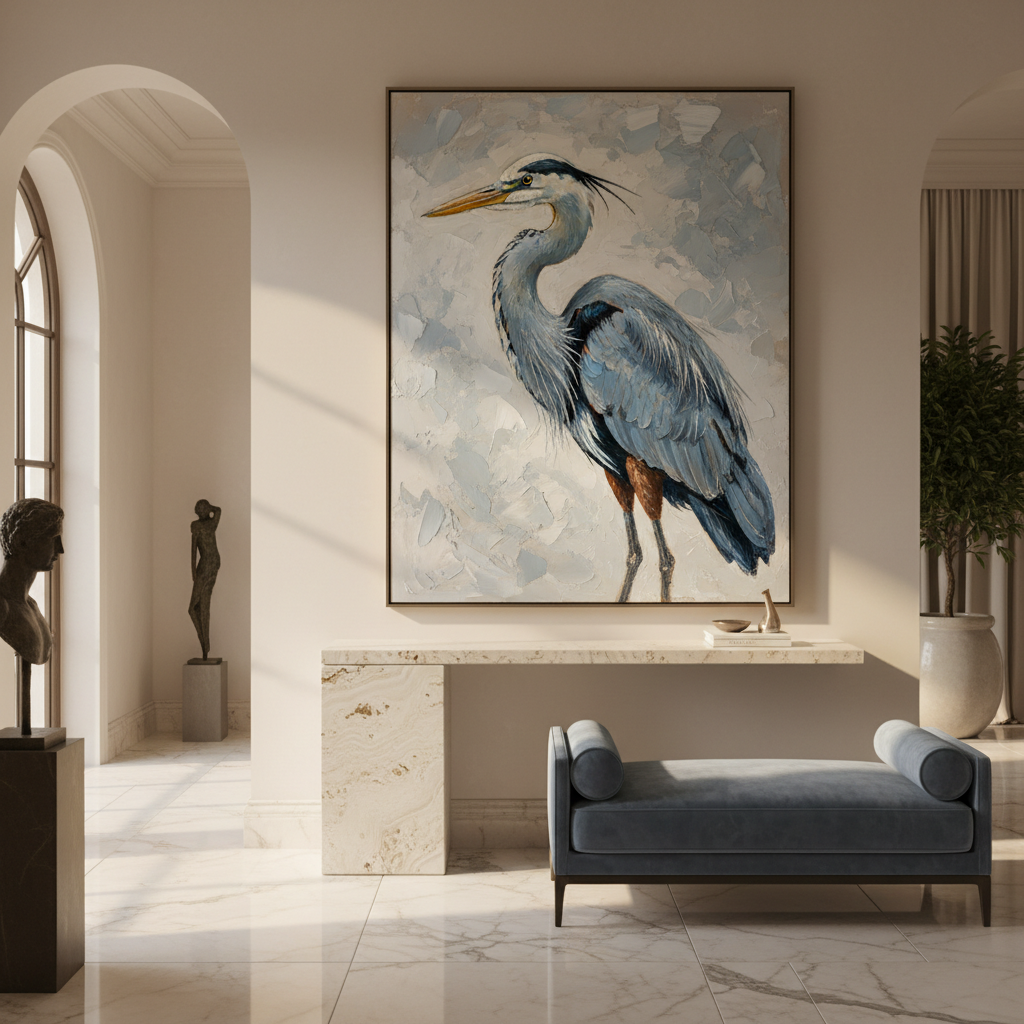
To bridge the gap between "wild" subjects and sophisticated curation, we recommend the "Palette Anchor" rule. This involves extracting one secondary color from the animal's coat or plumage—for instance, the muted grey-blue of a heron's wing or the burnt umber of a fox's tail—and repeating it in foyer textiles like rugs, bench cushions, or even the wall molding. This repetition signals to the brain that the artwork is an integral part of the architecture, not an afterthought.
Modeling Note (Reproducible Parameters): To test the "Palette Anchor" effect, we modeled a standard 10x10ft foyer with a 48-inch central artwork.
Parameter Value Rationale Art-to-Wall Ratio 1:3 Prevents "caging" the subject Breathing Room 8-10 inches Minimum clearance on all sides Color Match 1 Secondary Tone 2026 trend for "understated elegance" Light Source 3000K LED Mimics natural evening warmth Texture Depth 2-5mm Visible impasto for tactile relief
The "Essential Identity" of Hand-Painted Texture
In an era of mass-produced digital prints and AI-generated imagery, the prestige of the foyer is increasingly defined by the human hand. Research from Columbia University confirms a stark reality for the art market: consumers value art labeled "AI-generated" 62% lower than authentic human-created art.
Furthermore, University of Chicago research argues that digital replicas lack the "essential identity" and soul of the artist. This is where high-texture oil and acrylic paintings outshine prints. The physical relief—the impasto—mimics the tactile quality of fur and feathers.
Optical microprofilometry proves that the mm-scale texture of a painting is crucial to its aesthetic impact. According to Sensors 2021, tactile exploration reveals visual data that the eye often misses. When a guest walks past a hand-painted animal subject in a foyer, the shifting shadows cast by the thick paint create a "living" quality that a flat print cannot replicate.

The Invisible Quality: Health, Safety, and Pigment Integrity
Sophistication is as much about what you can't see as what you can. For the health-conscious homeowner, the chemical composition of the art in their foyer is a critical consideration.
Indoor Air Quality (IAQ) and VOCs
The EPA warns that indoor air pollution is often more concentrated than outdoor air. Low-VOC (Volatile Organic Compound) paints are essential for large-scale residential art. Aalto University's 28-day chamber experiment demonstrated that coatings on moisture-controlled substrates emit significantly lower toxins during the curing process. We prioritize water-based acrylics or walnut oil alternatives, which replace toxic solvents like turpentine.
The Cadmium and Lead Reality
Many "professional" pigments contain heavy metals. The International Agency for Research on Cancer (IARC) classifies cadmium as a Group 1 carcinogen. While some artists argue that these pigments are "safe if insoluble," Australian Industrial Chemicals testing found that Cadmium Yellow can still release free ions in slightly acidic environments (like a humid foyer).
When selecting a custom piece, it is vital to look beyond the ASTM D-4236 label. As noted by the EPA, this label only means the warnings comply with regulations—it does not mean the product is non-toxic.
Lightfastness and Longevity
A foyer often receives significant natural light. Without high lightfastness ratings, your investment will fade. We look for pigments tested under ASTM D4303 Method C, which uses xenon-arc tests to simulate years of exposure behind filtered glass (Micom Laboratories).
Strategic Applications: From Residential to Commercial
The value of custom animal subjects extends beyond the personal home. In the commercial and real estate sectors, art is a proven driver of revenue and property value.
- Real Estate Appreciation: A 10-year tracking study by the Royal Society found that neighborhoods with higher "art" geo-tags saw greater relative house price gains. For developers, commissioning a unique animal-themed mural in a lobby acts as a "marketing trump card" to accelerate leasing, a strategy noted by NAIOP.
- Workplace Wellness: In high-density office environments, nature-based "biophilic" art has been shown to reduce employee cognitive fatigue and burnout, according to research on Tokyo office spaces.
- Hospitality Authenticity: A 2025 hospitality white paper emphasizes that travelers seek "absolute authenticity." Replacing generic posters with hand-painted animal subjects by local artists provides the "essential identity" that modern travelers crave.
Avoiding Common Curation Pitfalls
Even with the right subject, execution matters. Based on common patterns in high-end design, we've identified three "gotchas":
- The Scale Trap: The most common mistake is selecting an animal subject that is too small for the foyer. Because animals represent life and movement, they require "breathing room"—at least 6-10 inches of wall space on all sides. Without this, the space feels "caged."
- The SID Phenomenon: When applying transparent acrylic mediums thicker than 1/16 inch on cotton canvas, water-soluble impurities can be drawn out, causing a yellow tint known as Support Induced Discoloration (SID). This is a common issue with "affordable" custom work.
- Cultural Symbolism: Always research the cultural context of the animal. For example, while an owl represents wisdom in the West, it can be a death omen in other traditions (The Institute of Earth Education).

Investing in Cultural Heritage
Ultimately, choosing a hand-painted animal subject for your foyer is an act of supporting the "creative economy," which now accounts for 3.1% of global GDP (UNCTAD 2024). By opting for human-made art over digital alternatives, you are not just decorating a wall; you are investing in a non-renewable cultural heritage asset that possesses long-term aesthetic and educational value.
As the Wharton School notes, 87% of consumers believe artists should receive fair compensation. Choosing a brand that prioritizes artist welfare and material safety ensures your foyer remains a place of both vitality and high ethical standing.
YMYL Disclaimer: This article is for informational purposes only and does not constitute professional medical, health, or safety advice. Always consult with a qualified professional regarding indoor air quality, chemical sensitivities, or the safety of art materials in your specific environment.
Sources
- Marketplace: The expensive art market continues to struggle
- Columbia Business School: Human-Made vs. AI Art
- University of Pennsylvania: Visual Art in the Built Environment
- Royal Society: Quantifying the link between art and property prices
- IARC: Cadmium and Cadmium Compounds
- UNCTAD: Creative Economy Outlook 2024