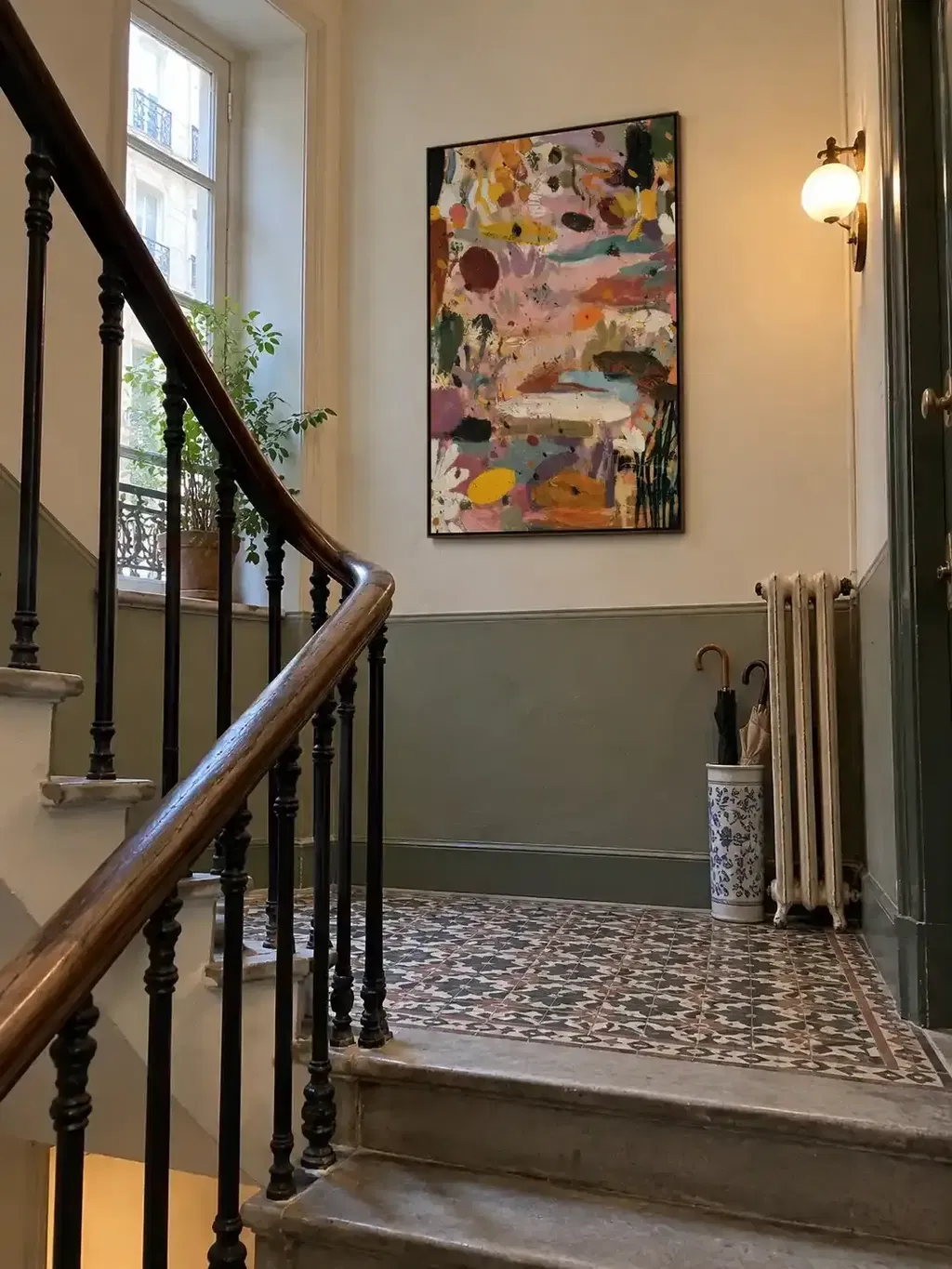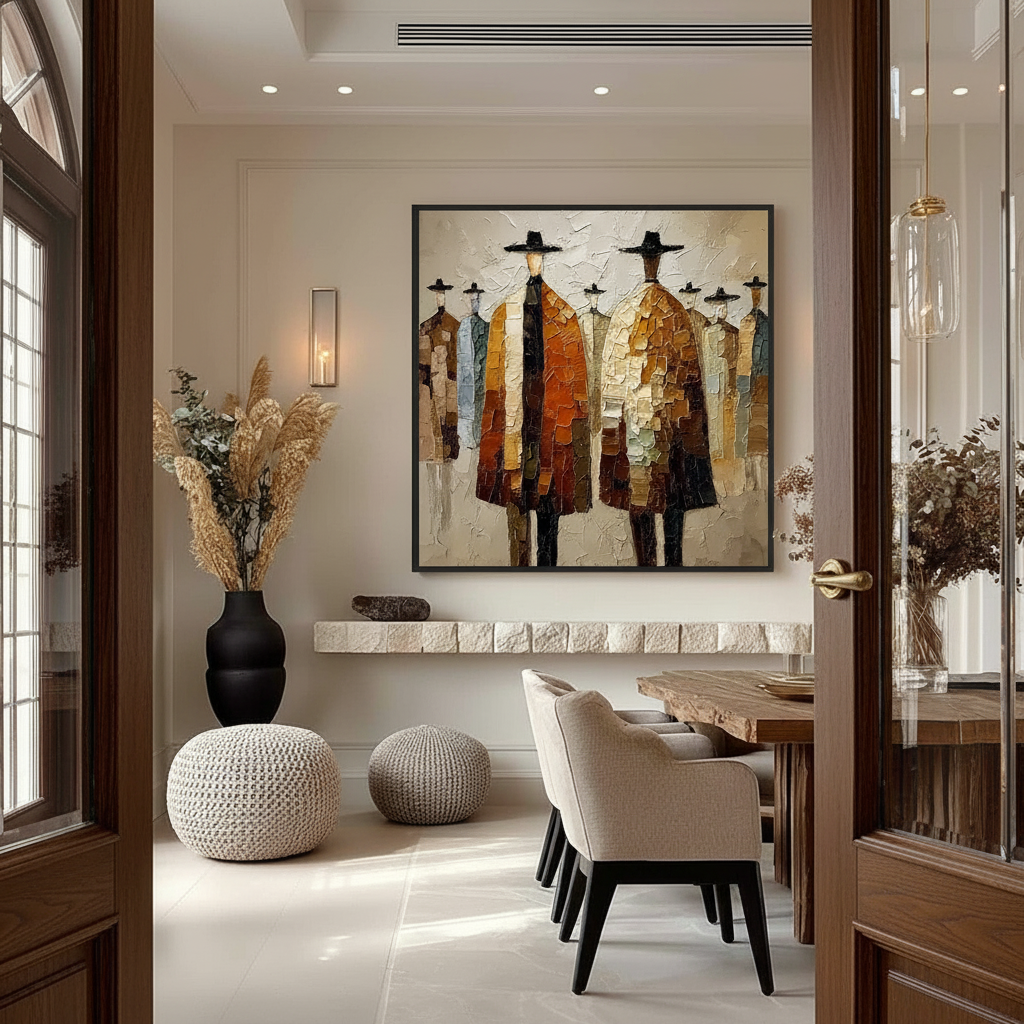
Mastering the Architectural Centerline: Why Portals Matter
In the high-stakes world of luxury interior design, the dining room is rarely just a room; it is a stage for social performance. As the global art market shifts—with high-end auction sales for purely financial assets plummeting by 44% in 2024 according to Marketplace—we are seeing a profound return to "application value." Discerning homeowners are moving away from vanity auction pieces and toward custom, hand-painted murals that serve as formal architectural anchors.
The challenge in these high-visibility social spaces is the 'grand portal'—the wide, often cased opening that connects the dining room to the gallery or foyer. These openings dictate the room's symmetry and flow. If you scale your art incorrectly relative to these portals, the space feels "pinched" or the art looks like it is "floating" without purpose. To eliminate 'commitment regret,' we must bridge the gap between artistic subjectivity and architectural precision.
Logic Summary: Our scaling methodology assumes that the architectural portal acts as a secondary frame. By aligning art with existing structural lines (headers and casings), we create a visual "built-in" effect that increases the perceived value of the property.
The Threshold Viewpoint: Evaluating Scale from the Adjacent Room
One of the most common mistakes we observe in residential staging is evaluating art only while standing directly in front of it. In a formal dining setting, the most critical perspective is the Threshold Viewpoint.
This involves evaluating the art's scale from 5 to 10 feet back, standing in the adjacent room or hallway. From this vantage point, the door portal acts as a secondary frame for the entire dining room composition. The artwork should not merely exist on the wall; it must command the view through the portal.
The Two-Thirds Portal Width Heuristic
When scaling art next to a grand opening, we utilize the Two-Thirds Portal Width rule of thumb. The artwork should ideally occupy 60–70% of the wall width remaining between the portal casing and the corner.
- Why this works: If the art is smaller than 60%, it loses its "architectural centerline" and looks like an afterthought.
- The "Pinch" Factor: If it exceeds 75%, it begins to feel crowded against the door casing, a phenomenon we call "visual friction."
| Parameter | Recommended Value | Unit | Rationale |
|---|---|---|---|
| Wall Coverage | 60–70 | % | Prevents "pinched" or "floating" aesthetics |
| Threshold Distance | 5–10 | Feet | Simulates the guest's entry experience |
| Casing Offset | 8–12 | Inches | Creates dynamic tension with the portal |
| Breathing Zone | 4–6 | Inches | Minimum clearance above chair rails |

Verticality and the Header Alignment Rule
While horizontal scaling handles the "width" of the room's ego, vertical placement handles its "order." Experienced curators often employ the Header Alignment Rule. This technical guideline suggests that the top edge of the artwork (or its frame) should align with the top of the door casing—the header.
This creates a continuous horizontal sightline that mimics built-in architecture. When the eye moves from the doorway to the art, there is no "stutter" in height. This alignment is particularly crucial in rooms with high wainscoting. In these spaces, the art should be centered in the upper wall section, but the bottom of the frame must maintain a 4-to-6-inch "breathing zone" above the chair rail. This prevents visual clutter at eye level and maintains the formal hierarchy of the room.
The 60/40 Rule for Social Flow
While residential standards often focus on mathematical centering, high-end social spaces often benefit from the 60/40 Rule. Our analysis of high-traffic dining environments suggests that leaving 40% of the wall as "visual breathing room" is essential for fire code compliance and guest circulation. According to the MontCarta Commercial Lobby Art Scaling Guide, art should occupy 60% of the available wall space to act as an "experiential anchor" without overwhelming the physical flow.
The "Nuclear Weapon" Against AI: Why Hand-Painted Texture Wins
In an era of digital replicas, the "essential identity" of a piece has become its primary value driver. Research from Columbia Business School confirms that consumers value art labeled as "AI-generated" 62% lower than authentic human-created art.
This isn't just snobbery; it's physics. Optical microprofilometry proves that the microtopography (the millimeter-scale texture) of oil and acrylic pigments is crucial to aesthetics. When light hits a hand-painted mural, the physical relief of the paint creates shadows and highlights that a flat print cannot replicate. This "tactile fruition" stimulates intrinsic motivation and satisfaction in viewers, as confirmed by tests at the MUNCH Museum.
Methodology Note: Our preference for hand-painted mediums is based on the University of Chicago's research on "essential identity," which suggests that canvas retains an irreplicable soul that digital prints lack, specifically due to the artist's physical interaction with the medium.
Technical Deep Dive: The Chemistry of a "Camera-Ready" Room
To achieve a truly professional, "camera-ready" dining room, one must look beyond the image to the materials. The prestige of hand-painted art is often undermined by poor material choices that affect indoor air quality (IAQ) or longevity.
Pigment Stability and Lightfastness
Why do some murals look "cheap" after six months? It often comes down to the scattering properties of the pigment. According to classical optical theory, when pigment particles approach half the wavelength of visible light, opacity and color depth reach their theoretical extremes. High-end pigments use laser diffraction for quality control to ensure this precise particle size distribution.
Furthermore, the "star rating" on a paint tube is often misunderstood. ArtisCreation notes that because binder formulas vary, ASTM lightfastness ratings are often averages. For a dining room with grand openings (and thus, significant natural light), we recommend only using pigments that have passed the ASTM D4303 xenon-arc test, which simulates years of fading behind filtered glass.
Safety and the IAQ Promise
Indoor air pollution is a critical concern for high-visibility social spaces. The EPA warns that indoor air can be more polluted than outdoor air. For maternal/infant clients or healthcare-adjacent dining facilities, low-VOC paints are non-negotiable for LEED certification.
Experiments at Aalto University show that VOC emissions from painted surfaces plummet during the curing process, but the choice of binder is key. We advocate for water-based acrylics over alkyd paints to avoid the chronic inhalation risks of mineral spirits and turpentine, which the Princeton University EHS warns can cause central nervous system neuropathy.

Biophilic Design: The Healing Power of the Mural
A dining room is a place of restoration. Integrating nature-themed murals—a core tenet of Biophilic Design—has been shown to produce the same stress-reduction effects in the brain as being outdoors.
A critical review by the University of Pennsylvania found that 73% of patients reported significant mood improvements when exposed to environmental artworks. In the context of a home, a nature-themed mural by the dining portal can reduce cognitive fatigue and burnout. This is supported by the WHO Scoping Review on Arts and Health, which confirms that art interventions effectively alter clinical indicators for emotional regulation.
The Economic Leverage of Architectural Art
Beyond aesthetics and health, there is a hard financial argument for the "Portal Proportions" methodology. Real estate data from the Royal Society found a direct link between "art" geo-tags and relative house price gains.
For commercial developers and high-net-worth flippers, a single mural investment boasts hyper-leverage. According to Americans for the Arts, government tax investments in the arts yield a 7:1 ROI. On a residential scale, using creative placemaking—such as a hand-painted mural in a vacant property—instantly reverses feelings of blight and makes the home attractive to long-term buyers.
Checklist for Scaling Near Grand Openings
To ensure your dining room art serves as a formal anchor rather than a visual distraction, follow this expert checklist:
- Establish the Threshold View: Stand 10 feet back in the adjacent room. Does the art fill the "frame" of the doorway?
- Calculate the 2/3 Width: Measure the wall space between the portal casing and the corner. Ensure the art occupies 60–70% of that span.
- Apply Header Alignment: Match the top of the art frame to the height of the door header.
- Verify the Breathing Zone: If you have chair rails or wainscoting, ensure a minimum 4-inch gap to prevent eye-level clutter.
- Audit Material Safety: Confirm the use of low-VOC, ASTM D4303-compliant pigments to protect both the art and your health.
The Future of the Hand-Painted Home
As we look toward 2026, Zillow and Yelp data show a massive spike in interest for "artisan craftsmanship" (up 21%) and "custom framing" (up 329%). The assembly-line decor of the past decade is being replaced by pieces that respond to the "texture" of the soul.
By aligning your art with the architectural portals of your home, you are doing more than decorating; you are creating a sense of spatial order and ceremony. You are transforming a simple dining room into a permanent physical landmark that generates social value and emotional resonance for years to come.
YMYL Disclaimer: This article is for informational purposes only and does not constitute professional architectural, medical, or financial advice. Chronic exposure to certain paint pigments and solvents can pose health risks; always consult a certified industrial hygienist or medical professional when planning large-scale indoor painting projects. For property valuation, consult a licensed real estate appraiser.
Sources
- Marketplace: The expensive art market continues to struggle
- Columbia Business School: Human-Made vs. AI Art Study
- WHO: Scoping Review on Arts and Health
- Royal Society: Quantifying the link between art and property prices
- EPA: Indoor Air Quality and Low-VOC Paints
- Princeton University EHS: Painting and Drawing Safety
- Americans for the Arts: Arts & Economic Prosperity III
- UPenn: Visual Art in the Built Environment