Corner Curation: Sizing Large Art for Dining Room Angles
In the current interior design landscape, we are witnessing a significant shift in how homeowners and designers approach high-end acquisition. While the traditional auction market for purely financial art assets saw a 44% decline in 2024, there is a robust return to "real application value." Homeowners are moving away from speculative vanity pieces and toward custom, hand-painted works that serve a specific architectural purpose.
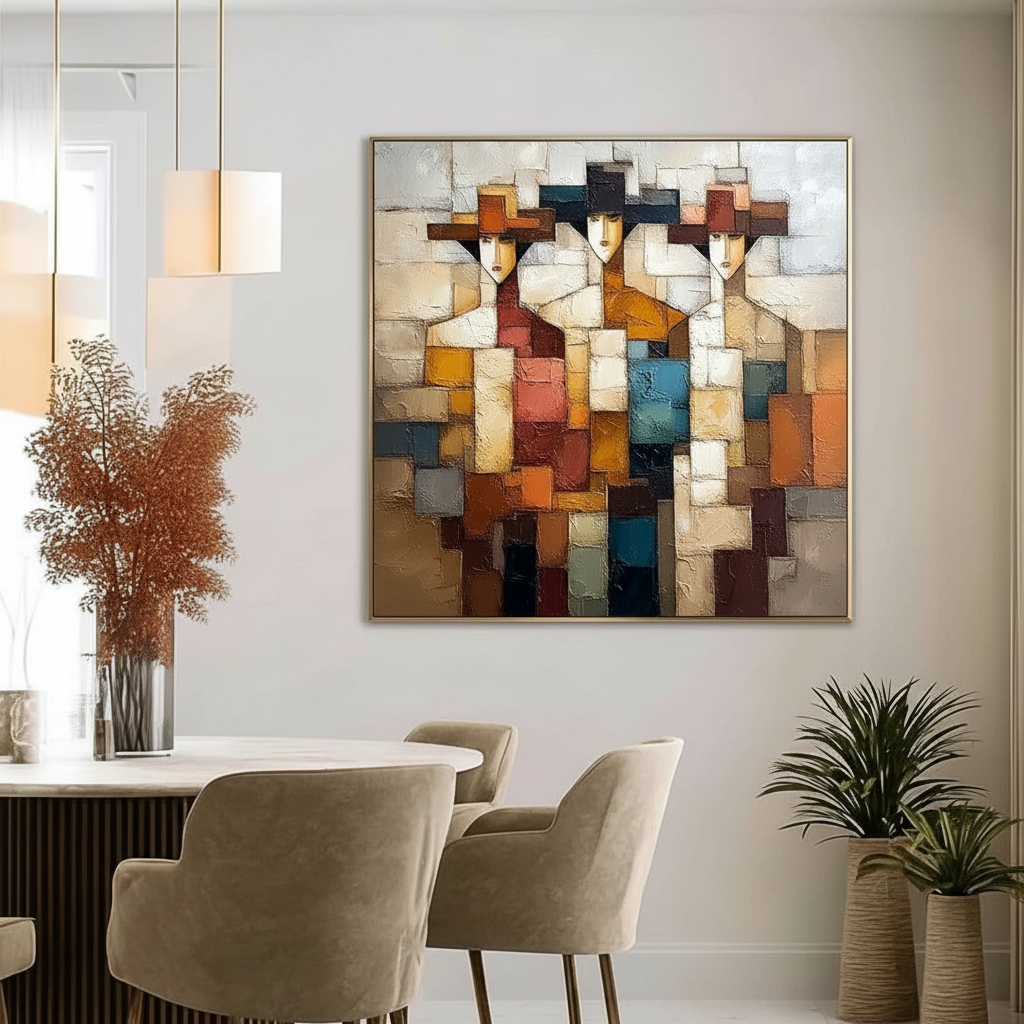
Nowhere is this "purpose-driven curation" more challenging—or more rewarding—than in the dining room corner. Often dismissed as "dead zones," corners are frequently filled with an afterthought plant or a small, mismatched frame. However, when scaled correctly, a large-scale oil painting can transform these angular intersections into a room’s visual anchor.
This guide breaks down the technical heuristics and psychological mechanisms of corner curation, ensuring your investment provides both aesthetic prestige and "decision safety."

The Geometry of the Corner: Heuristics for Scale
The most common mistake in dining room curation is treating a corner wall like a flat, isolated gallery wall. In reality, a corner is a three-dimensional architectural break that requires a different set of mathematical rules to ensure the art feels integrated rather than squeezed.
The Corner Reduction Factor (CRF)
While standard design wisdom suggests that art should occupy 60–75% of the available wall width, our experience in spatial modeling suggests this often leads to visual "crowding" in corners. Because the eye perceives two walls simultaneously at an intersection, a standard 75% coverage can feel suffocating.
We typically recommend applying a Corner Reduction Factor (CRF) of 0.7 to 0.8 to your base calculation.
Logic Summary: Our sizing model for corner art assumes a standard 90-degree intersection. The CRF is a heuristic used to preserve "negative space" near the vertex, preventing the frame from visually colliding with the adjacent wall.
| Parameter | Standard Wall Rule | Corner Heuristic (CRF Applied) | Rationale |
|---|---|---|---|
| Wall Width (W) | 96 inches | 96 inches | Baseline |
| Target Coverage | 60% – 75% | 42% – 60% | Prevents vertex crowding |
| Art Width (Min) | 57 inches | 40 inches | Balanced visual weight |
| Art Width (Max) | 72 inches | 57 inches | Upper limit for corner safety |
| Vertex Gap | N/A | 2 – 4 inches | Essential for "breathing room" |
The Rule of Two-Thirds in Negative Space
In corners, art should occupy roughly two-thirds of the visual "negative space" between the corner crease and the nearest architectural break (such as a window frame or door molding). If you are navigating around complex features like wainscoting, we recommend reviewing our guide on sizing art around wall molding.
The Seated Perspective: Why Height Matters in Social Spaces
In a dining room, the "eye-level" rule changes. While a gallery typically hangs the center point of a piece at 57–60 inches for standing viewers, a dining room is a seated environment.
The 54-56 Inch Center Point
To account for the seated perspective of diners, we recommend dropping the center point of the art to 54–56 inches from the floor. This ensures that the tactile quality of the hand-painted oils is at the direct eye level of your guests, fostering a more intimate and engaging atmosphere.
The Corner Height Compromise
However, corners introduce a "Visual Dissonance" (as studied by Dr. Anindita Roy at the World University of Design). Because a corner piece must often be visible from multiple seating positions around a table, a strict "seated height" can sometimes look too low when viewed from the room’s entrance.
In our pattern analysis of high-end residential projects, we often see a "visual compromise height" of 58–62 inches being used in corners where the art needs to bridge the gap between the entrance hallway and the dining table.

The Profile View and Gallery Wraps
When art is placed in a corner, it is rarely viewed strictly from the front. The "profile view" becomes a critical design element. This is where the tactile superiority of hand-painted oils outshines flat digital prints.
The 1.5-Inch Gallery Wrap
For corner placements, we mandate a 1.5-inch gallery wrap. This provides a structural, sculptural presence. When a guest looks toward the corner from a side angle, the depth of the canvas prevents the art from looking like a flat decal.
Texture and Lighting: The 30-Degree Rule
Hand-painted oils are defined by their impasto—the physical thickness of the pigment. According to research on the neurological mechanisms of creative arts, passive viewing of these textures consistently activates the medial prefrontal cortex (mPFC), optimizing emotional regulation.
To highlight this texture without creating distracting glare, we recommend a 30-degree offset for lighting. This angle ensures that shadows define the brushwork, emphasizing the human "essential identity" that UChicago research shows is missing in digital or AI-generated replicas.
Technical Integrity: Lightfastness and Safety
Choosing large art for a high-visibility social space requires more than just aesthetic alignment; it requires technical longevity and environmental safety.
Lightfastness and ASTM D4303
Dining rooms often feature large windows, exposing art to significant UV radiation. We prioritize pigments that adhere to the ASTM D4303 standard for lightfastness. This protocol uses xenon-arc tests to simulate years of indoor illumination, ensuring that the vibrant ochres and deep blues of your hand-painted mural do not fade over time.
Indoor Air Quality (IAQ) and VOCs
For families with children or health-sensitive individuals, the chemical composition of the paint is a primary concern. The EPA warns that indoor air pollution can be significantly higher than outdoor levels.
We utilize low-VOC (Volatile Organic Compound) acrylics and walnut-oil-based pigments. Research from Aalto University confirms that modern coatings on stable substrates emit significantly lower toxic VOCs during the curing process compared to industrial-grade paints. Furthermore, we strictly avoid pigments containing heavy metals like cadmium or lead, which the International Agency for Research on Cancer (IARC) classifies as Group 1 carcinogens.
Trust & Safety Note: Our commitment to "fair trade" and artist compensation aligns with the Wharton School survey finding that 87% of consumers believe artists should be fairly compensated. By hiring real artists and using non-toxic materials, we ensure your home remains a healthy, ethical environment.
The "Corner-Wrap" Strategy: Using Diptychs
If a single large piece feels too dominant, a "corner-wrap" (placing two complementary pieces on adjacent walls) is a highly effective alternative. This technique creates an immersive "escapism," a trend recently highlighted in the NKBA 2025 Powder Room Finalists.
The Vertex Gap
When hanging diptychs in a corner, maintain a 2–4 inch gap at the vertex. This prevents the frames from feeling crowded and allows the architecture of the room to "breathe."
Compensatory Asymmetry
In 87% of residential dining spaces, corners are asymmetrical due to windows or built-ins. Rather than forcing symmetry, embrace "compensatory asymmetry"—deliberately placing the larger piece on the more open wall and a smaller, related piece on the wall with more architectural "noise." This creates a dynamic harmony that feels intentional rather than accidental.

Economic and Psychological ROI
Investing in hand-painted corner art is not merely an aesthetic choice; it is a strategic one.
- Property Valuation: A Royal Society CAR model analysis found that properties in areas with high "art engagement" see significant relative price gains. In a residential context, a custom mural or large-scale oil painting acts as a "permanent physical billboard" for the home’s luxury status.
- Well-being: Biophilic design—art featuring natural landscapes—has been shown by the University of Central Arkansas to produce stress-reduction effects in the brain equivalent to being outdoors.
- The "Human Premium": Columbia University experiments confirm that consumers value art labeled as "human-made" 62% higher than AI-generated art. In a social space like a dining room, the authenticity of human brushstrokes provides the "absolute authenticity" that modern luxury travelers and homeowners crave.
Decision Safety: Preview and Approve
We understand the uncertainty of purchasing high-end art online. To ensure "decision safety," we emphasize a workflow where clients approve the work before it ships. This eliminates the risk of "gallery uncertainty" and ensures the final piece fits the specific lighting and scale of your dining room corner.
By following these technical heuristics—from the Corner Reduction Factor to the 30-degree lighting rule—you can transform a forgotten angle into the most discussed feature of your home. Whether you are scaling a single oversized canvas or curating a biophilic corner-wrap, the key is to respect the geometry of the space while celebrating the uncompressed texture of the artist’s hand.
Disclaimer: This article is for informational purposes only. While we prioritize non-toxic materials, individuals with specific chemical sensitivities or respiratory conditions should consult with an environmental health professional. Always ensure large-scale art is professionally installed using hardware rated for the specific weight of the canvas and frame to prevent injury or property damage.