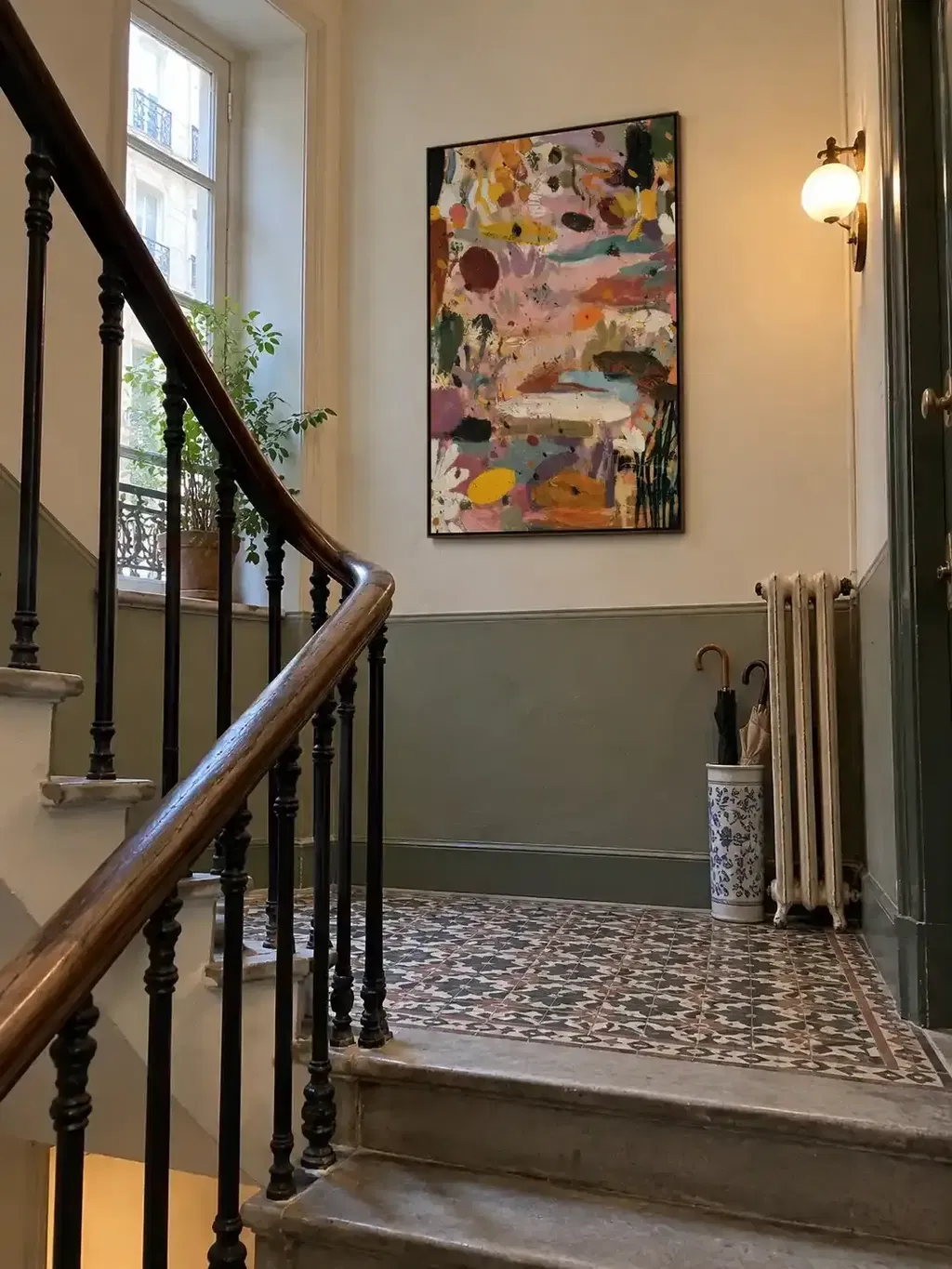
Scaling Precision: How Detail Levels Evolve on Large Canvases
The global art market is undergoing a fundamental shift. While high-end auction sales for vanity assets plummeted 44% year-over-year in 2024 according to Marketplace, the demand for custom, hand-painted art with "real application value" remains robust. Buyers are increasingly moving away from overpriced auction pieces in favor of large-scale murals and oversized canvases that offer emotional resonance and spatial impact.
However, moving from a small accent piece to an oversized statement—often 60 inches or wider—is not a simple matter of "enlarging" the image. As a painting grows, the technical relationship between canvas dimensions and brushwork scale must evolve. If an artist attempts to maintain the same density of microscopic detail on a six-foot canvas that they use on a six-inch one, the result is often a visual and economic failure.
Understanding the "Scaling Precision" framework is essential for collectors and designers who want to ensure their investment maintains visual clarity and structural integrity at scale.

The Physics of Vision: Why "More Detail" Isn't Always Better
A common misconception among art buyers is that a larger canvas should contain a proportional increase in fine detail. In reality, human visual acuity creates an absolute resolution ceiling that dictates how we perceive art in a room.
The 10-Foot Rule and Visual Acuity
According to research from the University of Utah, at typical viewing distances of 8 to 15 feet—the standard for oversized art in residential or commercial lobbies—details smaller than approximately 0.1 to 0.15 inches become physically invisible to the average viewer.
This is not just a matter of "blurry vision"; it is a fundamental constraint of diffraction physics known as the Rayleigh Criterion. When light passes through the pupil, it diffracts, creating a limit on the minimum angular spread between two points that the eye can resolve. On a 72-inch canvas, attempting to scale precision beyond 150–200 lines per inch represents a "category error" where digital printing principles are misapplied to analog material domains.
Logic Summary: Our scaling analysis assumes a standard viewing distance of 10 feet. At this range, microscopic brushstrokes (~1mm) merge into a single perceived tone, making extreme fine-detail coverage redundant for the viewer's experience.
The Artist's Productivity Paradox: The Cost of Fine Brushes
Beyond the physics of vision, there is a staggering productivity penalty associated with maintaining high-density detail on large surfaces. Based on common patterns from our studio operations and labor handling, we have identified an exponential relationship between brush size and coverage time.
Labor Hours vs. Detail Density
Moving from a 3-inch "macro" brush to a 1-inch "detail" brush reduces the coverage area by 80% per stroke. For a 100-square-foot mural, this translates to a massive shift in professional labor:
| Detail Level | Typical Brush Size | Estimated Coverage Rate | Total Labor Hours (100 sq ft) |
|---|---|---|---|
| Macro/Broad | 3 - 4 inches | ~7.5 sq ft / hour | ~13 Hours |
| Medium/Standard | 1.5 - 2 inches | ~3.0 sq ft / hour | ~33 Hours |
| Fine/Detailed | 0.5 - 1 inch | ~0.75 sq ft / hour | ~133 Hours |
Note: Estimates based on standard industry coverage rates and PaintCalcs productivity models.
For the collector, this explains why a "highly detailed" oversized work can cost five to ten times more than a "painterly" or "expressive" work of the same size. Experienced studio painters typically follow a heuristic rule of thumb: For every doubling of canvas width, they reduce fine-detail coverage by approximately 40% while increasing macro-element contrast by 25%. This ensures the work remains economically viable while maximizing its visual impact from across the room.

Structural Integrity: Avoiding "Visual Clutter"
Interior designers frequently observe that clients who insist on excessive fine detail in oversized art experience "installation disappointment." When the piece is hung, the microscopic details that looked impressive in a small studio photo become invisible. What remains is a "busy," undefined texture that lacks a clear focal point.
The Macro-Contrast Solution
Successful large-scale works prioritize bold color transitions and clear compositional structures. According to The New Consumer of Crafts 2025, top-tier consumers are increasingly valuing the fusion of avant-garde design with authentic handcrafting techniques—specifically "texture as the soul" of the piece.
By utilizing techniques like Alla Prima or traditional underpainting, artists can create depth through physical relief rather than just tiny lines. This tactile quality is scientifically proven to increase viewer satisfaction. Tests at the MUNCH Museum confirmed that interacting with art featuring physical relief textures exponentially stimulates intrinsic motivation and emotional regulation.
Material Science: The Chemistry of Large-Scale Pigments
When scaling a painting, the choice of medium—oil versus acrylic—becomes a critical decision for longevity and safety. Each has distinct chemical behaviors that react differently to the large surface area of an oversized canvas.
Acrylic vs. Oil: The Longevity Debate
Acrylic polymers consist of long-chain molecules that form films through physical "coalescence." This makes them more resistant to embrittlement than oil films, which undergo oxidative cross-linking. However, acrylics face a unique challenge known as Support Induced Discoloration (SID).
As detailed by Golden Artist Colors, water-soluble impurities in cotton or linen canvases can be drawn into the paint film if transparent mediums are applied thicker than 1/16th of an inch. This can cause a permanent yellow or brown tint. For large-scale works where heavy mediums are common, proper sizing and priming are non-negotiable.
The Lightfastness Standard
For oversized art placed in sunlit foyers or commercial spaces, lightfastness is paramount. We rely on the ASTM D4303 standard, which uses xenon-arc tests to simulate years of indoor aging.
- Titanium White (PW6): Dominates 90% of the market due to its extreme opacity and chemical inertness (NCBI).
- Prussian Blue (PB27): A "mystery" pigment that fades at the same rate regardless of whether it is in oil or acrylic media, according to The National Gallery, London.
Health, Safety, and the "Green Mural" Movement
Large-scale indoor painting involves a significant volume of material, making air quality a primary concern for homeowners and developers. The EPA warns that indoor air pollution can be significantly higher than outdoor levels, and low-VOC (Volatile Organic Compound) paints are now a prerequisite for LEED and WELL certifications in healthcare and corporate facilities.
The Toxicity of Traditional Pigments
While many artists still favor traditional pigments, the health risks are well-documented by the International Agency for Research on Cancer (IARC). Cadmium compounds, for instance, are classified as Group 1 carcinogens. Even "insoluble" pigments like Cadmium Yellow can release free ions in slightly acidic environments (Australian Industrial Chemicals Evaluation).
For residential projects, especially in children's rooms, we recommend water-based acrylics that pass the BS EN 71-3 standard for heavy metal migration. This ensures that the art adds beauty without compromising the safety of the indoor environment.

The Economic and Social Impact of Large-Scale Art
Commissioning a large-scale hand-painted work is more than a decorative choice; it is a proven driver of property value and community well-being.
Property Value and ROI
A Royal Society CAR model analysis found that neighborhoods with higher art geo-tags experienced greater relative house price ranking gains. In the commercial sector, the ROI is even more dramatic. Public art projects in Chicago's Millennium Park drove an estimated $1.4 billion in real estate-related growth (NC Realtors). For developers, a unique mural serves as a "marketing trump card" to lease up large office spaces in a competitive market.
Psychological and Public Health Benefits
Beyond economics, art has a measurable impact on the human brain. Passive art viewing consistently activates the medial prefrontal cortex (mPFC) and the amygdala, optimizing emotional regulation (PMC11480958). In clinical settings, 73% of patients reported significant mood improvements when nature-themed murals were present in their environment.
Authenticity in the Age of AI
As AI-generated prints flood the market, the value of "100% human-made" art has reached a premium. A Columbia University study confirmed that consumers value art labeled as "AI-generated" 62% lower than authentic human-created work.
This preference is rooted in what researchers at the University of Chicago call "essential identity." Digital replicas lack the artist's soul and the physical "microtopography" (the mm-scale texture) that optical microprofilometry proves is crucial to the aesthetic experience of an oil painting (MDPI Sensors).
Summary Checklist for Large-Scale Commissions
When selecting or commissioning oversized art, use this checklist to ensure technical and visual success:
- Prioritize Macro-Structure: Ensure the composition is legible from at least 10 feet away.
- Verify Material Safety: Request low-VOC acrylics or non-toxic oil alternatives for indoor installations.
- Check Lightfastness: Confirm that pigments used are ASTM D-4236 compliant and rated for high lightfastness (I or II).
- Embrace Texture: Use physical impasto to provide visual interest that doesn't rely on microscopic lines.
- Scale the Labor: Understand that "fine-line realism" at 60+ inches requires an exponential increase in time and budget compared to expressive styles.
Large-scale art is a powerful tool for transforming environments, but its success relies on respecting the physical limits of vision and the technical realities of the artist’s hand. By scaling precision intelligently, you ensure that your statement piece remains a source of inspiration and value for decades to come.
YMYL Disclaimer: This article is for informational purposes only and does not constitute professional health, safety, or financial advice. The chemical safety of art materials can vary by manufacturer; always consult Safety Data Sheets (SDS) and follow local environmental regulations for large-scale paint applications.
Sources
- Marketplace: The expensive art market continues to struggle
- University of Utah: Visual Acuity in Adults
- Columbia University: Human-Made vs. AI Art Study
- EPA: Indoor Air Quality and Low-VOC Paints
- Royal Society: Quantifying the link between art and property prices
- WHO: Cadmium Environmental Health Criteria
- Golden Artist Colors: Supporting Induced Discoloration