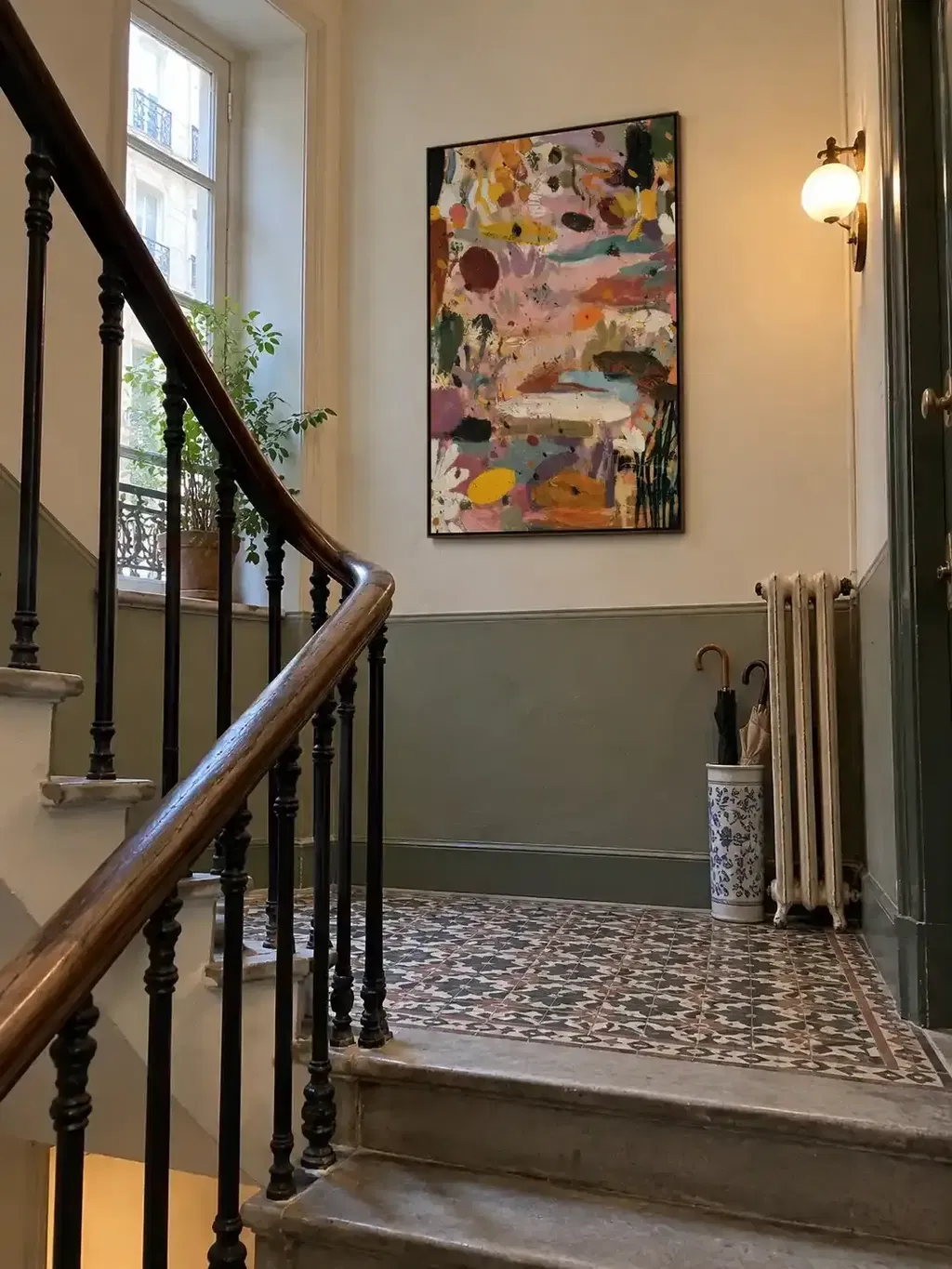
The Hidden Mechanics of Thermal Stress in Fine Art
The global art market is undergoing a seismic shift in consumer behavior. According to Marketplace, high-end auction sales for pieces over $10 million plummeted by 44% year-over-year in 2024. This retreat from purely financial "vanity assets" signals a return to real application value. Modern collectors—aesthetic-driven homeowners and interior designers—are prioritizing custom hand-painted murals and textured oils that offer emotional resonance and "essential identity."
However, this shift toward art as a living part of the home environment introduces a critical challenge: decision safety. Unlike a digital print, a hand-painted canvas is a complex, multi-layered biological and chemical structure. When placed in modern homes equipped with high-output HVAC systems and radiant heating, these layers are subjected to "thermal stress"—a physical phenomenon that can lead to irreversible degradation, such as "alligatoring" (a specific pattern of cracking) and delamination.
Protecting your investment requires moving beyond generic "keep away from heat" advice. It requires an understanding of the physics of heat transfer and the specific thermal tolerances of the materials involved.

The Physics of Failure: Differential Expansion Coefficients
A hand-painted oil painting is essentially a "material sandwich." It consists of a wooden stretcher bar (typically pine), a textile substrate (linen or cotton), a ground layer (gesso), and multiple layers of pigment-loaded oil binder. Each of these materials reacts differently to temperature changes.
While conventional wisdom focuses on absolute temperature, professional art conservators emphasize the "10-degree rule": the most significant damage occurs during rapid fluctuations exceeding 10°F within a 24-hour period. This is because of the Coefficient of Thermal Expansion (CTE)—the rate at which a material changes in size as the temperature changes.
Modeling Note: Thermal Expansion Dynamics
Logic Summary: The following table illustrates the inherent mechanical conflict within a painting's structure. These values represent standard material properties; however, the actual shear forces generated depend on the thickness of the paint film and the age of the binder.
| Material | Estimated CTE (per °C) | Expansion Ratio (vs. Wood) | Rationale / Source |
|---|---|---|---|
| Wooden Stretcher (Pine) | ~5 × 10⁻⁶ | 1.0x (Baseline) | Canadian Conservation Institute |
| Linen Canvas | ~1.5 × 10⁻⁵ | ~3.0x | Standard Textile Physics |
| Oil Paint Layer | ~8 × 10⁻⁵ | ~16.0x | CCI Technical Bulletin |
| Acrylic Paint Layer | ~1.2 × 10⁻⁴ | ~24.0x | High-Polymer Elasticity |
| Gesso (Ground) | ~2.5 × 10⁻⁵ | ~5.0x | Mineral-Binder Composite |
Why this matters: A 10°C (18°F) temperature increase causes the oil paint layer to expand up to 16 times more than the wooden frame it is attached to. This creates massive shear forces at the interface of the paint and the canvas. Over time, these forces fatigue the binder, causing it to lose its grip and eventually flake or crack.
Heating Systems and Micro-Climates: Forced Air vs. Radiant
Not all heating systems are created equal when it comes to art preservation. Based on observational patterns from conservation audits, forced-air systems typically create 3–5 times greater thermal stress than radiant heating.
The Forced-Air "Micro-Desiccation" Zone
Forced-air vents act as high-velocity delivery systems for dry, heated air. When a painting is placed directly in the path of a vent, it enters a "micro-desiccation" zone. The high-velocity air strips moisture from the natural oils in the paint film. This is particularly dangerous for older artworks. Research indicates that paintings with 15–20% binder loss have 30–40% greater vulnerability to thermal stress because the reduced organic matrix provides less elasticity to accommodate expansion (Nature).
The Radiant Heating Advantage
In contrast, radiant heating systems (such as in-floor heating or radiant wall panels) create more uniform temperature gradients. While forced air can create surface temperature differentials of 8–12°C between the side of the artwork facing the vent and the opposite side, radiant systems typically keep this gradient within a safer 2–4°C range.

The Fireplace Dilemma: The Thermal Deflection Test
The most common placement for a focal-point painting is above a fireplace mantel. However, this is also the most hazardous location due to convective heat—the rising "curtain" of hot air that follows the wall surface.
To ensure "decision safety," we recommend a simple expert heuristic: The Thermal Deflection Test.
- During active use of the fireplace, place your hand on the top surface of the mantel shelf.
- If the mantel is warm or hot to the touch, it lacks the depth or insulation required to protect a canvas.
- A safe mantel must stay cool to the touch, acting as a physical shield that "deflects" the rising heat away from the wall and into the center of the room.
The Inverse Square Law of Placement
When determining the safe distance from a heat source, professional installers use a mathematical relationship known as the Inverse Square Law. Thermal stress decreases by the square of the distance from the heat source.
- A painting 30cm (approx. 12 inches) from a radiator experiences 4 times less thermal stress than one 15cm (6 inches) away.
- Moving it to 45cm (18 inches) reduces the stress by 9 times.
This mathematical reality allows for precise placement. If you are styling a room with a high-output radiator, even a few additional inches of clearance can provide an exponential increase in the longevity of the artwork (RedLineIPS).
Strategic Placement & Mitigation Strategies
For modern homes where architectural constraints make "perfect" placement difficult, there are several professional-grade mitigation strategies that bridge the gap between high-end styling and archival safety.
1. The 0.5-Inch "Offset Spacer"
In homes with radiant heating or internal wall ducts, heat can transfer through the wall via conduction. To prevent this, use "offset spacers" or "bumpons" on the four corners of the frame. This creates a 0.5-inch air gap between the canvas and the wall, allowing for passive air circulation. This gap acts as a thermal break, preventing the wall's internal temperature from directly affecting the canvas substrate.
2. Humidity Buffering
Thermal stress is rarely a "dry" problem. As temperature rises, relative humidity (RH) often drops. According to Tate Research, when environmental humidity and temperature rise simultaneously, surfactants in acrylic paints can migrate to the surface, causing a "hazy" or cloudy appearance. Maintaining a stable RH of 40–55% alongside temperature control is the "gold standard" for investment-grade art.
3. Material Selection: Acrylic vs. Oil
If a painting must be placed in a high-traffic or thermally active area (such as a kitchen or a sunroom), consider the medium. Acrylic polymers consist of long-chain molecules that form films through physical "coalescence," making them naturally more flexible and resistant to embrittlement than oil films, which undergo oxidative cross-linking over decades (JustPaint).

Health, Safety, and the Indoor Environment
Beyond the physical integrity of the art, thermal stress can impact the air quality of your home. High temperatures can accelerate the "off-gassing" of Volatile Organic Compounds (VOCs) from lower-quality pigments and binders.
The Environmental Protection Agency (EPA) warns that indoor air pollution is often more concentrated than outdoor air. For homeowners seeking LEED or WELL certification, using low-VOC, hand-painted art is a strict prerequisite. High-quality pigments, such as Titanium White, have largely replaced toxic historical alternatives like Lead White, which is now strictly regulated under REACH Annex XVII.
When art is subjected to heat, ensuring that it is composed of non-toxic, archival-grade materials is not just about protecting the painting—it’s about protecting the residents.
Investment Security: The ROI of Preservation
The economic argument for proper placement is clear. The Art Basel and UBS Art Market Report 2024 notes that the global art market reached $65 billion in 2023. As collectors move away from speculative auction pieces toward "application value," the condition of the artwork becomes the primary driver of its resale price.
A painting with visible "alligatoring" or heat-induced binder separation can lose up to 70% of its market value, as restoration costs for structural delamination are prohibitively high. By following the "10-degree rule" and utilizing the "Inverse Square Law" for placement, you are effectively "locking in" the asset's appreciation.
For more detailed insights on maintaining your collection, you may find our guide on Maximizing Resale Appeal Through Cleaning or Comparing Original Art to Generic Decor helpful in understanding the technical relationship between material quality and investment security.
Summary Checklist for Decision Safety
To ensure your hand-painted investment survives the modern heating season, use this final checklist:
- Audit Your HVAC: Ensure no forced-air vents are blowing directly onto the canvas surface.
- The Mantel Check: Perform the "Thermal Deflection Test." If the mantel is warm, move the art or install a deeper shelf.
- Mind the Gap: Use offset spacers to create a 0.5-inch air buffer behind the frame.
- Calculate Distance: Apply the Inverse Square Law—doubling the distance from a heater reduces thermal stress by 75%.
- Monitor Fluctuations: Use a smart hygrometer to track the "10-degree rule" (keeping 24-hour swings under 10°F).
By treating art placement as a technical discipline rather than just a styling choice, you protect the "essential identity" of the work and ensure that your investment remains a vibrant, structural part of your home for decades to come.
Disclaimer: This article is for informational purposes only and does not constitute professional conservation, architectural, or medical advice. For high-value historical assets, always consult a certified member of the American Institute for Conservation (AIC) or a qualified HVAC engineer.