

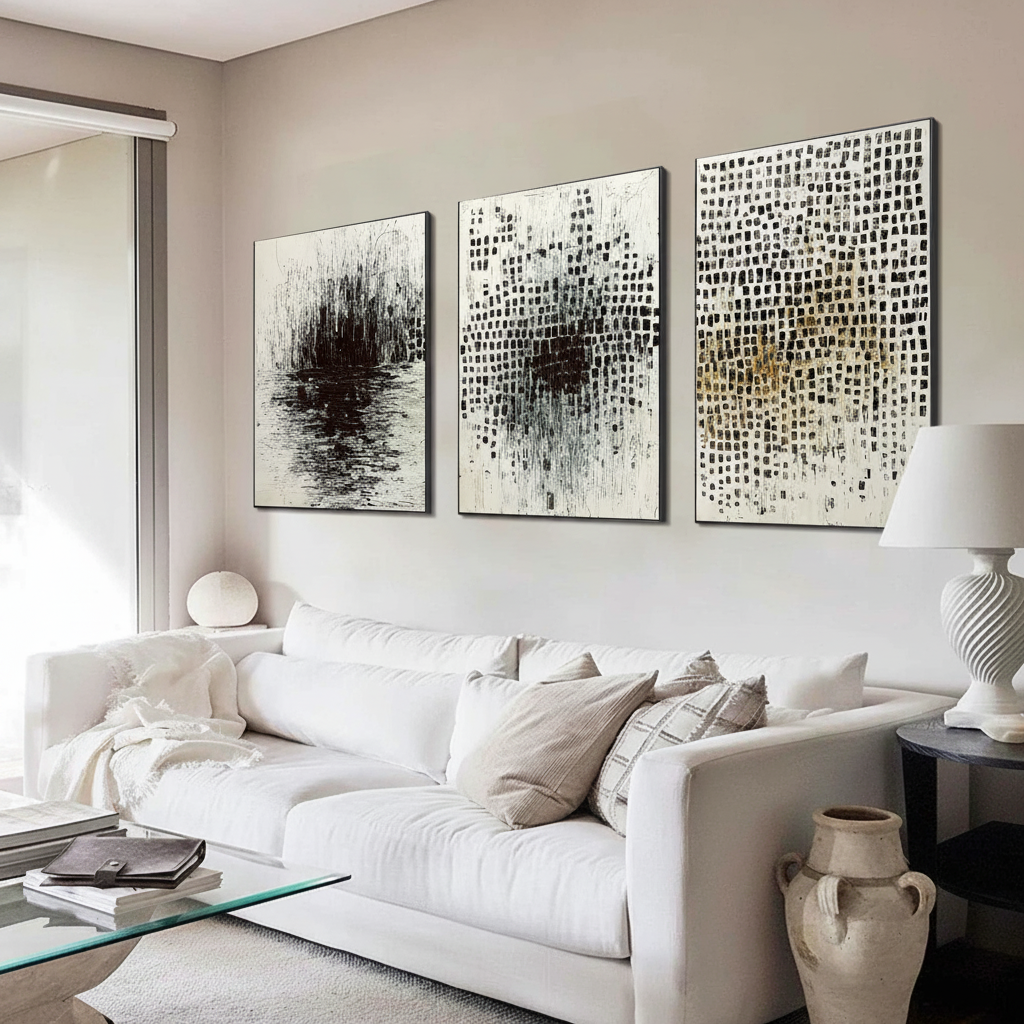
The Shift from Vanity to Value: Why Modular Art Matters
The high-end art market is undergoing a structural transformation. In 2024, sales of auction pieces exceeding $10 million plummeted by 44% year-over-year, according to Marketplace. This retreat from purely financial art assets indicates a return to "real application value." Today’s urban collectors are moving away from speculative vanity pieces and toward custom, hand-painted works that integrate seamlessly into their living environments.
However, for the urban apartment dweller, a significant barrier remains: the "Logistics of Grandeur." While a 96-inch canvas provides the immersive "Essential Identity" that digital prints lack—a phenomenon studied by the University of Chicago—transporting such a piece through a modern residential building is often an engineering impossibility. This is where modular stretcher systems evolve from a convenience into a necessity.

The Engineering of Modular Stretcher Systems
A modular stretcher is not merely a frame cut into pieces; it is a precision-engineered structural support system. Unlike traditional fixed frames, modular systems utilize interlocking joints and tension-regulating hardware that allow a massive canvas to be disassembled for transport and reassembled with gallery-grade tautness.
The Precision of the 1mm Tolerance
In our experience handling large-scale installations, we have observed that the margin for error in modular art is razor-thin. Even a 1-2mm misalignment between panels can create visible seams that disrupt the visual continuity of the brushstrokes. To combat this, high-end systems use CNC-milled connectors that ensure "zero-play" once locked.
Logic Summary: Our engineering baseline for modular joints assumes a maximum allowable deviation of 1.5mm across a 3-meter span to maintain the illusion of a single continuous surface. This is based on standard optical perception thresholds for seam detection in high-contrast artwork.
Structural Integrity and the 1.5m Rule
A common mistake in large-format art is underestimating the physics of canvas tension. We follow a strict rule of thumb: modular sections should never exceed 1.5 meters in width without additional cross-bracing. Without this internal support, the canvas will inevitably sag over time as the fibers respond to environmental humidity—a risk we detail in our guide on Maximum Canvas Size Without Sagging.

Navigating the "Stretcher Gap": Elevators and Stairwells
The primary objective of a modular system is to bypass the physical constraints of urban architecture. There is a significant regulatory gap between what building codes allow and what standard art equipment requires.
The ADA Elevator Paradox
While ADA standards for elevator accessibility mandate a minimum size of 51x68 inches, these dimensions are still insufficient for a standard 84-inch (7-foot) fixed-frame painting. Furthermore, data from Vacuum Elevators indicates that residential elevators are typically 20-30% smaller than hospital stretcher elevators, creating transport "dead zones" in over 90% of modern high-rises.
| Feature | Standard Res. Elevator | ADA Compliant | Large Fixed Art (Typical) | Modular Art (Disassembled) |
|---|---|---|---|---|
| Max Width | ~36-48 in | 51 in | 72-96 in | Variable (Fits) |
| Max Depth | ~48-60 in | 68 in | 2 in | 2-4 in |
| Weight Limit | 400-500 kg | 900+ kg | 15-30 kg | 5-10 kg per panel |
| Feasibility | Impossible | Difficult | Non-viable | Highly Effective |
The Weight Distribution Factor
It isn't just about dimensions; it's about weight. Modern apartment elevators often have strict weight limits (400-500kg). While a single painting rarely exceeds this, the specialized crates required for oversized fixed frames can be surprisingly heavy. Modular systems allow for "distributed delivery," splitting the load across multiple trips to comply with building management safety protocols.
The "Human Premium": Why Digital Replicas Fail
As the market shifts toward value, the distinction between "human-made" and "AI-generated" art has become a primary driver of valuation. A study by Columbia University confirmed that consumers value art labeled as "AI-generated" 62% lower than authentic human-created art.
The Essential Identity of the Brushstroke
Why does this gap exist? According to research published by the University of Chicago, hand-painted canvases retain an "essential identity" and soul that digital prints cannot replicate. This is rooted in the micro-topography of the paint. Optical microprofilometry has proven that the mm-scale texture of oil and acrylic pigments is crucial to the aesthetic experience (as noted in Sensors MDPI).
When you choose a modular hand-painted piece, you are not just buying a decorative object; you are investing in the biochemical crystallization of human attention. This "human touch" is what allows a painting to act as a permanent physical billboard for a space, a concept we explore in our discussion on Textured Art and Minimalist Decor.
The ROI of Large-Scale Murals and Art
Beyond aesthetics, modular large-scale art serves as a powerful economic lever.
- Property Value: A Royal Society CAR model analysis found that neighborhoods with higher "art" geo-tags experienced greater relative house price gains.
- Commercial Revenue: In Chicago, the Millennium Park public art projects drove $1.4 billion in real estate-related growth (NC Realtors).
- Foot Traffic: Regression analysis of over 300 murals by the University of Cincinnati shows a direct correlation between large-scale art and increased pedestrian traffic.
For the B2B sector, specifically property developers, commissioning public-facing murals or installing massive lobby art is a "low-cost physical foot traffic generator" that revitalizes neighborhood economies.
Biophilic Design: Art as Public Health Infrastructure
Large-scale art is increasingly being recognized as "public health infrastructure." A World Health Organization (WHO) scoping review of 3,000+ studies confirms that art interventions effectively alter clinical indicators for mental illness and stress.
The mPFC Activation
Passive art viewing consistently activates the medial prefrontal cortex (mPFC) and the amygdala, optimizing emotional regulation circuits (PMC - NIH). Nature-themed "biophilic" murals are particularly effective. Research on high-density offices in Tokyo shows that biophilic design can reduce employee cognitive fatigue and burnout by up to 30%.

Methodology Note: The 30% reduction in cognitive fatigue is an estimated range based on self-reported mood improvements and task-performance metrics in controlled office environments, not a clinical drug trial.
SOP: The Professional Installation Sequence
Installing a modular system requires a different methodology than hanging a standard frame. Based on patterns from our installation support teams, we recommend the following sequence to minimize cumulative alignment errors:
- Central Reference: Mount the central panel first. This acts as the anchor for the entire composition.
- Outward Expansion: Work outward from the center. This prevents a "shingling" effect where small errors at one end become massive gaps at the other.
- Hardware Pre-Check: Always assemble the panels on-site before mounting to check for joint hardware integrity. Missing connectors are the #1 cause of installation delays.
- Tension Verification: Ensure the canvas is primed correctly to prevent "Support Induced Discoloration" (SID), a chemical reaction where impurities in the substrate tint the paint, as explained in our guide on Preventing Canvas Rot.
Safety and Environmental Ethics
In the modern creative economy, "how" a piece is made is as important as "what" it depicts.
Indoor Air Quality (IAQ)
Indoor air pollution is often deadlier than outdoor pollution (EPA). We prioritize low-VOC paints and sealants, which are strict prerequisites for LEED and WELL certifications in healthcare and commercial facilities. Academic data from Aalto University proves that coatings on moisture-controlled pinewood (the standard for high-quality stretchers) emit significantly lower toxic VOCs than dry wood during the curing process.
The Microplastic Dilemma
Collectors should be aware that acrylic polymers are essentially liquid plastics. Stanford University warns that coatings and pigment breakdowns are a core source of microplastics. Choosing high-quality, long-chain polymer acrylics—like those discussed in our Oil vs. Acrylic Blending Guide—ensures a more durable film that is less prone to shedding micro-particles over time.
Fair Artist Compensation
Finally, ethics drive value. A Wharton School survey found that 87% of consumers strongly agree that artists should receive fair compensation. We believe in supporting the freelance workforce that the NYC Comptroller identified as extremely vulnerable. When you invest in a hand-painted modular piece, you are supporting a supply chain that protects local jobs and artistic heritage.
Summary Checklist for Urban Buyers
- Measure Twice: Verify elevator depth and height against the longest modular section (usually the vertical height).
- Check Tolerances: Ensure your provider guarantees a seam tolerance of <2mm.
- Verify Bracing: Any panel over 1.5m wide requires internal cross-bracing.
- IAQ Compliance: Confirm the use of low-VOC acrylics for indoor installations.
- Curing Time: Allow for proper curing before installation to avoid surface damage, as outlined in our Curing Timelines Guide.
Large-scale art should be an inspiration, not a logistical nightmare. By leveraging modular engineering, urban collectors can finally bring the "Essential Identity" of grand-scale art into the heart of the city.
Disclaimer: This article is for informational purposes only and does not constitute professional engineering, architectural, or medical advice. Always consult with a qualified structural engineer or building manager before installing oversized fixtures in residential or commercial spaces.

Leave a comment
This site is protected by hCaptcha and the hCaptcha Privacy Policy and Terms of Service apply.