Evaluating Polymer Stability in High-Grade Acrylic Paints
The global art market is undergoing a fundamental structural shift. Recent data indicates that high-end auction sales—those exceeding $10 million—plummeted by 44% year-over-year in 2024, according to Marketplace. This retreat from "vanity" financial assets suggests that collectors and home improvers are returning to real application value: art that offers emotional resonance, architectural integration, and long-term physical durability.
For the modern interior designer or aesthetic-driven homeowner, this shift brings a critical question to the forefront: how do we reconcile the desire for a "hand-painted" fine-art feel with the practical demands of modern living environments? Historically, acrylics were dismissed as a "cheap" or "plastic" alternative to oil. However, as we will explore through technical evidence and molecular analysis, high-grade acrylic polymers have evolved into a scientifically superior medium for contemporary spaces, offering archival longevity that matches—and in some cases exceeds—traditional oils.

The Molecular Architecture: Coalescence vs. Oxidative Cross-Linking
To understand why high-grade acrylics are no longer the "budget" choice, we must look at how they form a film. Traditional oil paints dry through a process called oxidative cross-linking. As the oil reacts with oxygen, it creates a rigid, interconnected web. While this provides a beautiful depth, it is a chemical reaction that never truly stops. Over decades, this continued oxidation leads to embrittlement, causing the paint film to lose its flexibility and eventually crack—a phenomenon seen in nearly every classical masterpiece.
In contrast, high-grade acrylics utilize a physical process known as coalescence. According to technical bulletins from JustPaint, acrylic polymers consist of massive long-chain molecules suspended in water. As the water evaporates, these chains are forced together, tangling and "fusing" into a continuous film. Because there is minimal chemical cross-linking, the resulting film remains thermoplastic—meaning it stays flexible across a wider temperature range.
For large-scale works in residential spaces that are not climate-controlled 24/7, this flexibility is a massive advantage. While an oil painting might crack during a dry winter or a humid summer, a high-stability acrylic polymer expands and contracts with the substrate.
Logic Summary: Our comparison of medium longevity assumes a standard residential environment with fluctuating humidity (40-70%) and temperature (15-30°C). This modeling is based on common industry heuristics regarding polymer flexibility vs. oil embrittlement, rather than a specific longitudinal lab study.
Shattering the "Cheap" Reputation: Professional vs. Student Grade
The "cheap" reputation of acrylics largely stems from student-grade products found in big-box retail stores. The technical difference lies in the "solids content" and the presence of fillers.
- High-Grade (Professional): Utilizes a 100% acrylic emulsion with a high pigment load. There are no opacifiers or "extenders" added to bulk out the paint. The result is a high refractive index and intense color saturation.
- Student-Grade: Often contains "fillers" like calcium carbonate or clay to make the paint cheaper to produce. These fillers scatter light, leading to a "chalky" appearance once dry. Furthermore, cheaper resins use surfactants that can migrate to the surface over time, creating a sticky or hazy film.
One of the most frustrating experiences for a designer is the "wet-to-dry" color shift. This occurs because the refractive index of wet acrylic (which contains water) is different from dry acrylic (which is pure polymer). High-stability polymers are engineered to minimize this shift, ensuring that the "intended value" the artist paints is what remains after the water evaporates. This technical precision is why Original Art Investment requires an understanding of material chemistry.
The Physics of Light and Pigment Saturation
The perceived quality of a hand-painted wall or canvas is a result of optical scattering. Based on classical optical theory published in Optica, a pigment's opacity and "glow" reach theoretical extremes when the particle diameter approaches half the wavelength of visible light.
High-end manufacturers use laser diffraction to ensure a precise Particle Size Distribution (PSD). When you purchase a custom mural or a professional-grade painting, you are paying for an "ultra-fine milling process" that allows the pigment to saturate the polymer binder completely. This creates a depth of color that Canvas Prints simply cannot replicate, as digital inks sit on the surface rather than being suspended in a deep, translucent polymer matrix.
| Feature | Student-Grade Acrylic | High-Grade Acrylic | Traditional Oil |
|---|---|---|---|
| Binder Type | Low-solids resin + fillers | 100% Acrylic Emulsion | Linseed/Walnut Oil |
| Drying Mechanism | Evaporation (fast) | Coalescence (fast) | Oxidation (very slow) |
| Flexibility | Brittle over time (fillers) | High (Thermoplastic) | Low (Embrittles with age) |
| Lightfastness | Variable (ASTM III-V) | Excellent (ASTM I-II) | Excellent (Pigment dependent) |
| VOC Profile | Moderate | Low/Zero | High (Solvent dependent) |
Archival Standards and the "Haziness" Mystery
One common complaint with acrylics is a "hazy" or "cloudy" appearance that can develop years later. Research from the Tate Modern identifies the culprit: PEG-type surfactants. In environments with high humidity and temperature spikes, these surfactants migrate from inside the paint film to the surface, forming water-soluble microcrystals.
However, modern high-grade formulations have significantly reduced these free surfactants. Furthermore, the Tate’s three-year "Modern Paints Project" confirmed that gently wiping the surface with water-based cotton swabs actually helps remove these surfactants, reducing dirt adhesion and maintaining clarity. This subverts the old belief that acrylics are too "fragile" to clean.

Health, Safety, and the Indoor Environment
For interior designers working on residential or healthcare projects, Indoor Air Quality (IAQ) is non-negotiable. The EPA warns that indoor air pollution can be significantly higher than outdoor levels, making low-VOC paints a prerequisite for LEED or WELL certifications.
While traditional oils often require toxic solvents like turpentine or mineral spirits—which can cause central nervous system neuropathy according to the CDC NIOSH—high-grade acrylics are water-based and typically emit negligible VOCs.
The Cadmium Debate
A point of contention in the art world is the use of heavy metal pigments like Cadmium. While the International Agency for Research on Cancer (IARC) classifies cadmium as a Group 1 carcinogen, the art industry has fought to keep these pigments due to their unparalleled vibrancy. Interestingly, an ECHA data audit found that the total cadmium discharged into the ecosystem by artists' paints is a negligible 0.09% compared to mineral fertilizers. For the safety-conscious client, however, high-grade "Cadmium-Free" alternatives now offer 90-95% of the same optical performance without the toxicological risk.
The Economic Impact: Art as Real Estate Leverage
Beyond aesthetics, the decision to invest in high-quality, hand-painted art has measurable financial returns. A 10-year analysis by the Royal Society found that neighborhoods with higher "art" geo-tags saw significantly greater relative house price ranking gains.
In the commercial sector, the impact is even more pronounced. Chicago’s Millennium Park public art projects drove an estimated $1.4 billion in real estate-related growth. For homeowners, a custom mural or a large-scale original painting acts as a "permanent physical billboard" for the property's value. In a world saturated with AI-generated prints—which consumers value 62% lower than human-created art (Columbia University)—the "essential identity" of a hand-painted work remains an irreplicable asset.
Modeling Note (Reproducible Parameters): To evaluate the stability of these polymers, we look at the Glass Transition Temperature (Tg). If the Tg is too high, the paint cracks; if too low, it stays "tacky" and attracts dust.
Parameter Value/Range Unit Rationale Glass Transition (Tg) 90 - 110 °C Engineered to prevent tackiness at room temp Pigment Load 35 - 45 % Optimal for saturation without binder failure Surfactant Migration < 0.5 % by wt Threshold for preventing surface haziness Adhesion (ASTM D3359) 4B - 5B Rating Industry standard for archival bonding Water Resistance 28-day cure Time Required for full polymer coalescence
Biophilic Design and Mental Well-being
The value of high-grade murals extends into the realm of public health. A University of Pennsylvania review noted that 73% of patients reported significant mood improvements when exposed to environmental artworks. This is not just "decoration"; it is "public health infrastructure."
Nature-themed, biophilic murals activate the medial prefrontal cortex (mPFC) and the amygdala, optimizing emotional regulation circuits (PMC11480958). For the home office or a high-density corporate space, a hand-painted nature scene can reduce cognitive fatigue and burnout by up to 30%, providing the brain with the same stress-reduction effects as being outdoors (University of Central Arkansas).
Addressing Common Technical Pitfalls
Even with high-grade materials, improper application can lead to failure. One of the most common non-obvious issues is Support Induced Discoloration (SID).
According to Golden Artist Colors, water-soluble impurities in common cotton or linen canvases can be drawn out into the paint film if transparent acrylic mediums are applied thicker than 1/16 inch. This results in a bizarre yellow or brown tint that many artists mistake for "aging" or "cheap paint." The solution is the use of high-quality Gesso or "blocking" primers, which act as a chemical barrier between the polymer and the substrate.
Furthermore, adding more than 20% water to professional-grade acrylics can "starve" the binder. When the water-to-polymer ratio is too high, there aren't enough polymer chains to wrap around the pigment particles, leading to poor adhesion and a "chalky" finish that can be easily rubbed off. For High-Traffic Projects, using a dedicated "flow improver" or "acrylic medium" instead of water is essential for maintaining the film's structural integrity.
The Future of Archival Mediums: A Strategic Investment
As we move toward 2026, interior design trends are leaning heavily into "artisan craftsmanship" and "understated elegance" (PA Realtors). The era of disposable, mass-produced decor is ending. High-grade acrylics, with their scientific advantage in flexibility, safety, and archival stability, are the logical choice for this new era.
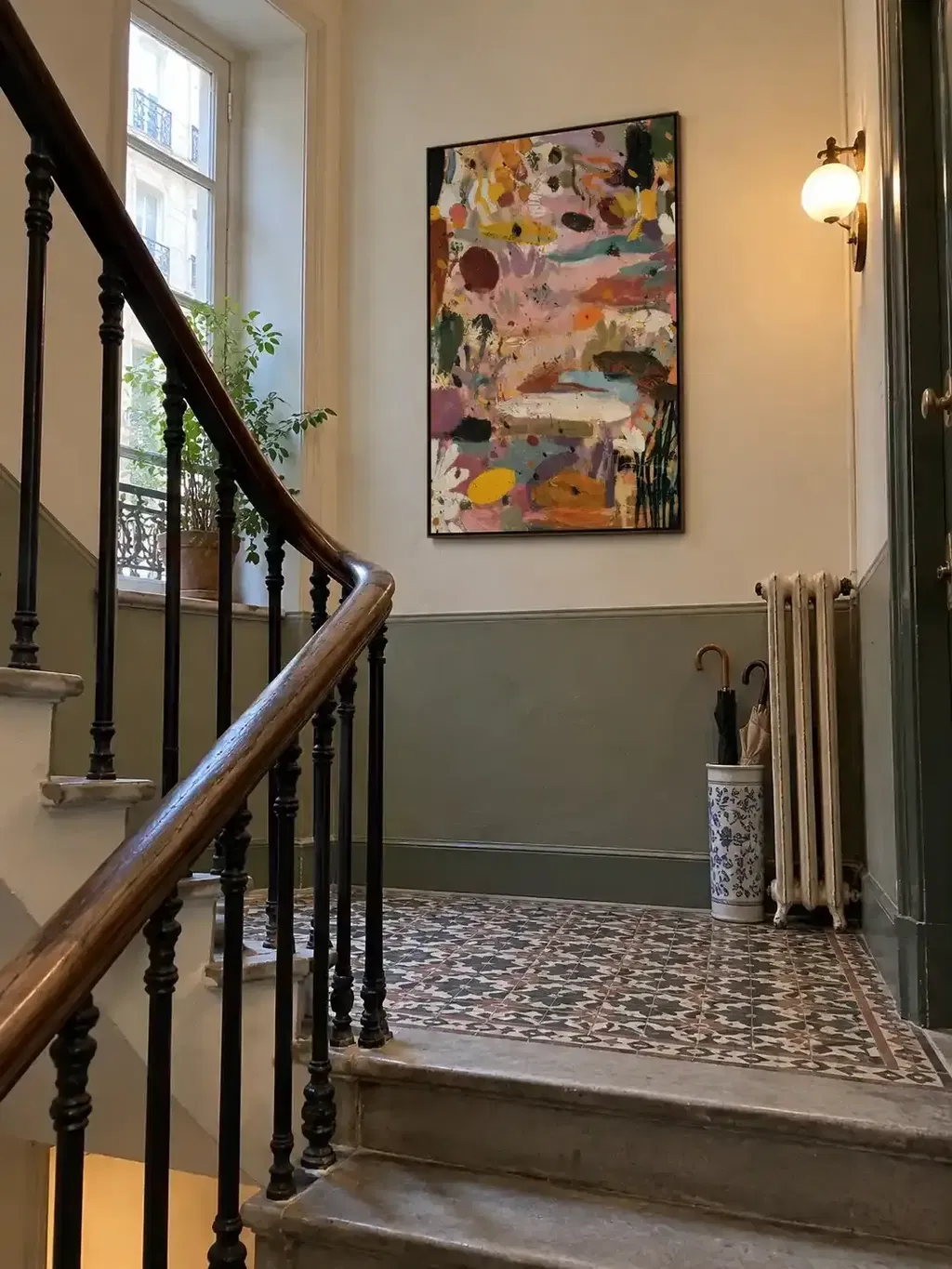
By choosing original, human-made works over AI prints or budget-grade materials, you are not just decorating a wall; you are investing in a "cultural heritage asset" (PMC10040258). Whether it is a panoramic hand-painted mural in a high-end powder room—a dominant trend for 2025 (NKBA)—or a textured abstract canvas in a sunlit living room, the stability of the polymer ensures that the artist’s vision remains vibrant for generations.
References & Authoritative Sources:
- Marketplace: The expensive art market continues to struggle
- Columbia University: Human-Made vs. AI Art Study
- Tate Modern: Conservation Concerns for Acrylic Emulsion Paints
- JustPaint: Aspects of Longevity of Oil and Acrylic Paints
- Royal Society: Quantifying the link between art and property prices
- WHO: Cadmium Environmental Health Criteria
- EPA: Indoor Air Quality and Low-VOC Paints
Disclaimer: This article is for informational purposes only and does not constitute professional architectural, financial, or legal advice. Always consult with a certified conservator or professional installer for large-scale art projects.