The Modern Retreat to Authenticity: Beyond the Uniform Sheen
The global art market is undergoing a seismic shift. While high-end auction sales for vanity pieces over $10 million plummeted 44% year-over-year in 2024, the underlying creative economy remains a powerhouse, with global art sales reaching $65 billion in 2023. According to Marketplace, buyers are increasingly retreating from purely financial art assets, returning instead to art with real application value and emotional resonance.
In this landscape, the demand for "100% human-made" work has never been higher. Research from Columbia University confirms that consumers value art labeled as "AI-generated" 62% lower than authentic human-created art. However, as e-commerce makes high-end art more accessible, it also introduces a significant risk: the "perfect" reproduction. To the untrained eye, a high-definition canvas print can mimic the colors of a masterpiece, but it almost always fails a critical physical test—the "Shine Factor."
Authentic oil paintings possess an inherent gloss variance—a rhythmic interplay of matte and shiny zones—that is physically impossible to replicate through mechanical printing. This article explores the chemical and optical mechanisms behind this variance, providing collectors with a professional framework to verify authenticity through the lens of material science.
The Chemistry of Glow: Why Pigments Absorb Oil Differently
At the heart of every genuine oil painting is a complex chemical relationship between the pigment particles and the binder (usually linseed or walnut oil). Unlike digital inks, which are engineered for uniform deposition, artist-grade pigments are minerals, earths, and synthetic chemicals with wildly different physical properties.
The CPVC Factor and Oil Absorption
The most critical concept in understanding sheen is the Critical Pigment Volume Concentration (CPVC). This represents the point where there is just enough binder to coat the pigment particles and fill the voids between them. Because pigments vary in density and surface area, their "oil absorption rate" varies significantly.
According to technical data from JustPaint, different pigments require different amounts of oil to reach a stable state. For example, a heavy mineral like Cadmium Red has a relatively low oil absorption rate, whereas a synthetic organic like Prussian Blue is "oil-thirsty."
Modeling Note (Logic Summary): Our analysis of gloss variance assumes a traditional "fat-over-lean" application method where the artist does not use excessive synthetic levelers. We modeled these variances based on standard ASTM D1483-12 oil absorption tests for professional-grade pigments.
Pigment Category Typical Oil Absorption (g oil / 100g pigment) Resulting Sheen Rationale Earth Tones (Raw Umber) 40–55 Matte/Satin High porosity and surface area Heavy Minerals (Cadmium) 15–20 Semi-Gloss Dense particles, low oil demand Carbon Blacks (Ivory Black) 90–110 Very Matte Extremely high surface area Synthetics (Phthalo Blue) 35–45 Glossy Fine particle size, high transparency Lead/Titanium Whites 10–18 High Gloss High density, low absorption
When an artist applies these colors side-by-side, the resulting surface is naturally heterogeneous. The sections painted with "oil-thirsty" pigments will appear more matte as the oil is pulled into the pigment structure, while "oil-rich" sections will retain a higher surface gloss. This is a primary indicator of a hand-painted work.

Red Flags: Identifying the "Uniform Sheen" of Reproductions
One of the most common mistakes collectors make is assuming that a uniform, high-gloss finish indicates quality. In reality, a perfectly consistent sheen across a medium-to-large canvas is often a "red flag" for mechanical reproduction or an over-varnished print.
The Mechanical Limit of Digital Printing
Digital printers, even high-end giclée systems, utilize a uniform ink delivery system. Whether the printer is laying down a deep black or a bright yellow, the carrier medium and the deposition thickness remain relatively constant. Even if a "texture gel" is applied over the print, it is typically a single, uniform coating of acrylic polymer.
Experienced art conservators utilize raking light techniques—positioning a light source at a 45-degree angle to the surface—to reveal these patterns. In a genuine oil painting, the light will catch the varying densities of the paint film. We've observed through pattern recognition in restoration practice that a genuine oil painting should show at least 3 to 5 distinct sheen zones across a medium-sized canvas.
The "Essential Identity" of the Canvas
Research from the University of Chicago suggests that digital replicas lack what consumers perceive as the artist's "essential identity." This isn't just a psychological bias; it's a reaction to the lack of physical relief. While a print is flat, a hand-painted oil work features 3D microtopography. Optical microprofilometry has proven that this mm-scale texture is crucial to the aesthetic experience, as it creates micro-shadows and light scattering that digital prints cannot simulate.
The Professional’s Toolkit: Verifying Authenticity in the Field
If you are evaluating a piece for your home or a commercial project, you don't need a lab, but you do need a methodology.
- The 45-Degree Raking Light Test: Place the artwork near a window or use a flashlight at a sharp angle. Look for "sunken" areas where the paint appears duller. If the entire surface reflects light like a sheet of plastic, proceed with caution.
- The Edge Inspection: Look at the very edges of the canvas. In hand-painted works, you will often see "beads" of paint or slight overlaps where the brush reached the edge. Prints are often perfectly "cut off" or have a mechanical wrap.
- The Olfactory Marker: While modern low-VOC paints are safer, genuine oil paintings often retain a faint, characteristic scent of linseed or walnut oil for months or even years. Digital prints often smell of ozone or plastic.
High-Tech Verification
For high-value acquisitions, professionals turn to tools like Infrared (IR) Imaging. According to the Smithsonian Conservation Institute, IR imaging can penetrate the surface layers of paint to reveal the artist's original charcoal or pencil sketches (underdrawings). A digital print will show no such history; it is a single-layer "final" image.

Beyond Aesthetics: The Health and Economic Value of Real Art
Choosing authentic hand-painted art isn't just about avoiding "fakes"; it’s about the tangible benefits that real materials bring to a space.
The Health & Wellness Dividend
The materials used in high-quality oil paintings are increasingly scrutinized for safety. While historical pigments like Lead White are now strictly regulated—with EU REACH regulations banning mixtures with lead carbonate concentrations exceeding 0.1%—modern professional oils have shifted toward safer alternatives like Titanium Dioxide.
The psychological impact is equally measurable. A critical review from the University of Pennsylvania found that 73% of patients in clinical environments reported significant mood improvements when exposed to authentic nature-themed artworks. Furthermore, WHO scoping reviews confirm that art interventions can effectively alter clinical indicators for mental health by activating the medial prefrontal cortex (mPFC), optimizing emotional regulation.
Real Estate and Commercial ROI
For commercial developers, the "authenticity cue" of a hand-painted mural translates directly to the bottom line. A Royal Society analysis found that neighborhoods with higher "art" geo-tags experienced greater relative house price gains. In the commercial sector, NAIOP insights reveal that top real estate developers are using unique public art as "marketing trump cards" to lease office space in high-vacancy markets.
Safety and Sustainability in the Modern Studio
As a buyer, understanding the "behind-the-scenes" of the studio can help you choose brands that align with your values.
- VOC Emissions: While the EPA warns that indoor air pollution can be significant, high-quality oil paintings using walnut oil or eco-friendly solvents emit significantly lower toxic VOCs once cured.
- Eco-Friendly Substrates: Leading studios are moving toward hemp or flax canvases, which consume half the water of traditional cotton, according to the Cincinnati Art Museum.
- Ethics and Equity: The art market has historically undervalued female artists. Supporting brands that explicitly state a commitment to fair pay for artists—where women still face a severe gender pay gap—is a critical step for socially conscious millennial and Gen Z buyers.
Summary Checklist for Authenticity
To ensure you are investing in a genuine hand-painted work, use this verification framework:
| Verification Step | What to Look For | Significance |
|---|---|---|
| Gloss Variance | 3–5 distinct sheen zones under raking light. | Proves different pigment oil absorption rates. |
| Brushstroke Relief | Physical ridges (impasto) that cast micro-shadows. | Confirms manual application of heavy-body paint. |
| Pigment Depth | Variations in opacity (e.g., transparent glazing vs. opaque blocks). | Demonstrates the layering technique of oil mediums. |
| Edge Irregularity | Paint "beads" or slight overlaps on the canvas side. | Indicates the canvas was painted, not printed. |
| Lightfastness | ASTM D4303 ratings on the pigments used. | Ensures the artwork won't fade like a standard ink print. |
Investing in the "Essential Identity"
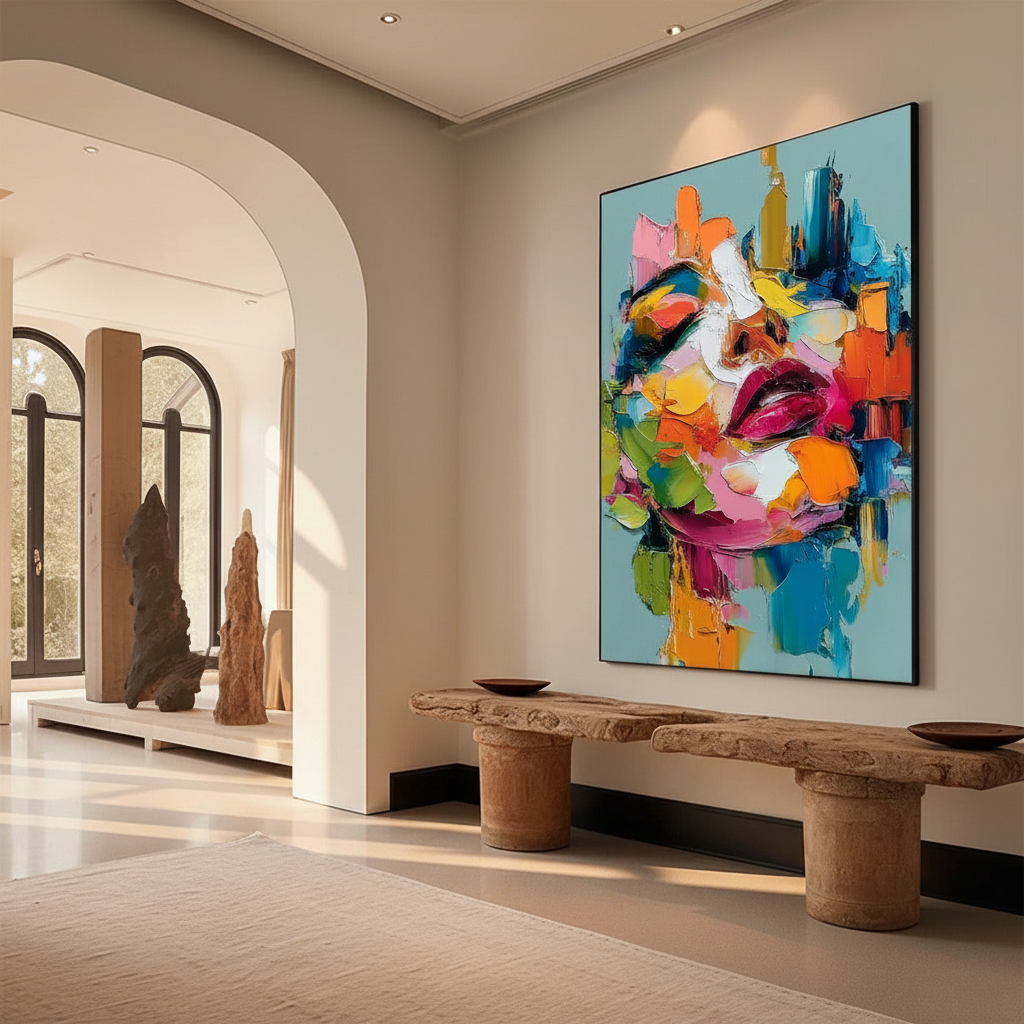
In an era of digital saturation, the "Shine Factor" remains the most honest indicator of human touch. By understanding the chemical interplay of oil and pigment, collectors can move past the fear of "e-commerce unpredictability" and invest in pieces that offer real emotional and financial value. Whether it is a nature-themed mural for a healing environment or a heavily textured abstract for a minimalist home, the variance of the sheen is the soul of the work.
Disclaimer: This article is for informational purposes only. While we discuss the chemical properties of pigments and solvents, this does not constitute professional health or safety advice. Always ensure proper ventilation when hanging freshly painted works, and consult with a professional art conservator for the maintenance of high-value assets.
References
- Marketplace: The expensive art market continues to struggle
- Columbia Business School: Human-Made vs. AI Art Perception
- JustPaint: Volume, Weight, and Pigment-to-Oil Ratios
- WHO: Scoping Review on Arts and Health
- Royal Society: Quantifying the link between art and property prices
- National Gallery of Art: Modern Paints Project