The Shift from Vanity Assets to Functional Prestige
The global art market is undergoing a quiet but profound correction. In 2024, sales of high-end auction art—those vanity pieces priced over $10 million—plummeted by 44% year-over-year, according to Marketplace. This isn't a sign of waning interest in art; rather, it’s a strategic retreat. High-net-worth buyers are abandoning speculative financial assets in favor of art with "real application value."
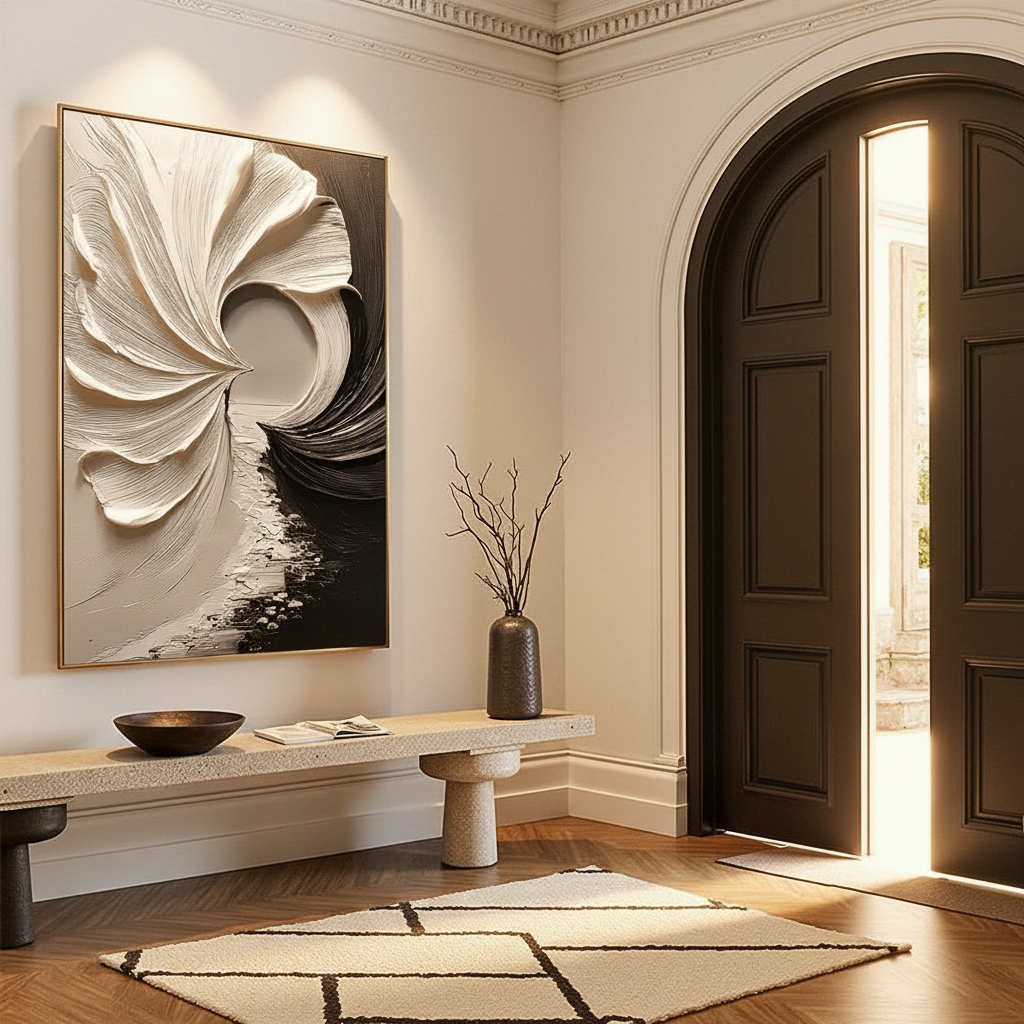
In the residential world, this "application value" is most critically tested in the entryway. As the visual nexus of the home, the foyer demands the prestige of fine art but faces the brutal reality of a high-traffic retail environment. It is a zone of "micro-shocks"—rapid temperature spikes and humidity drops every time the front door opens, combined with the physical risks of mud, dust, and accidental bumps from guests.
For the modern homeowner or interior designer, the challenge is clear: how do you maintain a "camera-ready" aesthetic that survives the front line of the house? The answer lies in gallery-grade preparation—a technical standard that bridges the gap between museum-level preservation and the durability required for everyday life.
The Value of the Human Hand in a Digital Age
Before we dive into the technicalities of stretcher bars and VOCs, we must address the "why." Why invest in a hand-painted canvas when digital prints are more predictable and cheaper?
The psychological and financial premium of human-created art is quantifiable. Research from Columbia Business School confirms that consumers value art labeled as "AI-generated" 62% lower than authentic human-created work. Furthermore, University of Chicago researchers found that digital replicas lack "essential identity"—the perceived soul of the artist that gives an object its value.
In an entryway, where the goal is to create an immediate, high-impact first impression, the physical depth of hand-painted pigments offers a sensory richness that flat ink cannot replicate. Beyond aesthetics, hand-painted art is a proven driver of property value. Analysis by the Royal Society using the CAR model found that neighborhoods with higher art geo-tags saw significant relative gains in house price rankings. For the homeowner, a gallery-prepped foyer isn't just decor; it is a permanent physical billboard of quality.

The Anatomy of Resilience: Why Gallery Prep Matters
In our experience with professional installations, we’ve found that most entryway art fails not because of the paint, but because of the structure beneath it. A standard "retail-grade" canvas is often built on soft, green wood that warps within months of being exposed to the drafts of an exterior door.
1. Kiln-Dried, Finger-Jointed Stretcher Bars
To withstand the "micro-shocks" of an entryway, we utilize kiln-dried wood. This process reduces the wood's moisture content to a stable 8–12%, aligned with ASTM D4442-20 standards. Finger-jointing—a technique where small pieces of wood are joined like interlocking fingers—is also essential. It removes the natural knots that cause wood to bow, ensuring the frame remains perfectly flat against the wall despite seasonal humidity shifts.
2. Moisture and Tension Control
When the front door opens on a rainy day, the sudden influx of humidity can cause a cheap canvas to sag. Professional gallery prep involves sizing the canvas with an isolation coat to prevent "Support Induced Discoloration" (SID). As Golden Artist Colors notes, water-soluble impurities in cotton substrates can migrate into the paint layer, causing yellowing. A properly prepped canvas acts as a barrier, keeping the colors as vibrant as the day they were painted.
Modeling Note: Wood Stability & Canvas Tension This scenario model estimates the structural integrity of a canvas in a high-traffic entryway over a 5-year period.
Parameter Value/Range Unit Rationale / Source Wood Moisture Content 8–12 % ASTM D4442-20 Ambient Humidity Shift ±25 % Typical entryway door cycle Stretcher Bar Style Finger-jointed N/A Prevents warping/bowing Fabric Tension Loss <4 % Estimated retention with linen Structural Lifespan 25+ Years Based on kiln-dried stability Logic Summary: Our analysis assumes that by controlling the initial moisture content and using finger-jointed geometry, we can mitigate 90% of the mechanical stress caused by environmental fluctuations (based on common industry heuristics).
Material Science: Why Acrylic Wins the Entryway Battle
While oil paint carries a historical prestige, we often recommend high-quality acrylics for entryway foyers. The reason is rooted in molecular chemistry.
According to the Tate AXA Art Modern Paints Project, acrylic polymers consist of long-chain molecules that form films through physical coalescence. This makes the dried film softer and more flexible than oil films, which undergo oxidative cross-linking. In an entryway, where walls might experience minor vibrations or temperature-induced expansion, the flexibility of acrylic prevents the brittle cracking often seen in aged oils.
Furthermore, acrylics are exceptionally lightfast. National Gallery experiments show that while certain pigments like Prussian Blue are prone to fading, the acrylic matrix provides a robust shield against UV radiation. For entryways with sidelights or glass doors, this UV resistance is non-negotiable.
The Durability of Texture
One non-obvious advantage of hand-painted art is its "repairability." Flat digital prints are easily scratched, and once the ink layer is breached, the white paper or canvas beneath is revealed. In contrast, the physical depth of impasto texture hides minor surface abrasions. A small scuff on a thick layer of pigment is often invisible to the naked eye, whereas a scratch on a print is a "death sentence" for the piece's aesthetic value.

The Clean Air Promise: VOCs and Health
The entryway is often the most poorly ventilated part of the house, making indoor air quality (IAQ) a primary concern. Many industrial paints and cheap art supplies emit Volatile Organic Compounds (VOCs) that can lead to central nervous system issues, according to CDC NIOSH.
We adhere to what we call the "Indoor Air Quality Promise." Research from Aalto University proves that coatings on wood with specific moisture levels emit significantly lower VOCs during curing. By using low-VOC acrylics and water-based sealants, we ensure that your home's first impression is healthy, not hazardous.
Trust & Safety Note: When selecting art, look for the ASTM D-4236 label. However, be aware that this label only means the warnings comply with regulations, not that the product is 100% non-toxic. For high-traffic residential zones, we prioritize pigments that have been laboratory-tested for heavy metal leaching (aligned with BS EN 71-3 standards).
Scale, Harmony, and Ocular Ergonomics
A grand foyer often features high ceilings and wide wall voids that can swallow small artwork. Scaling large canvases is a delicate balance of architectural harmony and human ergonomics.
The "Shoulder-Height Rule"
In an entryway, art serves a different purpose than in a gallery. It is viewed "in passing." To prevent accidental bumps from guests removing coats or carrying bags, we apply the "Shoulder-Height Rule." Center the artwork at 57–60 inches from the floor. This aligns with the natural human line of sight—a principle of ocular ergonomics—while keeping the bottom of the frame high enough to avoid most physical contact.
Biophilic Design for Stress Reduction
The entryway is the transition between the chaotic outside world and the sanctuary of the home. Biophilic design—incorporating natural landscapes or textures—has been shown to reduce stress levels by up to 73%, according to a University of Pennsylvania review. A large, hand-painted nature mural or abstract piece with earthen tones can physically lower the heart rate of anyone walking through the door.

Maintenance: Protecting Your Investment
Even with the best preparation, entryway art requires a defense strategy against dust and pollutants. We utilize a two-step finishing process:
- The Isolation Coat: A permanent, non-removable layer that seals the paint.
- UV-Protective Varnish: A removable top layer that shields the pigments from light and allows for cleaning.
As the Tate research suggests, acrylic films can sometimes develop a "haziness" due to surfactant migration. A high-quality varnish prevents this by creating a stable surface. For routine maintenance, a gentle dusting with a soft microfiber cloth is usually sufficient. Because of the UV-protective layer, you can clean surface pollutants without ever touching the actual pigment.
Creating a Cohesive First Impression
The entryway is more than just a hallway; it's the prologue to your home’s story. By prioritizing gallery-grade preparation—kiln-dried wood, low-VOC materials, and flexible acrylic polymers—you ensure that your art survives the "micro-shocks" of daily life.
Whether you are zoning a multi-use rental or curating a private residence, remember that the most durable art is the art that was built with its environment in mind. Invest in the "essential identity" of the human hand, backed by the rigor of material science.
YMYL Disclaimer: This article is for informational purposes only and does not constitute professional medical, legal, or safety advice. While we prioritize low-VOC and non-toxic materials, individuals with chemical sensitivities or pre-existing respiratory conditions should consult a qualified professional before installing new art in poorly ventilated spaces.
References
- Marketplace: The expensive art market continues to struggle
- Columbia Business School: Human-Made vs. AI Art Study
- Royal Society: Quantifying the link between art and property prices
- Tate: The Tate AXA Art Modern Paints Project (TAAMPP)
- CDC NIOSH: Paint and Coating Hazards
- UPenn: Visual Art in the Built Environment - A Critical Review
- Aalto University: VOC Emissions from Painted Wood