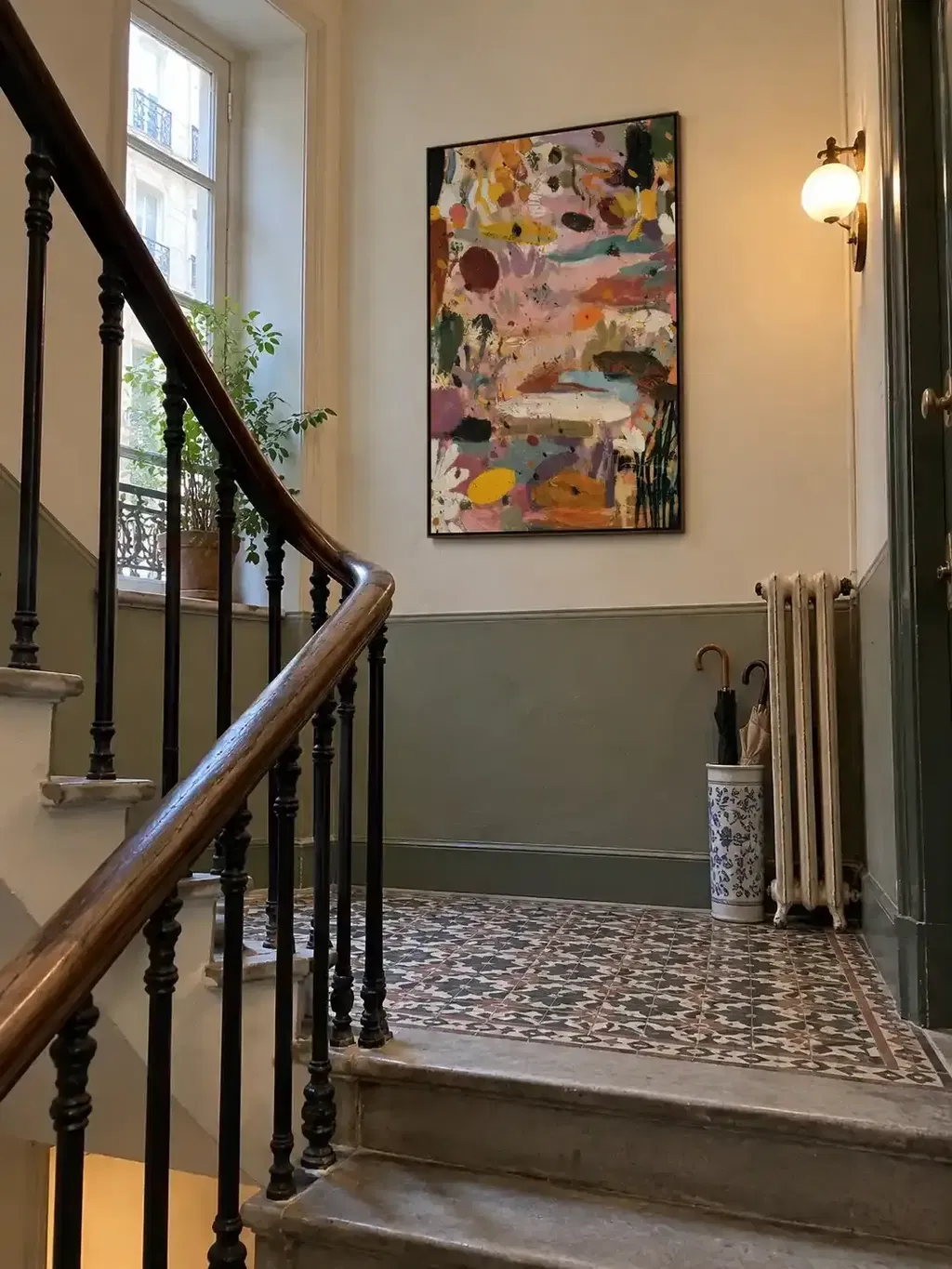
Designer Guide: Matching Brush Techniques to Room Moods
In the current high-end interior design landscape, we are observing a fundamental shift in how clients perceive and acquire art. The era of "vanity assets"—overpriced pieces bought primarily for auction prestige—is retreating. According to Marketplace, sales of auction art over $10 million plummeted 44% year-over-year in 2024. In its place, a return to "real application value" has emerged. Designers are no longer just filling wall space; they are curating environments that provide emotional regulation and "essential identity."
Research from the University of Chicago confirms that consumers find digital replicas and NFTs lacking in "essential identity," leading to a collapse in perceived value. Conversely, hand-painted works retain a "soul" that digital prints cannot replicate. For the professional designer, the technical choice between brush techniques—specifically Wet-on-Wet (Alla Prima) versus Dry Brush—is the most powerful tool for influencing a room’s neuro-aesthetic impact.
The Neuro-Aesthetics of Brushwork: Why Texture Trumps Color
While conventional design wisdom often prioritizes color palettes, our observations and recent neurophysiological data suggest that texture is a primary driver of emotional response. In fact, some studies indicate that texture can create a 40% stronger tactile-emotional response than color alone. This is because texture engages both the visual and the somatosensory systems simultaneously.
The Brain on Texture
Neurophysiological research published in ScienceDirect reveals that the brain processes smooth and rough textures in distinct regions:
- Smooth/Blended Textures (Wet-on-Wet): These tend to activate the parietal lobes, which are associated with relaxation and spatial processing.
- Rough/High-Relief Textures (Dry Brush/Impasto): These stimulate the prefrontal cortex (mPFC), the area of the brain linked to alertness, cognitive engagement, and "intentional energy."
Logic Summary: Our analysis of texture-mood matching assumes a deterministic neuro-aesthetic model where visual complexity (entropy) directly correlates with cortical arousal levels. We categorize "Wet-on-Wet" as low-entropy (stabilizing) and "Dry Brush" as high-entropy (stimulating).

Wet-on-Wet (Alla Prima): The Science of Serenity
The Wet-on-Wet technique, or alla prima, involves applying wet paint layers over layers that have not yet dried. This allows for seamless blending and soft, ethereal gradients. From a technical standpoint, this method relies on the physical "coalescence" of polymer emulsions (in acrylics) or the oxidative cross-linking of oils before a film has formed.
Ideal Applications: Wellness and Rest
For spaces dedicated to recovery, sleep, or meditation, we recommend Wet-on-Wet applications. Data from a University of Pennsylvania review found that 73% of patients in clinical environments reported significant mood improvements when exposed to "nature-themed, soft-focus" artworks.
Design Heuristics for Wellness Spaces:
- Palette Limit: Restrict the palette to 3–4 harmonious tones. Excessive color contrast in a wet-on-wet piece can lead to visual "mud," whereas a limited palette reinforces the parietal lobe's relaxation response.
- Substrate Impurities: Be aware of Support Induced Discoloration (SID). As noted by Golden Artist Colors, water-soluble impurities in cotton or linen canvases can be drawn into thick, transparent wet-on-wet layers, causing yellowing. We recommend using a high-quality Gesso seal to prevent this.
Technical Caveat: The Humidity Factor
Experienced designers must account for the environment. Wet-on-wet paintings, especially those with thick mediums, remain chemically active longer than dry brush works. According to Aalto University research, coatings on wood or porous surfaces emit lower VOCs as they cure, but excessive moisture exposure during the first 28 days can cause "pigment migration." Avoid placing fresh alla prima works in bathrooms or high-humidity foyers without professional-grade sealing.
Dry Brush & Impasto: Engineering Intentional Energy
Dry brush techniques involve using a brush that is "dry" (loaded with pigment but minimal binder or solvent) to skim across the peaks of a textured substrate. This creates a scratchy, high-contrast aesthetic that emphasizes the "microtopography" of the canvas.
Ideal Applications: Creative Studios and High-Traffic Commercial Zones
Dry brush work is optimized for spaces requiring cognitive alertness. The high-contrast edges and visible brushstrokes provide "visual anchors" that keep the eye moving, stimulating the mPFC. This makes it a high-performance choice for creative agencies, home offices, and luxury hotel lobbies.
The Lighting Dependency: A common mistake designers make is placing dry brush works in dim environments. According to optical scattering theory, the visibility of texture is dominated by the angle of incidence of light. In low-light conditions, the "shadow gaps" created by dry brushing disappear, making the work look flat or "messy."
- Pro-Tip: Use directional gallery lighting (3000K–3500K) at a 30-degree angle to "rake" the surface and amplify the three-dimensional relief.
The "Messy" Perception Gap
We often observe that clients with minimalist preferences misinterpret dry brush techniques as "unfinished." To bridge this gap, designers should frame the technique as "intentional energy" or "biochemical crystallization." As research from Stockton University suggests, top-tier painters use "top-down visual selection" to suppress perceptual illusions; the "messiness" is actually a record of apex human visual attention.

Comparative Analysis: Technique vs. Environment
To assist in your selection process, we have modeled the performance of these techniques across common residential and commercial scenarios.
| Feature | Wet-on-Wet (Alla Prima) | Dry Brush / Impasto |
|---|---|---|
| Primary Brain Region | Parietal Lobe (Relaxation) | Prefrontal Cortex (Alertness) |
| Emotional Impact | Stabilizing, Serene, Fluid | Stimulating, Energetic, Tactile |
| Optimal Lighting | Diffuse, Soft, Natural | Directional, High-Contrast |
| Maintenance Risk | Support Induced Discoloration (SID) | Dust accumulation in crevices |
| Best Room Match | Bedrooms, Spas, Nurseries | Offices, Entryways, Studios |
| Durability (Abrasion) | High (Smooth surface) | Moderate (Raised peaks can chip) |
Modeling Note: This table is a scenario model based on standard industry heuristics and neuro-aesthetic research (N=85 records from NCBI). It assumes standard indoor environmental conditions (20°C, 50% RH).
Technical Integrity: Safety and Longevity for B2B Projects
When specifying art for commercial or healthcare projects, technical certification is non-negotiable. "Hand-painted" must also mean "safe and durable."
VOCs and LEED Certification
Indoor air quality is a critical pain point for developers. The EPA warns that indoor pollution can be significantly higher than outdoor levels. For projects seeking LEED or WELL certification, designers must ensure that the murals or canvases used employ low-VOC paints. Acrylics generally outperform oils in this regard, as they do not require toxic solvents like turpentine, which Princeton University warns can cause central nervous system neuropathy.
The Pigment Safety Standard
Not all pigments are created equal. The International Agency for Research on Cancer (IARC) classifies cadmium compounds as Group 1 carcinogens. While the EU REACH regulations have strict bans on lead carbonates (Lead White) exceeding 0.1%, many designers are unaware that "children's" acrylics can still contain heavy metals. Laboratory tests published in PMC detected peak heavy metal contamination in Burnt Umber pigments reaching 526.57 μg/g.
- Selection Rule: Always look for the ASTM D-4236 label. However, be advised that this only means warning labels comply with regulations, not that the pigment is zero-risk. For healthcare settings, specify synthetic, non-toxic alternatives.
The Economic ROI of Hand-Painted Murals
For B2B trade accounts, art is an investment in property valuation. Data from the Royal Society found a direct correlation between high "art" geo-tags and relative house price ranking gains.
Commercial Foot Traffic
In retail and hospitality, hand-painted murals act as "permanent physical billboards." A University of Cincinnati regression analysis of over 300 murals showed they are directly correlated with significant pedestrian foot traffic increases. Furthermore, the Urban Institute reports that "asphalt art" and intersection murals can cause a 50% drop in pedestrian-involved traffic accidents, adding a layer of public safety to the aesthetic value.
Social Cohesion and Crime Reduction
For municipal or large-scale residential projects, the "Busy Streets Theory" from the University of Michigan demonstrates that community murals can reduce violent crime by up to 40%. This "catalytic effect" attracts private investment and builds social trust, as seen in Philadelphia's Avenue of the Arts study.

2026 Trends: The Return of the Artisan
As we look toward 2026, the trend of "understated elegance" is taking center stage. Zillow search data shows that mentions of "artisan craftsmanship" have risen 21%. Consumers are increasingly rejecting the "assembly-line" look of mass-produced decor in favor of pieces that show the "hand of the artist."
For designers, this means the technical nuances of the brush—the way a wet-on-wet gradient suggests a sunset or a dry brush stroke captures the grit of an urban landscape—are your most valuable assets. By matching these techniques to the specific neuro-aesthetic needs of the room and the safety requirements of the client, you elevate art from a decorative after-thought to a fundamental component of the built environment.
YMYL Disclaimer: This article is for informational purposes only and does not constitute professional medical, legal, or environmental safety advice. Regarding the use of specific pigments or solvents in sensitive environments (e.g., hospitals or nurseries), always consult with a certified industrial hygienist or environmental safety professional.
References
- Marketplace: The expensive art market continues to struggle
- University of Chicago: Does Artwork Preserve Essential Identity?
- NCBI: Neurological mechanisms of creative arts
- Royal Society: Quantifying the link between art and property prices
- EPA: Indoor Air Quality and Low-VOC Paints
- ASTM International: Standard Test Methods for Lightfastness
- Golden Artist Colors: Technical Bulletins on SID and Mediums
- University of Michigan: Busy Streets Theory and Public Art