If your wall art arrives damaged, photograph the unopened package, label, and visible damage before moving or opening it. Record the delivery and tracking details, preserve the box and packing materials, then unpack only as far as you can safely support the artwork. Inspect the canvas, frame, glazing, backing, hardware, and raised paint without touching loose areas or attempting repairs. Finally, contact the seller or order-support channel with a factual record and ask which carrier or protection process applies.
Document the Shipment Before Opening It
The first few minutes of a damaged wall art delivery are mainly about preserving context. Your photos should connect the package condition to the artwork condition without guessing who caused the damage or what the final claim outcome will be.
- Photograph the unopened package. Take wide photos of every accessible side, including crushed corners, punctures, tears, wet spots, exposed contents, or crushed panels. Keep the package as still as practical.
- Capture the label clearly. Photograph the shipping label and tracking number close enough to read, then take a wider image showing where the label sits on the package. UPS lists photos of the damaged item in its packaging, the shipping label, and the outside of the package as examples of supporting documentation; another carrier may request different materials (UPS supporting documents).
- Add context and close-ups. Use a medium-distance photo to show the damage's location on the box, followed by close-ups of each defect. If part of the artwork is exposed, photograph that area without pulling it farther out.
- Record factual details. Note the delivery date, approximate delivery time, order number, tracking number, and a short description such as "right side panel crushed near the lower corner." Describe what you see rather than writing "the carrier caused it."
- Create an evidence folder. Keep the original images together with your order confirmation, tracking page, delivery record, and notes. Do not treat a delivery photo, a notation, or a complete photo set as a guarantee of approval.
This is a practical way to document a damaged painting shipment. The specific seller, carrier, or protection provider may ask for additional records, such as value documentation, package dimensions, or an inspection.
Open the Package Without Adding Damage
Once the exterior is documented, open the shipment slowly on a clear, stable surface. Remove only the restraints you can cut away from the artwork, photograph each layer as it becomes visible, and stop if the package or art becomes unstable.
- Clear enough floor or table space to support the full piece and keep people, pets, and sharp tools out of the work area.
- Photograph the sealed package again if its position or condition changes before opening.
- Remove tape, straps, and outer wrapping only when you can see a cutting path separated from the canvas, frame, glazing, and raised paint.
- Pause at each inner layer. Photograph how the artwork is positioned, then set the wrapping, corner protection, inserts, and other materials aside in the condition in which you received them.
- Stop if the artwork is heavy, wet, glass-damaged, unstable, or too large for the available help. A supported, partly documented piece is better than a more complete inspection that creates new damage. Tell the seller which areas you could not safely inspect.
If you need general preparation context for future moves, see our guide to packing large oil paintings. Do not use packing advice as a substitute for the seller's or carrier's instructions for an active claim.
Inspect the Canvas, Frame, and Raised Paint
After documenting the package and unpacking layers, inspect the artwork in place. Separate what you see on the artwork surface from damage to the canvas, stretcher, frame, glazing, backing, or hardware, and describe visible conditions without diagnosing repairability or cause.
Check Canvas Edges and Corners
Canvas edges and corners can reveal folds, punctures, slackness, tears, or displacement that a front-facing photo misses. Keep the artwork supported and stationary while you take a close-up of each affected edge or corner and a wider location photo showing where it appears on the full piece.
Check the front perimeter, then the back perimeter and stretcher-bar areas only if they are safely accessible. Note whether the canvas appears slack, warped, torn, separated from the frame, or displaced. Do not press, pull, flatten, align, or retension it. If the back cannot be photographed without moving the piece, record that limitation instead.
Examine Raised Paint Without Touching It
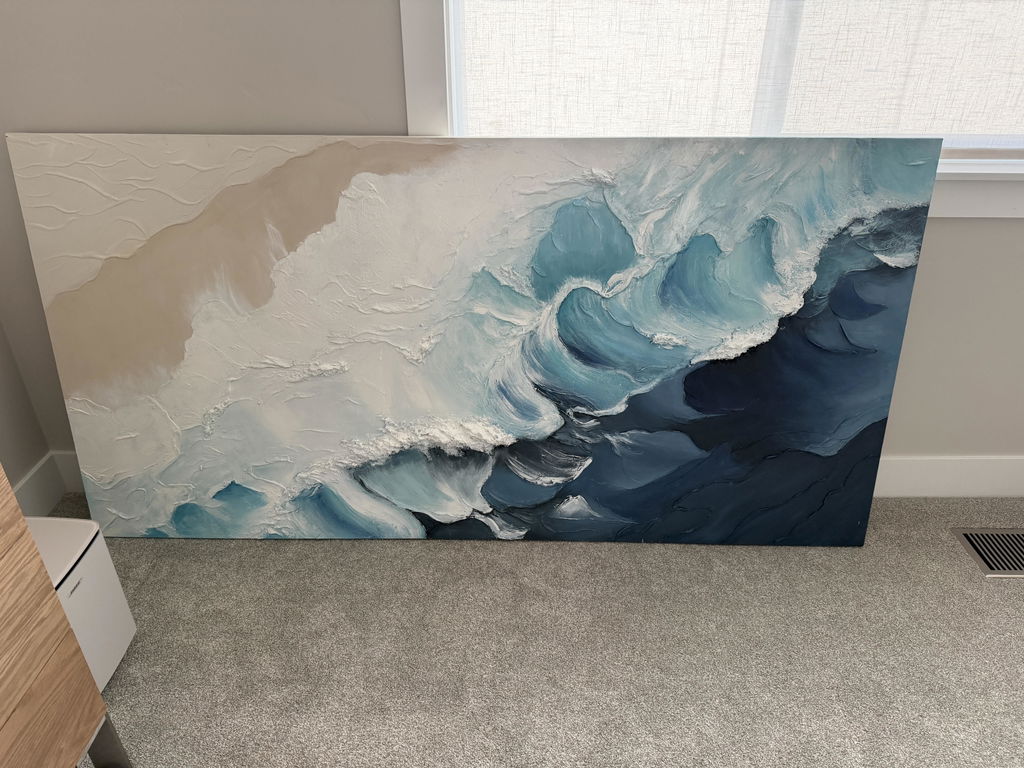
For a textured painting damaged in transit, inspect the surface visually from more than one angle without rubbing, brushing, pressing, or trying to reattach a loose area. Pair an overall artwork photo with close-ups of each affected section.
Describe whether the texture appears lifted, cracked, chipped, flattened, detached, or missing. Side lighting can make raised texture easier to see, but use it only if it does not require moving, heating, or handling the artwork. Do not clean the surface while documenting it; our textured painting care guide is not a substitute for claim-specific instructions.
Check Frames, Prints, and Hardware
Check each visible component separately so your record distinguishes artwork damage from frame, glazing, backing, and hanging-hardware damage. Photograph each issue with a location view and a close-up, and leave intact protective layers in place unless the responsible party directs otherwise.
| Component | What to Look For | Evidence to Capture | Handling Boundary |
|---|---|---|---|
| Canvas | Tears, folds, slackness, warping, or separation | Front and edge views; back view only if safely accessible | Do not pull, flatten, or retension it |
| Frame | Broken joints, chips, dents, or shifted corners | Full frame view and close-up of each issue | Do not dismantle the frame |
| Glazing | Cracks, scratches, breaks, or movement | Reflection-free views when possible, without pressing | Do not remove or press damaged glazing |
| Backing | Tears, gaps, shifted material, or exposed contents | Back view only when the piece is already safely positioned | Do not remove intact backing |
| Hardware | Bent wire, detached brackets, or damaged hangers | Component close-up and its location on the piece | Do not test-load or reinstall it |
| Artwork surface | Distortion, chips, lifted areas, or missing material | Overall context plus close-up | Do not clean, touch, or retouch it |
Keep the Artwork and Packaging Intact
Until the responsible party gives instructions, retain the artwork and shipment in the condition you received them as a practical claim-preservation default. Keep the box, labels, wrapping, corner protection, inserts, contents, and any damaged pieces together rather than trying to make the package look presentable again.
Do not:
- discard the box, packing materials, labels, or damaged contents;
- trim, flatten, or rearrange packaging before photographing it;
- clean, repair, retouch, reglaze, re-stretch, or repackage the artwork;
- return or reship the artwork unless the seller, carrier, or protection provider instructs you to do so; or
- hang, transport, or repeatedly reposition an unstable piece just to obtain another photo.
Store the artwork and materials in a dry, secure place with minimal handling. If a broken glazing panel, exposed sharp edge, moisture, or instability creates an immediate hazard, protect people and property first and document any necessary move as soon as practical.
Carrier requirements are not identical. UPS says to hold on to the contents and packaging for a damaged package (UPS claim guidance). USPS says that, when its applicable claim conditions apply, claimants should retain the mailing container, wrappings, packaging, contents, and damaged items until resolution and should not return or reship them without following its process (USPS Publication 122). FedEx may request photos or an inspection report and advises keeping the original packaging and contents until the claim is resolved (FedEx claims). Treat these as carrier-specific instructions, not proof that every shipment has the same requirement or outcome.
Put your evidence in one folder: original photos, delivery and tracking details, the order confirmation or invoice, factual notes, messages, case numbers, and any applicable value or shipping-protection records. A complete folder supports review, but it does not guarantee coverage, approval, a refund, a replacement, or a particular resolution.
Contact the Seller and Carrier With a Complete Record
For most online purchases, the seller or order-support channel is the safest first contact when the seller arranged delivery. Send the record, ask who controls the carrier or protection process, and follow the designated instructions rather than opening conflicting requests on your own.
- Assemble the message. Include the order number, tracking number, delivery date, a short factual damage summary, package photos, artwork photos, and a list of the materials you retained.
- Notify the seller promptly. You can write: "Order [number] arrived on [date]. The package shows [visible condition], and the artwork shows [visible condition]. I have attached package, label, packaging, and artwork photos and have retained the shipment materials. Please confirm the next step and whether you will coordinate the carrier or protection process."
- Ask for the controlling process. Request the current instructions for inspection, pickup, return, replacement review, repair assessment, or refund review. Do not assume which option applies or that a carrier claim must be filed by you.
- Follow the directed carrier or provider channel. If the seller tells you to open an art shipping damage claim, use the current official instructions for that shipment. If a shipping-protection or insurance process applies, verify its documentation, coverage, and reporting requirements rather than assuming the label establishes coverage.
- Keep a written trail. Save case numbers, emails, uploaded files, chat transcripts, and instructions. If someone gives directions by phone, send a short written follow-up asking them to confirm what should happen to the artwork and packaging.
A wall art shipping insurance claim may involve value records, tracking evidence, or other documents, but the required materials depend on the order and applicable terms. Report the problem promptly and check the seller's terms and current carrier instructions; do not rely on a universal deadline, assumed liability, or a promise of approval.
Questions Buyers Ask After Damaged Wall Art Delivery
Can I Open the Box If the Outside Looks Undamaged?
Yes, you can usually document the intact exterior and proceed carefully, but photograph the sealed package, label, and each packing layer first. If concealed damage appears, leave the artwork and inner wrapping in place, photograph the discovery, and record the unpacking sequence before contacting the seller.
What If I Find Damage Only After Removing the Inner Wrapping?
Photograph the artwork exactly where the damage becomes visible, including the inner wrap, outer box, and surrounding protection. Note which layer you had just removed and describe the condition without guessing whether it happened in transit. Keep every layer and send the record to the seller for next-step instructions.
Should I Use a Measuring Tape in Photos of Damaged Artwork?
A nearby scale reference can clarify the size of a tear, dent, or missing area, but it is optional. Use one only when you can place it beside the damage without touching loose paint, pressing the canvas, or moving unstable art. Context and close-up photos remain necessary even when a scale reference is included.
What If the Damaged Painting Is Too Large to Move Safely?
Do not force a solo inspection or carry the piece to improve the photos. Leave it supported, photograph accessible areas, record what you could not reach, and ask the seller whether an inspection or pickup can be arranged under the applicable process. Do not imply that a pickup or a particular outcome is guaranteed.
Can I Hang the Artwork Temporarily While Waiting for a Claim Decision?
Avoid hanging artwork that is unstable, has damaged hardware, broken glazing, loose texture, or a compromised frame. Store it supported in a dry area without new holes, pressure, moisture, or repeated handling, and ask the seller before reinstalling it. This protects the piece while preserving the condition record needed for review.