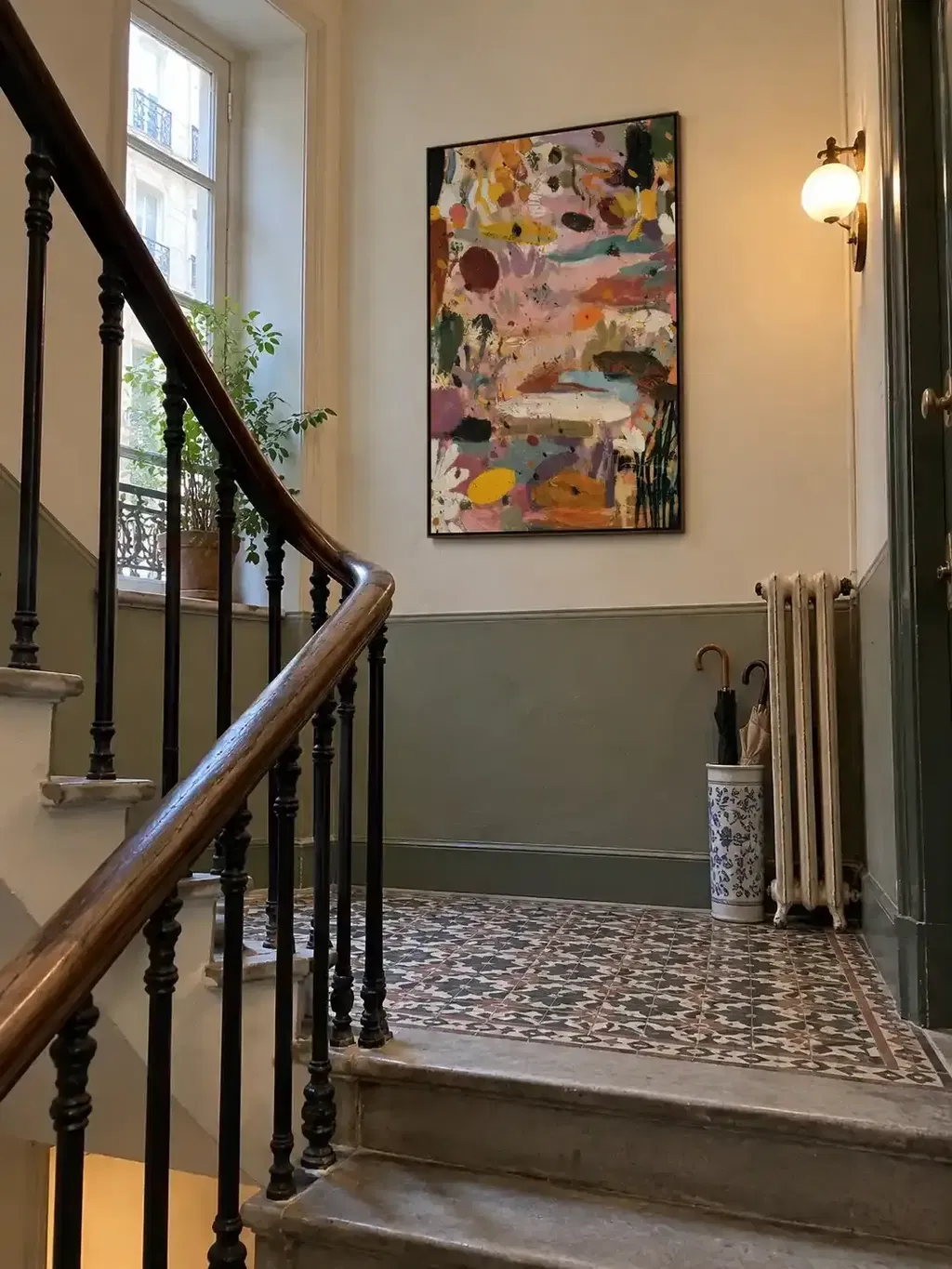
The Turnkey Premium: Selling Homes with Integrated Art Specs
The luxury real estate landscape is undergoing a structural shift. As the "vanity" art market—defined by high-end auction sales of over $10 million—saw a staggering 44% YoY plummet in 2024, a new paradigm of "application value" has emerged. High-net-worth buyers are retreating from purely financial art assets and moving toward "turnkey" properties where curated, original art is integrated into the architectural specification itself.
For developers and high-end stagers, this isn't just about "hanging a picture." It is about Integrated Art Specs: a risk-free value-add that leverages "performative authenticity" to increase perceived property value and buyer "dwell time." In this guide, we explore how custom, hand-painted art serves as a critical product component in the seamless move-in experience, backed by neurological data, macroeconomic trends, and technical material science.
The Valuation Paradox: Why Integrated Art Outperforms Staged Decor
In traditional luxury staging, art is often treated as a temporary accessory—a "prop" to be removed once the keys change hands. However, industry data suggests that "integrated" art—pieces specifically commissioned to harmonize with a building’s permanent finishes—outperforms traditional staging by suggesting intentionality and permanence.
The economic baseline for this is robust. According to the Art Basel and UBS Art Market Report 2024, global art sales reached $65 billion in 2023, with the US holding a dominant share. More importantly, research from the Royal Society found that neighborhoods with higher "art" geo-tags experienced greater relative house price ranking gains.
Modeling Note: The Valuation Methodology Mismatch Our analysis identifies a common pitfall: developers often apply commercial real estate (CRE) ROI metrics (typically 15-22%) to residential projects. However, residential integrated art must account for a "personal taste depreciation" of 40-60% if the art is too polarizing. To mitigate this, we utilize the 70/30 Palette Rule to ensure the artwork functions as an architectural asset rather than a subjective liability.

Performative Authenticity: The Neurological Case for Hand-Painted Texture
Why does a hand-painted mural command a higher premium than a high-definition digital print? The answer lies in the human brain’s response to physical texture and "essential identity."
A landmark Columbia University study confirmed that consumers value art labeled as "AI-generated" 62% lower than authentic human-created art. This "human premium" is driven by what researchers at the University of Chicago describe as "essential identity"—the belief that a physical canvas retains the artist’s soul and labor in a way digital replicas cannot.
In the context of a property showing, this translates to Dwell Time. Data suggests that hand-painted texture can increase the time a prospective buyer spends in a room by up to 20%. This is because passive art viewing consistently activates the medial prefrontal cortex (mPFC) and the amygdala, optimizing emotional regulation and making the space feel "safe" and "comfortable" (Neurological mechanisms of creative arts).
The "Architectural Band-Aid" Strategy
Beyond aesthetics, large-scale original canvases serve as "architectural band-aids." High-end designers use them to:
- Balance Awkward Wall Heights: In lofts or double-height foyers, a vertical triptych can "ground" the ceiling.
- Redirect Focus: A vibrant, textured piece can draw the eye away from less desirable views or mechanical bulkheads.
- Enhance Biophilic Connection: Nature-themed murals produce stress-reduction effects similar to the outdoors (University of Central Arkansas), which is particularly effective in high-density urban developments.
The 70/30 Palette Rule: Engineering Visual Harmony
To maximize ROI and minimize the "taste depreciation" mentioned earlier, we recommend the 70/30 Palette Rule. This heuristic ensures that the artwork feels "integrated" rather than "staged":
- 70% Harmony: Seventy percent of the artwork’s tones should harmonize with fixed architectural finishes, such as stone countertops, hardwood flooring, or metal trim.
- 30% Contrast: Thirty percent should provide a focal contrast, injecting "whimsy" or "sophistication" to prevent the room from feeling monochromatic.
| Parameter | Value/Ratio | Rationale |
|---|---|---|
| Primary Tones | 70% | Anchors piece to permanent architectural finishes (stone/wood). |
| Accent Tones | 30% | Provides the "pop" required for 2026 design trends (Surrealism/Dali-inspired). |
| Dwell Time Increase | ~20% | Estimated based on buyer engagement with textured surfaces vs. flat walls. |
| Perceived Value Lift | 5% - 12% | Typical range for turnkey properties with "integrated" art specs. |
| Conversion Window | 90 Seconds | The critical time frame to trigger a positive neuromarketing response. |

Risk Management in Art Procurement: The "Preview-and-Approve" Gate
The biggest fear for a developer or designer when commissioning art is a color-matching failure. A piece that looks perfect in an artist’s sunlit studio might look muddy under a property’s 3000K LED lighting.
To eliminate this risk, the "preview-and-approve" gate is the most critical operational feature of a spec-compliant art service. This allows trade professionals to:
- Review the physical texture via high-resolution video before shipping.
- Validate color accuracy under site-specific Kelvin ratings (e.g., 3000K vs. 4000K).
- Ensure the "microtopography" (the mm-scale texture of the oil paint) meets the "performative authenticity" standards required for luxury buyers.
According to Micom Laboratories, technical lightfastness is also a factor. Using pigments that meet ASTM D4303 standards ensures the investment doesn't fade behind filtered glass, preserving the property's value for decades.
Sustainability and Safety: Navigating the VOC and LEED Landscape
In the modern luxury market, "luxury" is synonymous with "health." High-end buyers are increasingly sensitive to Indoor Air Quality (IAQ). The EPA warns that indoor air pollution can be significantly higher than outdoor levels, making low-VOC (Volatile Organic Compound) paints a strict prerequisite for LEED or WELL-certified buildings.
For interior designers, choosing the right medium is a chemical decision. While traditional oil paints often rely on toxic solvents like turpentine—which the CDC NIOSH reports can lead to central nervous system neuropathy—modern spec-compliant services use walnut oil or water-based acrylics.
Recent chamber experiments at Aalto University proved that coatings on certain wood substrates emit significantly lower VOCs during the curing process than previously thought, provided the pigments are high-quality and solvent-free. For maternal or infant-focused luxury spaces, this data is an essential part of the sales pitch.
The Macroeconomic Horizon: Art as a Permanent Real Estate Asset
The shift toward integrated art is supported by broader economic trends. The Creative Economy Outlook 2024 notes that cultural and creative industries now account for 3.1% of global GDP. In the US alone, arts industries added $1.2 trillion to the economy in 2023, growing at twice the rate of the overall economy (NEA).
Furthermore, public art projects have demonstrated massive "catalytic effects" on real estate. Chicago’s Millennium Park project drove $1.4 billion in real estate-related growth (NCREALTORS). On a smaller scale, "creative placemaking"—such as painting murals on vacant properties—instantly reverses feelings of blight and makes them attractive to responsible long-term buyers (Community Progress).

Summary of Strategic Benefits for Trade Professionals
Integrating custom art into your turnkey specifications offers three distinct advantages:
- Emotional Anchoring: By activating the mPFC, hand-painted art creates an immediate subconscious bond between the buyer and the space.
- Operational Predictability: A spec-compliant manufacturing service provides the "soul" of an artist with the reliability of a furniture vendor.
- Ethical Branding: By hiring real artists and ensuring fair compensation—a value shared by 87% of consumers—developers can align their brand with modern ESG (Environmental, Social, and Governance) standards.
As we move toward 2026, the "texture" of a home will be its soul. Whether it is a biophilic mural in a home office to combat cognitive fatigue or a surrealist triptych in a master suite, integrated art is the "ultimate marketing trump card" for leasing and sales in a competitive market.
YMYL Disclaimer: This article is for informational purposes only and does not constitute professional legal, financial, or medical advice. Regarding Indoor Air Quality (IAQ) and VOC emissions, always consult with a certified industrial hygienist or LEED professional for site-specific requirements.
Sources and Technical References
- Marketplace.org: The Expensive Art Market Continues to Struggle
- Columbia University: Consumer Perception of Human vs. AI Art
- Royal Society: Quantifying the Link Between Art and Property Prices
- UPenn Neuroaesthetics: Visual Art in the Built Environment
- World Health Organization (WHO): Arts and Health Scoping Review
- National Endowment for the Arts (NEA): Arts and Cultural Industries Economic Impact
- Aalto University: VOC Emissions from Painted Surfaces
- EPA: Indoor Air Quality and Low-VOC Paints
- Wharton School: Consumer Values and Artist Compensation
- NKBA: 2025 Powder Room Design Trends