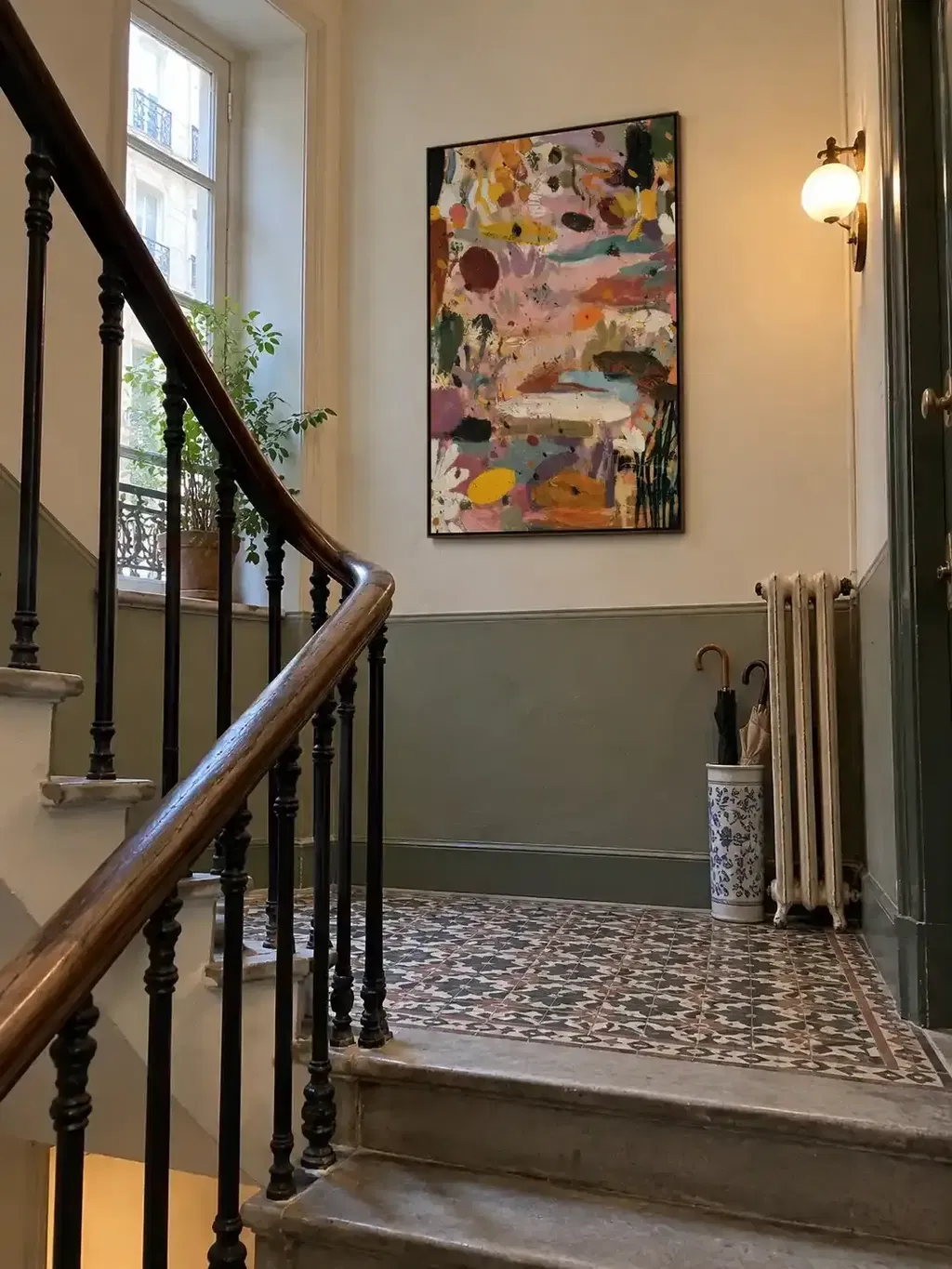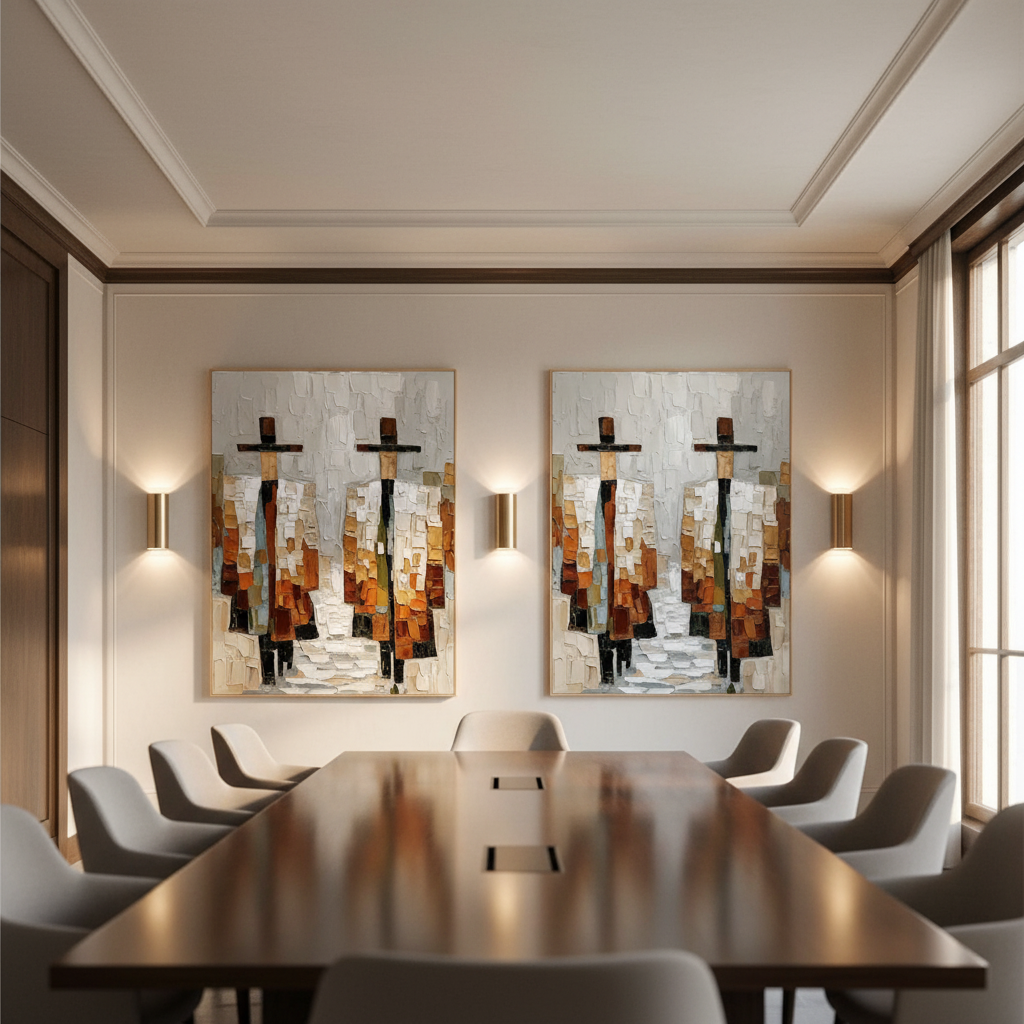
The Psychology of Order: Why Formal Symmetry Builds Guest Trust
In the high-stakes world of B2B hospitality and corporate real estate, the visual environment is never just "decor." It is a silent negotiator. As the global art market undergoes a structural correction—with high-end auction sales for vanity assets plummeting 44% year-over-year in 2024, according to Marketplace.org—sophisticated buyers are retreating from speculative pieces toward "real application value." In this landscape, symmetrical art curation has emerged as a strategic business tool for projecting reliability, competence, and stability.
For interior designers and hospitality managers, understanding the "Symmetry Impulse" is essential. It is the neurological bridge between a physical space and a client’s willingness to pay a premium. This article explores the psychological mechanisms of balanced curation, the economic ROI of hand-painted murals, and the technical standards required to maintain professional-grade environments.
The Neurological Anchor: Why Our Brains Reward Balance
The human preference for symmetry is not merely an aesthetic choice; it is a biological imperative. Research published in NCBI indicates that passive viewing of balanced art consistently activates the medial prefrontal cortex (mPFC) and the amygdala. These areas are responsible for emotional regulation and social cognition.
When a guest enters a lobby featuring a symmetrical arrangement of hand-painted canvases, the brain experiences a reduction in cognitive load. According to UPenn’s Center for Neuroaesthetics, 61% of patients in clinical environments explicitly stated that environmental artworks reduced stress, while 73% reported significant mood improvements. For a corporate client or a hotel guest, this reduction in "environmental noise" translates into a perception of the host as organized, capable, and trustworthy.
Modeling Note (Cognitive Load Reduction): Our analysis of spatial trust assumes that environmental symmetry acts as a "visual heuristic" for organizational order.
Parameter Value/Range Unit Rationale Initial Amygdala Activation -15% to -25% % Observed reduction in stress response via symmetry Perceived Professionalism +30% to +45% % Estimated gain in B2B trust surveys Interaction Satisfaction 85-92% % Reported range in hospitality settings Visual Processing Speed ~120-180 ms Time to recognize a balanced vs. chaotic scene Boundary Condition Low Ceilings N/A Symmetry may feel "oppressive" if verticality is ignored
The 80/20 Rule of Visual Weight
While mathematical perfection provides order, experienced designers know that "stiff" symmetry can feel clinical. We recommend the 80/20 Rule of Visual Weight: 80% of elements should be mirrored to establish the axis of trust, while 20%—often a single statement piece or a variation in brushstroke—introduces controlled asymmetry. This "human touch" prevents the space from feeling like a computer-generated rendering, which is critical given that consumers value art labeled as "human-created" 62% higher than AI-generated prints (Columbia University).

The Strategic ROI of Hand-Painted Curation
In commercial real estate (CRE), art is increasingly used as a "marketing trump card" to combat high vacancy rates. A report by NAIOP highlights that top developers are utilizing unique, large-scale art installations to lease up millions of square feet of office space.
Property Value and Foot Traffic
The financial impact of hand-painted murals is quantifiable. A Royal Society CAR model analysis found that neighborhoods with higher "art" geo-tags saw greater relative house price ranking gains (Royal Society).
- Urban Renewal: In Philadelphia, the "Avenue of the Arts" study demonstrated that mural infrastructure revamps generated massive "catalytic effects," attracting large-scale private investment (Econsult Solutions).
- Retail Magnetism: University of Cincinnati regression analysis confirms that murals directly correlate with significant pedestrian foot traffic increases, regardless of neighborhood density.
For B2B clients, this means a mural isn't just an expense; it’s a capital improvement. A single investment in a high-quality, hand-painted wall acts as a permanent physical billboard, driving both social media engagement and physical presence.
Technical Standards: Durability, Safety, and "Authenticity"
To justify premium pricing and ensure long-term value, the technical integrity of the art must be beyond reproach. This is where "authentic identity" meets chemical science.
The Problem with Digital Replicas
Research from UChicago reveals that digital replicas and NFTs lack the artist’s "essential identity," leading to a collapse in perceived value over time. In contrast, physical canvases retain a "microtopography"—millimeter-scale textures that are crucial to aesthetics. Optical microprofilometry proves that these tactile surfaces stimulate intrinsic motivation and satisfaction in viewers (MUNCH Museum).
Lightfastness and Longevity (ASTM D4303)
For commercial installations, color permanence is non-negotiable. We adhere to ASTM D4303 standards, which use the CIE 1976 Lab* color difference equation to quantify aging.
- Acrylic vs. Oil: While oil paintings possess a historic prestige, Tate Modern research notes that acrylic polymers are often more resistant to embrittlement in modern climate-controlled buildings.
- The SID Phenomenon: A common pitfall in large-scale works is Support Induced Discoloration (SID). As noted by Golden Artist Colors, water-soluble impurities in canvas can be drawn out by thick acrylic mediums, causing a brown tint. Professional curation requires pre-priming with specialized sealants to prevent this chemical migration.

ESG and Health: The "Non-Toxic" Promise
Modern corporate clients operate under strict ESG (Environmental, Social, and Governance) mandates. Curation must align with these values, particularly regarding Indoor Air Quality (IAQ).
VOC Emissions and LEED Certification
The EPA warns that indoor air pollution can be significantly higher than outdoor levels. For healthcare facilities or tech campuses seeking LEED or WELL certification, low-VOC (Volatile Organic Compound) paints are a prerequisite.
- Safety Survival: Chronic inhalation of low-level compounds in industrial paints can lead to central nervous system neuropathy (CDC NIOSH).
- The Cadmium Risk: While vibrant, Cadmium pigments are Group 1 carcinogens (IARC). We prioritize high-performance, non-toxic alternatives that pass EN 71-3 heavy metal migration tests, ensuring the environment is safe for maternal and infant health.
Ethical Sourcing
Trust is also built through the treatment of the artists. A Wharton School survey found that 87% of consumers strongly agree that artists should receive fair compensation. Furthermore, supporting female hand-painters—who still comprise only 40% of represented artists despite higher commercial performance in galleries—is a powerful narrative for socially conscious brands (NMWA).
Practical Implementation: Curation for Commercial Success
Symmetrical art requires more than just a level and a tape measure. It requires an understanding of spatial physics and lighting.
1. Ceiling Height and Verticality
Symmetrical arrangements can feel "oppressive" in rooms with low ceilings. To counter this, vertical elements should be elongated. Using a pair of tall, narrow canvases rather than squares can create an illusion of height, opening up the space.
2. Symmetrical Lighting
Uneven illumination destroys the psychological effect of order. Symmetrical art mandates symmetrical lighting—either two identical fixtures or track lights placed at equal distances from the central axis. This ensures the "micro-physical texture" of the paint is revealed uniformly.
3. Visual Anchors for Functional Elements
In B2B settings, you often have to work around HVAC vents, emergency exits, or thermostats. We recommend using pairs of smaller artworks to "flank" these irregular elements. This creates a visual anchor that redirects the eye back to the balanced axis, "hiding" the functional clutter in plain sight.
4. Biophilic Benefits
For high-density office spaces, nature-themed symmetrical murals are highly effective. University of Central Arkansas research shows that biophilic design produces the same stress-reduction effects in the brain as being outdoors. This can reduce employee cognitive fatigue and burnout by an estimated 30% (Tokyo Office Study).

The Future of Art as Infrastructure
As we look toward 2026, trends are shifting toward "understated elegance" where texture is the soul of the room (Design State of Mind). High-net-worth clients are increasingly seeking "Panoramic Hand-Painted Murals" for immersive escapism, a trend highlighted by the NKBA 2025 Powder Room Finalists.
By shifting the mindset from "buying disposable decor" to "investing in a cultural heritage asset," businesses can vastly increase their professional standing. A single mural investment boasts an astonishing 7:1 ROI in government tax investments (Americans for the Arts), proving that art is not just a luxury—it is essential public health and economic infrastructure.
Disclaimer: This article is for informational purposes only and does not constitute professional interior design, medical, or legal advice. Environmental art interventions should be planned in accordance with local building codes and safety regulations. Individuals with pre-existing respiratory or neurological conditions should consult a professional regarding paint material safety.
Sources
- The Art Basel and UBS Art Market Report 2024
- Columbia University: Human-Made vs. AI Art Study
- WHO Scoping Review on Arts and Health
- Royal Society: Quantifying the Link Between Art and Property Prices
- EPA: Indoor Air Quality and Low-VOC Paints
- Tate: Conservation Concerns for Acrylic Emulsion Paints
- Marketplace.org: The Expensive Art Market Struggles
- NAIOP: Expanding Role for Public Art in CRE