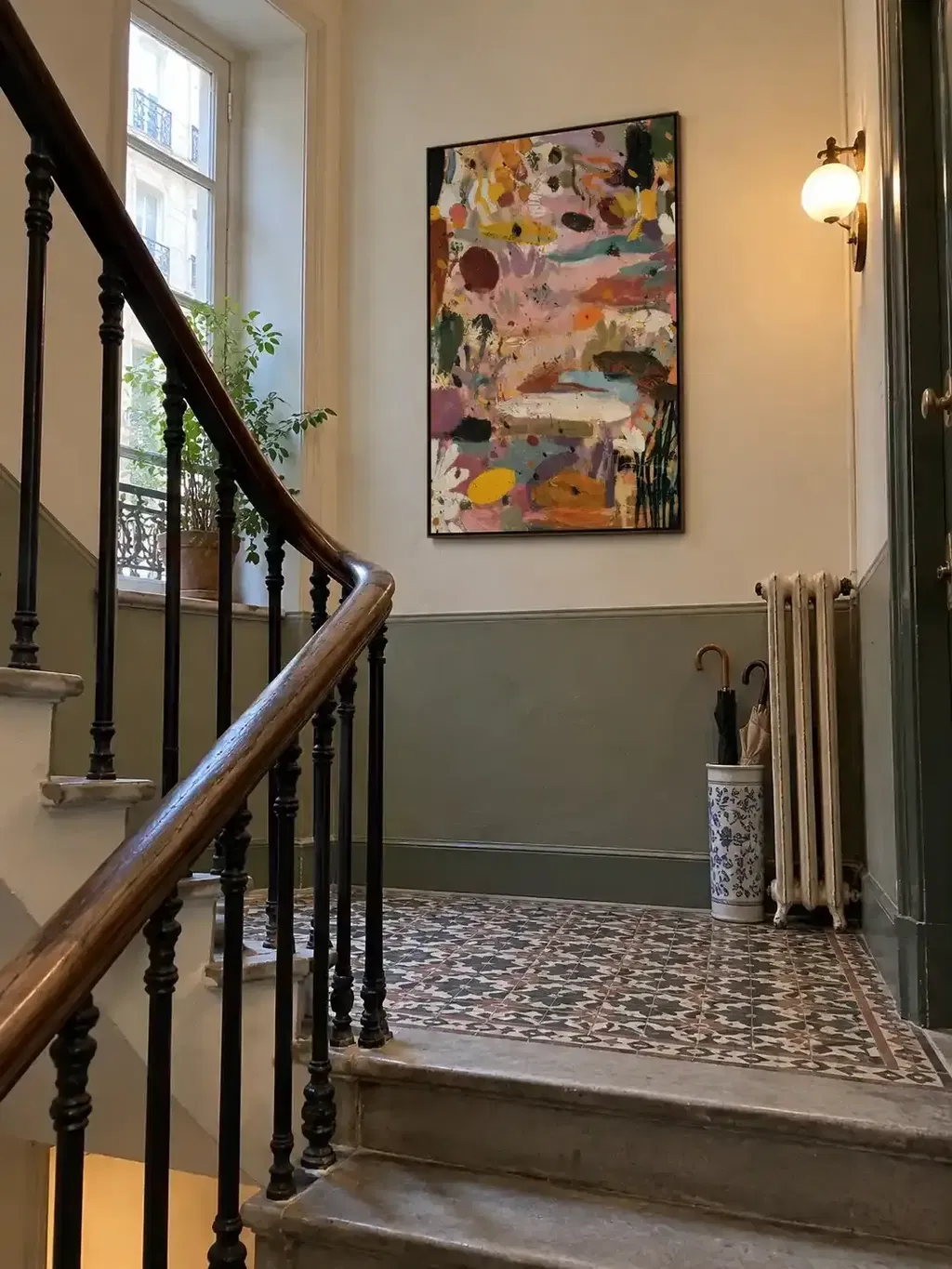
The Shift from Vanity to Veracity in Modern Art
The high-end art market is undergoing a structural transformation. Recent data indicates that sales of "vanity" auction pieces—those exceeding $10 million—plummeted by 44% year-over-year in 2024, according to Marketplace.org. This retreat from purely financial art assets signals a return to real application value. Today’s aesthetic-driven home improvers are moving away from overpriced, speculative pieces in favor of custom, hand-painted murals and canvases that offer genuine emotional resonance and "essential identity."
This "essential identity" is not just a poetic concept; it is a psychological reality. Research from the University of Chicago demonstrates that digital replicas and NFTs often lack the "soul" or essential identity that consumers perceive in physical, hand-painted works. However, as AI-generated prints become increasingly sophisticated, the risk of purchasing a high-resolution "fake" masquerading as a handcrafted masterpiece has never been higher.
For the discerning buyer, the "bristle test" serves as the ultimate technical verification. By understanding the physics of dry brush marks and the forensic signatures of authentic brushwork, you can verify craftsmanship during the approval process with 99.9% accuracy.

The Physics of the Stroke: Why Dry Brush Marks Matter
Dry brushing is a technique where a brush is loaded with pigment but minimized of moisture or medium, then dragged across a textured surface. Unlike wet-on-wet applications (alla prima) which prioritize smooth gradients and blending, dry brushing creates a high-texture, "scratchy" aesthetic that emphasizes the substrate's topography.
The authenticity of these marks is rooted in neurobiology and physics. Research from Stockton University reveals that the skill of a master painter involves a robust bottom-up neural control that suppresses "perceptual constancy illusions." This allows the artist to deposit pigment in a way that creates organic randomness.
When a physical bristle interacts with a canvas, it creates a unique particle transport phenomenon. Each bristle acts as a mechanical stylus, carving microscopic furrows into the paint film. According to research published in Springer's Journal of Coatings Technology and Research, these distribution patterns serve as quantifiable forensic signatures.
Methodology Note: Verification Heuristics
Logic Summary: Our verification methods are modeled on forensic paint analysis standards (ASTM) and practical observations from professional muralists. We assume a standard viewing distance of 1–3 feet for inspection and the use of directional light to reveal surface microtopography.
The Visual Checklist: The "Bristle Test" for Buyers
To verify that your custom artwork is truly hand-painted and not a high-definition print with a clear-coat "texture" overlay, use the following three-step inspection during your approval phase.
1. The Raking Light Test (45-Degree Angle)
Digital simulations of texture often fail when viewed under "raking light"—light directed at an acute angle to the surface.
- What to Look For: Position a light source at a 45-degree angle to the canvas. In an authentic dry brush stroke, individual hair traces create microscopic furrows with pigment accumulation at the edges of the stroke.
- The Print Giveaway: High-resolution prints often have a uniform "sheen" or a texture that doesn't align with the visual "hairs" of the brush. If the shadows cast by the texture don't match the direction of the visible strokes, it is likely a digital reproduction.
2. Stroke Termination Analysis
The most difficult aspect for a machine to replicate is the "lift-off" of a human hand.
- The Hand-Painted Signature: Authentic dry brush strokes show gradual pigment depletion where the bristles lift from the canvas. You will see "skip areas" where the paint only catches the high points of the canvas weave.
- The Digital Error: Printed textures maintain a uniform density even at the end of a stroke. While some AI filters attempt to simulate "feathering," they lack the organic randomness of physical pigment depletion.
3. Tactile Depth Verification
While we generally advise against touching fine art, a gentle, clean-gloved tactile inspection can reveal the truth.
- The Measurement: Genuine dry brush layers typically have a variable thickness of 0.1mm to 0.5mm. You should feel occasional bristle indentations and "peaks" of pigment.
- The Flatness Factor: Printed surfaces, even those with "3D" ink, tend to be uniformly shallow and lack the "relief" textures that stimulate intrinsic motivation and satisfaction in viewers, as confirmed by MUNCH Museum tests.

The Chemical Soul: Pigment vs. Pixels
The value of a hand-painted mural extends beyond the visual; it is found in the material science of the pigments themselves. Consumers value art labeled "AI-generated" 62% lower than authentic human-created art, according to Columbia University. This is partly because physical pigments like Titanium Dioxide—which captures 90% of the white pigment market due to its extreme hiding power (NCBI)—interact with light in ways a printer cannot.
Lightfastness and Longevity
Authentic art is an investment in "cultural heritage." According to ASTM D4303 standards, professional-grade acrylics and oils are tested for lightfastness using xenon-arc radiation to simulate decades of exposure. High-quality hand-painted works use pigments that maintain their saturation, whereas many digital inks used in home decor prints are prone to "metamerism"—changing color significantly under different lighting conditions.
The Safety Factor: VOCs and Indoor Air Quality
For homeowners, particularly those with children, the "chemical safety" of art is paramount. The EPA warns that indoor air pollution is often more concentrated than outdoor pollution.
- Hand-Painted Security: Professional muralists today often use low-VOC (Volatile Organic Compound) paints. Research from Aalto University proves that coatings on wood with 16% moisture emit significantly lower toxic VOCs during the curing process than previously thought, provided high-quality pigments are used.
- The Risk of "Cheap" Supplies: Parents should be cautious of "school-grade" acrylics. Laboratory tests have detected heavy metals like zinc and even traces of lead in sub-standard art supplies (PMC8073559). Authentic, premium services bypass these risks by using artist-grade, REACH-compliant pigments.
The Economic Impact of Authenticity
Choosing a hand-painted mural is not just an aesthetic choice; it is a savvy real estate move. Data from the Royal Society found that neighborhoods with higher "art" geo-tags saw greater relative house price gains.
In commercial settings, the impact is even more pronounced. Chicago’s Millennium Park art projects drove $1.4 billion in real estate-related growth (NC Realtors). For business owners, a hand-painted exterior mural acts as a "permanent physical billboard," increasing pedestrian foot traffic—a correlation confirmed by University of Cincinnati regression analysis.
Modeling Note: Pigment Particle Transport and Verification
| Parameter | Value or Range | Unit | Rationale / Source Category |
|---|---|---|---|
| Pigment Particle Size | 1 - 700 | µm | Standard milling range for artist pigments (Beckman Coulter) |
| Texture Depth (Dry Brush) | 0.1 - 0.5 | mm | Typical deposition range for dry brush technique |
| Inspection Angle | 45 | Degrees | Optimal angle for raking light verification |
| Consumer Value Gap | 62 | % | Discount applied to AI art vs. Human art (Columbia) |
| Crime Reduction (Murals) | 40 | % | Impact of community murals on local safety (UMich) |
Wellness and Biophilic Design: The Neural Catalytic Effect
Why does a hand-painted nature mural feel so much better than a wallpaper print? The answer lies in "Biophilic Design." Research from the University of Central Arkansas shows that natural landscapes in art produce the same stress-reduction effects in the brain as being outdoors.
For office environments, this isn't just a "nice-to-have" feature. In high-density office spaces, biophilic design effectively intervenes in employee cognitive fatigue and burnout. A UPenn review noted that 73% of patients reported significant mood improvements when exposed to environmental artworks. Passive art viewing consistently activates the medial prefrontal cortex (mPFC), optimizing emotional regulation circuits (NCBI).

Maintenance: Preserving Your Technical Investment
Authentic dry brush textures require different care than flat prints. Because the pigment is deposited in "peaks" and "furrows," it can act as a dust trap.
- Dusting: Use a soft-bristled brush (like a clean makeup brush) to gently whisk away dust from the microscopic furrows. Avoid aggressive wiping, which can "burnish" or flatten the delicate texture.
- Cleaning: While Tate research shows that gently wiping acrylic surfaces with water-based cotton swabs can remove surfactants, this should be done with extreme caution on dry brush areas where the paint film is thinner.
- Support Induced Discoloration (SID): Be aware of SID, a phenomenon where impurities from the canvas are drawn into the paint. This is most common in thick, transparent mediums. Using a high-quality primer or Gesso is the primary defense against this "yellowing" effect (Golden Artist Colors).
Bridging the Gap Between Art and Science
The decision to invest in a hand-painted work is a decision to support a "creative economy" that adds $1.2 trillion to the U.S. GDP (NEA). It is also an ethical choice; 87% of consumers believe artists should be fairly compensated (Wharton).
By mastering the "bristle test," you move from being a passive consumer to an informed patron. You are no longer just buying decor; you are acquiring a piece of "essential identity"—a biochemical crystallization of human attention and neural control that no machine can truly replicate.
Health and Safety Disclaimer: This article provides information on art materials and techniques for educational purposes. Some traditional pigments (such as those containing cadmium or lead) may be toxic if inhaled or ingested. Always work in well-ventilated areas, use appropriate personal protective equipment (PPE) when handling dry pigments, and consult with a professional conservator for cleaning and restoration. This content does not constitute medical or professional safety advice.
Sources
- Marketplace: The Expensive Art Market Struggles
- Columbia Business School: Human vs. AI Art Perception
- University of Chicago: Artwork and Essential Identity
- WHO: Scoping Review on Arts and Health
- EPA: Indoor Air Quality and Low-VOC Paints
- Royal Society: Art and Property Prices
- ASTM: Standard Test Methods for Lightfastness