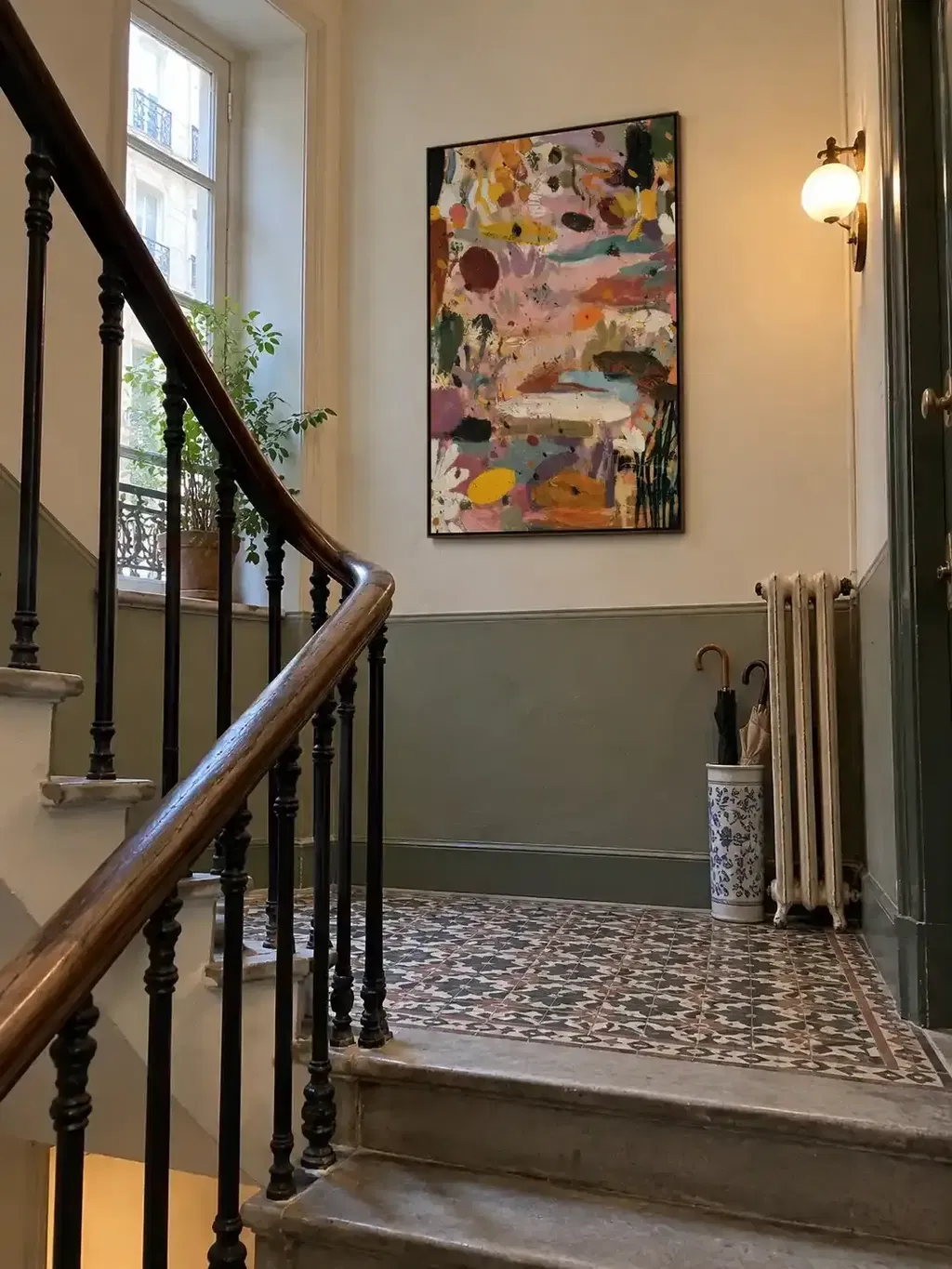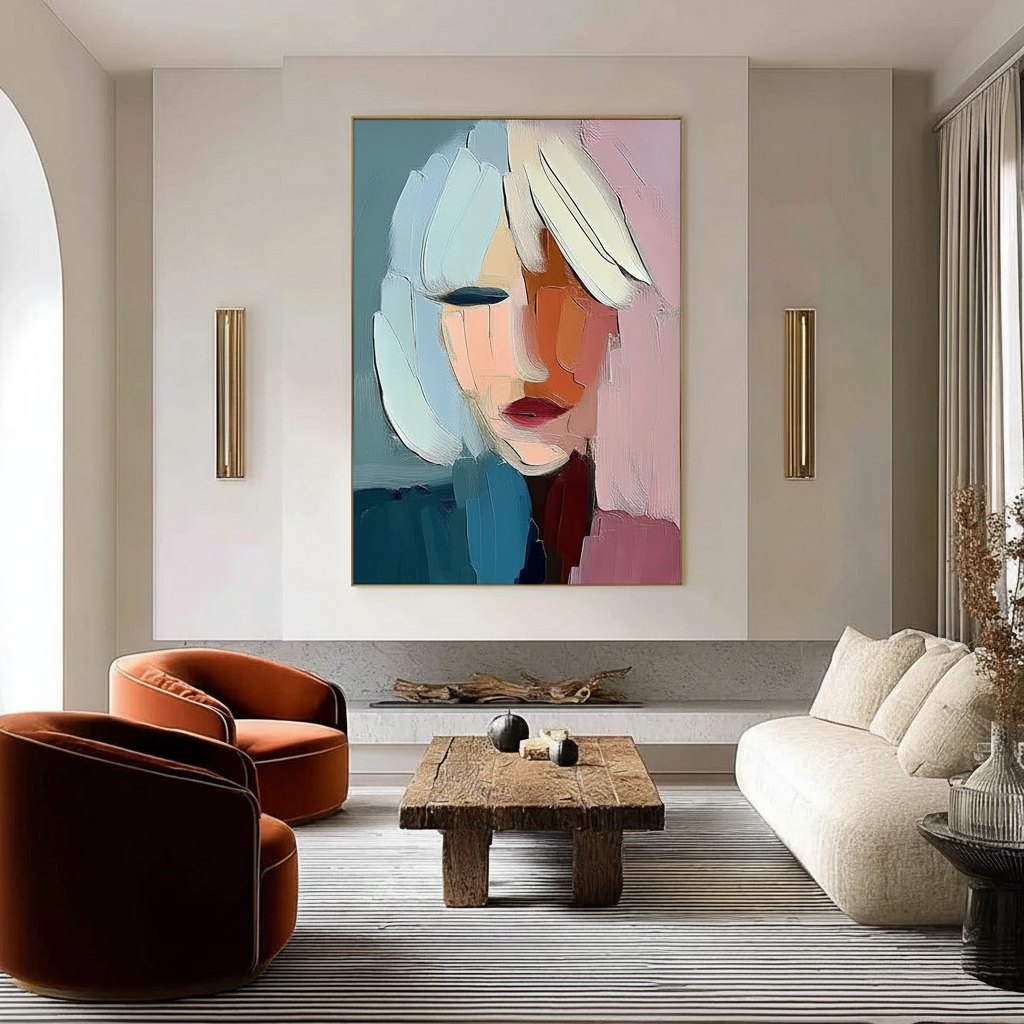
The Seated Perspective: Why Your Living Room Art Height is Likely Wrong
Walking into a professional art gallery, you will notice a consistent rhythm: paintings are typically hung so their centers sit precisely 57 to 60 inches from the floor. This "gallery standard" is designed for a specific behavior—standing and walking. However, the living room is not a transit corridor; it is a sanctuary for lounging. When you apply standing-height logic to a seated environment, you create a subtle but persistent visual friction.
Recent shifts in the global art market underscore a move toward this type of experiential value. While high-end auction sales for "vanity" pieces plummeted 44% in 2024, according to Marketplace, homeowners are increasingly investing in custom, hand-painted works that offer real emotional and functional utility. Central to this utility is how the art interacts with the viewer. If you find yourself tilting your chin up to look at a canvas while sitting on your sofa, the art isn't just "high"—it is ergonomically misaligned.
The Ergonomics of the Lounge: Why "Lower" is Better
The most common mistake in residential art placement is hanging pieces too high. This often stems from a fear of the art being "blocked" by furniture or a misunderstanding of how the human eye tracks imagery while at rest.
The Seated Eye Level Formula
To understand why the 60-inch rule fails, we must look at the mechanics of the human body. According to ergonomic research cited by Wellyhub, the average seated eye level for an adult ranges between 47 and 50 inches from the floor. This figure, however, is highly dependent on the "seat height" of your furniture.
In our observations of modern interior configurations, we see a wide variance in sofa geometry. A low-slung, Japanese-inspired sofa might have a seat height of just 12 inches, while a traditional high-back recliner can exceed 22 inches.
Logic Summary: The "Seated Perspective Model" assumes that for maximum comfort, the center of the artwork should align with the viewer's horizontal line of sight or slightly below it to accommodate a natural 10-20 degree downward gaze angle.
| Parameter | Standard Range | Unit | Rationale / Source |
|---|---|---|---|
| Average Seated Eye Level | 47 – 50 | Inches | Wellyhub Ergonomics |
| Modern Sofa Seat Height | 15 – 20 | Inches | Industry Heuristic |
| Optimal Gaze Angle | 10 – 20 | Degrees | Oregon State University EHS |
| Art-to-Sofa Clearance | 8 – 12 | Inches | Interior Design Practice |
| Vertical Viewing Zone | 15 | Inches | Metric Data 02 |
Note: This model is a scenario-based analysis for residential lounging and should be adjusted for specific physical needs or non-standard furniture.

The Psychological Moat: Human-Made vs. AI Artifice
As you lower your art to eye level, the physical details of the work become more prominent. This is where the "essential identity" of the piece becomes critical. Research from the University of Chicago suggests that consumers perceive a significant collapse in value when art is revealed to be a digital replica or NFT, as these lack the artist's "soul" or physical imprint.
Furthermore, a Columbia Business School study confirmed that consumers value art labeled "AI-generated" 62% lower than authentic human-created art. When art is placed at a lounging height (closer to the viewer), the micro-topography of the paint—the brushstrokes, the impasto texture, and the chemical depth of the pigments—becomes a primary source of satisfaction.
This tactile fruition is not just a matter of taste; it’s physics. Optical microprofilometry has proven that the mm-scale texture of oil and acrylic paintings is crucial to their aesthetic impact. When you sit close to a hand-painted mural or canvas, your brain registers these physical reliefs, which MUNCH Museum tests show exponentially stimulates intrinsic motivation and satisfaction compared to flat, printed posters.

Designing for Well-being: The Biophilic Connection
The height at which you hang art also dictates how it influences your mental state. In a living room, art often serves as a "visual window." If that window is placed too high, the brain struggles to integrate it into the immediate environment, leading to a "museum wall" effect that feels cold and disconnected.
By lowering the art, you can better leverage Biophilic Design. According to the University of Central Arkansas, nature-themed art produces stress-reduction effects in the brain similar to being outdoors. A University of Pennsylvania review noted that 73% of patients reported significant mood improvements when exposed to environmental artworks.
In a residential context, a large-scale, nature-based mural hung at seated eye level acts as a subconscious anchor. It activates the medial prefrontal cortex (mPFC) and the amygdala, which are key to emotional regulation. This neurological "hug" is most effective when the art occupies the viewer's primary field of vision without requiring neck extension.
Practical Installation: The 8-12 Inch Rule
While eye-level math is the foundation, you must also consider the relationship between the art and the furniture.
1. The Anchor Heuristic
A common designer's rule of thumb is to place the bottom of the frame or canvas 8 to 12 inches above the top of the sofa back.
- Why this works: This gap is large enough to prevent the art from looking "cramped" but small enough that the sofa and art feel like a single, cohesive unit.
- How to verify: Sit on your sofa. Have a partner hold the art at 8 inches above the back. If the center point feels significantly above your eye level, lower it to 6 inches. If you have a very low sofa, you may need to increase the gap to 14 inches to keep the center within the "Seated Perspective" zone.
2. Multi-Generational Compromise
In homes with varying heights (adults and children), we recommend a compromise. Instead of aiming for the tallest person’s eye level, set the center point slightly lower—roughly 48 inches from the floor. This serves the median viewer and prevents the room from feeling "top-heavy."
3. Scaling for the Space
The size of the art also dictates its height. A massive vertical piece might naturally sit closer to the sofa back (around 6-8 inches) to ensure the top doesn't hit the ceiling, while a horizontal triptych might benefit from a full 12-inch clearance to emphasize the horizon line. You can find more on this in our guide on scaling large canvases for open-plan rooms.
The Environmental and Health Factor: Low-VOC Pigments
When art is hung at seated eye level, you are physically closer to the materials. This makes the chemical composition of the paint a health priority rather than an afterthought. The EPA warns that indoor air pollution can be significantly more concentrated than outdoor air.
For large-scale indoor murals or oversized canvases, using Low-VOC (Volatile Organic Compound) paints is essential. Research from Aalto University shows that VOC emissions from painted surfaces plummet during the curing process, but choosing water-based acrylics over traditional oils can further reduce the risk of respiratory irritation. Furthermore, passing standards like BS EN 71-3, which guards against heavy metal migration, ensures that the art is safe for homes with children and pets.
Investment and Property Value
Beyond personal comfort, strategic art placement and the choice of hand-painted murals can impact property valuation. A Royal Society study found that neighborhoods with higher "art" geo-tags saw greater relative house price gains.
For homeowners looking to sell, a well-placed mural can act as a "creative placemaking" tool. According to Community Progress, art instantly reverses feelings of "blight" or emptiness, making a space feel curated and premium. By hanging art at the correct seated height, you allow potential buyers to "feel" the room's livability as they sit during a walkthrough, subconsciously associating the home with comfort and high-end design.

Summary of Placement Logic
To ensure your living room art is optimized for the lounging experience, follow this checklist:
- Measure your furniture: Don't assume a standard height. Measure from the floor to the top of your sofa back.
- Find your seated eye level: Sit with your typical "lounging" posture and mark the wall at eye height.
- Apply the 8-12 inch rule: Start with the bottom of the art 8-12 inches above the sofa.
- Check the center point: Ensure the center of the piece is within the 47–52 inch range from the floor.
- Prioritize texture: Choose hand-painted works that reward the closer viewing distance that seated heights provide.
By breaking away from the "museum standard" and embracing the "seated perspective," you transform your living room from a static display into an interactive environment designed for human comfort.
Disclaimer: This article is for informational purposes only and does not constitute professional interior design, medical, or architectural advice. Art installation involves physical labor and wall-mounting; always consult with a professional installer if you are unsure about the structural integrity of your walls or the weight of your artwork.
Sources
- Marketplace: The expensive art market continues to struggle
- Wellyhub: How Tall is the Average Eye Level?
- Columbia Business School: Human-Made vs. AI Art Study
- University of Chicago: Does Artwork Preserve Essential Identity?
- UPenn: Visual Art in the Built Environment
- WHO: Scoping Review on Arts and Health
- Royal Society: Quantifying the link between art and property prices
- EPA: Indoor Air Quality and Low-VOC Paints