
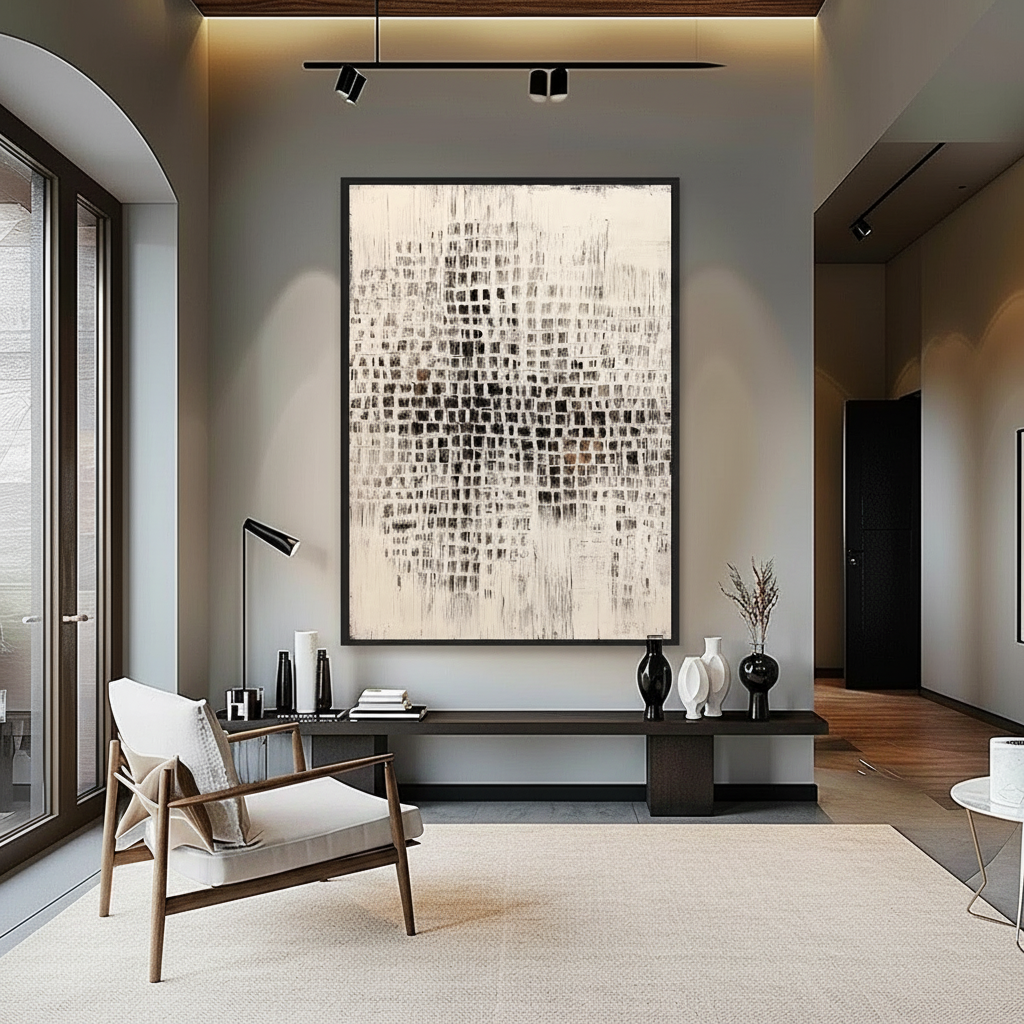
The Invisible Anchor: Redefining the Vertical Connection
In the pursuit of a camera-ready home, most improvers focus on the "hero" pieces: the plush velvet sofa, the statement area rug, or the oversized canvas. However, we often observe that the difference between a room that feels "decorated" and one that feels "curated" lies in the invisible vertical connection between the floor and the wall. When these two planes fail to communicate, the space feels fragmented, regardless of the individual item's price tag.
The high-end art market is currently undergoing a structural shift. According to Marketplace, sales of auction pieces over $10 million plummeted 44% in 2024. This retreat from vanity assets suggests a return to real application value. Homeowners are moving away from overpriced gallery names and toward custom, hand-painted murals and canvases that offer authentic emotional resonance and visual harmony.
Coordinating wall art with area rugs is not merely a stylistic choice; it is a spatial strategy. By aligning these elements, you reinforce the boundaries of a conversation area, creating a "room within a room" that feels grounded and intentional.
The Mathematics of Proportion: Scaling Art to Your Rug
The most common mistake we see in our design consultations is treating art selection as an isolated task. To create a cohesive "anchor," the width of your wall art must be calculated in direct relation to your rug's primary visual boundary.
The 2:3 Heuristic and Its Variables
A standard rule of thumb used by professional designers is the 2:3 ratio. For a standard rectangular rug in a living room, maintaining an art width that is roughly two-thirds the width of the rug creates a sense of proportional harmony. However, our analysis of spatial perception shows that this number is not static.
Logic Summary: Our scaling recommendations are based on a deterministic parameterized model that accounts for ceiling height and visual gravity. Standard heuristics often fail because they ignore the volume of the room.
| Parameter | Standard Ceiling (8ft) | High Ceiling (10ft+) | Rationale |
|---|---|---|---|
| Optimal Art-to-Rug Ratio | 0.63 (approx. 5:8) | 0.57 (approx. 4:7) | Visual scale perception changes by 8-12% with height. |
| Visual Weight | Grounded | Vertical Dominance | Taller spaces require more "breathing room" around art. |
| Placement Height | 57" - 60" on center | 62" - 65" on center | Adjusts for the higher visual horizon in large volumes. |
According to research published in International Journal of Environmental Research and Public Health, wall patterns and textures significantly influence the perception of interior space. In rooms with ceilings over 12 feet, we recommend flipping the script: wall art can actually anchor the rug through vertical dominance, often requiring a 1.2:1 ratio where the art's vertical presence commands more attention than the horizontal floor covering.

The Asymmetry Formula
For rooms where furniture is offset or the layout is unconventional, a simple ratio isn't enough. We utilize a specific formula to prevent visual dissonance: Art Width = (Rug Width × 0.6) + (Furniture Offset × 0.2)
This calculation ensures that even if your sofa is not perfectly centered on the rug, the art bridges the gap between the two, creating a balanced focal point. This is particularly useful when Scaling Large Canvases for Open-Plan Living Rooms.
The Psychology of the "Hand-Painted" Premium
Why does a hand-painted mural feel more "comfortable" than a high-definition print? The answer lies in our neurobiology. A systematic review of 85 records found that passive art viewing consistently activates the medial prefrontal cortex (mPFC) and the amygdala, which are critical for emotional regulation (PMC11480958).
Essential Identity vs. Digital Replicas
Consumers are increasingly rejecting AI-generated and mass-produced prints. A Columbia University study confirmed that consumers value art labeled "AI-generated" 62% lower than authentic human-created art.
This "nuclear weapon" against digital prints is rooted in what University of Chicago researchers call "Essential Identity." Digital replicas lack the artist's soul and the physical "imprint" of the creator. When you invest in a hand-painted piece, you are consuming the biochemical crystallization of apex human visual attention mechanisms.

The Role of Texture
Texture is the soul of 2026 design trends. Optical microprofilometry proves that the mm-scale texture of oil and acrylic paintings is crucial to their aesthetic impact. The physical relief of the paint—the way it catches light and creates micro-shadows—stimulates intrinsic motivation and satisfaction in the viewer (Frontiers in Computer Science).
When coordinating with a rug, consider "Calculated Dissonance." A 30-40% texture mismatch—for example, a heavy impasto painting paired with a low-pile silk rug—creates more visual interest than perfect matching, which can often feel sterile.
Safety and Sustainability: The Modern Standard
For the aesthetic-driven improver, "camera-ready" must also mean "health-ready." The materials used in your art are as important as the colors.
Indoor Air Quality (IAQ) and VOCs
Traditional oil paints often rely on toxic solvents like turpentine. However, the industry is shifting toward safer alternatives. Aalto University experiments proved that coatings on wood with proper moisture levels emit significantly lower VOCs during curing (PubMed 33939214).
When commissioning a mural or large canvas, ensure your artist uses low-VOC acrylics or walnut oil-based pigments. The EPA warns that indoor air pollution can be more concentrated than outdoor pollution; choosing LEED-compliant materials is a prerequisite for a truly premium home environment.
The Cadmium and Lead Transition
Historically, vibrant yellows and reds relied on Cadmium, a Group 1 carcinogen (IARC Volume 58). Modern high-end pigments have largely replaced these with safer organic alternatives. Furthermore, Titanium Dioxide (TiO2) now dominates 90% of the white pigment market, having successfully eliminated the need for highly toxic Lead White in residential settings.
Methodology Note: Our safety guidelines are derived from a cross-analysis of CDC NIOSH hazards and EPA ASTM D-4236 labeling standards. We prioritize water-based acrylics for indoor environments to minimize respiratory risks from dry pigment dust.
Strategic Integration: B2B and Commercial Value
The coordination of art and space isn't just for homeowners; it’s a powerful tool for developers and business owners.
- Real Estate Appreciation: neighborhoods with higher "art" geo-tags see greater relative house price gains (Royal Society).
- Commercial Foot Traffic: Large-scale murals act as permanent physical billboards. In Chicago, public art projects drove $1.4 billion in real estate-related growth.
- Healthcare ROI: 61% of patients at the Cleveland Clinic reported that environmental artwork reduced their stress levels. For private clinics, "nature-themed healing murals" are no longer decor—they are public health infrastructure.
2026 Trends: Texture, Whimsy, and Surrealism
As we look toward 2026, Zillow data shows a 21% rise in mentions of "artisan craftsmanship" and a 15% increase in "whimsy." The trend is moving away from the "assembly-line" look and toward pieces that tell a story.
The Panoramic Powder Room
One emerging "blue ocean" niche is the panoramic hand-painted mural for high-end powder rooms. Inspired by KBIS 2025 finalists, designers are wrapping murals entirely around the walls to create immersive escapism. When paired with a small, high-texture rug, these spaces become social media landmarks.
Biophilic Design
Biophilic murals—those featuring natural landscapes—produce the same stress-reduction effects in the brain as being outdoors. In high-density office spaces, such as those in Tokyo, nature-based design has been shown to intervene effectively in employee burnout and cognitive fatigue.

Practical Implementation Checklist
To ensure your art and rug coordination is successful, follow these steps:
- Map the Axis: For irregular rugs, identify the strongest visual axis. Align your art along this line rather than trying to match the rug's contours.
- Check the "Sightline": Position art where it can "see" the rug. Furniture like sofa backs should not obstruct the visual link between the bottom of the frame and the edge of the rug.
- Verify Lightfastness: Ensure your art uses pigments rated by ASTM D4303. This ensures your investment won't fade in sun-drenched living rooms.
- Support Ethical Labor: 87% of consumers believe artists should receive fair compensation. Choosing brands that prioritize fair trade for their painters aligns your home with modern moral demands.
By treating the relationship between your wall art and area rug as a technical coordination problem rather than a vague aesthetic one, you reduce the risk of a "floating" design. You create a space that is not only camera-ready but also neurologically restorative and structurally sound.
Disclaimer: This article is for informational purposes only and does not constitute professional architectural, medical, or legal advice. Always consult with a qualified interior designer or environmental health specialist when making significant structural or material changes to your home.
Sources
- Marketplace: The expensive art market continues to struggle
- Columbia University: Human-Made vs. AI Art Study
- Royal Society: Quantifying the link between art and property prices
- WHO: Scoping Review on Arts and Health
- EPA: Indoor Air Quality and Low-VOC Paints
- UPenn: Visual Art in the Built Environment
- ASTM International: Standard Test Methods for Lightfastness











