Beyond the Surface: Why Stretcher Bar Integrity is the Foundation of Art Investment
In the current global landscape, the way we value art is undergoing a seismic shift. While high-end auction sales for purely financial art assets plummeted 44% YoY in 2024, as reported by Marketplace, there is a distinct return to "real application value." Modern collectors are moving away from overpriced vanity pieces toward custom, hand-painted works that offer emotional resonance and physical presence.
However, for a hand-painted oil or acrylic work to retain its value—both aesthetic and financial—its structural foundation must remain flawless. We often see collectors focus exclusively on the pigment and brushwork, yet the most critical component for longevity is hidden behind the canvas: the stretcher bars. According to the Art Basel and UBS Art Market Report 2024, the global art market reached $65 billion in 2023, a massive economic baseline that relies heavily on the physical preservation of these assets.
When the wooden framework fails, the artwork begins a slow, often irreversible process of decay. Identifying when to replace stretcher bars isn't just about fixing a "sag"; it’s about preventing the structural collapse of a multi-thousand-dollar investment.
The Anatomy of Structural Failure: Subtle Signs vs. Fatal Flaws
Most homeowners assume that if a canvas isn't visibly drooping, the stretcher bars are healthy. In our experience handling professional restorations, the most critical indicator of failure is actually subtle tension loss that concentrates at the corners first.
The 45-Degree Warp Test
One of the most effective non-invasive diagnostics we use is the 45-degree warp test. Instead of looking at the painting from the front, view the canvas from a sharp corner angle. If you notice a slight "twist" or "propeller" shape where one corner pulls away from the wall while the opposite remains flush, the wood has likely undergone internal stress. This deformation is often more revealing than frontal inspection, as it indicates a loss of "planar integrity."
Identifying Tension Loss
A common mistake is attempting to tighten a sagging canvas by over-adjusting corner keys. If the underlying bars are already compromised—due to poor grain selection or lack of kiln-drying—this added pressure can actually accelerate structural failure. Experienced conservators note that joint stress concentrates at these points; if the wood fibers have begun to "creep" (permanently deform under load), no amount of keying will restore the original tension.

Environmental Catalysts: The Invisible Threat of Humidity
While age is a factor, environmental history determines a stretcher bar's lifespan more than chronological years. Wood is a hygroscopic material, meaning it constantly exchanges moisture with the surrounding air.
According to research insights from Encapsulations Down Under, stretchers in stable 40–60% relative humidity (RH) environments can last decades. However, those experiencing greater than 5% daily humidity fluctuations may reach a critical failure point within 2 to 5 years.
The Shrinkage-Cracking Cycle
The real danger isn't just high humidity, but the fluctuation. In humid environments, wood fibers expand. When moved to a drier space—such as a modern home with central heating—the wood shrinks. A shrinkage of just 0.1cm can cause significant stress to the paint layers. This is particularly dangerous for oil paintings, where the binder undergoes oxidative cross-linking over time, becoming brittle.
Modeling Note: Lifespan Sensitivity Analysis Our analysis of stretcher bar longevity assumes a standard 12oz cotton duck canvas under 40lbs of tension.
Parameter Range Unit Rationale Optimal RH 40–60 % Prevents wood rot and pigment embrittlement Critical Fluctuation >5 %/day Triggers cumulative fiber fatigue Wood Moisture Content 6–8 % Industry standard for kiln-dried stability Expansion Threshold 0.1 cm Point at which paint film cracking typically initiates Estimated Lifespan (Unstable) 2–5 Years Based on observed failure rates in non-climate controlled zones
Biological Decay: Rot, Infestation, and the "Thumb Pressure Test"
For art stored in older buildings or coastal regions, biological threats are the leading cause of "silent" structural decay.
Detecting Moisture Rot
Moisture damage often starts from the back, where the wood meets the wall. Professionals use the "thumb pressure test" on the bar surfaces: if you find soft spots or areas that feel "spongy," the wood is rotting internally even if there are no visible stains on the canvas. Rot compromises the wood's ability to hold staples or tacks, leading to a sudden and catastrophic loss of tension.
Insect Infestation
Evidence of wood-boring insects often appears as fine, light-colored powder (frass) accumulating near the joints. Do not mistake this for common house dust. If you see tiny, pin-sized holes or powder, the bars must be removed and replaced immediately to prevent the infestation from spreading to the rest of your home or other artworks.
The Psychological and Financial ROI of Proper Mounting
Investing in high-quality structural mounting isn't just a maintenance cost; it’s a value multiplier. Research published in the Royal Society using the CAR model found that areas with high "art" geo-tags—indicating a culture of quality art appreciation—saw greater relative house price ranking gains.
Furthermore, the presence of authentic, well-maintained hand-painted art has profound psychological benefits. A University of Pennsylvania review noted that 73% of patients reported significant mood improvements when exposed to high-quality environmental artwork. When art is sagging or warped, it sends a subconscious signal of "neglect," which can negate these biophilic benefits.
Human-Made vs. AI Art Perception
The stakes for maintaining hand-painted art are higher than ever. A Columbia University study confirmed that consumers value art labeled "AI-generated" 62% lower than authentic human-created art. Because the "essential identity" of the artist is retained in the physical canvas and its unique micro-topography—as explored by UChicago research—preserving the structural integrity of that physical object is paramount to maintaining its market premium.

Replacement vs. Lining: The Economic Decision
When a stretcher bar fails, collectors often face a choice: replace the bars or perform a "lining" (adhering a second canvas to the back for support).
According to professional conservation economics and Tate research, lining can cost 3 to 5 times more than a simple stretcher replacement. More importantly, lining is an invasive procedure that alters the artwork's material history. In many cases, replacing the old, warped bars with kiln-dried stretcher bars is the more economical and ethical choice, as it restores structural integrity without changing the original canvas's "breathability."
The "Odorless" Trap and Studio Safety
If you choose to work with a local framer for replacement, ensure they adhere to modern safety standards. The CDC NIOSH warns that chronic inhalation of volatile compounds in certain paints and solvents can lead to central nervous system issues. Even "odorless" solvents can be toxic. At MontCarta, we prioritize Indoor Air Quality (IAQ) by using low-VOC materials, ensuring that your restored artwork doesn't just look healthy, but is safe for your living environment.
When is a Complete Re-stretch Necessary?
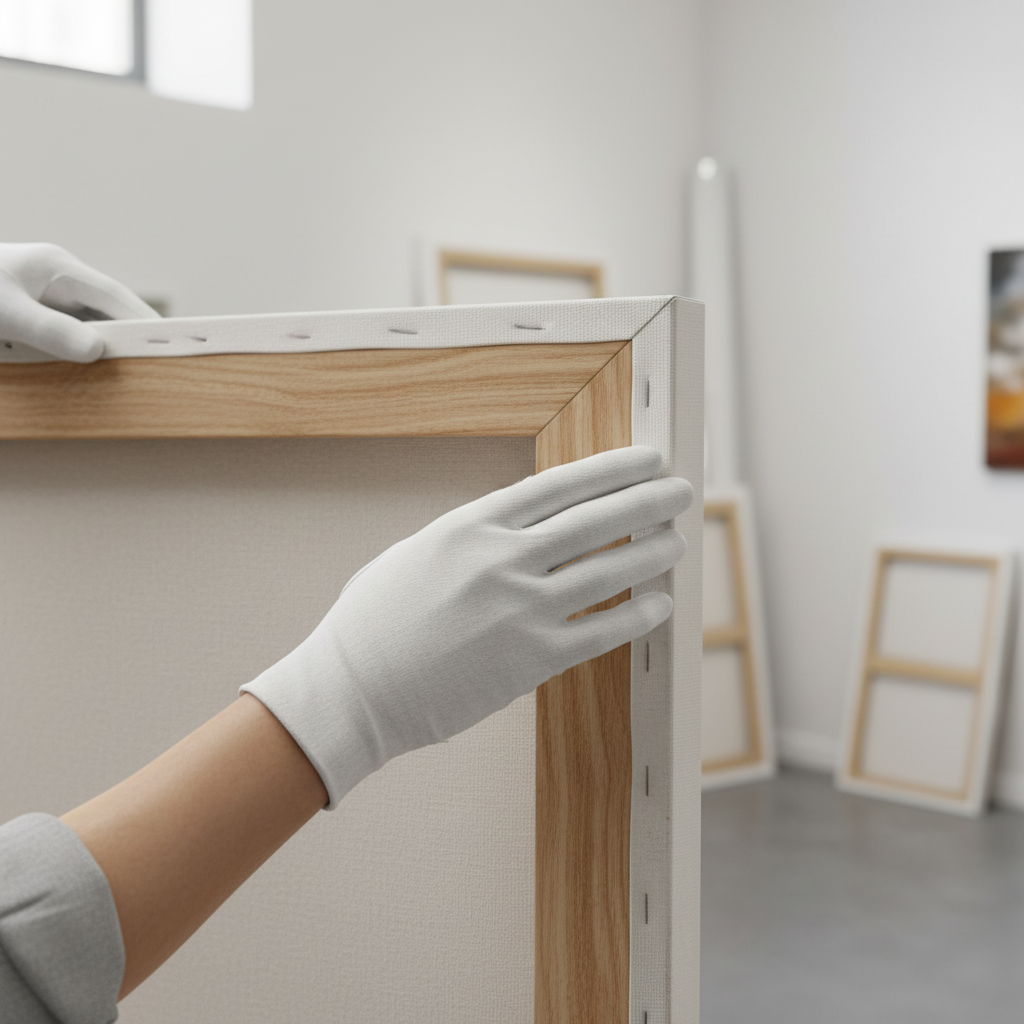
A complete re-stretch involves removing the canvas entirely and mounting it on a new, superior framework. You should consider this a priority if:
- The 45-degree warp is greater than 1/2 inch: This indicates the wood has reached its elastic limit.
- The "Thumb Pressure Test" reveals Sponginess: This is a sign of irreversible rot.
- Visible "Chalking" or Paint Cracking: This suggests that Support Induced Discoloration (SID) or structural stress is already damaging the pigment layer.
- The Bars are not Kiln-Dried: Non-kiln-dried wood will continue to warp indefinitely as it reaches equilibrium with your home's RH.
For larger works, you may also need to evaluate if the original bars lacked proper cross-bracing, which is essential for maintaining tension across wide spans.
Practical Checklist for Collectors
To ensure your investment remains a "permanent physical billboard" for your home's aesthetic, follow this maintenance protocol:
- Quarterly Inspection: Perform the 45-degree warp test every change of season.
- RH Monitoring: Use a simple hygrometer to keep your art display area between 40–60% RH.
- The Tap Test: Gently "drum" the center of the canvas with your finger. A healthy canvas should have a resonant, drum-like sound; a "thud" suggests tension loss.
- Backing Board Caution: While often recommended, backing boards can trap moisture. Ensure any backing is breathable to prevent mildew and rot.
By understanding the mechanics of the stretcher bar, you move from being a passive owner to an active steward of your collection. Authentic, hand-painted art is a "non-renewable cultural heritage asset," as noted by PMC research. Protecting the wood behind the paint is the single most effective way to ensure that heritage lasts for generations.
YMYL Disclaimer: This article is for informational purposes only and does not constitute professional art conservation, financial, or legal advice. Structural art repairs should be performed by qualified professionals. Always consult with a certified conservator before undertaking invasive procedures on high-value artworks.
Sources
- Marketplace: The expensive art market continues to struggle
- The Art Basel and UBS Art Market Report 2024
- Columbia University: Human-Made vs. AI Art Perception Study
- Royal Society: Quantifying the link between art and property prices
- Tate: Paintings on Canvas: Lining and Alternatives
- WHO: Scoping Review on Arts and Health
- Canadian Conservation Institute: Keying Out of Paintings
- EPA: Indoor Air Quality and Low-VOC Paints