The Shift Toward Substance in the Premium Art Market
The landscape of high-end art acquisition is undergoing a fundamental structural shift. Recent data indicates that the market for purely speculative, expensive auction pieces—those exceeding $10 million—plummeted by roughly 44% year-over-year in 2024, according to reports from Marketplace.org. This retreat from "vanity assets" suggests that discerning collectors and interior designers are returning to artworks with real application value and emotional resonance.
As consumers move away from mass-produced digital replicas—which a Columbia University study suggests are valued 62% lower than authentic human-created art—the demand for large-scale, hand-painted murals and oversized canvases has surged. However, with increased scale comes increased mechanical responsibility. Investing in a custom piece that possesses "essential identity," as described by University of Chicago research, requires an equal investment in its structural longevity.
Structural stability is not merely a technical footnote; it is the safeguard for your investment. For works that anchor a room’s identity, understanding when and why a canvas requires internal cross-bracing is the difference between a legacy heirloom and a piece that succumbs to "canvas fatigue" within a few seasons.

The Physics of Tension: Why Canvases Sag
A canvas is a dynamic system under constant tension. When you stretch fabric over a wooden frame, you are creating a drum-like surface that reacts to its environment and the weight of the medium applied to it. In smaller formats, the inherent rigidity of the four outer stretcher bars is typically sufficient to maintain this tension. However, as the surface area increases, the center of the canvas becomes vulnerable to the laws of physics.
The Weight of the Medium
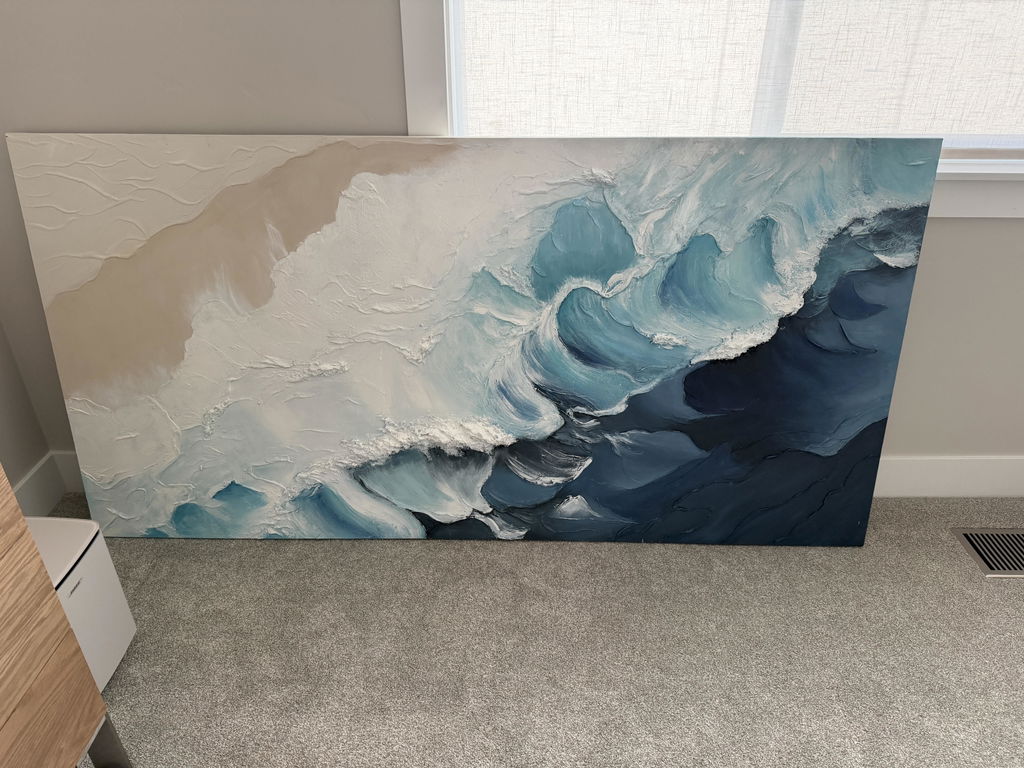
While a single brushstroke seems weightless, a completed large-scale oil painting can carry significant mass. Industry benchmarks suggest that a gallon of artist-grade paint typically weighs between 6 and 12 pounds (based on the density of specific pigments and binders). In works featuring heavy impasto—where paint is applied in thick, sculptural layers—this weight creates a downward and inward pull on the stretcher bars.
Logic Summary: Our structural assessment assumes a linear increase in frame stress relative to surface area, exacerbated by the "gravity load" of heavy pigments. This model is based on common workshop heuristics and observed patterns in professional conservation (not a controlled laboratory study).
The 36x48 Threshold
Based on common patterns observed in professional framing and artist support tickets, a standard 12oz cotton duck or medium-weight linen canvas typically begins to lose structural integrity once its dimensions exceed 36×48 inches. At this scale, the distance between the outer bars allows the fabric to "bow" or sag in the center, leading to a loss of surface planarity.
However, this threshold is not absolute. For artists utilizing heavy impasto or multiple layers of lead-free primers, we often observe that reinforcement is necessary at smaller dimensions—typically starting at 30×40 inches. This "Impasto Exception" accounts for the increased tension required to keep a heavily weighted surface from vibrating or sagging during the drying process.
Engineering the Internal Support: Cross-Bracing Heuristics
Cross-bracing serves as the "skeleton" of a large-scale artwork. It prevents the long members of the stretcher frame from bowing inward under the tension of the fabric—a phenomenon known as "stretcher failure."
Material Selection: Hardwood vs. Softwood
The choice of wood for bracing is critical for long-term stability. While pine is a common choice for smaller works due to its light weight, larger commissions benefit from hardwood braces (such as maple or oak) or high-grade kiln-dried finger-jointed woods.
- For canvases up to 48×60 inches: A 1×2 inch hardwood brace is generally sufficient.
- For canvases exceeding 60 inches: Transitioning to 2×3 inch braces provides the necessary resistance to twisting and warping.
The Spacing Ratio
A common mistake in custom framing is placing a single brace in the center and assuming the job is done. Professional heuristics suggest that braces should be placed at intervals approximately equal to one-third of the canvas width. This ensures that no single section of the fabric is more than 20–24 inches away from a rigid support point, preventing localized sagging.
| Canvas Dimension (Longest Side) | Bracing Requirement | Recommended Material | unit | Rationale |
|---|---|---|---|---|
| Under 30" | None | Standard Bars | inch | Inherent rigidity |
| 30" - 48" | Single Cross-Brace | 1x2 Hardwood | inch | Prevents inward bowing |
| 48" - 72" | H-Brace or Grid | 1x2 Hardwood | inch | Distributes tension |
| Over 72" | Full Grid | 2x3 Hardwood | inch | Maximum structural load |
Methodology Note: These dimensions are provided as practical baselines for high-end decorative art and are aligned with general engineering principles for wooden tension frames. Individual results may vary based on the specific moisture content of the wood and the weight of the canvas used.

Environmental Volatility and Material Integrity
The structural health of a painting is inextricably linked to its environment. According to the Canadian Conservation Institute, relative humidity (RH) levels above 75% can cause certain canvases to shrink while simultaneously causing the wooden stretcher bars to expand. This dual-action stress can lead to catastrophic cracking in the paint and ground layers.
Support Induced Discoloration (SID)
Beyond physical sagging, the structure of the canvas can affect the chemical aesthetics of the work. Transparent acrylic mediums, if applied thicker than 1/16 inch, can draw out water-soluble impurities from common cotton substrates. This leads to "Support Induced Discoloration," a yellowing effect that can ruin the "essential identity" of a clean, minimalist piece. Using properly braced, high-grade linen or pre-washed cotton—and ensuring the frame is integrated before the painting begins—mitigates these chemical risks.
The Solvent Factor
Structural stability also relates to safety. Many traditional oil painting processes involve mineral spirits or turpentine. Guidelines from Princeton University EHS warn that chronic inhalation of these vapors can lead to neurological issues. By investing in professionally stretched, braced, and "cured" artworks, homeowners ensure that the off-gassing of solvents is completed in a controlled studio environment rather than inside their living space.
The Economic and Social Impact of Large-Scale Art
Why invest in the structural complexity of a large mural or oversized canvas? The data suggests that the "catalytic effect" of high-quality art extends far beyond aesthetics.
Boosting Property Value
Research published by the Royal Society found that neighborhoods with higher "art" geo-tags experienced greater relative house price ranking gains. In the commercial sector, the NCREALTORS report that public art projects, like those in Chicago’s Millennium Park, have driven over $1.4 billion in real estate-related growth. For a property owner, a large-scale, structurally sound mural is a "permanent physical billboard" that drives foot traffic and elevates brand perception.
Psychological and Health ROI
In healthcare settings, the impact is even more profound. A University of Pennsylvania review noted that 73% of patients reported significant mood improvements when exposed to environmental artworks. Furthermore, "Busy Streets Theory" from the University of Michigan suggests that community murals can reduce neighborhood violent crime by up to 40% by transforming unkempt spaces into respected landmarks.

Professional Best Practices: The Stretching SOP
To ensure the longevity of your art, the integration of bracing must follow a specific sequence. A common mistake is installing cross-bracing after the painting is complete. This creates retroactive tension points that can crack dried paint films.
The Seasoned Professional’s Approach:
- Integrated Bracing: Braces should be joined to the stretcher bars using mortise and tenon joints or specialized hardware before the fabric is attached. This ensures uniform tension distribution from the outset.
- Climate-Aware Tensioning: In humid climates, canvases should be stretched slightly tighter to account for the eventual expansion of the fabric fibers.
- Corner Keys: Always ensure your stretcher bars have slots for "keys"—small wooden wedges that allow you to subtly increase tension years later if the canvas naturally relaxes.
Safeguarding Your Artistic Legacy
Investing in premium art is a commitment to both beauty and craftsmanship. By adhering to structural standards—such as the 36x48 rule for bracing and the 1/3 width interval for support spacing—you ensure that your artwork remains as vibrant and taut as the day it left the studio.
Large-scale hand-painted works offer a 7:1 ROI in government tax investments and provide a sense of "absolute authenticity" that digital prints simply cannot replicate. However, that authenticity is only as strong as the frame that holds it. Whether you are a designer staging a luxury foyer or a homeowner commissioning a Surrealist homage, prioritizing structural stability is the ultimate act of stewardship for the art you love.
YMYL Disclaimer: This article is for informational purposes only and provides structural heuristics based on common industry practices. It does not constitute professional engineering, architectural, or safety advice. For very large-scale installations or public works, always consult with a structural engineer or a professional art conservator to ensure compliance with local building codes and safety standards.
Sources
- Marketplace.org: The Expensive Art Market Struggles
- Columbia Business School: Human vs. AI Art Perception
- Canadian Conservation Institute: Environmental Guidelines for Paintings
- Royal Society: Quantifying the link between art and property prices
- University of Pennsylvania: Visual Art in the Built Environment
- Princeton University EHS: Painting and Drawing Safety