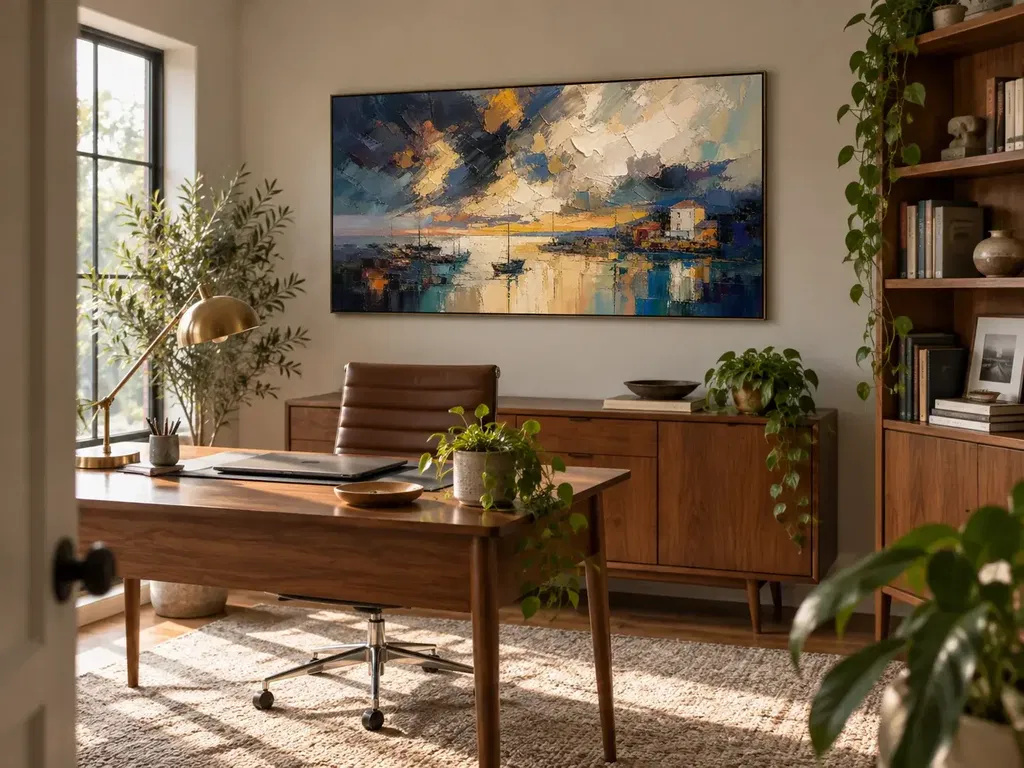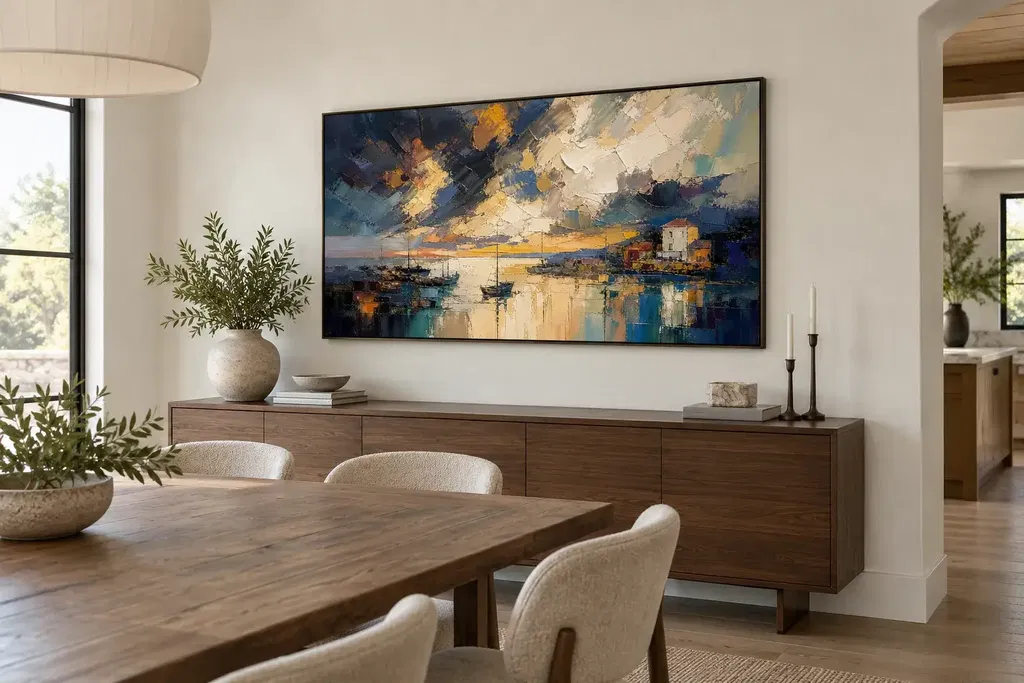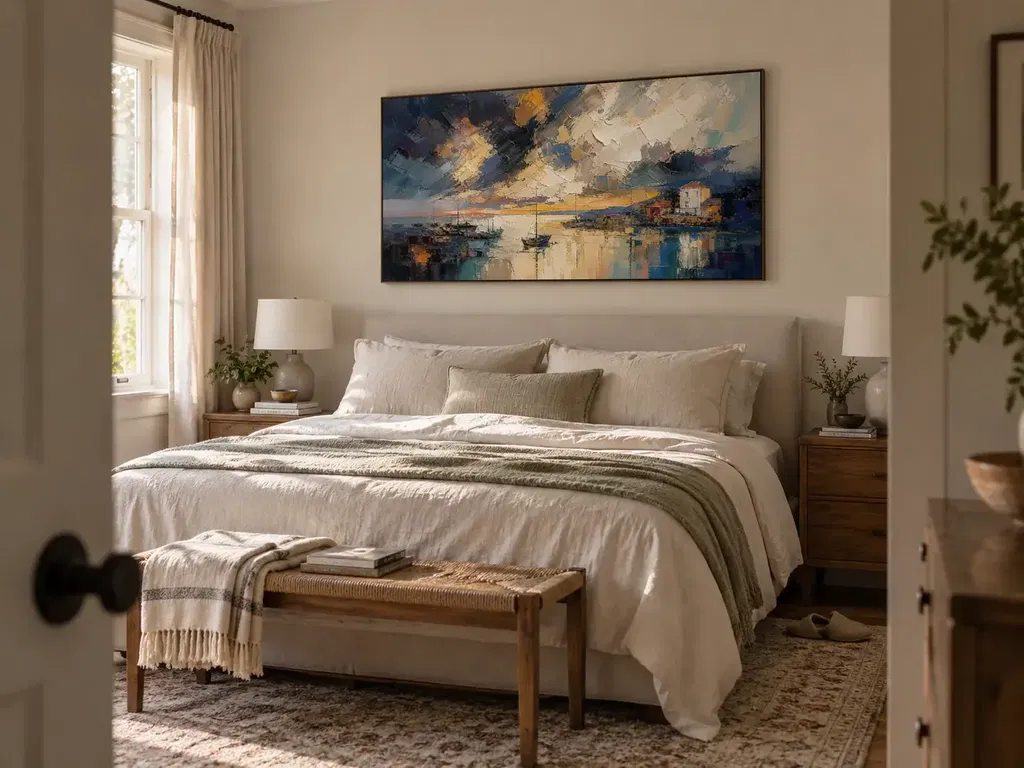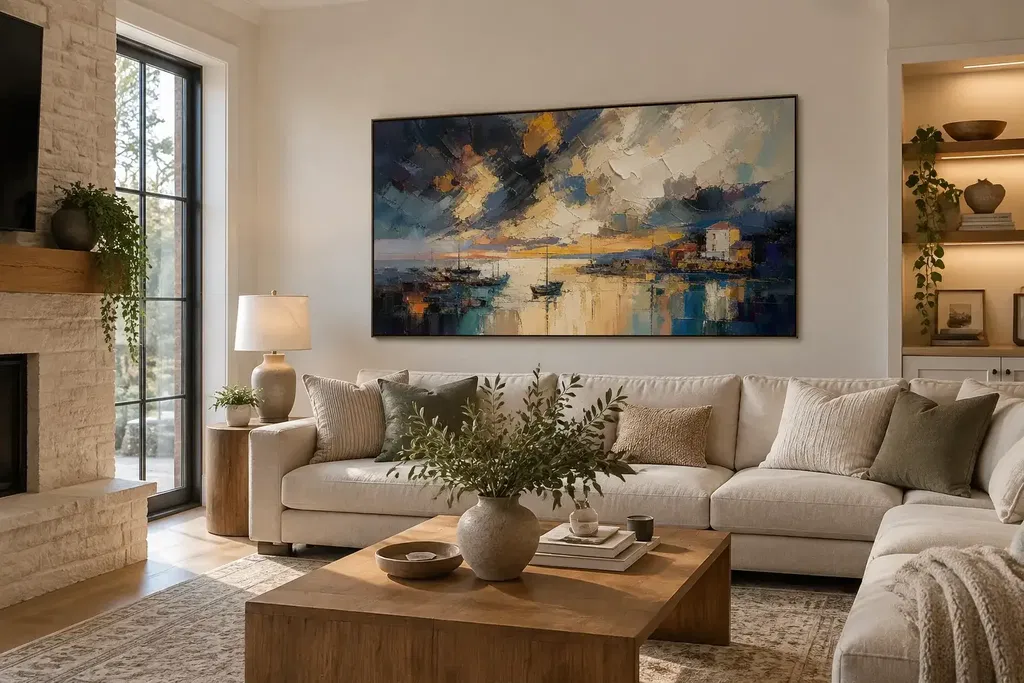
The Pivot from Auction Houses to Authentic Living Spaces
The landscape of high-end art acquisition is undergoing a structural transformation. While the traditional auction market for trophy assets—pieces exceeding $10 million—saw a precipitous 44% year-over-year decline in 2024, the broader creative economy remains a powerhouse, contributing $1.2 trillion to the U.S. GDP in 2023. This retreat from speculative "vanity" assets indicates a shift toward "real application value," where homeowners prioritize the emotional and aesthetic impact of art within their primary living zones.
In modern residential design, the living room is no longer just a gallery; it is a high-visibility media hub. The central challenge for designers and homeowners is reconciling the prestige of hand-painted oil art with the dominant presence of large-scale digital screens. This concept, which we define as "performative authenticity," seeks to use the physical, micro-topographical texture of oil paint to provide a necessary sensory counterpoint to the flat, glowing surfaces of modern OLED and LED televisions.
The value of this human touch is quantifiable. Research from Columbia Business School confirms that consumers value art labeled as "AI-generated" 62% lower than authentic human-created works. This "human premium" is rooted in what University of Chicago researchers describe as "essential identity"—the irreplicable soul and physical imprint of the artist that a digital print simply cannot capture.
The Texture-to-Tech Ratio: Managing the Visual Weight
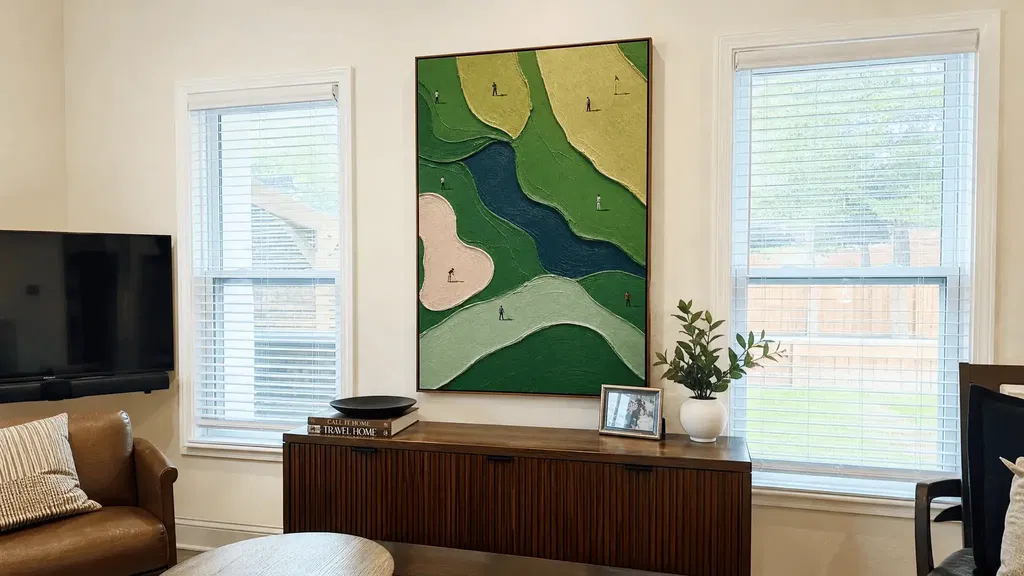
When placing an oil painting in the same visual field as a television, the "texture-to-tech" ratio becomes the primary driver of room harmony. A television is a "black hole" of visual weight when turned off and a source of intense light when on. To compete with this, an oil painting must possess significant physical presence.
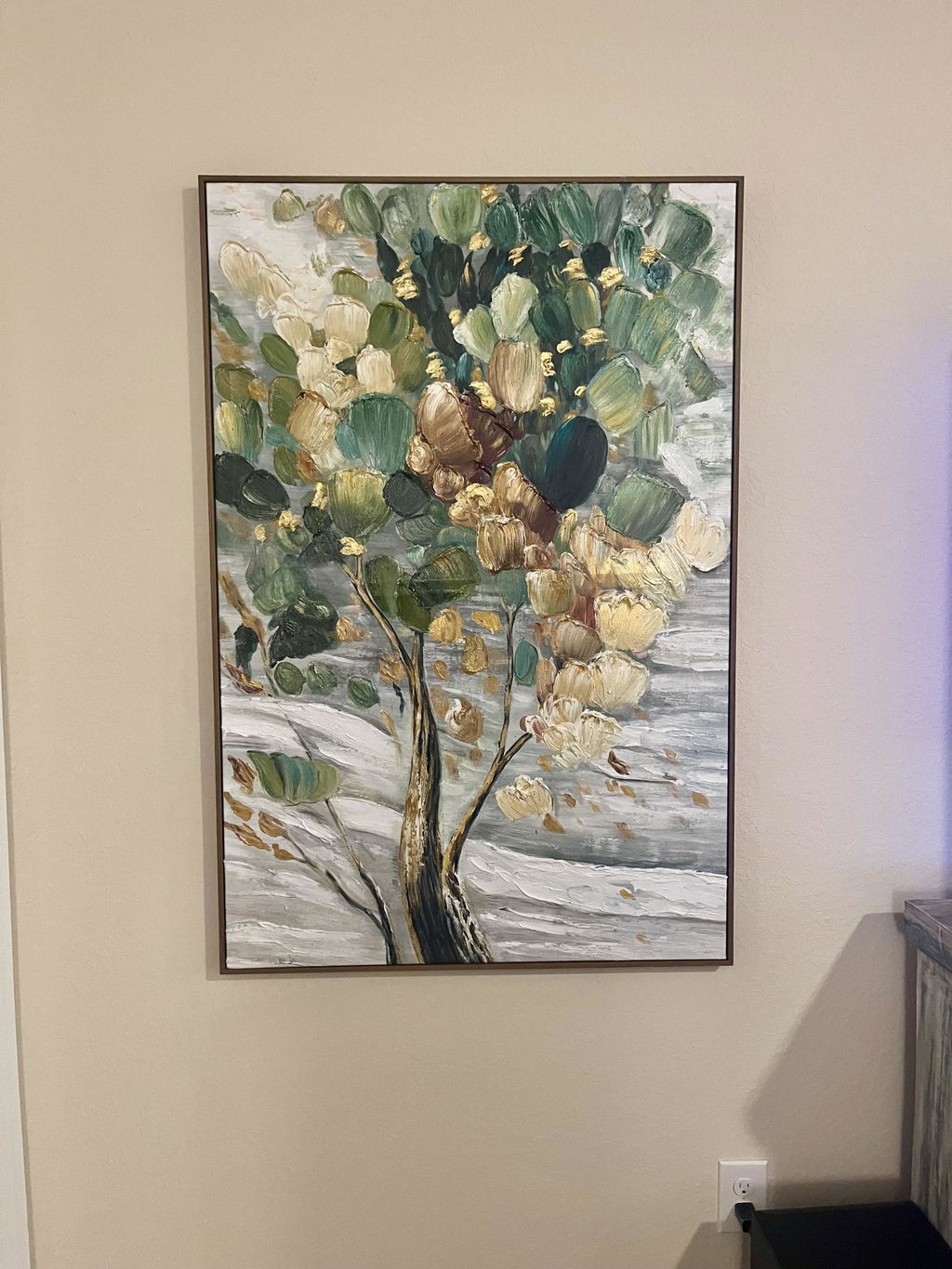
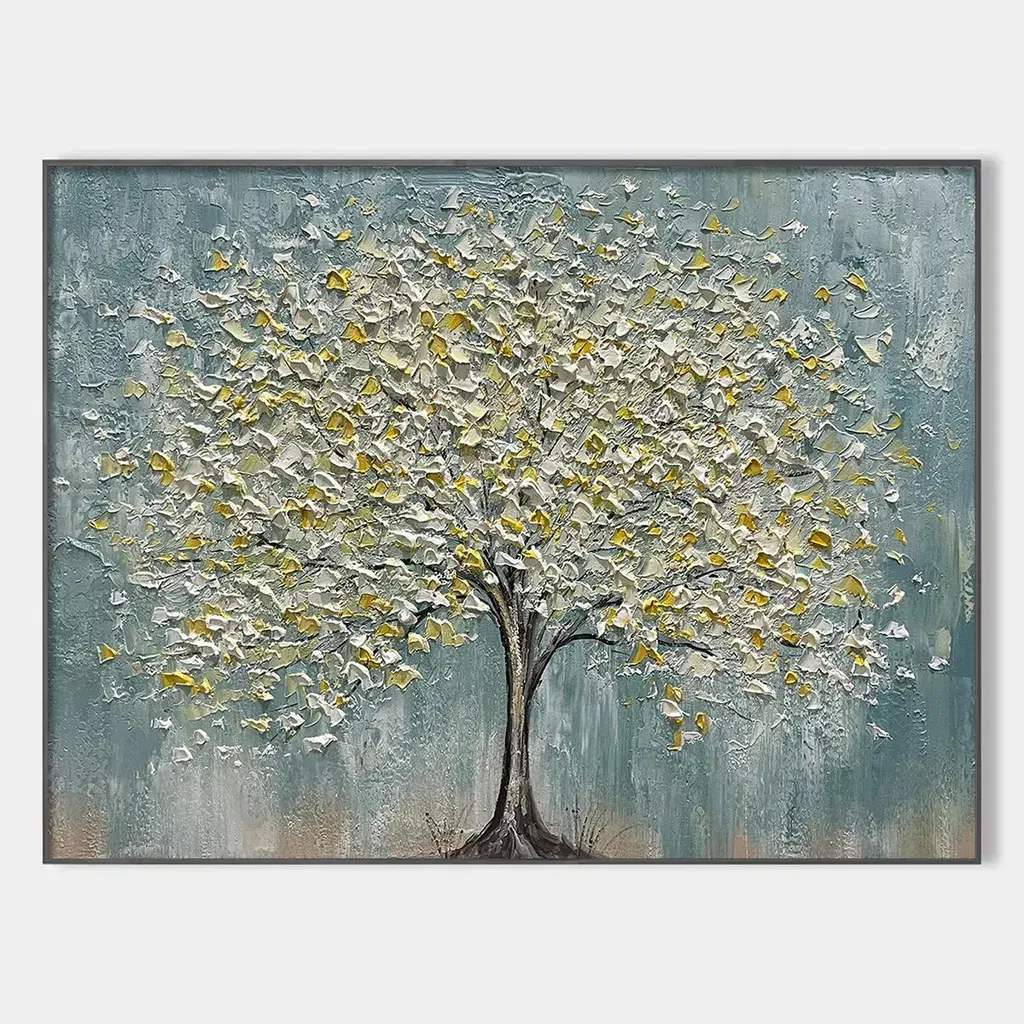
We typically recommend high-impasto (thickly textured) paintings for TV-adjacent walls. The micro-topography of oil paint—the millimeter-scale ridges and valleys created by palette knives—interacts with ambient light in a way that digital screens cannot. This tactile relief stimulates intrinsic motivation and viewer satisfaction, as evidenced by MUNCH Museum tests on physical 3D replicas.
The 75% Width Heuristic
A common mistake is selecting art that is too small for the screen it accompanies, leading to a "top-heavy" or disconnected aesthetic.
- The Rule: Art placed above a television should be roughly 75% of the TV's total width.
- Why this works: This ratio provides enough visual anchor to balance the screen without overwhelming it.
- How to verify: Measure the horizontal width of your TV frame. Multiply by 0.75. This is your target canvas width (including the frame).

Logic Summary: The 75% width heuristic is a design rule of thumb (not a mathematical law) intended to create a stable visual pyramid. It assumes the TV is the base of the composition. In asymmetrical layouts, this rule may be relaxed if the art is "grounded" by other furniture like a side console.
The Height Gap: Ergonomics vs. Aesthetics
There is a fundamental conflict between optimal TV viewing and optimal art appreciation. Ergonomic research suggests the center of a TV screen should be roughly 42–48 inches from the floor for seated viewing. Conversely, the "gallery standard" for hanging art is usually 57–60 inches on center (eye level).
| Feature | Standard Mounting Height (Center) | Rationale |
|---|---|---|
| Television | 42–48 inches | Eye-level comfort for seated viewers. |
| Oil Painting | 57–60 inches | Optimal viewing for standing appreciation. |
| The Gap | 9–18 inches | The "dead zone" that requires careful bridging. |
To bridge this 9–18 inch gap, designers often use "visual connectors" like floating shelves or dark-painted accent walls that unify the two objects into a single "media wall" composition.
Technical Preservation: Protecting Pigments from Digital Heat
While the aesthetic goal is integration, the technical requirement is separation. Modern LED and OLED televisions run significantly cooler than older plasma models, but they still generate rising warm air that can affect the longevity of oil art.
Thermal Cycling and Desiccation
Oil paintings are living, breathing objects. The binder (typically linseed or walnut oil) undergoes oxidative cross-linking over decades. Excessive heat can accelerate this process, leading to premature embrittlement or "varnish softening," where the protective layer becomes tacky and attracts dust.
- The 12-Inch Clearance Rule: Maintain at least 8–12 inches of vertical clearance between the TV's top vent and the bottom of the canvas.
- The OLED Factor: High-end OLED panels can reach surface temperatures that, while safe for electronics, create a micro-climate of dry air. We recommend a minimum of 18 inches of clearance for high-heat gaming setups.
Support Induced Discoloration (SID)
When working with modern mixed-media or acrylic-primed canvases, artists and collectors must be aware of Support Induced Discoloration (SID). This occurs when water-soluble impurities in the canvas substrate are drawn into the paint layer as it dries, causing a yellow or brown tint. This phenomenon is exacerbated in humid environments or when the art is placed near heat sources (like a TV), which can alter the evaporation rate of the paint film.
Managing Sheen: The Satin Standard
In a room dominated by a large digital screen, glare is the enemy of both the art and the entertainment. A high-gloss varnish on an oil painting will create "competing glares," reflecting the TV's light and making the painting's details impossible to see from certain angles.
According to industry standards for TV-adjacent art, a satin finish is the optimal choice. Satin provides enough sheen to saturate the colors—following the Kubelka-Munk equation regarding pigment reflection—without the mirror-like reflections of gloss.
Methodology Note: Our recommendation for satin finishes is based on scenario modeling of residential lighting (300–500 lux ambient) compared to museum-grade conservation lighting (50–150 lux). In higher-light environments, gloss finishes consistently fail the "viewing angle test."
The Psychological ROI: Beyond Decoration
Investing in hand-painted murals or large-scale oils is not merely an aesthetic choice; it is a strategic investment in well-being and property value.
Health and Cognitive Fatigue
The presence of "biophilic" art—landscapes or nature-inspired abstracts—has a documented effect on the human nervous system. A University of Pennsylvania review found that 73% of patients reported significant mood improvements when exposed to environmental artworks. In a home office or living room, these paintings can intervene in "cognitive fatigue" caused by excessive screen time, as observed in high-density Tokyo office studies.
Property Valuation and Community Impact
Art is a proven driver of real estate value. The Royal Society found a direct correlation between "art" geo-tags and relative house price gains. On a commercial scale, public murals have been shown to reduce neighborhood violent crime by 40% and drive $1.4 billion in real estate-related growth in areas like Chicago’s Millennium Park.

Compliance, Ethics, and the Modern Collector
As the art market moves toward e-commerce, transparency regarding materials and labor has become a prerequisite for the socially conscious buyer.
Indoor Air Quality (IAQ) and Safety
The "smell of oil paint" is often associated with authenticity, but it can also signal the presence of Volatile Organic Compounds (VOCs). Traditional solvents like turpentine emit toxic vapors that can lead to central nervous system neuropathy.
- The LEED Standard: For large-scale installations in healthcare or high-end residential projects, low-VOC paints and sealants are required to achieve green building certifications.
- Non-Toxic Alternatives: Many modern artists are pivoting to walnut oil-based pigments and solvent-free cleaning methods to ensure the art is safe for "maternal and infant" environments.
The Fair Trade Narrative
Ethical compensation is a growing concern. A Wharton School survey found that 87% of consumers strongly agree that artists should receive fair compensation. Furthermore, while galleries with more female artists perform better commercially, a significant gender pay gap persists in the industry. Collectors are increasingly seeking brands that explicitly support local artists with equitable pay structures.
Synthesis: Creating the "Camera-Ready" Room
Balancing traditional oils with modern technology requires a shift from viewing art as a standalone object to viewing it as part of a "spatial solution." By adhering to the 75% width rule, maintaining proper thermal clearance, and selecting satin-finished impasto pieces, you create a room that feels both high-tech and deeply human.
The "performative authenticity" of a hand-painted canvas provides a soul-stirring contrast to the digital world. In an era where we ingest the equivalent of a credit card's worth of microplastics weekly and spend hours in front of flat screens, the tactile, physical reality of an oil painting is more than decor—it is a vital anchor for the modern home.
Disclaimer: This article is for informational purposes only and does not constitute professional architectural, medical, or conservation advice. Always consult with a certified art conservator for high-value asset placement and a structural engineer for large-scale mounting.
References
- The Art Basel and UBS Art Market Report 2024
- WHO Scoping Review on Arts and Health
- Canadian Conservation Institute: Environmental Display Guidelines
- EPA: Indoor Air Quality and Low-VOC Paints
- Royal Society: Quantifying the link between art and property prices
- Columbia Business School: Human-Made vs. AI Art Study