The Science of Oxidation: Why Oil Paintings Take Months to Cure
In an era of instant gratification and digital reproduction, the enduring appeal of a hand-painted oil canvas stands as a testament to the "slow art" movement. While high-end auction markets for purely financial art assets saw a significant 44% retreat in 2024 according to Marketplace, there is a resurgence in "real application value." Discerning home improvers are moving away from overpriced vanity pieces toward custom works that offer authentic emotional and tactile depth.
However, for those investing in premium decorative art, one of the most misunderstood aspects is the timeline between the final brushstroke and the moment a painting is "finished." To the uninitiated, a painting that is dry to the touch is ready for the wall. To the chemist and the master artist, that painting has only just begun its journey of transformation.
Understanding the science of oxidation vs. evaporation is not merely an academic exercise; it is the key to preserving the structural integrity and color depth of your investment.
The Molecular Metamorphosis: Oxidation vs. Evaporation
Most modern coatings, including house paints and acrylics, dry through evaporation. The water or solvent leaves the film, and the polymer chains physically "coalesce" into a solid state. As noted by JustPaint.org, this is a physical change with minimal chemical cross-linking.
Oil paint, conversely, is a living medium. It does not "dry" in the traditional sense; it cures. This process is known as oxidative polymerization. When the linseed or poppy oil binder is exposed to air, it begins to absorb oxygen. This triggers a chemical reaction where the liquid oil molecules link together to form a complex, three-dimensional solid network.

Logic Summary: Our analysis of curing timelines assumes standard gallery conditions (approx. 70°F and 50% humidity). We categorize "curing" as a chemical transformation (oxidation) rather than a physical one (evaporation), based on established material science heuristics.
This oxidation process is why oil paintings gain weight as they "dry"—they are literally pulling mass from the air. It is also why they take so long. While an acrylic painting might be stable in hours, an oil painting’s subsurface layers continue to evolve for months, and even years.
The Curing Timeline: From Touch-Dry to Fully Stable
Through our decade of experience working with professional oil painters, we have observed that the most common mistake collectors make is confusing "touch-dry" with "fully cured." A painting may feel dry in 2–3 weeks, but the internal layers are still in a semi-liquid state.
| Phase | Timeline | Physical Characteristic | Recommended Action |
|---|---|---|---|
| Touch-Dry | 2–4 Weeks | Surface feels solid; no pigment transfer. | Safe for light inspection only. |
| Handle-Dry | 2–3 Months | Film is firm; can withstand gentle pressure. | Safe for careful shipping/transport. |
| Initial Cure | 6–12 Months | Oxidation has slowed; film is stable. | Golden window for varnishing. |
| Deep Cure | 2–10 Years | Maximum cross-linking achieved. | Ultimate structural stability. |
Note: Timelines are estimated ranges based on common studio practices and ASTM D1640 standards for film formation.
The "Knuckle Test" and Other Professional Heuristics
Experienced framers often use the "knuckle test" to gauge readiness. By gently tapping the back of the canvas, a hollow, drum-like sound indicates the oil film has reached a level of tension and curing that allows for framing. A dull "thud" suggests the paint is still releasing solvents and remains too flexible for a sealed frame.
Why Thickness Matters: The Impasto Challenge
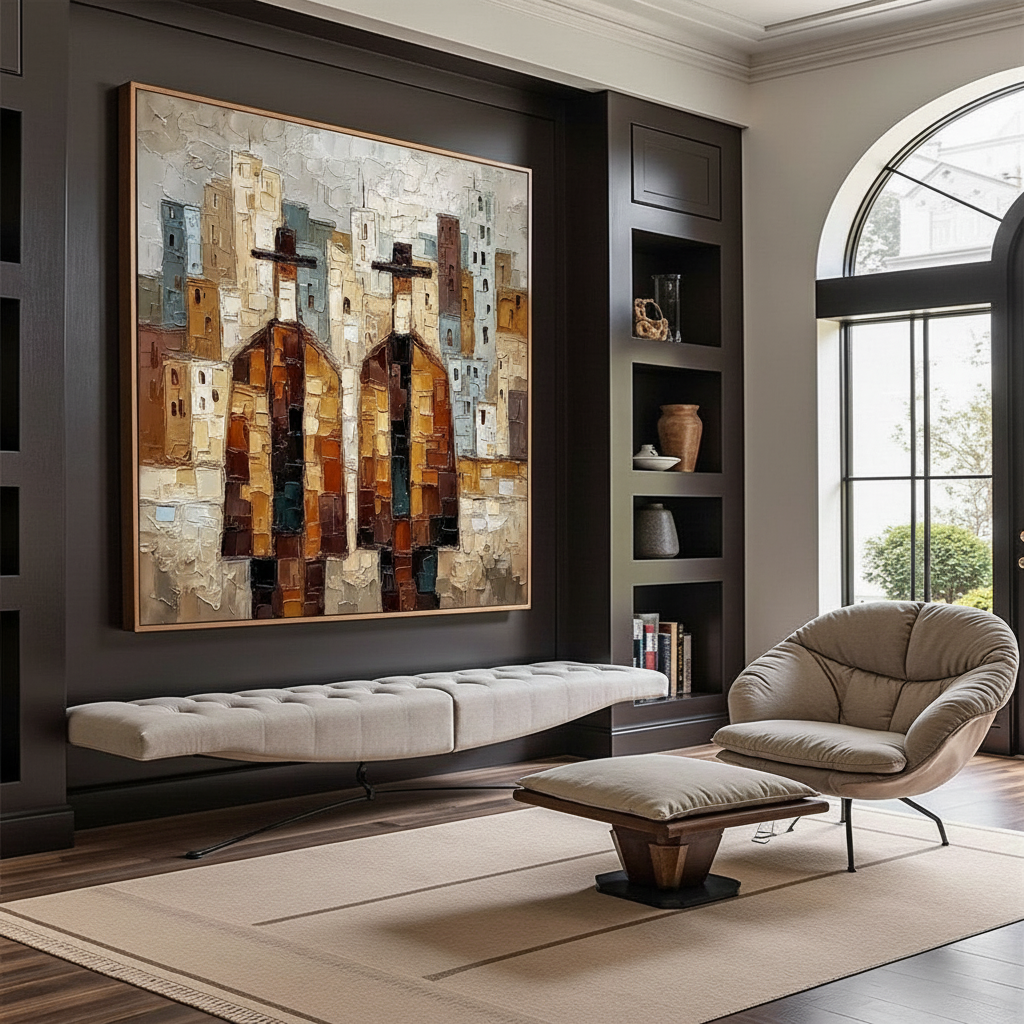
If you have commissioned a piece with heavy texture—known as impasto—the curing timeline lengthens exponentially. Thick ridges of paint create a "skin" on the surface that can actually slow the oxidation of the layers beneath by limiting oxygen access.

In our support history, we often see "blooming"—a whitish haze—on paintings that were shipped too early. This occurs when moisture or temperature changes interact with uncured oils trapped beneath the surface. For thick impasto works, we recommend a minimum of 3 months before any long-distance transit to ensure the internal "scaffolding" of the paint film is secure.
Methodology Note: These observations are based on common patterns from customer support and return handling, not a controlled lab study. Results may vary based on specific pigment-to-oil ratios.
The Varnish Gatekeeper: Why Patience Pays Off
Varnishing is the final step in protecting an oil painting from dust, UV light, and atmospheric pollutants. However, applying it too early is a catastrophic mistake. Because varnish creates a non-porous seal, applying it to a painting that hasn't cured for at least 6 months traps the remaining solvents and gases.
This leads to several "gotchas":
- Clouding: Trapped moisture creates an irreversible milky film.
- Uneven Sheen: The varnish may sink into uncured areas, creating "dry" spots.
- Stripping Risks: If the painting needs cleaning in 50 years, the conservator must remove the varnish. If the paint wasn't fully cured when the varnish was applied, the two layers may have chemically bonded, meaning the paint will come off with the varnish.
For high-net-worth buyers, this is a matter of asset preservation. As The Getty Conservation Institute notes, the surface refractive index—which dictates color saturation—is entirely dependent on the stability of the binder.
The "Real Art" Premium: Why Human-Made Beats AI
The extended timeline of oil painting is part of its value proposition. A study by Columbia University confirmed that consumers value art labeled "AI-generated" 62% lower than authentic human-created art. This "human premium" is rooted in what researchers at the University of Chicago call "essential identity"—the idea that a canvas retains the soul and labor of the artist.
When you buy a hand-painted mural or oil canvas, you aren't just buying an image; you are buying the chemical crystallization of hundreds of hours of human attention. This authenticity has tangible economic benefits. In real estate, the Royal Society found that neighborhoods with higher "art" geo-tags saw significantly greater relative house price ranking gains.
Scenario Analysis: Choosing Your Medium
To help you decide which curing timeline fits your project, we’ve modeled two common scenarios:
Scenario A: The Residential Focal Point (Standard Case)
- Goal: A large oil painting for a living room.
- Approach: Standard paint thickness.
- Timeline: 4 weeks to touch-dry, shipped in 6 weeks, varnished after 6 months in-home.
- Benefit: Provides the classic "oil glow" and depth with a manageable wait time.
Scenario B: The Luxury Hotel Lobby (The Power User)
- Goal: A massive, high-texture impasto mural.
- Approach: Multi-layered application with drying oils (linseed/walnut).
- Timeline: 8 weeks to touch-dry, shipped in 12 weeks, varnished after 12 months.
- Benefit: Creating a "permanent physical billboard" that generates foot traffic and "walking tour" interest, as seen in successful hospitality design trends.
Health, Safety, and the Indoor Environment
A common concern for home improvers is the safety of oil paints in a residential setting. While historical pigments like lead white are now strictly regulated (see REACH Annex XVII), modern professional oils are safer than ever.
In fact, research from Aalto University proves that VOC emissions from high-quality coatings plummet during the curing process. For those sensitive to air quality, choosing art that uses walnut oil instead of industrial solvents is a high-performance alternative. Furthermore, biophilic art—nature-themed murals—has been shown by UPenn to reduce stress in 61% of viewers, making it a "public health infrastructure" for the home.

Summary of Best Practices for Collectors
To ensure your hand-painted oil art remains a legacy piece, follow these expert-led heuristics:
- Respect the 6-Month Rule: Never apply a final varnish before the 6-month mark. If you need a temporary sheen, a "retouch varnish" can be used, but only after the painting is handle-dry.
- Monitor Humidity: High humidity can swell pigments (acrylics swell by ~7% in mass under 83% humidity, according to ResearchGate). Keep your art in a stable, climate-controlled environment.
- Verify the Label: Ensure your art materials comply with ASTM D-4236, which requires toxicological review of formulations.
- Embrace the Texture: Remember that the micro-physical texture of oil is what separates it from flat, digital prints. This texture is the result of the slow, deliberate oxidation you are waiting for.
By understanding the science of the canvas, you transition from a consumer to a custodian of fine art. The months required for curing are not a delay—they are the process of a liquid vision becoming a solid reality.
YMYL Disclaimer: This article is for informational purposes only. Handling art chemicals, solvents, and pigments carries inherent risks. Chronic inhalation of certain paint vapors or contact with heavy-metal pigments can lead to health complications. Always work in well-ventilated spaces and consult the CDC NIOSH guidelines for studio safety. If you have pre-existing respiratory or neurological conditions, consult a medical professional before engaging in oil painting or restoration.
References
- Marketplace: The expensive art market continues to struggle
- Columbia Business School: Human-Made vs. AI Art Perception Study
- JustPaint: Aspects of Longevity of Oil and Acrylic Paints
- Royal Society: Quantifying the link between art and property prices
- UPenn: Visual Art in the Built Environment: A Critical Review
- EPA: ASTM D-4236 Chronic Health Hazards Labeling
- Aalto University: VOC Emissions from Painted Wood
- Getty Conservation Institute: Color Science and Pigment Mixture