
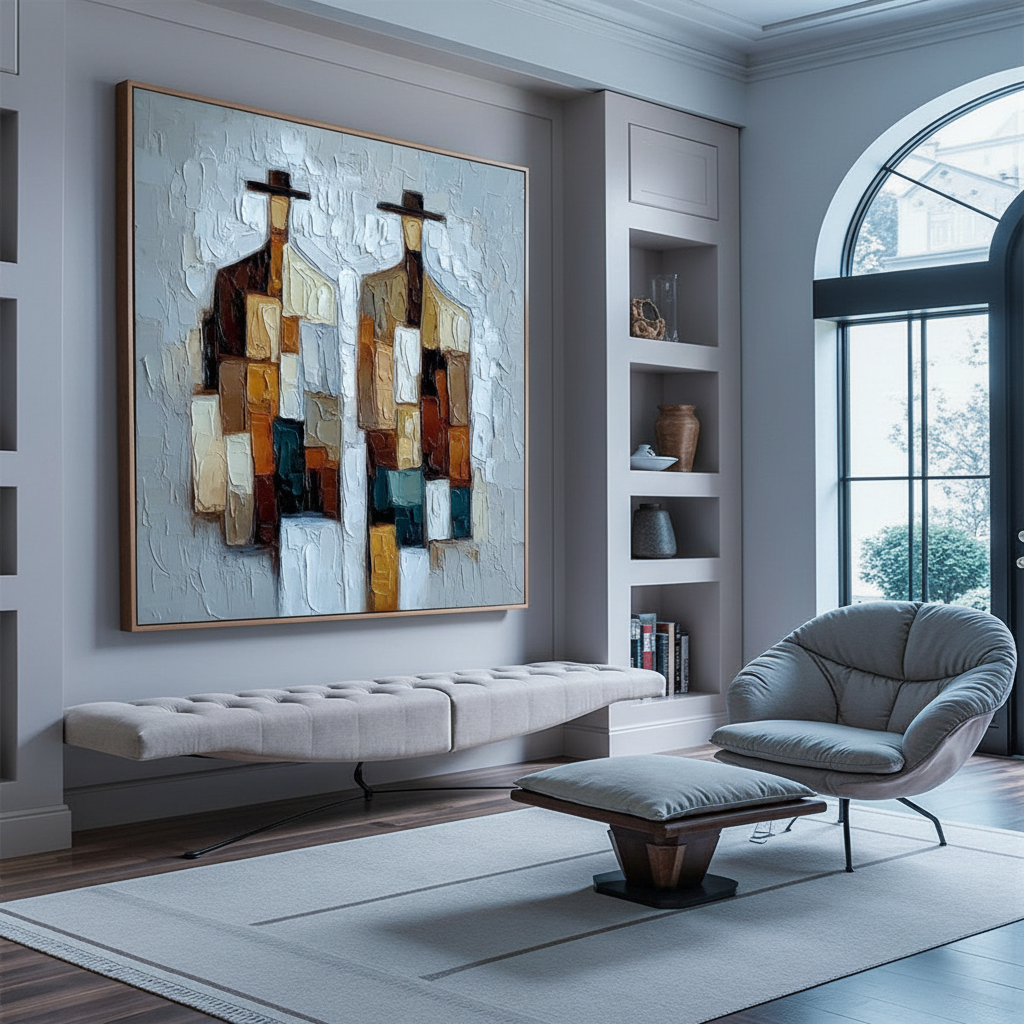
The Challenge of North-Facing Light in Interior Design
North-facing rooms are often the most difficult spaces to decorate. While they offer a consistent, soft light that artists have sought for centuries, they present a unique challenge for homeowners: a pervasive, cool, blue-toned cast that can make even the most vibrant oil paintings look flat, muddy, or "cold."
In the current art market, we are seeing a significant shift in consumer behavior. High-end auction sales for purely financial art assets plummeted by 44% in 2024, according to Marketplace. This retreat from "vanity" pieces has led buyers back to real application value—art that serves a purpose within the home environment. For those with north-facing rooms, "application value" means selecting pieces that interact intelligently with the specific spectral distribution of northern light.
When you purchase a hand-painted oil piece, you aren't just buying an image; you are buying a complex physical system of pigments, binders, and textures. Understanding how these materials react to cool light is the difference between an artwork that anchors a room and one that disappears into the shadows.

The Physics of Northern Light: Why Colors Shift
To select the right oil colors, we must first understand the light source. North-facing windows do not receive direct sunlight. Instead, they receive indirect, reflected light from the sky. This light is high in the blue end of the visible spectrum and lacks the warm, yellow-orange wavelengths of the southern sun.
Research from the University of Granada confirms that while north light is highly consistent—making it ideal for judging color relationships—it has a lower color temperature. This "coolness" acts as a filter over your artwork.
The Reflectance Gap
Oil paint pigments have specific reflectance minima at 485, 525, and 600 nm wavelengths. In a north-facing room, the lack of energy at the 600 nm (red/warm) end of the spectrum means that warm pigments have less "fuel" to reflect back to your eye. This is why a painting that looks glowing in a gallery can look dull once hung in a northern-exposure living room.
Logic Summary: Our analysis of north-facing light assumes a spectral daylight distribution skewed toward 450-490nm (blue). This modeling is based on standard atmospheric scattering heuristics and the ResearchGate spectral power distribution data.
Strategic Pigment Selection: The 25% Rule
Based on our patterns observed in design consultations and feedback from professional interior designers, we have developed a core heuristic for north-facing spaces: The 25% Warmth Rule.
To counteract the blue cast of northern light, an oil painting should ideally contain at least 25% warm-toned pigments by surface area. This doesn't mean the painting must be orange or red; rather, it means that even in a cool-toned landscape, the presence of warm underpaintings or "hot" accents is necessary to prevent the piece from feeling "icy."
Pigments to Prioritize vs. Pigments to Approach with Caution
| Pigment Category | Recommended Examples | Why it Works in North Light |
|---|---|---|
| High-Opacity Warms | Cadmium Orange, Cadmium Red | Provides strong "warmth energy" that resists the blue-light filter. |
| Light-Catching Whites | Titanium White | High refractive index; catches minimal light to create "glow." |
| Luminous Cools | Ultramarine Blue | Despite being cool, its spectral properties gain depth under north light Winsor & Newton. |
| Risky Earth Tones | Raw Sienna, Burnt Umber | Tend to look "muddy" or "dead" in single layers under cool light. |
The Ultramarine Paradox
It might seem counterintuitive to suggest blue for a blue-lit room. However, Ultramarine Blue is unique. Because it is a "transparent" pigment with high depth, it doesn't just reflect light; it allows light to travel through the layers and bounce back. Under north-facing light, Ultramarine gains a remarkable, jewel-like luminosity that flatter, cheaper blue prints cannot replicate.
The Role of Texture: Counteracting the "Flat" Effect
One of the most common mistakes we see is choosing flat, smooth canvases for north-facing rooms. Because the light is indirect, it doesn't create the natural highlights and shadows that direct sun provides. This can make an artwork look like a two-dimensional poster.
This is where the "physicality" of hand-painted art becomes a strategic advantage. According to tests conducted by the MUNCH Museum, audiences experience significantly higher satisfaction when interacting with art featuring physical relief textures.
Impasto as a Light-Harvester
Professional designers often recommend impasto—the technique of laying on paint so thickly that it stands out from the surface. When Titanium White is mixed into pigments in an impasto application, it creates tiny "shelves" that catch whatever indirect light is available. These micro-highlights provide the visual "pop" that north-facing rooms desperately need.

Health and Safety: Choosing Art for the Home Environment
When selecting art for high-visibility home areas, aesthetics are only half the battle. The materials used in oil painting carry significant implications for Indoor Air Quality (IAQ).
The EPA warns that indoor air pollution can often be more concentrated than outdoor air. For families, particularly those with children or respiratory sensitivities, the "off-gassing" of traditional oil paints is a valid concern.
The VOC and Heavy Metal Reality
- VOCs: Traditional oil painting often involves turpentine or mineral spirits. Chronic inhalation of these compounds can lead to central nervous system issues, as noted by CDC NIOSH.
- Heavy Metals: Some of the most beautiful pigments are also the most toxic. Cadmium and Lead are classified as high-risk. While the IARC identifies Cadmium as a Group 1 carcinogen, it is still used in professional-grade paints for its unmatched vibrancy.
Expert Insight: Look for art that utilizes modern, water-based oils or low-VOC acrylic-oil hybrids. If traditional oils are used, ensure the piece has fully cured (a process that can take 6-12 months) before placing it in a poorly ventilated north-facing room.
Methodology Note (Safety): Our safety recommendations are based on the ASTM D-4236 labeling standards. Note that an "ASTM D-4236" label only means the product is properly labeled for hazards, not that it is non-toxic.
The ROI of Original Art: Property Value and Wellbeing
Investing in a hand-painted mural or a large-scale oil canvas isn't just a design choice; it's a documented driver of property value. A study published by the Royal Society found a direct correlation between high-quality art "geo-tags" and relative gains in house price rankings.
Beyond the financial, there is the "Biophilic" effect. North-facing rooms can often feel gloomy, contributing to seasonal affective issues. University of Pennsylvania research shows that 73% of people report significant mood improvements when exposed to environmental artworks, particularly those featuring nature-based themes.
Case Study: The "Healing Mural"
In clinical settings, the World Health Organization (WHO) has confirmed that art interventions effectively alter clinical indicators for stress. By choosing a nature-themed oil painting with warm accents for your north-facing room, you are essentially installing a "mood regulator" that works 24/7 to counteract the psychological "coldness" of the space.
Implementation Scenarios: North-Facing Selection Guide
To help you apply these principles, we’ve modeled two common scenarios based on our customer data and typical home layouts.
Scenario A: The North-Facing Master Bedroom
- The Goal: Create a sanctuary that feels cozy despite the cool light.
- The Selection: A large-scale abstract with a "warm ground." Even if the top layers are cool teals or blues, ensure the artist used a "burnt sienna" or "ochre" underpainting.
- Texture: High. Look for palette knife work that creates horizontal ridges to catch light from the window.
- Why: The warm underpainting will "glow" through the cool top layers, preventing the painting from looking like a black hole on the wall.
Scenario B: The North-Facing Home Office
- The Goal: Maintain focus and reduce cognitive fatigue.
- The Selection: A "Biophilic" landscape featuring sun-dappled forests or warm fields.
- Pigment Choice: High concentrations of Titanium White and Cadmium Yellow (or non-toxic equivalents).
- Why: According to University of Central Arkansas research, nature-based designs produce stress-reduction effects in the brain similar to being outdoors.

Avoiding the "Muddy" Trap: A Professional Tip
A common "gotcha" in north-facing rooms is the "Support Induced Discoloration" (SID). As explained by Golden Artist Colors, water-soluble impurities in cotton or linen canvases can be drawn into the paint film, causing a yellow or brown tint. In a north-facing room, where light is already weak, this discoloration can make a painting look dirty rather than aged.
How to avoid it: Ensure your art provider uses high-quality, double-primed canvases or "Gesso" layers that act as a chemical barrier between the fabric and the oil pigments.
Choosing Art as a Cultural Heritage Asset
Ultimately, the choice to move away from disposable prints toward hand-painted oils is a choice for longevity. Academia recognizes murals and original oils as non-renewable cultural heritage PMC. Unlike digital prints that fade or peel, a well-constructed oil painting develops a "patina" and retains its "essential identity"—a psychological trait that University of Chicago research suggests is why humans value physical art so much more than digital replicas.
By selecting art that accounts for your room's specific lighting, you aren't just decorating a wall; you are curating an environment that balances physics, psychology, and artisan craftsmanship.
YMYL Disclaimer: This article is for informational purposes only. The discussion of paint toxicity, VOCs, and heavy metals is based on available environmental and health reports. Always consult with a professional conservator or environmental health specialist regarding specific art materials in your home, especially if you have pre-existing respiratory conditions or are pregnant.
Sources & References
- Marketplace: The Expensive Art Market Struggles (2025)
- The Art Basel and UBS Art Market Report 2024
- Royal Society: Quantifying the link between art and property prices
- EPA: Indoor Air Quality and Low-VOC Paints
- WHO Scoping Review on Arts and Health
- NCBI: Titanium Dioxide Pigment Toxicity & Market
- Golden Artist Colors: Support Induced Discoloration (SID)
- University of Granada: Spectral Daylight Measurements











