The Shift Toward Functional Prestige in Commercial Foyers
The high-end art market is undergoing a fundamental correction. According to Marketplace.org, sales of auction pieces exceeding $10 million plummeted by 44% year-over-year in 2024. This retreat from purely financial art assets signals a broader trend: buyers and developers are returning to "real application value." In the world of luxury commercial real estate, this means moving away from vanity acquisitions and toward custom, hand-painted assets that solve specific spatial challenges.
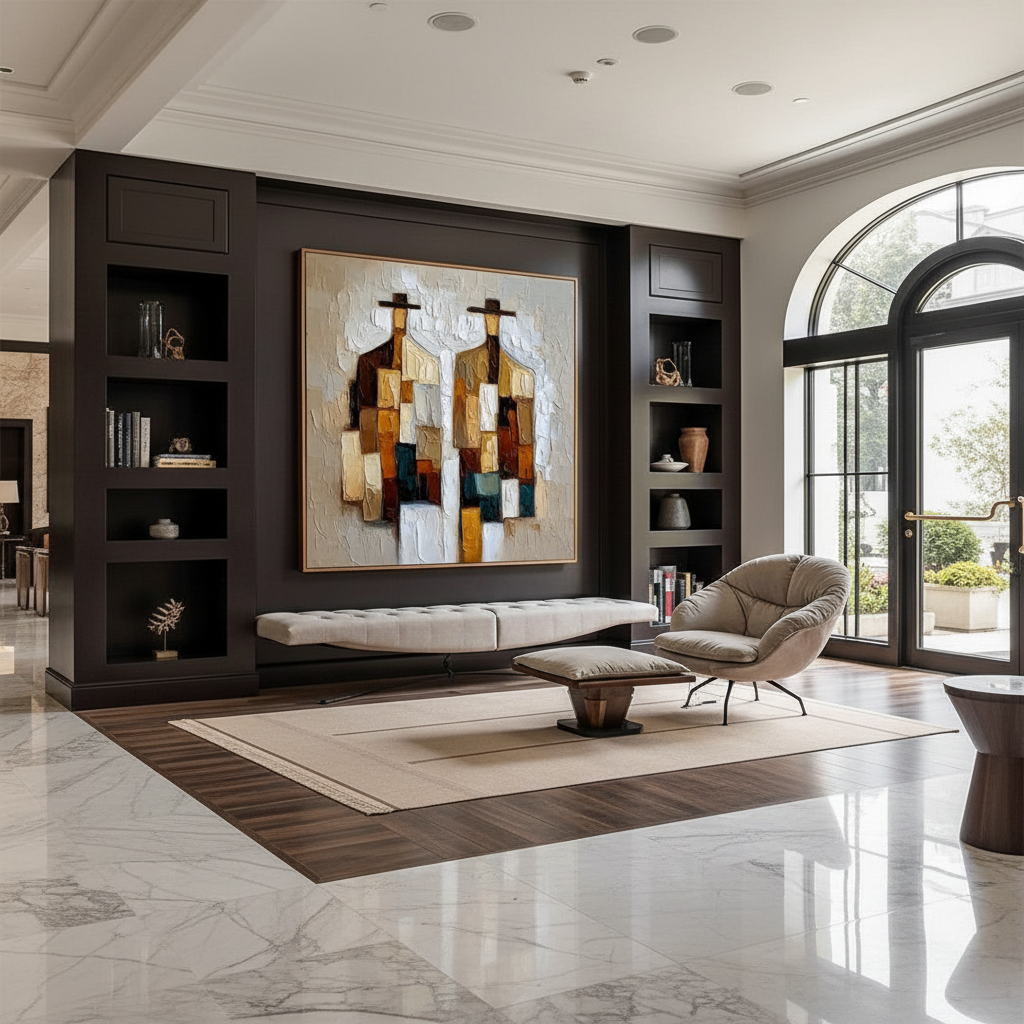
For interior designers and commercial developers, the lobby is the "handshake" of a building. It must convey prestige while managing the harsh technical realities of high-traffic environments—specifically, the acoustic "slap-back" echo common in marble-heavy foyers and the need for durable, low-maintenance surfaces. Large-scale oil canvases are emerging as a strategic solution, offering a unique intersection of high-frequency sound diffusion and the "essential identity" that only human-made art provides.
The Economic Case for Hand-Painted Assets
Despite the volatility of the auction market, the creative economy remains a powerhouse. The Creative Economy Outlook 2024 reports that global creative services exports reached a record $1.4 trillion, with cultural industries accounting for 3.1% of global GDP. For developers, this isn't just a macroeconomic statistic; it's a direct indicator of property value.
A decade-long analysis using the Royal Society’s CAR model found that neighborhoods with higher "art" geo-tags experienced significant gains in relative house price rankings (Royal Society Open Science). In commercial contexts, this translates to "decision safety." Investing in original murals and large-scale canvases is a proven method for boosting property revenue streams. For instance, public art projects in Chicago’s Millennium Park drove an estimated $1.4 billion in real estate-related growth, as noted by NC REALTORS®.

The "Human Premium": Why Digital Prints Fail the Lobby Test
In an era of generative AI, the commercial value of "human-made" has skyrocketed. A Columbia University study confirmed that consumers value art labeled "AI-generated" 62% lower than authentic human-created work. This isn't just about ethics; it's about the "essential identity" that a space retains. Research from the University of Chicago suggests that digital replicas lack the artist’s soul, causing their perceived value to collapse in the eyes of sophisticated tenants and visitors.
For a luxury foyer, a digital print is a liability. It suggests a "factory-line" approach that contradicts the exclusivity expected in high-end developments. Furthermore, the physical relief of oil paint—the microscopic texture of the brushstrokes—cannot be replicated by 3D printing. MUNCH Museum tests confirm that interacting with art featuring physical relief textures exponentially stimulates visitor satisfaction.
Acoustic Artistry: Beyond Simple Absorption
One of the most frequent mistakes in commercial design is treating art purely as a visual layer. In large lobbies, sound management is often an afterthought, leading to environments that feel cold and chaotic. While oil paintings are not a total replacement for dedicated acoustic foam, they serve as highly effective diffusers.
The Physics of Diffusion and the "Impasto Effect"
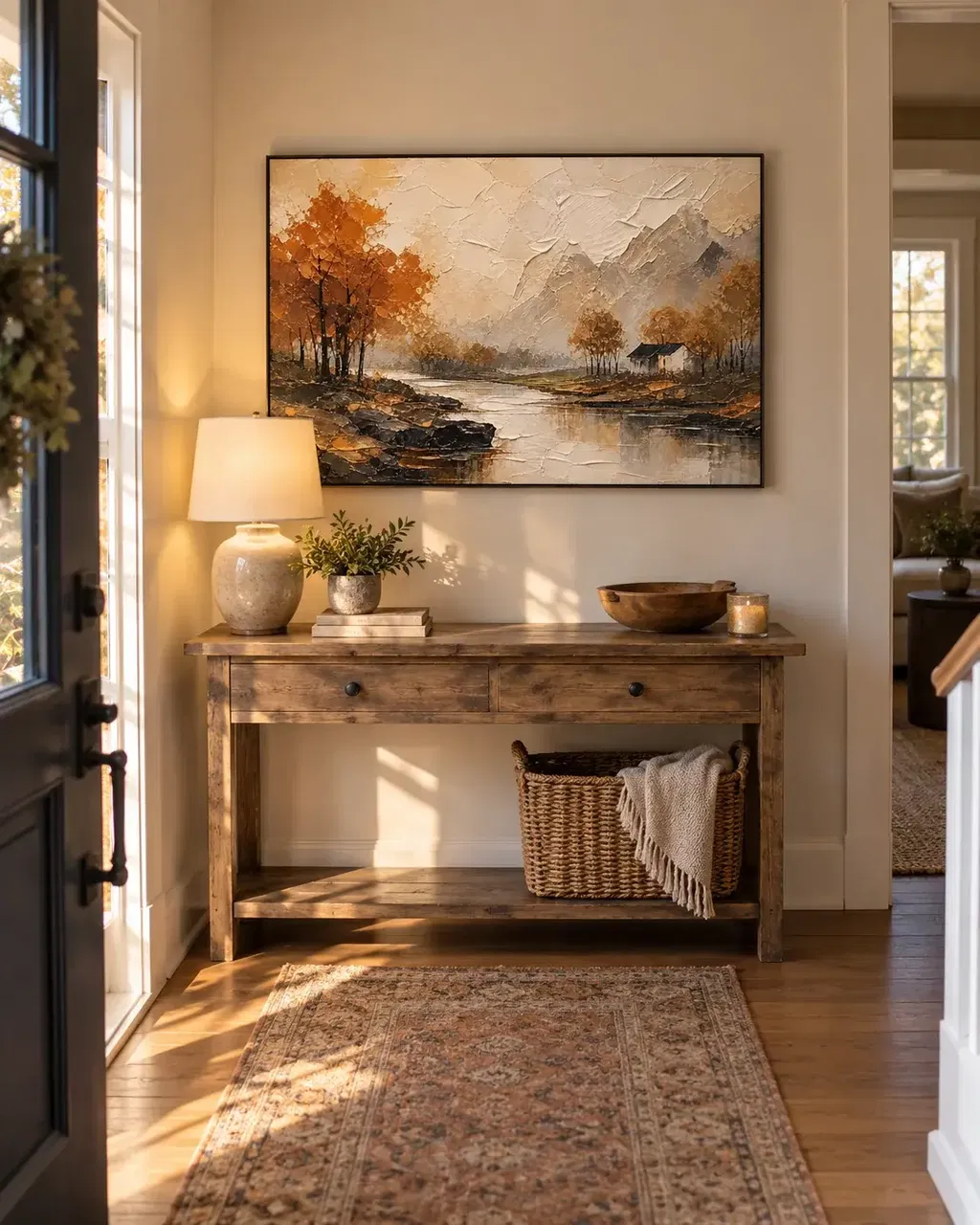
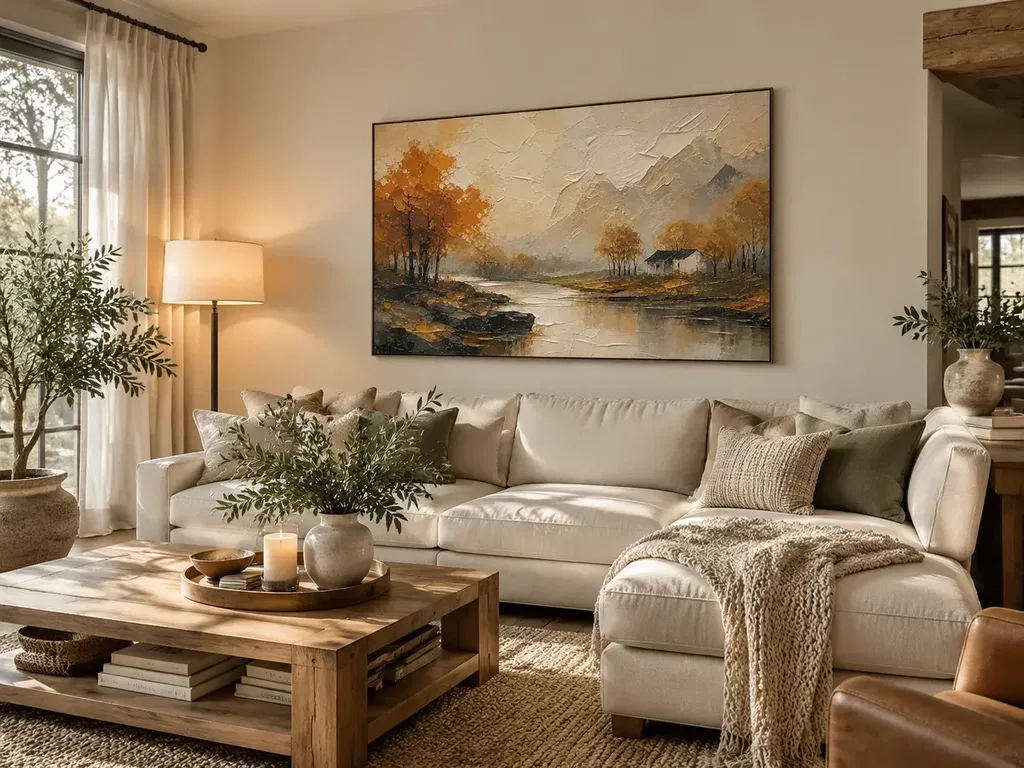
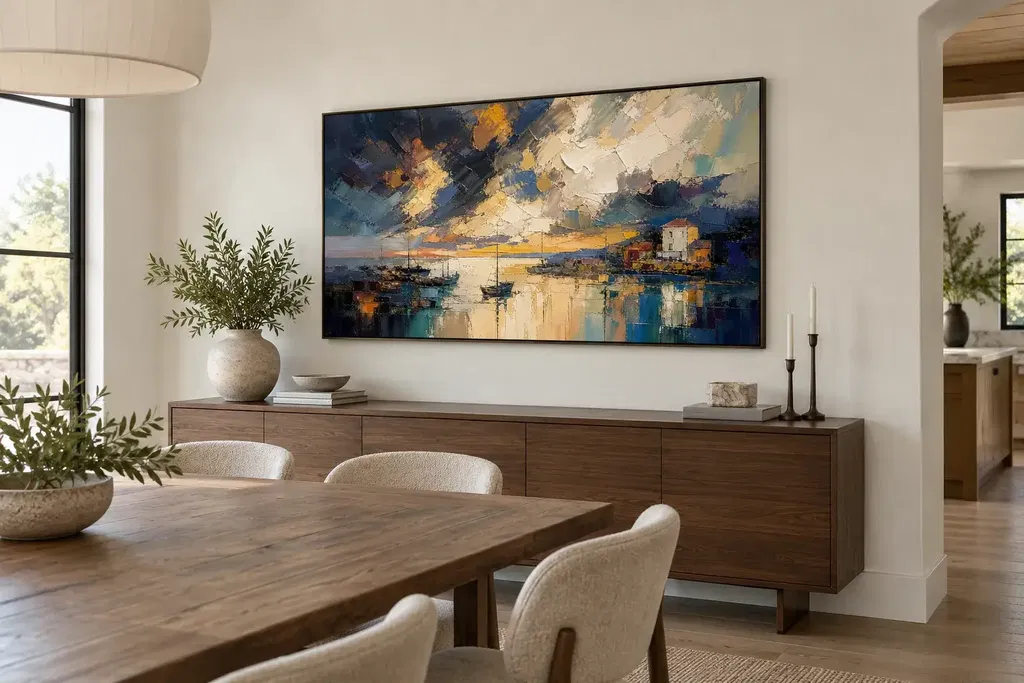
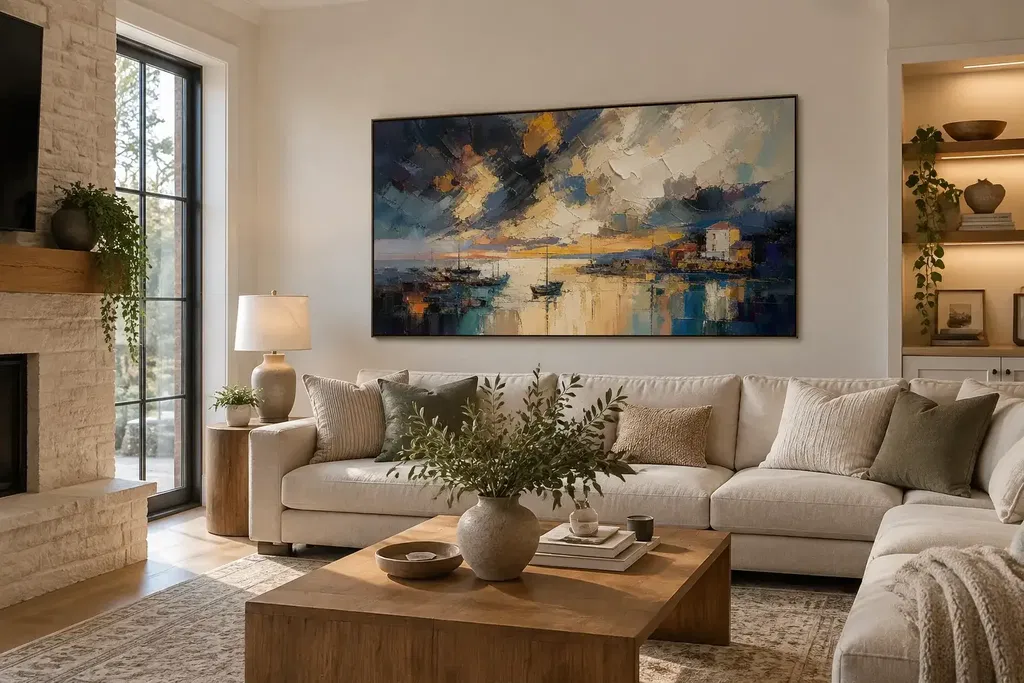
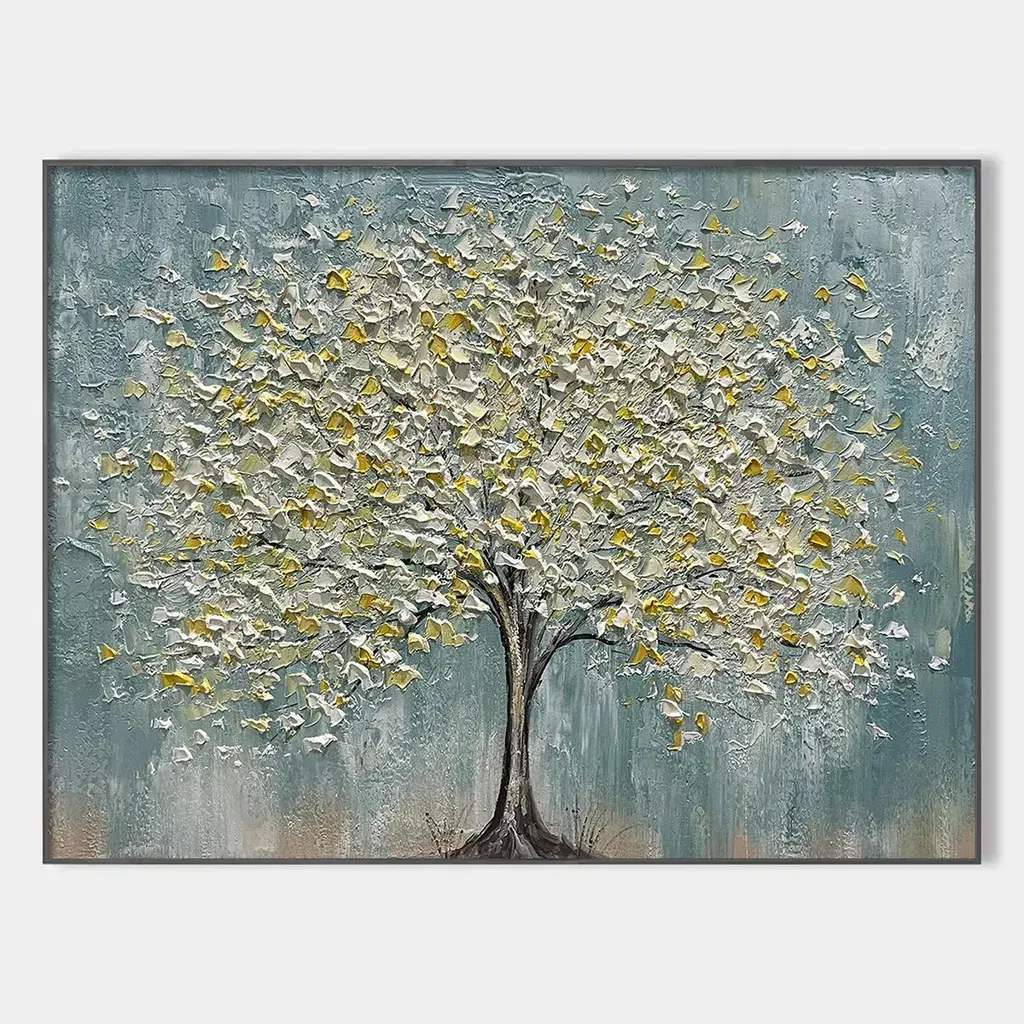
Traditional acoustic panels are designed to absorb sound, but in a lobby, total absorption can make a room feel "dead." Diffusion is often more desirable, as it scatters sound waves to prevent echoes while maintaining the room's natural energy. The varying thickness of impasto oil layers (where paint is applied thickly with a palette knife) creates a non-uniform surface. This micro-topography scatters high-frequency sound waves (above 2000Hz), significantly reducing the "slap-back" echo caused by parallel hard surfaces like marble or glass.
The Air-Gap Heuristic and Low-Frequency Dampening
Practitioners in hospitality design often utilize the "Air-Gap Heuristic." By mounting a large canvas with a 1.5 to 2-inch gallery wrap, a resonant cavity is created behind the fabric. This allows the canvas to act as a diaphragmatic absorber, helping to dampen low-to-mid frequencies (the range of human speech).
Logic Summary: Our acoustic analysis for commercial foyers assumes that a canvas must cover a specific percentage of the wall to impact the room's RT60 (reverberation time). This is a heuristic model based on common spatial layouts, not a controlled laboratory study.
| Acoustic Parameter | Estimated Range | Unit | Rationale |
|---|---|---|---|
| Wall Surface Coverage | 15–20 | % | Minimum for measurable RT60 change |
| Impasto Texture Depth | 2–8 | mm | Required for high-frequency diffusion |
| Air Gap (Stretcher Depth) | 1.5–2 | inches | Resonance cavity for mid-range dampening |
| Canvas Weight | 12–15 | oz | Mass required for diaphragmatic effect |
| Noise Reduction (NRC) | 0.25–0.45 | alpha | Estimated performance of decorative art |
As noted in research regarding acoustic performance standards, there is a performance gap between decorative art and mineral wool panels (which reach 0.75-1.05 NRC). However, for designers balancing aesthetics with function, the 0.25-0.45 NRC of a large canvas is a significant "free" benefit of the decor choice.

Psychological Infrastructure: Art and Well-being
Beyond acoustics, large-scale art acts as "public health infrastructure." A critical review by the University of Pennsylvania found that 73% of patients in medical settings reported significant mood improvements when exposed to environmental artworks. In a corporate or residential lobby, this translates to reduced stress and increased "social cohesion."
The World Health Organization (WHO) has reviewed over 3,000 studies confirming that art interventions effectively alter clinical indicators for stress and mental fatigue. This is driven by neurological mechanisms; passive art viewing consistently activates the medial prefrontal cortex (mPFC) and the amygdala, which are core to emotional regulation (Neurological Mechanisms of Creative Arts). For commercial developers, this means that a well-placed nature-themed or biophilic mural isn't just decor—it's a tool for reducing "cognitive fatigue" in employees and tenants.
Technical Specifications for High-Traffic Lobbies
When specifying oil art for commercial foyers, technical requirements differ significantly from residential projects.
1. Durability and Frame Integrity
Lobbies are subject to constant humidity fluctuations from open doors. We often observe that light wooden sub-frames warp under these conditions. Experts recommend specifying heavy-duty kiln-dried wooden frames or aluminum-reinforced stretchers to maintain tension over time.
2. Indoor Air Quality (IAQ) and Safety
In the pursuit of LEED or WELL certification, developers must be wary of VOC (Volatile Organic Compound) emissions. While traditional oil painting used toxic turpentine, modern professional studios have shifted toward walnut oil or low-VOC solvents. Aalto University experiments prove that coatings on wood with specific moisture levels emit significantly lower VOCs during the curing process.
Furthermore, the EPA warns that indoor air pollution can be a major health risk. Specifying pigments that are free of heavy metals like lead or cadmium is essential. According to the International Agency for Research on Cancer (IARC), cadmium compounds are Group 1 carcinogens, and their presence in high-traffic public spaces should be strictly avoided.
3. Lightfastness and Longevity
Lobbies with floor-to-ceiling windows expose art to intense UV radiation. To prevent the "fading blue" phenomenon seen in historical works like Smalt, modern artists use the ASTM D4303 standard to test for lightfastness. For commercial projects, only pigments with a "Category I" lightfastness rating should be used to ensure the investment lasts for decades.
The ROI of "Creative Placemaking"
Investing in large-scale hand-painted art provides a unique form of "fiscal leverage." Data from Americans for the Arts suggests that government and private tax investments in the arts can yield an astonishing 7:1 ROI in terms of economic activity generated.
In the context of vacant or underperforming properties, "creative placemaking"—such as commissioning a massive foyer mural—can instantly reverse the perception of blight, making the property attractive to long-term, responsible buyers (Community Progress). This is particularly effective for "House Flippers" or commercial developers looking to mask structural decay or "dead zones" before a sale.

Maintenance and Lifecycle Management
A common concern for developers is the maintenance of oil art compared to standard acoustic panels. While traditional panels can be vacuumed, oil paintings require specialized cleaning.
- Cleaning Costs: Expect to budget $150–$500 per large panel every 2–3 years for professional conservation cleaning in high-traffic areas.
- Surface Protection: Applying a UV-protective varnish is non-negotiable for sun-drenched lobbies.
- Cleaning Myths: Contrary to some amateur advice, Tate research suggests that while acrylics are water-sensitive, oil films are more solvent-sensitive. Never use industrial cleaners on hand-painted surfaces.
Final Considerations for Designers
When selecting art for a luxury foyer, the goal is to move beyond the "disposable decor" mindset. By treating a large oil canvas as a cultural heritage asset, developers can justify higher upfront costs through long-term property valuation and tenant satisfaction.
Checklist for Specifying Lobby Art:
- Scale: Does the canvas cover 15–20% of the wall surface for acoustic impact?
- Texture: Is the impasto thick enough to provide high-frequency diffusion?
- Safety: Are the pigments low-VOC and heavy-metal free (ASTM D-4236 compliant)?
- Structure: Is the frame heavy-duty enough to resist lobby humidity?
- Ethics: Does the project support fair artist compensation to align with modern consumer values?
YMYL Disclaimer: This article is for informational purposes only and does not constitute professional architectural, acoustic, or health advice. Acoustic performance may vary based on specific room geometry and material compositions. Always consult with a certified acoustic engineer and a licensed interior designer before making structural or environmental changes to a commercial space. Regarding health claims, individuals should consult with medical professionals concerning the impact of environmental factors on their well-being.
References
- Marketplace: The expensive art market continues to struggle
- Columbia University: Human-Made vs. AI Art Study
- Royal Society: Link between art and property prices
- WHO: Scoping Review on Arts and Health
- ASTM International: Standard Test Methods for Lightfastness
- EPA: Indoor Air Quality and Low-VOC Paints
- University of Pennsylvania: Visual Art in the Built Environment