Green Protection: Choosing Non-Toxic Varnishes for Home Art
In the current landscape of residential design, the definition of luxury is undergoing a fundamental shift. We are seeing a move away from purely financial art assets—evidenced by a 44% plummet in high-end auction sales in 2024—as homeowners return to "real application value." Today’s collectors prioritize the emotional resonance of hand-painted works over the vanity of the auction block. However, this desire for authentic, human-made art brings a modern dilemma: how do we protect these investments without compromising the air quality of our homes?
Choosing a varnish is the final, most critical step in preserving a painting's "essential identity." As research from the University of Chicago suggests, physical canvases retain a soul and identity that digital prints cannot replicate. To protect that soul, we must navigate the complex world of protective coatings. This guide serves as a technical roadmap for choosing non-toxic, high-performance varnishes that bridge the gap between fine art protection and residential wellness.

The Science of Indoor Air Quality and VOCs
For the health-conscious homeowner, the primary concern with traditional art finishing is the emission of Volatile Organic Compounds (VOCs). The EPA warns that indoor air pollution is often significantly higher than outdoor levels, making low-VOC paints and sealants a prerequisite for healthy living spaces.
In our experience handling residential commissions, we often encounter clients who are wary of the "new paint smell." This odor is typically caused by the off-gassing of solvents like turpentine or mineral spirits. According to Princeton University Environmental Health and Safety, chronic inhalation of these vapors can lead to central nervous system neuropathy.
Methodology Note: VOC Emission Modeling Our analysis of indoor air safety is based on the following parameters derived from Aalto University’s chamber experiments and EPA guidelines:
Parameter Value/Range Unit Rationale VOC Content (Low-VOC) < 50 g/L Industry standard for "Green" certification Curing Time (Initial) 24–48 Hours Peak off-gassing period for water-borne polymers Ventilation Efficiency 70–90 % Estimated reduction in exposure via active airflow Moisture Content ~16 % Optimal substrate moisture to minimize emissions Solvent Threshold < 0.1 % REACH compliance for hazardous mixtures Boundary Conditions: This model assumes standard residential ceiling heights (2.4m–2.7m) and typical HVAC exchange rates.
A practical "rule of thumb" we share with our clients is the 48-Hour Sniff Test: if an artwork still emits a sweet, chemical odor two days after application, it likely contains traditional damar or mineral spirit-based resins. These are generally unsuitable for nurseries or bedrooms with limited ventilation.
Water-Borne vs. Solvent-Based: The Performance Gap
The debate between water-borne and solvent-based varnishes often centers on durability versus safety. While solvent-based "conversion varnishes" offer extreme durability, they are rarely necessary for residential wall art that isn't subject to high-frequency physical contact.
Modern water-borne acrylic varnishes utilize a physical process called "coalescence." As explained by Golden Artist Colors, these long-chain molecules form a film as the water evaporates, creating a finish that is more resistant to embrittlement than traditional oil films.
Addressing the "Milky" Alarm
One of the most common friction points we see in high-end art placement occurs during the application process. When wet, water-borne varnishes often appear "milky" or opaque. We’ve had many panicked calls from designers worried the painting is being ruined. This cloudiness is actually a hallmark of safe, low-VOC acrylic polymers. As the water evaporates, the polymer chains move closer together and become perfectly transparent.
Restoring "Depth of Field"
It is true that water-borne finishes can have a slightly lower "visual depth" than their toxic counterparts. To solve this without introducing harsh chemicals, we recommend a Layering Heuristic:
- Apply one coat of high-gloss acrylic medium to saturate the pigments.
- Follow with a matte or satin non-toxic varnish. This technique restores the optical richness of the paint while maintaining a sophisticated, non-reflective finish suitable for bright living rooms.

The Hidden Hazards: Pigments and Labelling
Protection isn't just about the topcoat; it's about understanding what is being sealed in. Many traditional pigments contain heavy metals that pose long-term risks.
- Cadmium: The International Agency for Research on Cancer (IARC) classifies cadmium as a Group 1 carcinogen. While ECHA data shows that the art industry's contribution to environmental cadmium is low (~0.09%), the risk of direct contact or dust inhalation in a home studio remains a concern.
- Lead: While largely phased out, lead carbonates are still restricted under EU REACH regulations to concentrations below 0.1%.
- Zinc and Umbers: Laboratory tests have detected heavy metal peaks in common "earth" pigments like burnt umber, reaching up to 526.57 μg/g.
Decoding the ASTM D-4236 Label
A common misconception is that an ASTM D-4236 label means a product is "non-toxic." In reality, this label only signifies that the product has been reviewed by a toxicologist and that any known chronic hazards are labeled. It does not guarantee the absence of all toxins. For residential safety, we look for "AP" (Approved Product) seals from the Art and Creative Materials Institute (ACMI), which are more stringent for home use.
Expert Application: The Cross-Hatch Technique
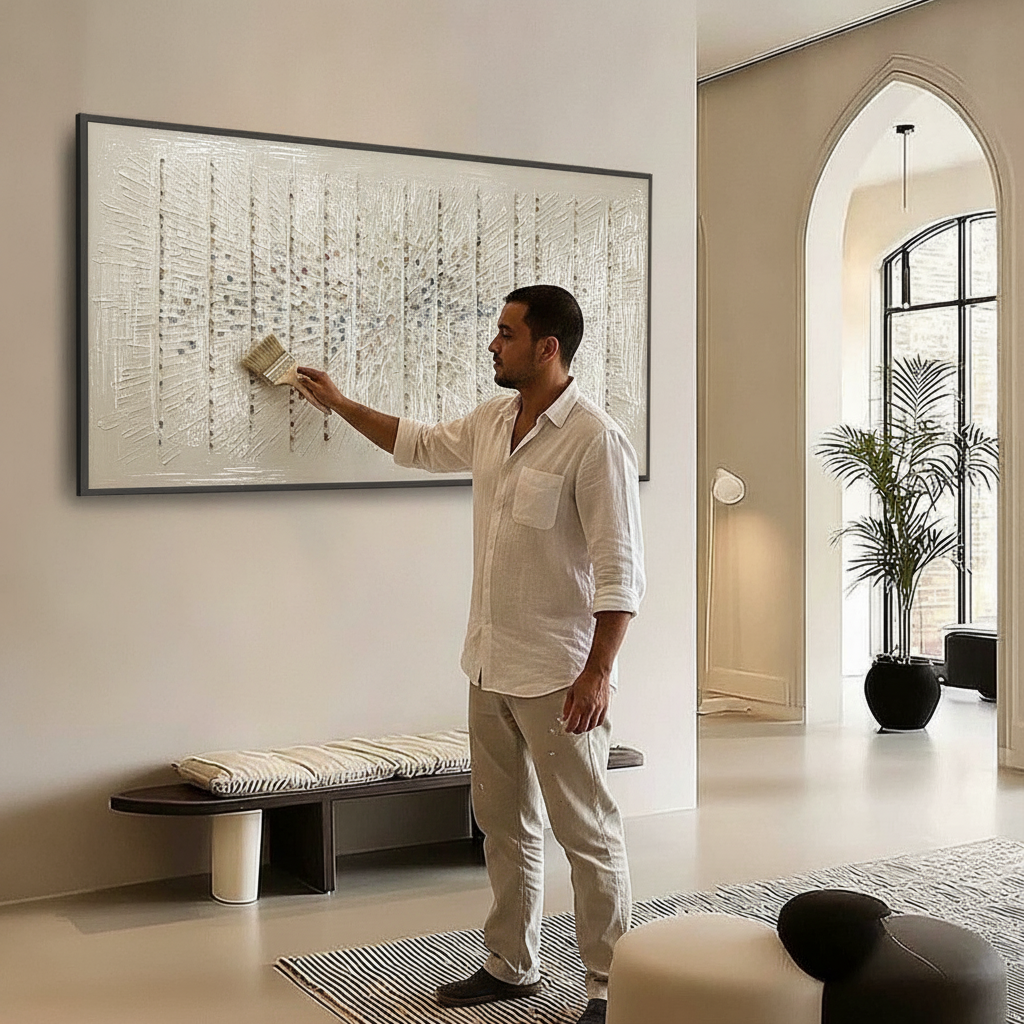
For large-scale residential murals or oversized canvases, the application method is as important as the product choice. Eco-friendly mediums are often more flexible but can be prone to "pooling" if applied too heavily.
We recommend the Cross-Hatch Method for even UV protection:
- Horizontal Pass: Apply the first thin coat using horizontal strokes.
- Vertical Pass: Once dry (usually 3–6 hours), apply the second coat vertically. This grid-like application ensures that every peak and valley of a textured impasto painting is covered, preventing the "chalking" effect often seen in unprotected outdoor acrylics.
Logic Summary: The Durability Trade-off While some counter-consensus research suggests water-based varnishes may require more frequent reapplication (potentially every 5–10 years vs. 15+ for solvents), the cumulative health benefit of a VOC-free environment typically outweighs the maintenance cycle for residential users.
Biophilic Design and the Healing Power of Art
The choice of non-toxic materials aligns with the broader trend of "Biophilic Design." Beyond mere aesthetics, art that depicts natural landscapes has been shown to have measurable clinical benefits. A critical review from the University of Pennsylvania found that 73% of patients reported significant mood improvements when surrounded by environmental artwork.
By using non-toxic varnishes, we ensure that these "healing" murals do not inadvertently introduce respiratory irritants. This is particularly vital in corporate offices, where nature-themed biophilic design has been shown to reduce employee cognitive fatigue and burnout in high-density urban environments like Tokyo.

The Environmental Lifecycle: Microplastics and Ethics
As we look toward 2030, the art industry is facing increased scrutiny regarding its environmental footprint. Stanford University scholars warn that coatings and pigment breakdowns are a core source of aquatic microplastics. Traditional acrylics are, essentially, liquid plastic.
To mitigate this, we are seeing a rise in "Bio-Based" alternatives:
- Walnut Oil: A traditional, non-toxic alternative to mineral spirits for thinning oil paints.
- Hemp/Flax Canvases: These substrates consume half the water of cotton and provide a more stable base for low-VOC coatings.
Furthermore, ethical curation is becoming a "decision safety" factor for millennial and Gen Z buyers. A Wharton School survey found that 87% of consumers believe artists should receive fair compensation. By choosing brands that prioritize both non-toxic materials and fair labor practices, homeowners are investing in a sustainable creative economy.
Long-Term Maintenance: Can You Clean Acrylic Art?
A common question in our support inbox is whether water can be used to clean a varnished painting. Traditional wisdom says "never," but museum-grade research suggests otherwise. The Tate's Modern Paints Project confirmed that gently wiping an acrylic surface with a damp cotton swab can actually help remove "free surfactants"—microscopic residues that migrate to the surface and cause haziness (the "PEG-type surfactant" phenomenon).
Maintenance Checklist:
- Dusting: Use a soft, dry microfiber cloth weekly.
- Deep Cleaning: Only use distilled water on a slightly damp swab, and only on fully cured (30+ days) acrylic varnishes.
- UV Protection: Ensure your varnish contains UVLS (Ultra Violet Light Stabilizers) to prevent the "Prussian Blue Fade" or yellowing of the binder.
Investing in Cultural Heritage
Ultimately, a hand-painted mural is more than decor; it is a "non-renewable cultural heritage asset." High-quality custom art has been proven to increase property values and drive foot traffic in commercial districts. By choosing non-toxic protection, you are ensuring that this asset remains a healthy, vibrant part of your environment for decades to come.
Whether you are wrapping a powder room in an immersive panoramic mural or placing a single textured canvas in a nursery, the safety of the finish is the final seal on your "decision safety." Authentic art deserves authentic protection—one that honors both the artist’s vision and the health of your home.
YMYL Disclaimer: This article is for informational purposes only and does not constitute professional medical, legal, or environmental safety advice. VOC sensitivity and pigment toxicity can vary significantly based on individual health conditions and specific product formulations. Always consult with a certified industrial hygienist or a professional art conservator for large-scale residential projects, and ensure adequate ventilation during any varnish application.
References
- Environmental Protection Agency (EPA) - Indoor Air Quality and Low-VOC Paints
- World Health Organization (WHO) - Scoping Review on Arts and Health
- The Tate - Conservation Concerns for Acrylic Emulsion Paints
- Princeton University - Painting and Drawing Safety Guidelines
- International Agency for Research on Cancer (IARC) - Cadmium Monograph
- Golden Artist Colors - Longevity of Oil and Acrylic Paints
- University of Pennsylvania - Visual Art in the Built Environment