The Shift Toward Substance: Why Heavy Art Mounting Matters
The global art market is undergoing a structural transformation. Recent data suggests a retreat from purely financial art assets; high-end auction sales for pieces over $10 million plummeted by 44% year-over-year in 2024, according to Marketplace. Buyers are returning to art with "real application value"—custom, hand-painted works that offer emotional resonance and physical presence rather than just investment potential.
This return to authenticity brings a technical challenge: the physical weight of quality. Unlike mass-produced digital prints, which Columbia University research confirms are valued 62% lower than human-created art, authentic oil paintings carry significant mass. High-quality pigments, heavy-duty canvases, and solid wood frames create a structural load that standard "picture hooks" cannot support.
At MontCarta, we prioritize "decision safety." We understand that mounting a heavy, premium artwork is not just about aesthetics; it is a structural engineering task. Whether you are a homeowner anchoring a legacy piece or a designer staging a high-visibility lobby, ensuring that a 50-pound masterpiece remains securely on the wall requires a move from "guessing" to "calculating."

Calculating the True Load: Beyond the Scale
The most common mounting failure occurs when homeowners underestimate the combined weight of a solid wood frame and stretched canvas. In our experience handling professional installations, we often see a "static weight bias"—assuming the weight on the day of purchase is the weight forever.
The Real-World Weight Heuristic
To ensure structural safety, we use a specific weight-modeling heuristic based on common gallery patterns:
- Frame Weight: For frames 36 inches or larger, expect 15–30 lbs depending on the wood density (e.g., oak vs. pine).
- Canvas & Tension: A high-quality stretched canvas adds 5–10 lbs.
- The Humidity Factor: Research from the Russell Collection suggests that oil paintings can experience a 2–5% weight increase over five years due to moisture absorption in backing materials. A 50 lb frame can silently grow to ~53 lbs, potentially pushing an anchor past its failure threshold.
Logic Summary: Our weight modeling assumes a 5% "environmental buffer" to account for humidity absorption and dynamic forces. We recommend hardware rated for double the measured weight to ensure a 2:1 safety factor.
Dynamic Forces: The Silent Threat
Static load ratings (like "rated for 50 lbs") are often based on ASTM 1-minute static tests. However, a wall is a dynamic environment. Structural engineering principles indicate that HVAC vibrations (0.5–2Hz) and foot traffic impact (up to 50N impulse forces) can reduce the effective capacity of an anchor by 40–60% over time, according to Hilti technical data.
Structural Integrity: Anchor Selection and Substrate Limits
Choosing the right hardware depends entirely on what lies behind your paint. Mounting a heavy oil painting into a stud is always the gold standard, but modern open-concept designs often require mounting into hollow drywall.
1. Drywall Without Studs: The Toggle Bolt Protocol
For heavy frames on drywall, we strictly recommend toggle bolts. Unlike plastic expansion anchors, which rely on friction and can pull out under constant tension, toggle bolts spread the load across a larger area of the drywall's backside.
- Heuristic: Use toggle bolts rated for at least double the estimated weight.
- The "Shared Wall" Risk: According to Maden.co, drywall typically has a capacity of 50–75 lbs per square foot. If you are creating a gallery wall with multiple heavy frames, a 300 lb concentrated load on a small wall section can lead to substrate fatigue, even if individual anchors are secure.
2. Stud Mounting: Lag Bolts and Washers
When you can locate a stud—using a high-quality stud finder or the "knock and listen" method—you move from hanging on the "skin" of the house to hanging on its "bones."
- Hardware: Use 1/4-inch lag bolts.
- Professional Tip: Always pre-drill pilot holes. This prevents the wood stud from splitting, which would compromise the bolt's grip. Use washers to distribute the pressure of the bolt head against the mounting bracket.
| Anchor Type | Best For | Weight Limit (Heuristic) | Risk Factor |
|---|---|---|---|
| Plastic Plug | Lightweight prints | < 10 lbs | High (Tends to pull out) |
| Self-Drilling | Medium decor | 10–25 lbs | Moderate (Drywall crumbling) |
| Toggle Bolt | Heavy Art (No Stud) | 25–50 lbs | Low (Requires large hole) |
| Lag Bolt | Heavy Art (Stud) | 50+ lbs | Zero (If installed correctly) |

Environmental Resilience: Humidity and Structural Maintenance
Hand-painted oil art is a living medium. The Aalto University study on VOC emissions and moisture highlights that moisture content in wood frames changes with the seasons.
Seasonal Hardware Check
As humidity fluctuates, wood frames expand and contract. This "breathing" can cause mounting hardware—specifically the screws holding D-rings to the back of the frame—to loosen. In professional gallery settings, we implement a 6-month inspection protocol.
- Actionable Step: Every six months, gently check the tightness of the screws on the back of the frame. If you notice "dust" around the screw hole, the wood may be stripping, requiring a larger screw or a structural adhesive.
- Moisture Protection: Ensure your art has Breathing Room by using spacers. This prevents Canvas Rot and reduces the moisture-driven weight gain mentioned earlier.
The ROI of Professional-Grade Mounting
Why invest so much effort into the "unseen" hardware? Beyond safety, the secure display of art has measurable economic and psychological benefits.
1. Property Value and Commercial Appeal
Data from the Royal Society shows a direct link between "art-rich" environments and property price gains. For commercial developers, high-quality murals and large-scale art acts as a "marketing trump card," helping to lease office space faster in a post-pandemic market.
2. Neurological and Health Benefits
The presence of authentic, hand-painted art is not just a status symbol; it is a health intervention. A UPenn review found that 73% of patients reported significant mood improvements when exposed to environmental artwork. Furthermore, passive art viewing consistently activates the medial prefrontal cortex (mPFC), optimizing emotional regulation.
By ensuring your art is mounted safely, you are preserving a "public health infrastructure" within your own home. You are protecting an asset that WHO research confirms can alter clinical indicators for stress and mental well-being.
Modeling Note (Safety Assumptions): Our recommendations for "double-rated" hardware are based on a sensitivity analysis of anchor failure points under dynamic vibration. This is a scenario model, not a controlled lab study, and assumes standard 1/2-inch residential drywall.
| Parameter | Recommended Value | Unit | Rationale |
|---|---|---|---|
| Anchor Safety Factor | 2.0 | Ratio | Accounts for dynamic HVAC vibrations |
| Min. Stud Depth | 1.5 | Inches | Ensures lag bolt thread engagement |
| Anchor Spacing | 12 | Inches | Prevents cumulative load zone failure |
| Humidity Buffer | 5 | % | Accounts for seasonal weight gain |
| Pilot Hole Diameter | 75% | % of Bolt | Prevents wood splitting in studs |
Step-by-Step Professional Installation Guide
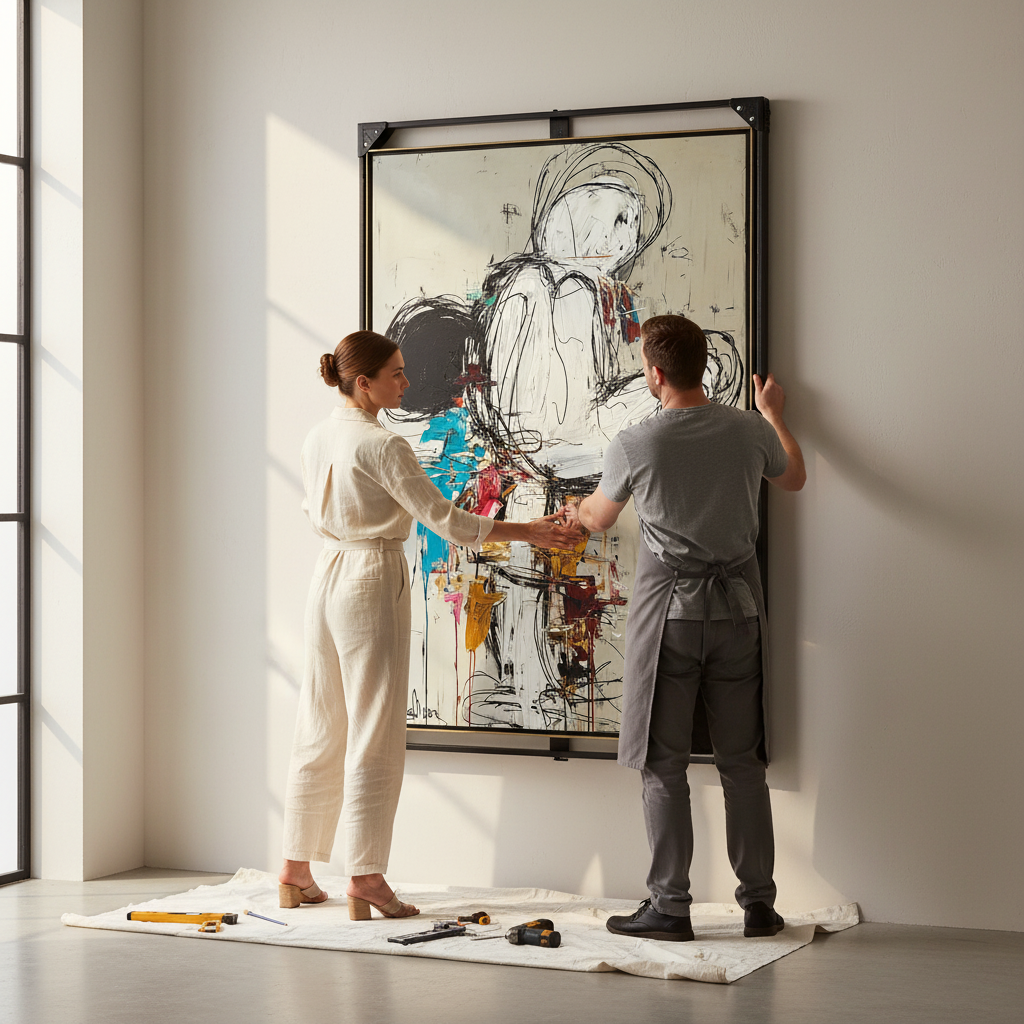
If you are ready to mount a heavy piece, follow this protocol used by professional art handlers:
- Measure the "Drop": Don't just measure the frame. Measure the distance from the top of the frame to the hanging wire or D-rings when they are under tension.
- Locate the Substrate: Use a stud finder. If no stud is available in your desired location, prepare your toggle bolts.
- Level and Mark: Use a laser level for precision. Mark your holes and double-check the spacing. We recommend spacing multiple anchors at least 12 inches apart to avoid "perforating" the drywall and weakening its structural capacity.
- Install Hardware: For toggle bolts, you will need to drill a larger hole to accommodate the "wings." For lag bolts into studs, pre-drill your pilot hole (typically ~75% of the bolt diameter).
- The Grip Test: Before hanging the art, apply gradual downward pressure to the installed hardware using your hands. This simulates the load and ensures the anchor is seated correctly.
- Mount and Inspect: Hang the piece and use a spirit level to confirm it is straight.
For larger pieces, consider Cross-Bracing to ensure the frame itself doesn't warp under its own weight over time.
The Psychological Peace of "Decision Safety"
The "essential identity" of a hand-painted work—the soul of the artist's brushstrokes—is what makes it valuable. Research from UChicago shows that consumers perceive digital replicas as lacking this "essence," which is why hand-painted murals retain their value.
When you purchase a premium piece from MontCarta, you are investing in a human legacy. Protecting that legacy starts with the wall. By following professional mounting standards, you eliminate the anxiety of "what if it falls?" and replace it with the confidence of a gallery-grade installation.
Whether it is a nature-themed healing mural in a private clinic or a bold abstract in your living room, the safety of the mount is the final step in the artistic process. Invest in the right hardware, respect the physics of the substrate, and enjoy the lifelong neurological benefits of authentic art.
Disclaimer: This article is for informational purposes only and does not constitute professional structural engineering or architectural advice. Wall conditions vary significantly; always consult with a licensed contractor or professional art installer for exceptionally heavy loads or complex wall types. MontCarta is not liable for damage or injury resulting from improper installation.
Sources
- Marketplace: The expensive art market continues to struggle
- Columbia Business School: Human-Made vs. AI Art
- Hilti: Technical Advisory on Anchor Inspection
- UPenn: Visual Art in the Built Environment
- WHO: Scoping Review on Arts and Health
- Maden.co: Drywall Anchor Weight Limits
- Russell Collection: How to Frame Oil Paintings