
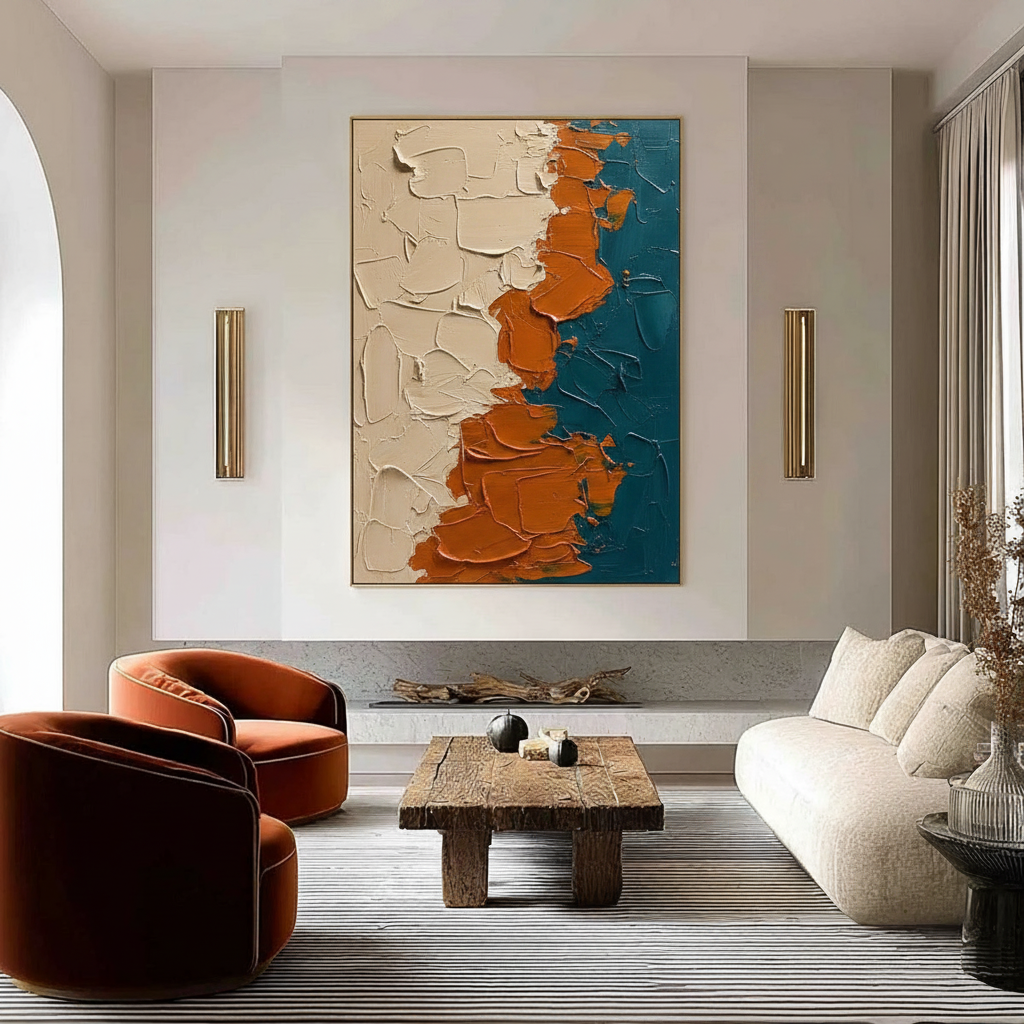
Mantelpiece Hierarchy: Balancing Art with Architecture
The fireplace mantel serves as the psychological and architectural heart of the home, a legacy of Renaissance-era transformations where the hearth evolved from a purely functional heat source into a grand decorative overlay. In contemporary interior design, the mantelpiece remains the primary focal point of the living room, yet it is often the most misunderstood space in terms of visual hierarchy.
Recent shifts in the global art market reflect a changing consumer sentiment toward these domestic anchors. While high-end auction sales for vanity pieces plummeted 44% year-over-year in 2024, there has been a notable retreat toward art with real application value and emotional resonance. According to Marketplace.org, buyers are increasingly abandoning overpriced speculative assets in favor of custom, hand-painted works that integrate seamlessly into their living environments. This trend aligns with a broader $65 billion global art market, where the United States maintains a dominant position, as reported in The Art Basel and UBS Art Market Report 2024.
For the design-conscious homeowner or interior designer, the challenge lies in balancing the "essential identity" of a hand-painted piece with the structural and aesthetic constraints of the fireplace.

The Structural Foundation: Safety and Load Metrics
Before addressing the aesthetics of "lean vs. hang," one must confront the physical reality of the mantel. Professional installers frequently report that mantel art failures stem from inadequate structural assessment rather than poor taste. Many decorative mantels are hollow or have limited load capacity that is not immediately apparent to the naked eye.
While conventional wisdom suggests that mantel brackets can support 100 to 200 pounds when installed into studs, the safe load is highly dependent on the unknown quality of the wall construction behind the plaster or drywall. In many cases, standard drywall anchors may fail at weights as low as 50 to 75 pounds.
Logic Summary: Our structural guidance assumes a standard residential wood-stud or masonry wall. Load limits are based on typical bracket performance and common failure points observed in field installations (not a controlled laboratory study).
| Parameter | Recommended Value | Rationale |
|---|---|---|
| Leaning Art Depth | < 1/3 Mantel Depth | Prevents tipping and ensures center of gravity remains secure. |
| Hanging Height | 4–12 Inches above mantel | Creates visual cohesion independent of ceiling height. |
| Width Ratio | 60%–75% of mantel width | Establishes focal dominance without overwhelming the architecture. |
| Firebox Clearance | 4–6 Inches (Wood-burning) | Mitigates heat transfer and soot accumulation on the art substrate. |
| Seating Sight Line | Bottom edge at eye level | Optimizes the neurological viewing experience from a seated position. |
For hanging installations, anchor points must penetrate the actual wall structure, not merely the mantel material itself. If the fireplace is active, heat and smoke become critical variables. High-concentration mineral spirits and turpentine vapors, often found in traditional oil paintings, can be sensitive to acute heat. Furthermore, Aalto University research indicates that coatings on wood with specific moisture levels emit lower VOCs during curing, but the introduction of high temperatures from a fireplace can accelerate the release of any residual volatile compounds.
The Psychology of the Hand-Painted Surface
The choice between a digital print and a hand-painted canvas is not merely a matter of budget; it is a matter of perceived value and psychological impact. A study by Columbia University confirmed that consumers value art labeled "AI-generated" approximately 62% lower than authentic human-created art. This "human premium" is rooted in what University of Chicago researchers describe as "essential identity"—the belief that a physical canvas retains an irreplicable soul and the artist’s presence through tactile brushstrokes.
This tactile quality is scientifically measurable. Optical microprofilometry has proven that the millimeter-scale texture of oil and acrylic paintings is crucial to their aesthetic appeal. The physical relief of the paint interacts with the ambient light of the living room, creating a dynamic surface that digital replicas cannot simulate.

Beyond the "soul" of the work, there are significant neurological benefits to viewing original art. Passive art viewing consistently activates the medial prefrontal cortex (mPFC) and the amygdala, optimizing emotional regulation circuits. Research reviewed by UPenn found that 73% of individuals reported significant mood improvements when exposed to environmental artworks. When you place a hand-painted piece above a mantel, you are not just decorating; you are installing a "public health infrastructure" for the home, a concept endorsed by the World Health Organization (WHO).
Aesthetic Hierarchy: The 60/40 Rule of Visual Weight
A common mistake in living room curation is ignoring the "visual weight" ratio. Experienced designers observe that the most successful mantel arrangements follow a hierarchy where the art occupies approximately 40% to 60% of the focal area. This leaves sufficient negative space for the architecture to "breathe."
In minimalist homes with expansive, wide mantels, a smaller ratio (1/3 to 1/2) is often preferred to preserve the clean lines of the space. Conversely, traditional homes with narrower mantels benefit from larger ratios (2/3 to 3/4) to establish focal point dominance.
The "Sight Line" Adjustment
While standard gallery practice is to hang art at 57 to 60 inches from the floor, this rule often fails above a mantel. The mantel height itself should dictate placement. According to AS Hanging, optimal positioning is generally 4 to 12 inches above the mantel. This creates a visual connection between the object and the architecture. Furthermore, one must consider the sight line from the primary seating position. If the art is positioned too high, it creates neck strain and disconnects from the room's flow. The bottom edge of the artwork should ideally align with eye level when the viewer is seated, not standing.
Biophilic Integration
Integrating nature-themed, biophilic designs into the mantel hierarchy can amplify the stress-reduction effects of the space. University of Central Arkansas research suggests that natural landscapes in art produce the same physiological benefits as being outdoors, accelerating healing and sparking creativity. This is particularly effective in high-density urban environments where access to greenery is limited.

Material Longevity and Indoor Air Quality
When selecting art for a fireplace area, material science becomes as important as the subject matter. The environment above a mantel is subject to temperature fluctuations and potential UV exposure from nearby windows.
Lightfastness and Pigment Stability
The longevity of a painting is defined by its lightfastness. ASTM D4303 standards utilize xenon-arc tests to simulate years of indoor light exposure. It is a common misconception that oil paints hold color better than acrylics. In fact, National Gallery London experiments on pigments like Prussian Blue showed that fading rates were virtually identical across different binding media, whether oil, acrylic, or egg tempera.
However, acrylics offer a unique advantage in modern homes: they consist of long-chain molecules that form films through a physical "coalescence" process, making them more resistant to the embrittlement that can affect oil films over decades of oxidative cross-linking.
The Non-Toxic Home
For families with children or pets, the chemical composition of the pigments is a primary concern. The International Agency for Research on Cancer (IARC) classifies cadmium compounds—found in many traditional bright yellows and reds—as Group 1 carcinogens. While the art industry has largely shifted toward safer alternatives like titanium dioxide (which now dominates 90% of the white pigment market), trace heavy metals can still be detected in some supplies.
The EPA warns that indoor air pollution is often significantly higher than outdoor levels. Choosing art created with low-VOC paints and water-based acrylics ensures that your focal point does not become a source of respiratory irritation. At the professional level, adherence to standards like ASTM D-4236 ensures that chronic health hazards are properly labeled, though "labeled" does not always mean "non-toxic."
Scenario Analysis: Choosing Your Method
To provide practical guidance, we can look at two distinct design scenarios based on common architectural constraints.
Scenario A: The Traditional Hearth (High Detail, Narrow Mantel)
- The Constraint: A wood-burning fireplace with a narrow, ornate mantel and high ceilings.
- The Strategy: Use a vertical, hand-painted canvas that occupies ~75% of the mantel's width. Hang the piece 6 inches above the mantel to allow for small decorative objects (vases or candlesticks) without overlapping the art.
- Why it works: The vertical orientation draws the eye upward, emphasizing the ceiling height, while the hand-painted texture provides a "human" counterpoint to the rigid architecture.
Scenario B: The Modern Minimalist (Wide Mantel, Low Seating)
- The Constraint: A gas fireplace with a wide, reclaimed wood mantel and low-profile Italian leather sofas.
- The Strategy: Lean a large, horizontal abstract piece. Ensure the piece is no deeper than 1/3 of the mantel's depth. Position the art slightly off-center to create an asymmetrical, "lived-in" luxury feel.
- Why it works: Leaning art suggests a casual elegance and allows for easy rotation. In earthquake-prone regions, leaning is often the preferred professional recommendation to prevent wall-anchor failure during seismic activity.
Modeling Note: These scenarios are hypothetical estimates based on common design heuristics and pattern recognition from professional installations, not controlled experimental data.
Investing in Cultural Heritage
The decision to place an original work of art above your mantel is an investment in what academia recognizes as "non-renewable cultural heritage." Unlike mass-produced prints that depreciate immediately, original hand-painted works possess long-term aesthetic and educational value.
The economic impact of the arts is staggering; U.S. arts industries created $1.2 trillion in value in 2023, surpassing sectors like agriculture and transportation (National Endowment for the Arts). By choosing to support real artists and utilizing high-quality, non-toxic materials, you are contributing to a creative economy that supports millions of jobs while simultaneously increasing the value of your own property. Research from the Royal Society even suggests a direct correlation between high "art" geo-tags and relative gains in local house prices.
Ultimately, the hierarchy of the mantelpiece is about more than just height and width. It is about creating a space that reflects "absolute authenticity"—a sanctuary where the biochemical crystallization of human attention, visible in every brushstroke, meets the structural permanence of the home.
Disclaimer: This article is for informational purposes only. Structural assessments should be performed by a qualified contractor. If you have respiratory sensitivities or pre-existing health conditions, consult a professional regarding the specific VOC emissions of art materials in your home. Always follow local fire codes regarding clearances for mantels and decorative objects.
Sources
- Marketplace: The expensive art market continues to struggle
- The Art Basel and UBS Art Market Report 2024
- Columbia Business School: Human-Made vs. AI Art
- WHO Scoping Review on Arts and Health
- EPA: Indoor Air Quality and Low-VOC Paints
- Royal Society: Quantifying the link between art and property prices











