The Shift Toward Meaningful, Safe Art in the Modern Home
The landscape of the art market is undergoing a structural transformation. For decades, the high-end art world was dominated by "vanity" auction pieces—works often purchased more for their financial speculation than their living-room application. However, recent data from Marketplace indicates that sales of high-end auction art (over $10 million) plummeted by 44% year-over-year in 2024. This retreat from purely financial assets suggests a return to "real application value," where collectors and homeowners prioritize pieces that offer emotional resonance and aesthetic authority within their personal environments.
For health-conscious parents and interior designers, this shift is particularly relevant. When selecting high-visibility art for a nursery, the primary objective is no longer just status; it is "decision safety." This involves bridging the gap between artistic authenticity—the rich, hand-painted textures traditionally associated with professional oils—and retail predictability, which demands rigorous safety standards and low-risk procurement.
The central question for many is whether safe, water-based mediums can truly replicate the premium, textured look of traditional oils without compromising indoor air quality (IAQ). The answer lies in the chemical evolution of professional acrylics, which have become the benchmark for residential wellness.
The Science of "Safe" Textures: Why Acrylics Dominate Nursery Design
Traditional oil painting often relies on volatile solvents like turpentine or mineral spirits for thinning and cleaning. According to Princeton University Environmental Health and Safety (EHS), acute inhalation of high-concentration mineral spirits can lead to central nervous system depression, while chronic exposure is linked to long-term brain damage. In a confined space like a nursery, these risks are unacceptable.
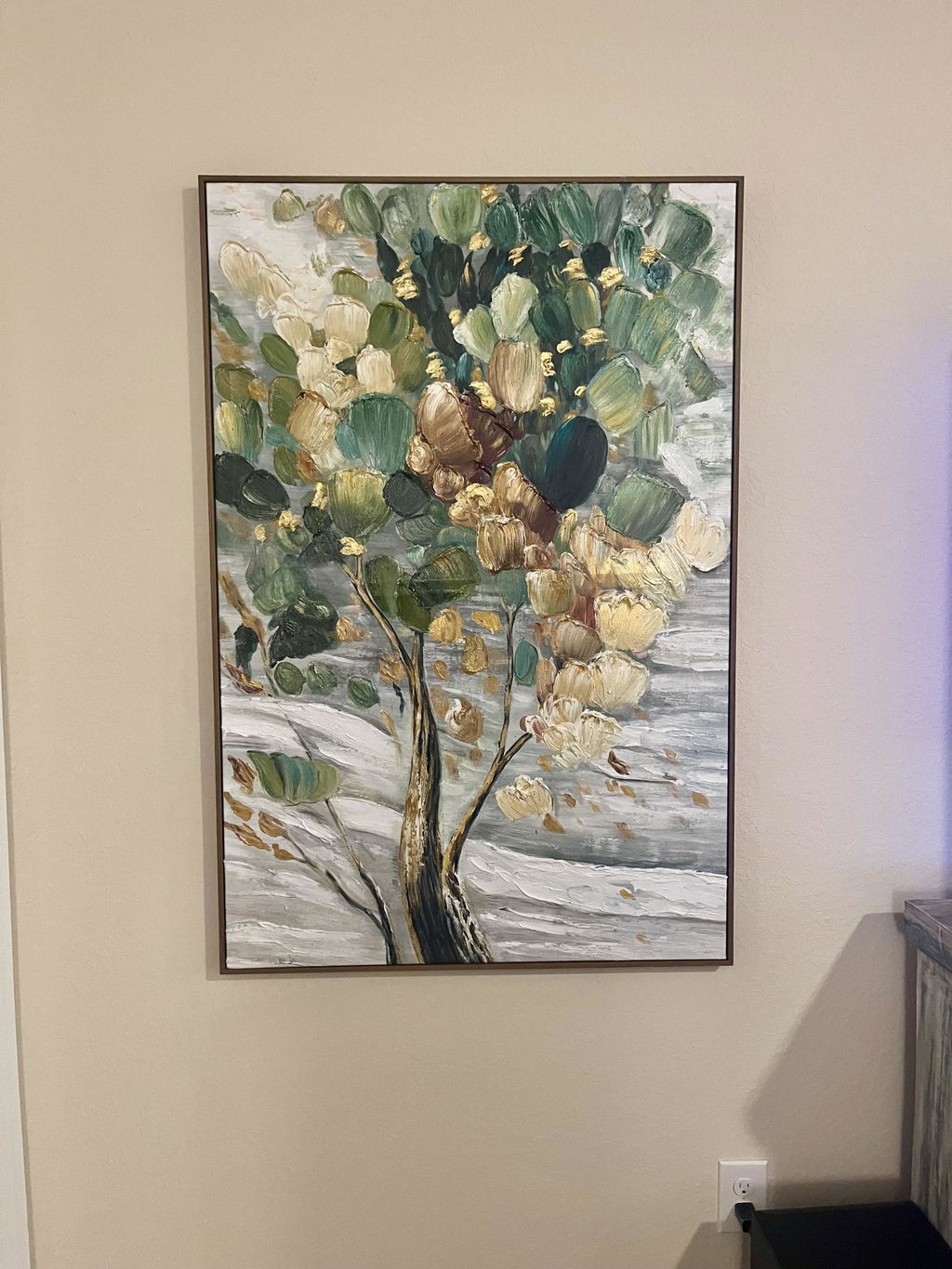
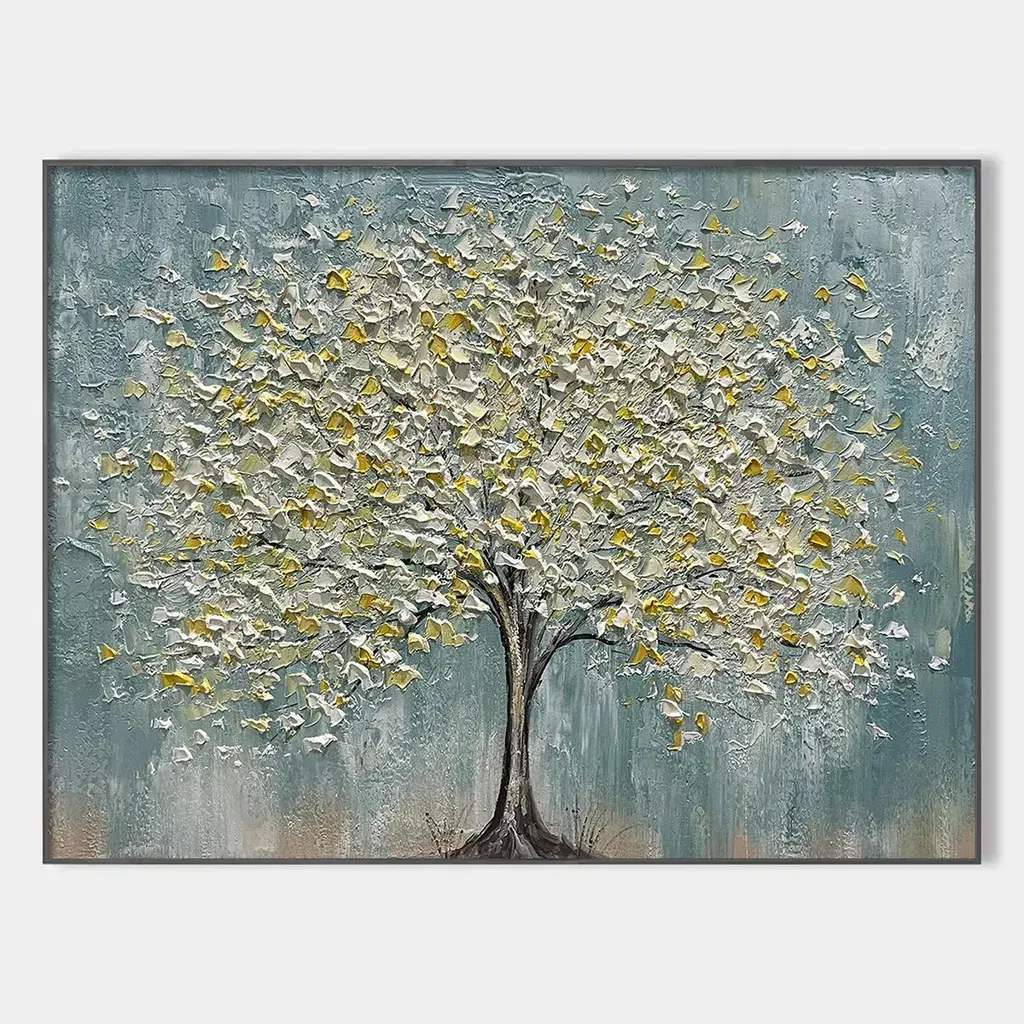
Acrylic paints, by contrast, are water-based. They consist of pigment suspended in an acrylic polymer emulsion. While they are often viewed as a "simpler" medium, modern professional-grade acrylics utilize advanced resin technology that allows for heavy impasto textures—the thick, palette-knife strokes that give art its physical presence—without the need for toxic solvents.
Logic Summary: Our comparison of art mediums assumes a residential environment with standard HVAC circulation. We prioritize water-based emulsions for nurseries because they eliminate the primary source of VOCs (solvents) found in traditional oil-based systems.
Understanding the "New Art Smell"
A common misconception is that if a painting has a scent, it is necessarily emitting harmful solvents. In the case of acrylics, the "new art smell" typically originates from the binders or the gesso primer rather than volatile organic compounds (VOCs). According to Aalto University research, coatings on wood with specific moisture levels emit significantly lower VOCs than traditional industrial solvents, with emissions plummeting rapidly during the curing phase.
Dry to the Touch vs. Fully Cured
For a nursery, it is vital to distinguish between these two states:
- Dry to the Touch (Minutes to Hours): The water has evaporated from the surface, and the paint is no longer tacky.
- Fully Cured (Up to 2 Weeks): The polymer chains have fully locked together through a process called coalescence.
Minor off-gassing can occur until the polymer chains are fully locked. Expert curators recommend allowing a hand-painted piece to sit in a well-ventilated area for at least 14 days before installation in a small nursery. This aligns with EPA Indoor Air Quality standards, which emphasize that choosing low-VOC products is only the first step; proper ventilation during the curing period is the second.

Beyond the Label: Navigating ASTM D-4236 and Safety Standards
Parents often look for safety labels as a guarantee of non-toxicity, but the reality is more nuanced. The EPA notes that the ASTM D-4236 logo on paint tubes means the product's warning labels comply with chronic health hazard regulations—it does not necessarily mean the pigment is "edible" or zero-risk.
One of the most significant breakthroughs in art safety was the replacement of Lead White with Titanium White. Data from the NCBI confirms that Titanium Dioxide now captures 90% of the white pigment market due to its chemical inertness and superior hiding power. However, other "heavy metal" pigments like Cadmium and Cobalt are still used in professional art for their vibrant hues.
The Cadmium Myth
Some industry voices claim that heavy metal pigments are safe because they are "insoluble." However, an evaluation by Australian Industrial Chemicals used OECD transformation protocols to prove that even "stable" Cadmium Yellow can release up to 5.75 $\mu g/L$ of free cadmium ions after 28 days in slightly acidic water (simulating common environmental shifts).
For a nursery environment, the most responsible choice is to specify "Cadmium-Free" acrylic ranges. These modern alternatives provide identical lightfastness and vibrancy through organic synthesis, eliminating the risk of heavy metal dust or leaching.
| Feature | Professional Acrylics | Traditional Oils | Nursery Impact |
|---|---|---|---|
| Primary Solvent | Water | Turpentine/Mineral Spirits | IAQ Safety |
| Drying Time | 20–60 Minutes | 2–7 Days | Installation Speed |
| Curing Time | ~2 Weeks | 6–12 Months | Off-gassing Window |
| Chemical Stability | High (once cured) | Reactive to humidity | Long-term durability |
| Texture Capability | High (with gels) | Naturally High | Aesthetic Authority |
The Psychological Edge: Biophilic Murals and Cognitive Development
The value of art in a nursery extends beyond simple decoration; it serves as "public health infrastructure" for the developing mind. A WHO scoping review of 3,000+ studies confirms that art interventions effectively alter clinical indicators for mental health and stress.
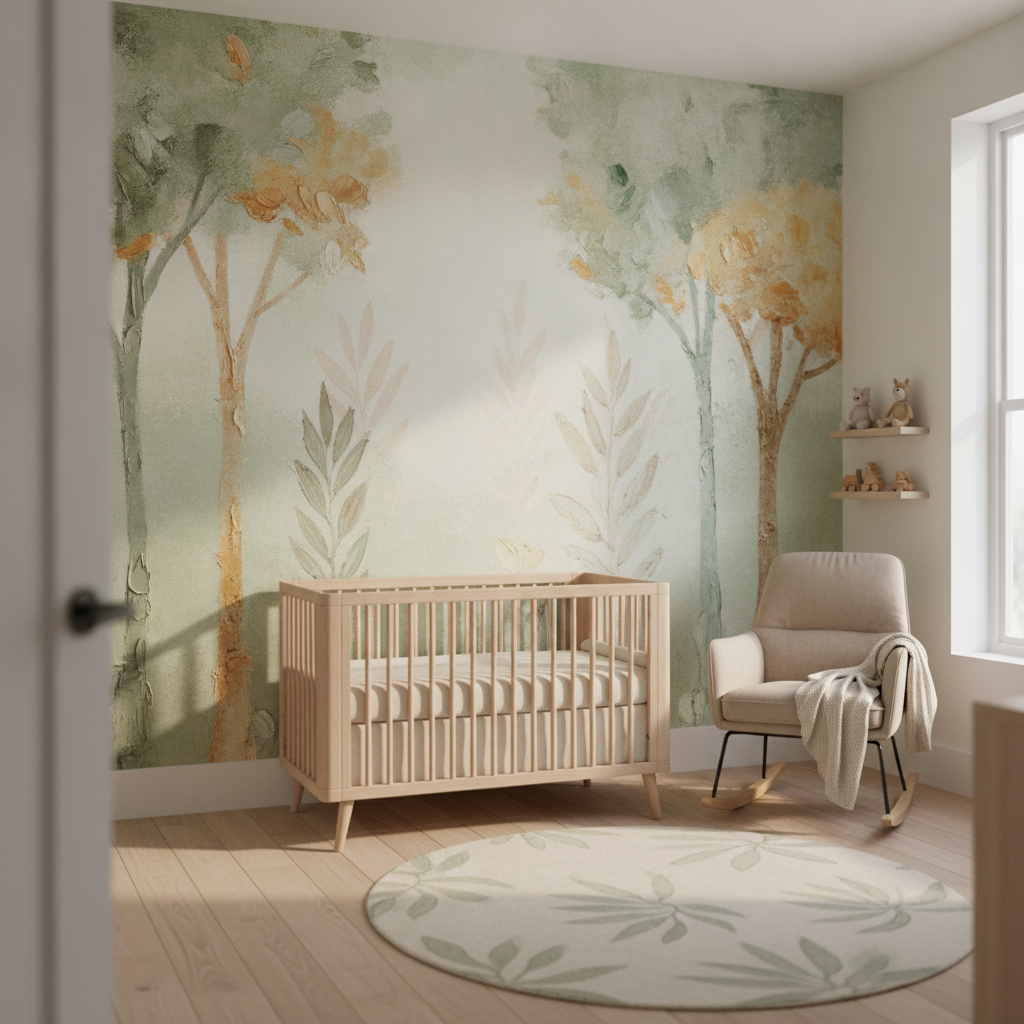
Specifically, "Biophilic Design"—art featuring natural landscapes, flora, and fauna—has been shown to produce stress-reduction effects in the brain similar to being outdoors. Research from the University of Pennsylvania found that 73% of patients reported significant mood improvements when exposed to environmental artworks.
In a nursery context, large-scale nature murals can act as a "neural catalyst." Data from Americans for the Arts shows that students in arts-rich environments see an 18% boost in academic scores. By surrounding a child with hand-painted, biophilic textures, parents are optimizing the "emotional regulation circuits" of the brain (activating the mPFC and amygdala), as noted in recent neurological studies.

Human-Made vs. AI Art: The Value of "Essential Identity"
As digital prints and AI-generated art become ubiquitous, the value of 100% human-hand-painted art has actually increased. A Columbia University study found that consumers value art labeled as "human-created" 62% higher than AI-generated alternatives.
Why does this matter for a nursery? According to research from the University of Chicago, digital replicas lack the artist's "essential identity." A hand-painted canvas retains a "soul"—a series of micro-decisions and physical imprints that a printer cannot replicate. For a parent, this represents a commitment to authenticity and ethical craftsmanship. Furthermore, Wharton School surveys show that 87% of consumers believe artists should receive fair compensation, a moral demand that is met when purchasing original commissions from professional painters.
Practical Procurement: A Checklist for Interior Designers
When specifying art for high-end residential nurseries, designers must balance the client's aesthetic desires with rigorous safety protocols.
1. Specify the Finish
Avoid heavy gloss varnishes in small, enclosed nurseries. These often contain higher concentrations of stabilizers and UV absorbers that can have higher chemical profiles. Instead, a matte or satin artist-grade finish provides the necessary protection with lower off-gassing potential.
2. Verify the Substrate
Water-soluble impurities in common cotton or linen canvases can sometimes be drawn out when applying thick acrylic mediums, a phenomenon known as Support Induced Discoloration (SID). To prevent this, ensure the artist uses a high-quality, multi-coat gesso primer. This acts as a chemical barrier between the raw fabric and the paint film.
3. Humidity and Stability
Unlike traditional oils, which can remain "active" and sensitive to environmental shifts for years, cured acrylics are chemically stable. They will not react with common household humidity, making them a superior choice for Moisture Tolerance in Art.
4. Lightfastness Ratings
Ensure the pigments used meet ASTM D4303 standards. This ensures the artwork will not fade when exposed to the bright natural light common in modern nurseries. For rooms with significant sun exposure, refer to guides on Choosing Art for Bright Spaces.
Methodology Note: These recommendations are derived from standard museum conservation practices and industrial safety guidelines (ASTM/EPA), adapted for residential nursery environments.
Scenario Analysis: Residential vs. Commercial Childcare
To better understand how these safety principles apply, we can look at two distinct scenarios.
Scenario A: The Private Residential Nursery
- Focus: Ultra-low VOCs and personalized biophilic themes.
- Priority: 14-day curing window before the baby arrives.
- Recommended Medium: Professional "Cadmium-Free" acrylics on double-primed linen.
- Outcome: A serene, safe environment that supports cognitive development through texture and color.
Scenario B: The Luxury Commercial Childcare Center
- Focus: Durability, washability, and LEED/WELL certification.
- Priority: Passing strict IAQ tests for green building points.
- Recommended Medium: High-flow acrylics with a hard, scrubbable matte topcoat.
- Outcome: A high-performance space that meets EPA safety requirements while providing the "authenticity" that modern parents demand.

The Long-Term Perspective: Art as a Healthy Asset
The decision to install hand-painted, low-VOC acrylic art is an investment in both aesthetic beauty and environmental health. While mass-produced prints may offer a quick fix, they lack the "micro-physical texture" that optical microprofilometry proves is crucial to the human aesthetic experience.
Furthermore, the economic impact of murals is well-documented. Neighborhoods with higher art geo-tags see greater relative house price gains, according to the Royal Society. By choosing a custom mural or a large-scale hand-painted piece, you are not just decorating a room; you are adding a permanent, cultural asset to the property.
As we move into 2026, the trend toward "artisan craftsmanship" and "whimsical custom walls" (which saw a 329% spike in searches according to Zillow/Yelp data) will only intensify. For the health-conscious parent, the path forward is clear: prioritize the breathable, non-toxic, and irreplicable beauty of human-made acrylic art.
For more insights on maintaining your collection, explore our guide on Low-Maintenance Acrylic Art Curation or learn about Specifying Art for Luxury Healthcare to see how these principles apply in even more sensitive environments.
Disclaimer: This article is for informational purposes only and does not constitute professional medical, health, or safety advice. Indoor air quality can be affected by numerous factors including ventilation, existing building materials, and external pollutants. Always consult with a qualified industrial hygienist or medical professional regarding specific health concerns in your home.
References
- Marketplace: The Expensive Art Market Continues to Struggle
- EPA: Volatile Organic Compounds' Impact on Indoor Air Quality
- Columbia Business School: Human vs. AI Art Perception
- WHO: Scoping Review on Arts and Health
- NCBI: Neurological Mechanisms of Creative Arts
- Princeton University EHS: Painting and Drawing Safety
- Royal Society: Quantifying the Link Between Art and Property Prices