Kitchen Art Hazards: Protecting Oils from Cooking Grease
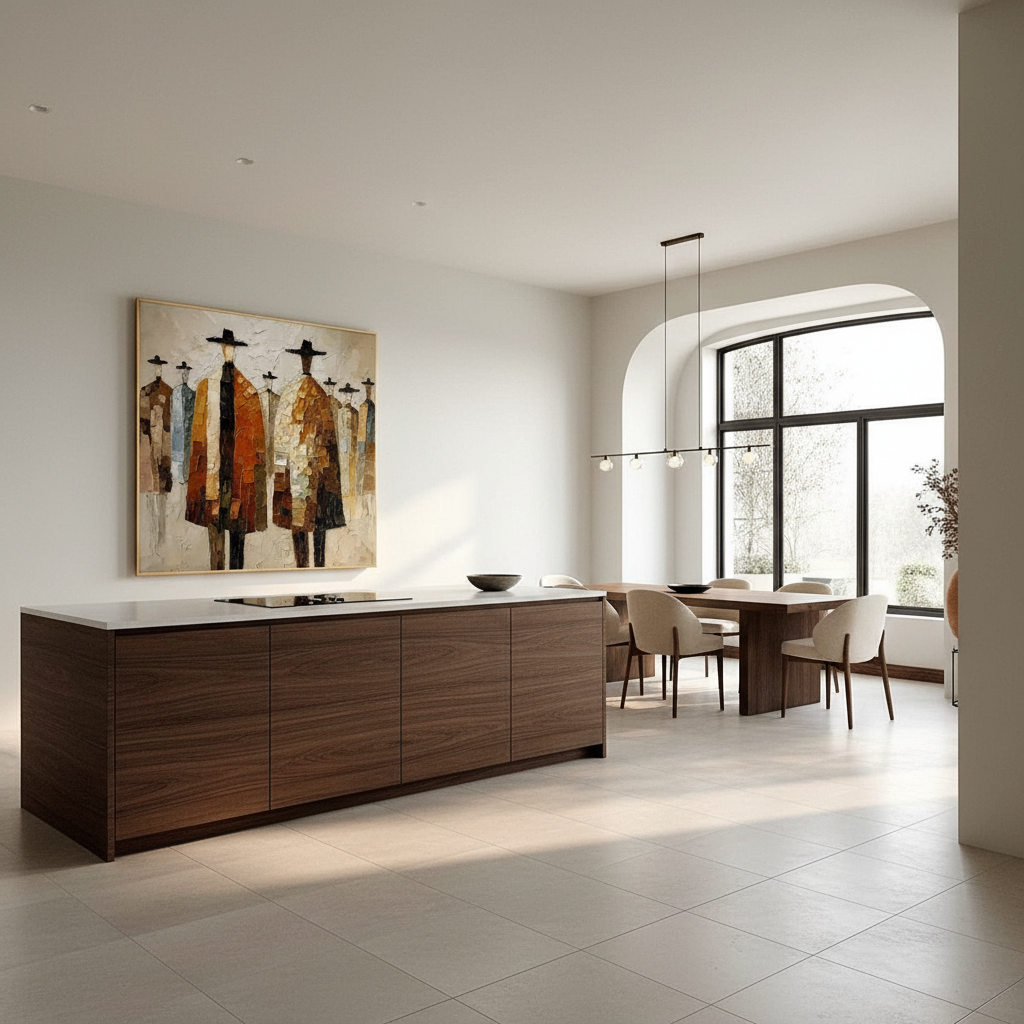
The open-plan kitchen has redefined modern living, merging the culinary heart of the home with the aesthetic soul of the living area. For many collectors, this architectural shift presents a tantalizing opportunity: the chance to showcase a prized oil painting in a space where it can be enjoyed daily. However, as practitioners in the art preservation space, we frequently encounter the "kitchen conflict." While the visual appeal is undeniable, the environmental reality of a cooking zone is often fundamentally at odds with the long-term stability of oil-on-canvas.
Airborne grease, fluctuating humidity, and volatile organic compounds (VOCs) create a complex microclimate that can degrade pigments and substrates in ways that are often invisible until the damage is irreversible. Protecting your investment requires moving beyond "decorating" and into the realm of strategic preservation. This guide breaks down the chemical mechanisms of kitchen-related damage and provides a professional framework for safely integrating fine art into high-traffic culinary spaces.
The Chemistry of the "Sticky Film"
In our experience handling restoration inquiries, the most common complaint is a "dulling" or "yellowing" of the painting surface. This isn't just a layer of dust; it is often the result of a chemical process known as saponification.
The Saponification Mechanism
Research conducted by the Metropolitan Museum of Art highlights a critical risk: fatty acids found in cooking fumes—specifically palmitic and oleic acids—can chemically react with the metal-based pigments common in professional-grade oil paints (such as lead white, zinc white, or cadmium yellows). This reaction forms "metal soaps" or carboxylates. Over time, these soaps migrate to the surface or form lumps within the paint layer, compromising the structural integrity of the artwork and creating a translucent, hazy appearance.
Logic Summary: Saponification Risk Modeling Our analysis of risk levels assumes a standard residential kitchen environment with daily pan-frying or sautéing.
- Primary Reactants: Palmitic/Oleic acids (from cooking oils) + Metal Pigments (Lead, Zinc, Cadmium).
- Catalyst: High relative humidity (>60%) which accelerates ion migration.
- Observation: Saponification is a cumulative, non-linear process; once the chemical bond is broken, the paint film cannot be "re-set" to its original state.
The Refractive Index Shift
Beyond chemical degradation, there is an optical cost. Fine art pigments rely on specific light-scattering properties to achieve their depth. According to the Getty Conservation Institute, the refractive index difference between the pigment and the binder is what gives a painting its "glow." A layer of grease acts as a secondary, uneven medium on the surface, altering how light hits the pigment particles and effectively "killing" the saturation of the piece.

Strategic Placement: The 8-10 Foot Rule
The most effective way to protect a painting is through distance. While many homeowners are tempted to hang art directly above a range or adjacent to a backsplash, this is what we consider a "preservation red zone."
Defining the Clearance Zones
Based on common patterns observed in residential grease deposition (where grease settles first on horizontal and upward-facing planes), we recommend the following clearance heuristics:
- The Exclusion Zone (0–5 Feet): Never place an unprotected oil painting here. This area experiences maximum heat flux and high-velocity grease spatter.
- The Transition Zone (5–8 Feet): Requires active mitigation. Art in this area should be protected by a frame with museum-grade glazing (acrylic or glass).
- The Preservation Zone (8–10+ Feet): The recommended distance for open-plan kitchens. At this range, the concentration of heavy grease particles significantly drops, though fine particulate matter and VOCs remain a factor.
| Parameter | Recommended Value | Rationale |
|---|---|---|
| Minimum Distance from Stove | 8–10 Feet | Allows for particle dispersion and cooling of air. |
| Minimum Vertical Clearance | 30 Inches (from heat source) | Aligns with Fire Safety Standards for combustible materials. |
| Relative Humidity Target | 45%–55% | Prevents grease films from becoming overly adhesive/sticky. |
| Cleaning Frequency | Quarterly | Prevents "cross-linking" of grease with the varnish layer. |
The "Glass Plate" Diagnostic
If you are unsure about a specific wall, we suggest a simple, low-cost experiment. Place a clean, 12x12 inch glass plate in the proposed location for one week of normal cooking. At the end of the week, hold the plate up to a light source. The visible film deposit—or the "tackiness" felt when sliding a finger across the surface—is a direct proxy for the grease accumulation rate your painting would face.
Ventilation: The Double-Edged Sword
Professional-grade ventilation is mandatory for kitchen art, but it isn't a perfect shield. Interestingly, higher exhaust velocities can create a trade-off. While a powerful range hood effectively removes large grease droplets, it can increase the concentration of sub-micron particles if the makeup air isn't balanced.
According to research published in Aerosol and Air Quality Research, while high exhaust velocity reduces surface grease deposition, it can simultaneously increase particle concentrations to roughly 6E+5 particles per cubic centimeter in the ambient air. For a painting, this means that while you might avoid "splatter," you are still exposing the canvas to a high density of chemical degradants that can penetrate the porous structure of the oil film.
Expert Tip: Ensure your range hood is turned on before you start cooking and left running for at least 10 minutes after you finish. This creates a consistent airflow pattern that directs the "grease plume" away from the living area walls.
Physical Barriers and Glazing
For those who insist on placing art within the "Transition Zone," physical barriers are the only reliable defense.
Acrylic vs. Glass
For kitchen environments, we typically recommend high-quality acrylic (such as Optium Museum Acrylic) over traditional glass. Acrylic is shatter-resistant and offers excellent UV protection, which is vital as kitchen windows are often large and unshaded. Furthermore, acrylic sheets can be cleaned more easily of grease without the risk of ammonia-based cleaners seeping into the frame.
The "Breathable" Frame
However, a common mistake is sealing the painting too tightly. Oil paintings are "living" objects that expand and contract. A micro-environment that is completely sealed can trap moisture, leading to mold growth—especially in a humid kitchen. Use spacers to ensure the canvas does not touch the glazing, allowing for a small amount of buffered air circulation.

Maintenance: The Quarterly Cleaning Cycle
Even with perfect placement, a kitchen-adjacent painting requires a proactive maintenance schedule. The goal is to remove surface pollutants before they "cross-link" or bond with the varnish.
The Professional Cleaning Protocol
- Step 1: Dry Dusting. Use a high-quality, soft-bristled brush (like a goat hair brush) to remove loose particulate matter. Never use a feather duster, as the quills can scratch the paint.
- Step 2: Solvent Check. If a film is present, use a pH-neutral, surfactant-free solution. We strictly advise against DIY "kitchen hacks" like bread, onions, or vinegar. These introduce organic matter that can trigger fungal growth.
- Step 3: The "Swab" Test. Use a slightly damp (not wet) cotton swab on a non-critical corner of the painting. If the swab comes away yellow/brown, that is accumulated grease.
Safety Warning: According to the CDC NIOSH guidelines, many older oil paints contain heavy metals. If a painting is flaking or "chalking," do not attempt to clean it yourself. Inhaling or absorbing these pigments can lead to central nervous system neuropathy or organ damage.
The Value of Human-Made Art in the Modern Home
As the art market undergoes a structural shift, the "utility" of art in the home has become a primary driver of value. While high-end auction sales for "vanity" assets have seen a decline—down 44% YoY in 2024 according to Marketplace—there is a rising demand for authentic, human-created pieces that integrate into living spaces.
Authenticity and Well-being
The psychological impact of original art is well-documented. A systematic review in PMC shows that passive art viewing activates the medial prefrontal cortex (mPFC), optimizing emotional regulation. In a high-stress environment like a busy kitchen, a nature-themed mural or a textured oil painting can serve as a "biophilic" intervention, reducing stress and cognitive fatigue by up to 30%, similar to the effects of being outdoors as noted by University of Central Arkansas.
Furthermore, consumers are increasingly rejecting AI-generated prints in favor of "100% human-painted" works. A study by Columbia Business School found that consumers value art labeled as "AI-generated" 62% lower than authentic human-created art. The "essential identity" of the artist, captured in the physical relief of the brushstrokes, is something digital replicas simply cannot replace.
Summary Checklist for Kitchen Art
To ensure your oil paintings remain a multi-generational investment, follow this professional checklist:
- [ ] Verify Distance: Is the painting at least 8 feet from the primary cooking surface?
- [ ] Check Combustibility: Is there at least 30 inches of clearance from any heat source?
- [ ] Assess Glazing: If the art is in the "Transition Zone," is it protected by UV-filtering acrylic?
- [ ] Monitor Humidity: Is the room maintained between 45%–55% RH to prevent "tacky" grease buildup?
- [ ] Schedule Maintenance: Is there a quarterly reminder to inspect and dry-dust the surface?
- [ ] Validate Materials: Does the painting use low-VOC, non-toxic pigments to ensure indoor air quality (IAQ) remains high?
Integrating fine art into a kitchen is a bold design choice that pays dividends in daily enjoyment and mental well-being. By understanding the chemical risks and implementing these preservation strategies, you can ensure that your collection thrives alongside your culinary creativity.
Disclaimer: This article is for informational purposes only and does not constitute professional art conservation or safety advice. Always consult with a certified conservator for high-value assets. For health concerns regarding paint toxicity, consult a medical professional.
References
- Metropolitan Museum of Art: Heavy Metal Soap in Oil Paintings
- Getty Conservation Institute: Color Science
- Aerosol and Air Quality Research: Cooking Particle Concentrations
- CDC NIOSH: Paint and Coating Hazards
- Columbia Business School: Human vs. AI Art Perception
- University of Central Arkansas: Biophilic Design and Well-being
- Marketplace: Art Market Trends 2024-2025
- PMC: Neurological Mechanisms of Art Viewing