
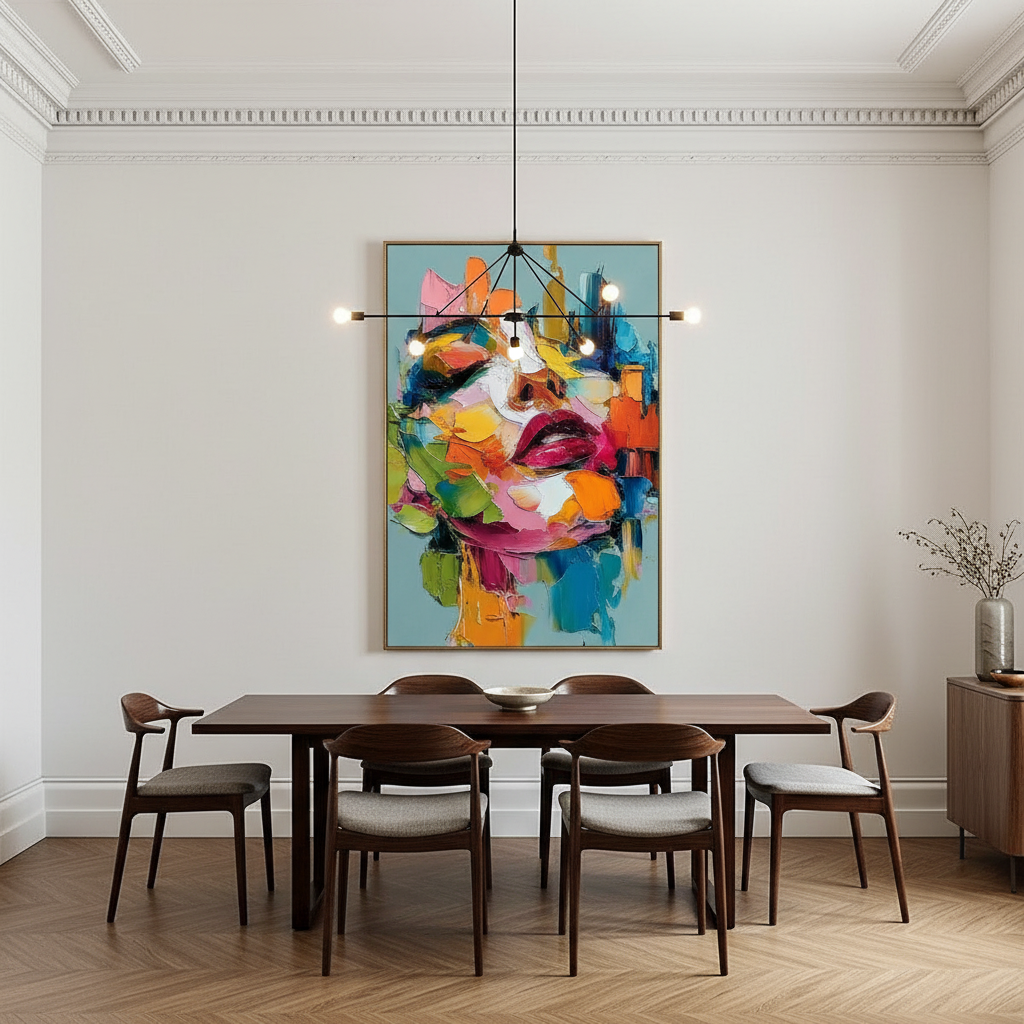
The High-Ceiling Dilemma: Why Standard Rules Fail
In the pursuit of 'camera-ready' interiors, homeowners with high-ceiling dining rooms often encounter a frustrating paradox: the more vertical space they have, the harder it is to make art look intentional. Standard gallery practices, such as the "57-inch center" rule, are designed for standard 8-foot walls. In a room with 12-foot or 14-foot ceilings, following this rule often leaves a vast expanse of "dead air" between the top of the frame and the crown molding, making even large canvases look like an afterthought.
Recent shifts in the global art market reflect a return to "real application value." While high-end auction sales for purely financial art assets plummeted 44% in 2024 according to Marketplace, buyers are increasingly investing in custom, hand-painted works that serve strategic architectural purposes. This move toward authenticity is supported by Columbia University research, which found that consumers value art labeled as "AI-generated" 62% lower than authentic human-created pieces. For the aesthetic-driven homeowner, the goal is "decision safety"—ensuring that a significant investment in a custom-sized mural or canvas will actually anchor the room rather than float aimlessly within it.
The "Top-Down" Method: Anchoring Art to Architecture
To solve the scaling issue in high-ceiling environments, professional designers often abandon eye-level rules in favor of the "Top-Down" method. Instead of measuring from the floor up, you measure from the crown molding down.
Defining the Molding Gap
The crown molding acts as the architectural "cap" of the room. To make the art feel integrated into the building's structure, we recommend leaving a 12-to-24 inch gap between the bottom of the molding and the top of the art frame.
- 12-inch Gap: Best for ceilings between 10 and 12 feet. It creates a tight, gallery-like tension that draws the eye upward.
- 24-inch Gap: Necessary for ceilings exceeding 14 feet or where the crown molding itself is particularly massive (exceeding 8 inches in height).
This gap prevents "scale shock," where a piece delivered to the home suddenly feels too small for the volume of the room. By anchoring the art to the ceiling line, you utilize the architecture to frame the work, rather than forcing the work to compete with the empty wall space.
Modeling Note: Vertical Volume Analysis Our scaling recommendations are based on a scenario model that calculates "Visual Weight Distribution" in residential dining spaces.
Parameter Value/Range Unit Rationale Ceiling Height 120–168 Inches Standard high-ceiling residential range Optimal Art Height 33–40% % of Wall Based on the "Rule of Thirds" heuristic Molding Height 4–12 Inches Varies by architectural style Buffer Zone (Gap) 12–24 Inches Prevents visual crowding at the crown Viewing Distance 8–15 Feet Standard dining room depth Logic Summary: This model assumes a seated viewing position (dining table) and prioritizes the elimination of "dead air" above the frame to maintain architectural hierarchy.

Vertical Scaling and the Rule of Thirds
When selecting the dimensions for a custom commission, the "Rule of Thirds" serves as a reliable heuristic for vertical scaling. In high-ceiling rooms, the artwork should ideally occupy the middle third of the total wall height.
If the art is too low, it feels disconnected from the ceiling; if it is too high, it creates a "looming" effect that can make diners feel physically uncomfortable. For a 12-foot wall (144 inches), the middle third sits between 48 and 96 inches from the floor. Placing a 48-inch tall canvas within this zone—while maintaining the 12-to-24 inch gap from the molding—ensures the piece is both at a comfortable viewing height and architecturally balanced.
Avoiding the 1/8th Rule Trap
Conventional wisdom often suggests the "1/8th to 1/12th rule" for sizing crown molding based on ceiling height. However, as noted in Fine Homebuilding, these 2,000-year-old Greek proportions can fail in modern minimalist homes. For a 12-foot modern ceiling, the rule might prescribe a 15-inch molding that looks heavy and dated. We observe that modern "decision safety" relies on matching the art scale to the actual molding present, not a theoretical ideal. If your molding is slim (3-5 inches), the art can sit closer to it; if the molding is ornate and deep, the gap must increase to avoid visual clutter.
The Physics of Texture: Lighting and Impasto Shadows
For homeowners who value the tactile quality of hand-painted oils, high placement presents a specific technical challenge: shadows. High-end custom art often features impasto—thickly applied paint that creates a three-dimensional surface.
According to research from the Getty Conservation Institute, the surface refractive index and physical texture (microtopography) are the root causes of color saturation and "geometric metamerism"—where a color looks different depending on the angle of light.
The 30-Degree Tilt Rule
When art is hung higher than 6 feet to accommodate high ceilings, standard recessed lighting can cause the heavy impasto ridges to cast "muddy shadows" downward, obscuring the detail of the painting.
- The Solution: Use a 30-degree downward tilt for the frame. This angle allows light to hit the texture more directly, minimizing shadows and revealing the true "essential identity" of the brushstrokes.
- Trade Secret: Professional installers use painter's tape to mock up the "molding gap" and the frame's footprint before the artwork arrives. This simple step prevents the common mistake of ordering a piece that is vertically correct but horizontally overwhelmed by the room's width.

Material Integrity: Health, Safety, and Longevity
Investing in large-scale art for a home environment requires more than just aesthetic consideration; it requires a focus on indoor air quality and material safety.
The VOC and Heavy Metal Reality
Many homeowners are unaware that traditional artist pigments can contain hazardous materials. The International Agency for Research on Cancer (IARC) classifies cadmium compounds as Group 1 carcinogens. Furthermore, Aalto University experiments have shown that indoor coatings can emit volatile organic compounds (VOCs) that impact health.
When commissioning custom art for a dining space, prioritize studios that use low-VOC acrylics or walnut-oil-based paints, which avoid toxic turpentine solvents. According to the EPA, low-VOC materials are essential for maintaining healthy indoor air, especially in spaces where food is consumed.
Lightfastness and Durability
Large dining rooms often feature significant natural light. To ensure your investment doesn't fade, look for materials that meet ASTM D4303 standards for lightfastness. Micom Laboratories notes that these tests simulate decades of indoor light exposure. High-quality acrylic polymers, while softer than oil, offer exceptional anti-aging properties and resistance to embrittlement, making them ideal for large-scale works that may experience slight temperature fluctuations in high-volume rooms.
The Economic and Psychological ROI of Custom Art
Beyond aesthetics, the presence of original, hand-painted art has measurable impacts on property value and occupant well-being.
Property Value Catalysts
A study published by the Royal Society found a direct correlation between "art" geo-tags and relative house price gains in urban neighborhoods. For the individual homeowner, a custom-sized mural or large-scale canvas acts as a "permanent physical billboard" of quality, potentially increasing the resale appeal of the home. In commercial contexts, NAIOP insights reveal that developers use unique art installations as marketing "trump cards" to drive leasing in high-vacancy environments.
The Healing Power of Biophilic Design
High-ceiling rooms can sometimes feel cold or imposing. Integrating "biophilic" art—pieces that feature natural landscapes or organic forms—can mitigate this. A University of Pennsylvania review found that 73% of patients reported significant mood improvements when exposed to environmental artworks. In a home setting, these works activate the medial prefrontal cortex (mPFC), optimizing emotional regulation and reducing stress after a long day.

Implementation Checklist for Homeowners
When planning your high-ceiling art installation, follow this professional sequence to ensure "decision safety":
- Measure the Anchor: Determine the height of your crown molding and calculate a 12-to-24 inch gap.
- Mockup with Tape: Use low-tack painter's tape to outline the proposed art size on the wall. View it from the dining table to check the vertical "Rule of Thirds."
- Verify Pigment Safety: Ask your artist for a material safety data sheet (MSDS) or confirmation that they use non-toxic, low-VOC pigments (e.g., Titanium White instead of Lead White).
- Audit the Lighting: Check if your existing spotlights hit the "texture zone." If the art is high, consider a 30-degree tilt bracket.
- Confirm Authenticity: Ensure the work is 100% hand-painted. As UChicago research suggests, digital replicas lack the "essential identity" that provides long-term emotional and financial value.
By treating art as a strategic architectural solution rather than mere decoration, you can transform the "dead air" of a high ceiling into a powerful visual statement that enhances both the value of your property and the quality of your daily life.
Disclaimer: This article is for informational purposes only and does not constitute professional architectural, legal, or health advice. Always consult with a structural engineer when hanging exceptionally heavy artworks and ensure all installation hardware meets local building codes.
Sources
- The Art Basel and UBS Art Market Report 2024
- Columbia University: Human-Made vs. AI Art Study
- Royal Society: Quantifying the link between art and property prices
- WHO Scoping Review on Arts and Health
- EPA: Indoor Air Quality and Low-VOC Paints
- Getty Conservation Institute: Color Science and Pigment Mixture
- ASTM D4303 Standard Test Methods for Lightfastness











