The New Era of Art Curation: Beyond the Gallery Wall
For decades, the high-end art market was dominated by vanity auction pieces—investments that often sat in climate-controlled vaults rather than being lived with. However, recent data indicates a structural shift. High-end auction sales for pieces over $10 million plummeted 44% year-over-year in 2024, according to Marketplace. Buyers are retreating from purely financial assets and returning to "real application value." They are looking for art that transforms their homes—specifically, custom hand-painted works that fit the unique architectural DNA of their living spaces.
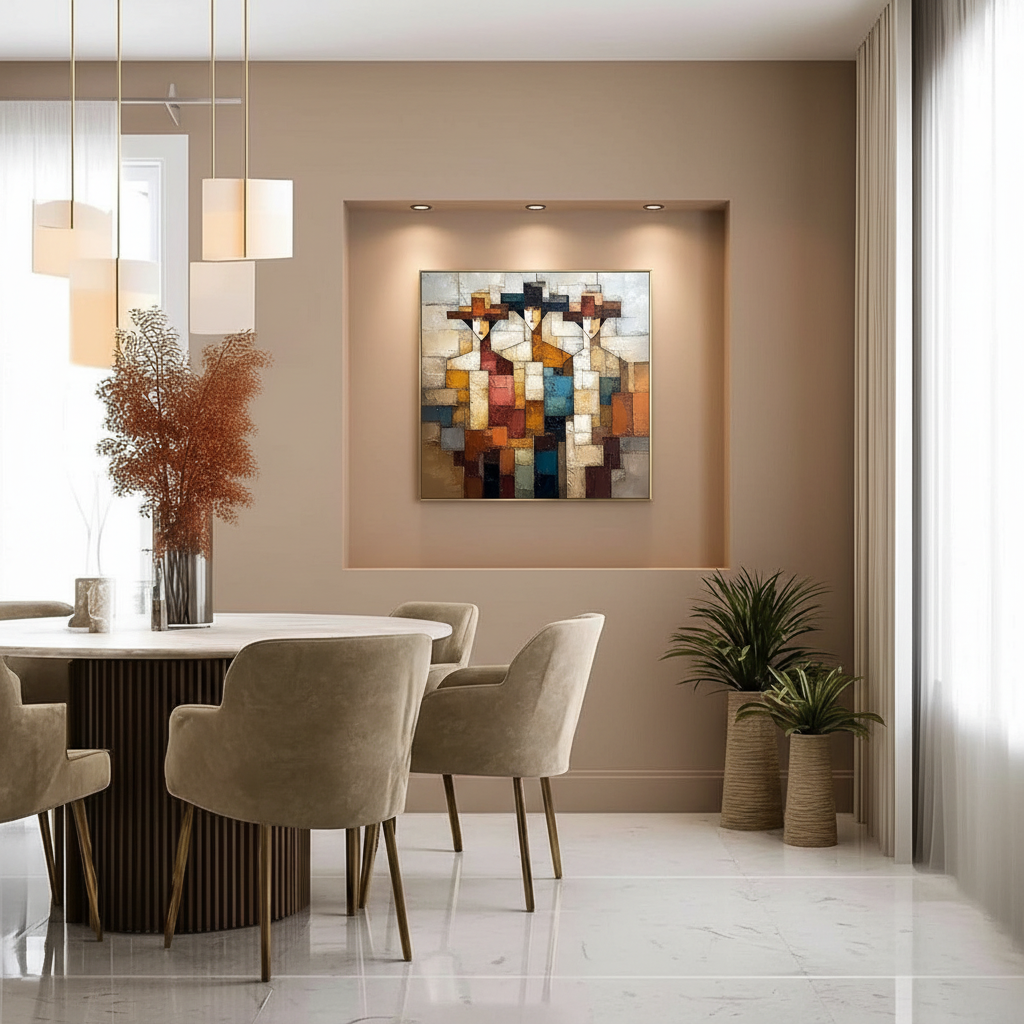
In the world of high-end interior design, few features are as impactful—or as technically demanding—as the dining room niche. These alcoves are designed to be "camera-ready" focal points, yet they present a unique challenge: fitting a three-dimensional object into a two-dimensional architectural void. The most common technical question we encounter in our studio involves the use of deep-profile stretcher bars. While these 1.5-inch to 2.5-inch frames provide a "sculptural" presence in an open room, their impact within a confined niche is often misunderstood.
To achieve "decision safety" in your curation, you must look past the aesthetic allure of a thick canvas and understand the physics of the alcove. This guide breaks down the technical precision required to ensure your dining room art looks intentional, stays structurally sound, and remains visible under varying light conditions.

The Depth Dilemma: Why Measurement Accuracy is Non-Negotiable
Architectural niches are rarely the "perfect boxes" they appear to be. In professional installations, we have observed that alcoves are almost never perfectly plumb or square. Settling in the home or minor drywall irregularities can result in a niche that is 4 inches deep at the top left but only 3.75 inches deep at the bottom right.
Before selecting a stretcher bar profile, you must measure the depth at all four corners and the center to identify the shallowest point. If you select a 2.5-inch deep-profile bar for a 3-inch niche, you might assume you have plenty of clearance. However, our internal analysis of niche installations suggests a common oversight: the mounting hardware.
Logic Summary: Our analysis of niche installations assumes that a "flush" look requires the canvas face to align with the wall plane. We utilize a heuristic known as the 1/4-Inch Deduction Rule to account for Z-clip or French cleat thickness.
To achieve a truly flush look, practitioners recommend subtracting at least 1/4 inch from the niche depth to account for mounting hardware. Without this deduction, a deep-profile canvas will often protrude past the wall plane, breaking the architectural "envelope" and creating a cluttered appearance.
Modeling Note: Niche Clearance Parameters
The following table outlines the estimated clearance requirements based on common industry heuristics for recessed installations.
| Parameter | Recommended Value | Unit | Rationale |
|---|---|---|---|
| Hardware Offset | 0.25 - 0.375 | Inches | Space required for Z-clips or cleats |
| Plumb Variance | 0.125 - 0.25 | Inches | Typical drywall irregularity allowance |
| Light Wash Gap | 1.0 - 2.0 | Inches | Recess depth needed for overhead light spread |
| Expansion Gap | 0.125 | Inches | Perimeter gap for thermal wood movement |
| Minimum Niche Depth | 4.0 | Inches | Base depth for standard 1.5" gallery wraps |
Note: This is a scenario model based on standard residential construction patterns, not a controlled lab study.
The Shadow Effect: Visibility vs. Profile Depth
The most significant "gotcha" with deep-profile stretcher bars in dining rooms is the creation of problematic shadow zones. Conventional wisdom suggests that deep bars create a "gallery-style" presence. However, in the context of a dining niche—which is typically illuminated by top-down puck lights or recessed cans—the results can be counterproductive.
Research into visual art in the built environment by the University of Pennsylvania notes that environmental artworks can reduce stress by up to 61%. But for this effect to occur, the art must be visible. Deep-profile bars (1.5" to 2.5") pull the canvas face further away from the back wall of the niche. Under typical dining room lighting, this creates harsh shadows that can obscure up to 40% of the artwork’s top third.
If you are using top-down lighting, we recommend a slightly recessed position—placing the art 1 to 2 inches back from the wall plane. This allows the light to "wash" the surface more evenly rather than being blocked by the top edge of the frame.

Structural Integrity and the "Dining Room Microclimate"
Dining rooms are not static environments. They experience significant temperature and humidity swings—often 15-25°F during large gatherings or holiday cooking. This "microclimate" has a direct impact on the wood used in stretcher bars.
According to technical bulletins from conservationists, wood stretcher bars can expand or contract significantly. Deep-profile bars, which contain 2 to 3 times more wood volume than standard profiles, exhibit 50-75% greater dimensional movement. In a tight niche, where the rigid sides of the alcove prevent natural weight distribution, this movement can lead to:
- Canvas Tension Loss: As the wood moves, the canvas can become "wavy" or lose its "drum-tight" feel within 6-12 months.
- Mounting Stress: Deep profiles create concentrated stress points. In an enclosed niche, the pressure on mounting points can be 3-4x higher because the frame cannot flex naturally.
For alcove stability, rigid cleats or French cleats are the industry standard. We strongly advise against traditional wire hanging in tight niches. Wire hanging causes the art to tilt forward, which often leads to the top of the canvas hitting the niche ceiling or creating uneven, distracting gaps.
The "Human Premium": Why Authenticity Matters in High-Visibility Areas
In high-visibility areas like the dining room, the "camera-ready" result isn't just about the frame—it's about the soul of the work. A study by Columbia University confirmed that consumers value art labeled as "human-created" 62% lower if it is revealed to be AI-generated. This is because digital replicas lack what researchers at the University of Chicago call "essential identity."
A hand-painted mural or canvas retains a physical, micro-topographic texture that digital prints cannot replicate. Optical microprofilometry proves that the millimeter-scale texture of oil paint is crucial to its aesthetic impact. When you view a hand-painted piece in a niche, your brain recognizes the "active" surface. This isn't just a subjective feeling; neurological research shows that viewing art activates the mPFC and amygdala, optimizing emotional regulation.
For homeowners, this means that investing in "real art" provides a tangible psychological ROI. Furthermore, neighborhoods with higher "art" geo-tags have seen greater relative house price gains, according to the Royal Society. A custom niche mural isn't just decor; it's a permanent physical billboard that increases property value.
Health and Safety: The Invisible Standards of Art Materials
When installing art in a dining environment, health and safety are paramount. Many consumers are unaware that art materials do not enjoy the same lead and VOC exemptions as common household paints.
The CDC and NIOSH warn that chronic inhalation of low-level volatile compounds in certain paints can lead to central nervous system issues. Specifically, traditional "oil" paints often rely on solvents like turpentine. Princeton University's EHS guidelines warn that even "odorless" solvents can cause skin defatting and brain damage over time.
To ensure a safe dining environment, we prioritize water-based acrylics or low-VOC oils. Modern acrylic polymers, as noted by Golden Artist Colors, consist of long-chain molecules that form films through a physical coalescence process. These films are softer and more resistant to embrittlement than traditional oils, making them ideal for the temperature-variable dining room.
Material Safety Checklist for Dining Areas:
- VOC Compliance: Ensure paints meet LEED or WELL certification standards for indoor air quality.
- Pigment Safety: Avoid cadmium-based pigments. The International Agency for Research on Cancer (IARC) classifies cadmium as a Group 1 carcinogen.
- ASTM D-4236: Look for this label, but remember it only means warning labels comply with regulations, not that the paint is "non-toxic."
- Eco-Friendly Substrates: Consider hemp or flax canvases, which consume half the water of cotton to produce, as highlighted by the Cincinnati Art Museum.
Designing for 2026: The Return of "Whimsy" and Texture
As we look toward 2026 home design trends, Zillow and Yelp data show a 21% rise in searches for "artisan craftsmanship" and a massive 329% spike for "custom framing." The "assembly-line" look is being replaced by "understated elegance," where texture is the soul of the space.
In high-end powder rooms and dining niches, the trend is moving toward "panoramic" hand-painted murals that wrap entirely around the walls. This creates a sense of "immersive escapism," a dominant theme at the NKBA 2025 awards. By integrating biophilic design—natural landscapes that mimic the outdoors—homeowners can trigger the same stress-reduction effects in the brain as being in nature, according to research from the University of Central Arkansas.
Final Checklist for Niche Art Installation
To ensure your dining room niche art is a success, follow this technical protocol:
- The 5-Point Measurement: Measure depth at all four corners and the center. Use the shallowest measurement as your baseline.
- Hardware Deduction: Subtract 1/4 inch from your depth baseline to allow for Z-clips or French cleats.
- Lighting Gap: If using top-down lights, ensure the canvas is recessed 1-2 inches from the wall plane to prevent "top-shadowing."
- Cleat Mounting: Always use rigid cleats for stability in alcoves to prevent forward tilt.
- Substrate Check: For dining rooms, prefer acrylics or low-VOC oils on stable, well-primed canvases to avoid "Support Induced Discoloration" (SID), where impurities from the canvas leach into the paint.
By focusing on these technical details, you move from "buying decor" to "investing in a cultural heritage asset." A perfectly fitted, hand-painted piece in a dining niche does more than fill a void; it anchors the room, protects your property value, and provides a safe, healthy environment for your family and guests.
Disclaimer: This article is for informational purposes only and does not constitute professional architectural, medical, or financial advice. Always consult with a qualified contractor or health professional before making structural changes to your home or selecting materials for sensitive environments.
Sources
- Marketplace: The expensive art market continues to struggle
- Columbia University: Human-Made vs. AI Art Study
- University of Pennsylvania: Visual Art in the Built Environment
- Royal Society: Quantifying the link between art and property prices
- Princeton University EHS: Painting and Drawing Safety
- WHO: Arts and Health Scoping Review
- National Gallery: Fading of Prussian blue in various binding media
- Tate: Conservation Concerns for Acrylic Emulsion Paints
- ASTM D4303 Standard Test Methods for Lightfastness