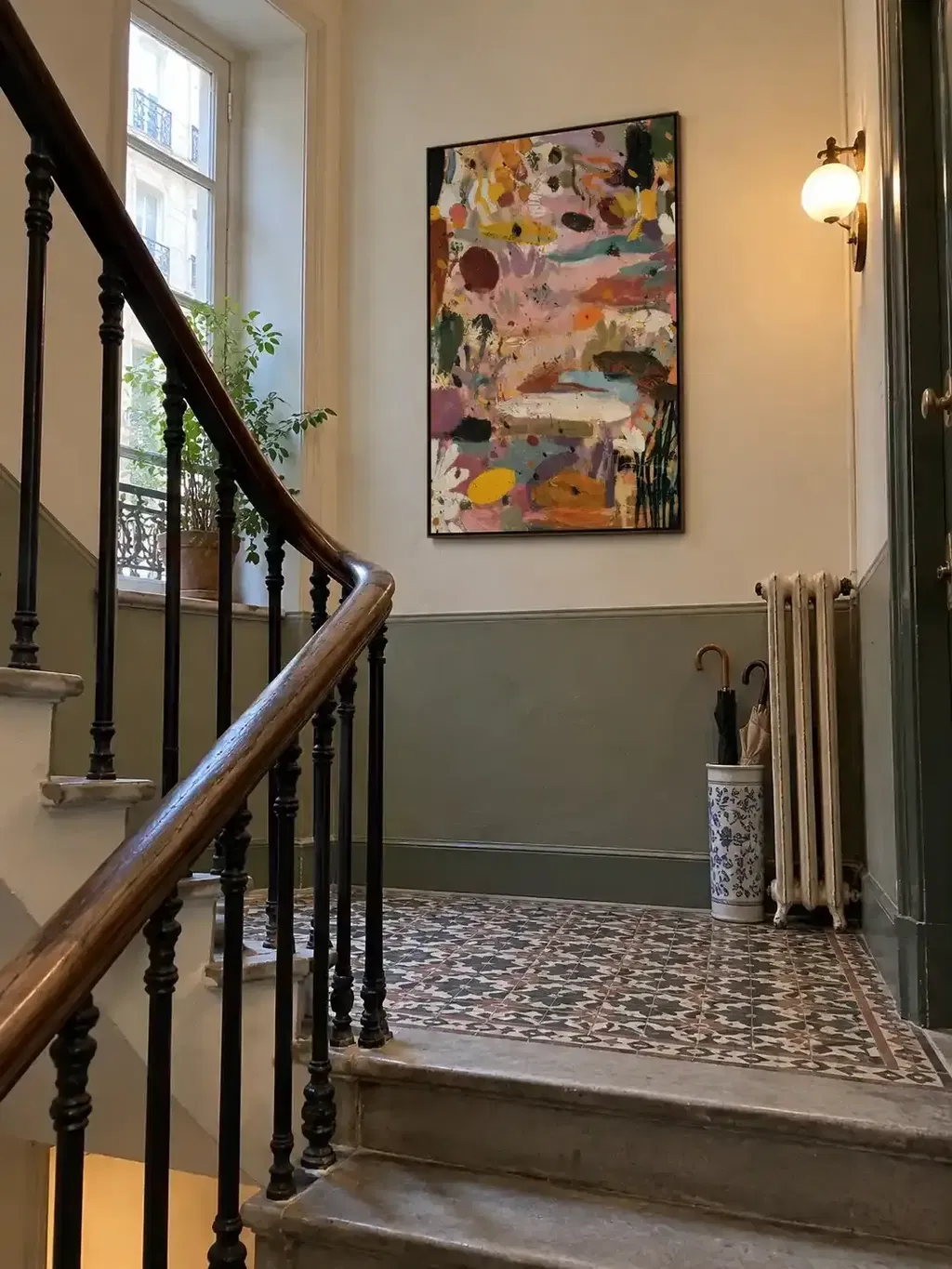
The 50-Millisecond Threshold: Why the Foyer Dictates Property Perception
In the high-stakes world of residential real estate, the foyer is often treated as a transitional space—a mere hallway to the "real" rooms. However, our observations in property staging and valuation suggest a different reality. The entryway is the psychological handshake of the home. According to research on real estate photography and first impressions from Velvet Images, potential buyers form an initial subconscious judgment of a property in as little as 50 milliseconds.
This micro-moment of perception sets the "emotional baseline" for the entire tour. When a foyer features a high-impact, hand-painted original work of art, it triggers what psychologists call the "Halo Effect." This cognitive bias leads buyers to perceive the entire property as better maintained, more luxurious, and of higher intrinsic value simply because the first point of contact was of superior quality.
We see this pattern consistently: homeowners who invest in a custom foyer mural or large-scale canvas often see a disproportionate return on investment (ROI). It isn't just about "decorating"; it is about signaling "decision safety" to a buyer. In an era where the expensive auction art market is struggling, falling by 44% for pieces over $10 million, savvy collectors and homeowners are shifting toward "application value"—custom art that lives within the architecture to solve specific spatial and financial problems.
The Neuroscience of Entryway Art: mPFC and Emotional Regulation
Why does a hand-painted canvas feel fundamentally different from a high-definition print? The answer lies in how our brains process texture and "essential identity."
A systematic review published in PMC (NCBI) reveals that passive viewing of art consistently activates the medial prefrontal cortex (mPFC) and the amygdala. These areas are responsible for emotional regulation and self-referential thought. When we encounter the physical relief of oil paint—the microscopic shadows created by impasto brushwork—our brains register a depth that flat digital prints lack. This activation optimizes our emotional state, making the transition from the "outside world" to the "private sanctuary" feel more profound.
Furthermore, a study by Columbia University confirms that consumers value art labeled "human-made" 62% higher than AI-generated alternatives. This "human premium" is critical in a foyer. A digital print signals mass production and "staging-by-numbers," whereas a hand-painted original signals the artist’s "essential identity." As noted in UChicago’s research on artwork and identity, digital replicas lack the soul that a canvas retains, causing a collapse in perceived value.

Quantifying the "Halo Effect": Art as a Valuation Catalyst
While design's impact is often dismissed as subjective, recent data-driven models provide a more concrete link between art and property prices. The Royal Society’s analysis of a 10-year dataset found that neighborhoods with higher "art" geo-tags experienced greater relative gains in house price rankings.
In the context of a single residence, the foyer serves as the "anchor" for this valuation. We have developed a scenario model to estimate the potential impact of strategic art placement on property perception.
Foyer Art Valuation Impact Model (Heuristic Estimate)
Modeling Note: This table represents a scenario model based on common industry heuristics and professional staging observations, not a controlled laboratory study. Impact varies by market density and property tier.
| Parameter | Value/Range | Unit | Rationale/Source Category |
|---|---|---|---|
| Initial Perception Speed | ~50 | Milliseconds | Velvet Images Neuroscience Data |
| Perceived Value Lift (Staging) | 5–15 | % of Total Value | MIT Value of Design Research |
| Art-to-Wall Width Ratio | 60–75 | % | Expert Staging Heuristic |
| "Human-Made" Value Premium | ~62 | % | Columbia University Consumer Study |
| ROI of Art Investment (Public/B2B) | 7:1 | Ratio | Americans for the Arts (AEP3) |
Boundary Conditions for the Model:
- The model assumes a "neutral" interior palette where the art acts as the primary focal point.
- Impact diminishes if the art is undersized (the "Postage Stamp Syndrome").
- The "Human-Made" premium applies specifically to original hand-painted works, not limited edition prints.
Technical Execution: Overcoming "Postage Stamp Syndrome"
The most common mistake we see in foyer design is the "Postage Stamp Syndrome"—hanging a piece of art that is too small for the wall, which inadvertently makes the entryway feel cramped and poorly planned.
To maximize the foyer's psychological impact, we recommend that art occupy 60–75% of the available wall width. This scale creates an immersive experience that commands attention. In foyers with high-angle lighting or sconces, the physical texture of the art becomes even more critical. Heavy oil texture (impasto) creates depth through micro-shadows. These shadows signal "luxury" to the subconscious mind because they are physically impossible to replicate in a flat print.
For interior designers and trade professionals, the ability to modify color palettes during the approval phase is a critical ROI protector. When commissioning a custom piece, ensuring the pigments harmonize with the specific flooring undertones and paint swatches (like Benjamin Moore or Sherwin-Williams codes) before the property goes live is essential for a cohesive "first impression."

Health, Safety, and the "Biophilic" Entryway
A foyer is not just a visual space; it is an environmental one. The materials used in your art significantly impact indoor air quality (IAQ).
The Low-VOC Mandate
The EPA warns that indoor air pollution can be more detrimental than outdoor pollution. For large-scale murals or heavy oil paintings, using low-VOC (Volatile Organic Compound) paints is non-negotiable, especially for health-conscious clients. Research from Aalto University shows that coatings on wood (common in foyer framing and panels) emit significantly lower VOCs during the curing process if high-quality, modern binders are used.
The Power of Biophilic Design
Integrating nature-themed art into the foyer—known as biophilic design—can have measurable health benefits. According to a WHO scoping review of over 3,000 studies, art interventions effectively alter clinical indicators for stress. In a foyer, a nature-themed mural can produce the same stress-reduction effects as being outdoors, accelerating the "decompression" process for residents returning home. This is particularly effective in high-density urban environments where cognitive fatigue is high.
Logic Summary: Our recommendation for biophilic art assumes that the visual representation of natural fractal patterns triggers an innate parasympathetic response, as supported by the University of Central Arkansas research on biophilic well-being.
Beyond the Home: Art as a Commercial Landmark
The "Psychology of the Foyer" extends to commercial and public spaces. Large-scale murals are often the lowest-cost physical foot traffic generators for urban business districts. A University of Cincinnati regression analysis of over 300 murals shows a direct correlation with increased pedestrian traffic.
For property developers, art is more than decoration; it is a marketing trump card. Insights from NAIOP (Commercial Real Estate Development Association) reveal that top developers are using unique public art installations to lease up millions of square feet of office space in a post-pandemic market. In these contexts, the foyer (or lobby) art serves as the "brand identity" of the entire building.
The Science of Pigment: Why Lightfastness Matters
When investing in foyer art, durability is a primary concern. Foyers are often subject to fluctuating light conditions from open front doors. This is where the chemistry of the paint becomes vital.
The ASTM D4303 standard defines the lightfastness of artist paints using physical instruments like xenon-arc testers. High-end pigments, such as those used in museum-quality hand-painted works, are tested to ensure they do not fade over decades. We often see homeowners disappointed by "budget" art that loses its vibrancy within two years of sun exposure.
Interestingly, while many believe oil paint is the "gold standard" for longevity, Tate Museum research suggests that modern acrylic polymers have extremely strong anti-aging properties and superior flexibility, making them less prone to the cracking (embrittlement) seen in old oil films. However, acrylics are sensitive to moisture; ResearchGate data shows that under 83% humidity, certain acrylic pigments can swell by over 7% in mass due to water absorption.

Ethics and the Future of the Art Industry
As a brand, we believe that the value of art is inextricably linked to the well-being of the creator. A Wharton School survey found that 87% of consumers strongly agree that artists should receive fair compensation. This ethical demand is driving a return to "fair trade" art models.
By supporting real artists with equitable pay, homeowners aren't just buying a visual asset; they are participating in a creative economy that adds $1.2 trillion to the U.S. GDP (NEA Data 2023). This social value further reinforces the "Halo Effect"—knowing the art was ethically sourced adds a layer of "moral luxury" that resonates with modern buyers.
Investing in "Essential Identity"
Ultimately, the psychology of the foyer is about more than just aesthetics or even valuation. It is about the "essential identity" of a home. Whether it is a panoramic hand-painted mural wrapping around a powder room (a dominant trend for 2026) or a single, textured abstract anchoring the entryway, the choice of art tells a story.
By moving away from mass-produced prints and toward hand-painted originals, you are investing in a non-renewable cultural asset. As the MUNCH Museum tests confirm, physical relief textures exponentially stimulate intrinsic motivation and satisfaction in viewers. In the foyer, this satisfaction translates directly into property value, emotional well-being, and a lasting first impression.
YMYL Disclaimer: This article is for informational purposes only and does not constitute professional real estate, financial, or medical advice. Property valuations are subject to market fluctuations. When handling art materials or paints, always refer to the manufacturer’s Safety Data Sheet (SDS) and ensure proper ventilation. If you have respiratory sensitivities, consult a specialist regarding low-VOC environments.
References
- The Art Basel and UBS Art Market Report 2024
- WHO Scoping Review on Arts and Health
- Royal Society: Quantifying the link between art and property prices
- Columbia University: Human-Made vs. AI Art Study
- Velvet Images: First Impressions in Real Estate Photography
- Tate: Conservation Concerns for Acrylic Emulsion Paints
- EPA: Indoor Air Quality and Low-VOC Paints