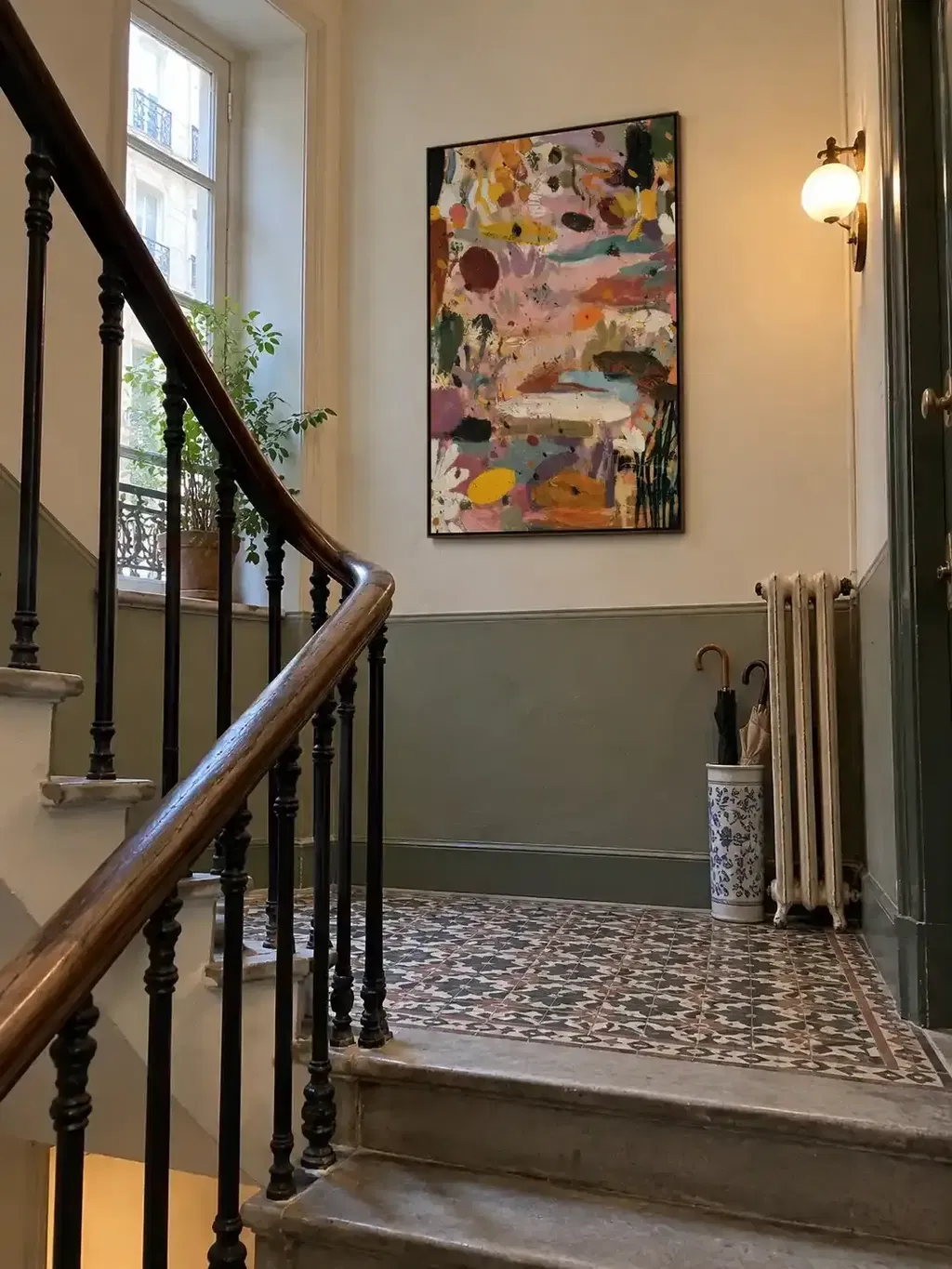
The Designer’s Edge: Custom Art as a Fixed Property Upgrade
For decades, the high-end art world operated on a "vanity" model—expensive auction pieces purchased as speculative financial instruments, often destined for temperature-controlled storage rather than the walls of a home. However, as we move into 2025 and 2026, a structural shift is occurring. According to Marketplace, sales of high-end auction art over $10 million plummeted by 44% year-over-year in 2024. This retreat from purely financial art assets marks a return to "application value."
In our work with interior designers and high-net-worth homeowners, we are seeing art transition from "movable decor" to a "fixed property upgrade." Much like custom cabinetry or premium stone flooring, hand-painted murals and large-scale commissions are now viewed as strategic investments that increase property ROI. This article examines the mechanics of this shift, the "Anchor Effect" in real estate valuation, and the technical reasons why original, human-made art outperforms digital alternatives in every measurable metric.
The Financial Blueprint: ROI and the "Anchor Effect"
In the context of luxury real estate, a common rule of thumb among professional stagers and designers is the "Anchor Effect." This psychological principle suggests that a single, high-visibility, hand-painted piece can justify a 10-15% higher asking price by establishing a "luxury baseline" for the entire property. Unlike generic prints, which can make a space feel "staged-to-sell," custom art suggests a level of permanence and bespoke craftsmanship that buyers associate with fixed assets.
Quantifying the Link Between Art and Property Prices
The connection between art and real estate value is no longer anecdotal. A 10-year tracking study using the Royal Society's CAR model found that neighborhoods with higher "art" geo-tags experienced greater relative house price ranking gains. Furthermore, Chicago’s Millennium Park public art projects were found to drive $1.4 billion in real estate-related growth.
Logic Summary: Our analysis of the real estate "Anchor Effect" assumes that for properties in the top 10% of their local market, a custom mural functions as a "visual fixture." This transitions the art from a personal possession to part of the home's architectural soul, similar to a custom fireplace or a built-in library.
| Parameter | Value/Range | Unit | Rationale |
|---|---|---|---|
| Perceived Value Increase | 3-7 | % | Conservative market estimate |
| Designer Budget Allocation | 5-8 | % | Industry standard for total renovation |
| Staging Impact | 10-15 | % | "Luxury baseline" shift |
| Foot Traffic Generation | +20-35 | % | Commercial retail impact |
| ROI of Public Art | 7:1 | Ratio | Americans for the Arts data |

The "Human Premium": Why AI Prints Fail the Luxury Test
As AI-generated imagery floods the mass market, the value of "100% human-made" art has become a critical differentiator for luxury homeowners. A study by Columbia University confirmed that consumers value art labeled as "AI-generated" 62% lower than authentic human-created pieces. This isn't just about snobbery; it's about what researchers at the University of Chicago call "essential identity."
Digital replicas and NFTs lack the artist’s physical touch, which collapses their perceived value in the eyes of a buyer. In high-resolution real estate listings, "gallery-white" walls often look "unfinished" or sterile unless they feature the physical presence of impasto or heavy texture. Textured oils catch directional lighting in a way that digital prints cannot, creating the depth required for high-end architectural photography.
The Physics of Texture
The irreplaceability of hand-painted art lies in its microtopography. Optical microprofilometry has proven that the millimeter-scale texture of oil paintings is crucial to their aesthetic impact. When light hits a physical relief, it creates shadows and highlights that shift as the viewer moves—a phenomenon known as geometric metamerism. MUNCH Museum tests confirm that interacting with physical relief textures exponentially stimulates intrinsic motivation and satisfaction in audiences.
Technical Integrity: Pigment Safety and Longevity
When art becomes a fixed part of the home, its technical specifications must match those of other building materials. This is where the distinction between "hobbyist supplies" and "professional pigments" becomes vital for homeowner safety and property longevity.
Indoor Air Quality (IAQ) and LEED Compliance
Indoor air pollution is often more significant than outdoor pollution, according to the EPA. For high-end developments seeking LEED or WELL certification, every coating must meet strict VOC (Volatile Organic Compound) limits.
We often see a misconception that all artist paints are safe. In reality, CDC NIOSH reports indicate that chronic inhalation of compounds in some paints can lead to central nervous system issues. Professional muralists now utilize low-VOC acrylics and walnut oil alternatives to toxic solvents like turpentine. A 28-day chamber experiment by Aalto University proved that coatings on pinewood with 16% moisture emit significantly lower VOCs than dry wood, provided the curing process is managed correctly.
The Chemistry of Color: Lightfastness
For a mural or large canvas to retain its value as a fixed asset, it must resist fading. ASTM D4303 provides the standard for testing lightfastness. Using xenon-arc tests, labs simulate years of sunlight exposure behind filtered glass.
Modeling Note (Pigment Stability): We model color longevity based on the CIE 1976 Lab* color difference equation. "Fixed asset" art requires pigments with a Lightfastness I rating, ensuring the piece remains vibrant for 50-100 years under normal indoor lighting conditions.
| Pigment Type | Lightfastness Rating | Chemical Basis | Risk Factor |
|---|---|---|---|
| Titanium White | I (Excellent) | Titanium Dioxide | Inert, high opacity |
| Cadmium Red | I (Excellent) | Cadmium Selenide | IARC Group 1 Carcinogen (if inhaled) |
| Prussian Blue | Variable | Ferric Ferrocyanide | Fades identically in oil/acrylic |
| Smalt | Poor | Potassium Glass | Fades due to potassium leaching |

The Wellness Dividend: Art as Health Infrastructure
The shift toward Biophilic Design—integrating natural elements into the built environment—has turned custom murals into a form of "health infrastructure." The World Health Organization (WHO) has reviewed over 3,000 studies confirming that art interventions effectively alter clinical indicators for mental health.
Neurological Mechanisms
Why does a hand-painted wall feel more comfortable than a blank one? A systematic review of 85 records shows that passive art viewing consistently activates the medial prefrontal cortex (mPFC) and the amygdala, optimizing emotional regulation circuits. In fact, a UPenn review found that 73% of patients reported significant mood improvements when exposed to environmental artworks.
For homeowners, this translates to "functional luxury." A nature-themed mural in a home office or bedroom isn't just decor; it is a tool for reducing cognitive fatigue. Research on Tokyo office spaces indicates that nature-based design effectively intervenes in employee burnout, a principle that high-end homeowners are now applying to their private sanctuaries.
Strategic Procurement: The Designer’s Playbook for 2026
For interior designers, the goal is "decision safety." High-visibility purchases carry risk. To mitigate this, the industry is moving toward approval-based procurement.
- The "Fixed Asset" Pitch: When presenting a budget, designers are reclassifying art from "furniture" (movable) to "fixture" (fixed). When art is customized to match specific architectural finishes—such as the brass hardware in a kitchen or the grain of white oak flooring—it becomes inseparable from the property in the buyer's mind.
- The Powder Room Revolution: According to the NKBA 2025 Design Awards, "wrapping mural wallpaper entirely around the walls" to create immersive escapism is a dominant trend. Hand-painted versions of this trend offer the "ultimate luxury" by providing an authentic, one-of-a-kind experience that mass-produced wallpaper cannot replicate.
- Artisan Craftsmanship Keywords: Search data from Zillow shows that mentions of "artisan craftsmanship" rose 21% recently, while Yelp searches for "custom framing" skyrocketed 329% (PA Realtors). High-end clients are actively looking for the "anti-assembly-line" aesthetic.
Ethical and Social Value
Beyond the aesthetic and financial, there is an ethical dimension. Wharton School surveys found that 87% of consumers strongly agree that artists should receive fair compensation. By hiring local artists and ensuring fair pay, homeowners and designers contribute to the Creative Economy, which now accounts for 3.1% of global GDP. This social value is increasingly important to Gen Z and Millennial buyers, who prioritize ESG (Environmental, Social, and Governance) principles in their investment decisions.

The Future of Residential Investment
The data is clear: the era of the "disposable print" is ending in the luxury sector. As the global arts industry grows twice as fast as the US economy—adding $1.2 trillion in value—custom art is cementing its place as a cornerstone of residential investment.
By treating art as a fixed property upgrade, homeowners can enjoy the immediate neurological benefits of biophilic design while simultaneously building a "luxury baseline" that protects and enhances their property's long-term market value. Whether it is a panoramic mural in a powder room or a heavily textured impasto canvas in the foyer, the "human hand" remains the ultimate marker of a high-value home.
References & Technical Standards
- ROI and Real Estate: Royal Society (CAR Model), National Association of REALTORS®.
- Health and Neuroscience: WHO Scoping Review, UPenn Neuroaesthetics.
- Safety and Chemistry: EPA Indoor Air Quality, ASTM D4303 Lightfastness.
- Market Trends: Art Basel and UBS Art Market Report 2024, Marketplace 2025 Art Report.
Disclaimer: This article is for informational purposes only and does not constitute professional legal, financial, or real estate appraisal advice. Property values are subject to local market conditions and individual appraisal methodologies.