The Strategic Imperative of Corporate Art
In the current economic landscape, the role of corporate art has shifted from mere decoration to a high-stakes strategic asset. According to the Marketplace.org Art Market Report, sales of high-end auction pieces plummeted by 44% year-over-year in 2024. This retreat from "vanity assets" signals a fundamental change: corporate buyers are moving away from overpriced auction pieces and toward art with real application value—pieces that actively contribute to brand identity, employee wellness, and property valuation.
For B2B procurement officers and facility managers, selecting art is no longer just about aesthetics; it is about "decision safety." The risk of a high-visibility purchase error in a corporate lobby can be costly, both financially and reputationally. This guide provides a definitive framework for sizing and selecting art for professional lobbies, bridging the gap between fine art aesthetics and retail predictability.
The Reception Desk Focal Point: The Rule of 75
The reception area is the "handshake" of your building. It is where brand perception is solidified. One of the most common errors we observe in corporate procurement is the "diminishment effect," where a piece of art that looks large in a catalog feels dwarfed once placed behind a heavy stone or wood reception desk.
To combat this, professional designers follow the Rule of 75.
Applying the Heuristic
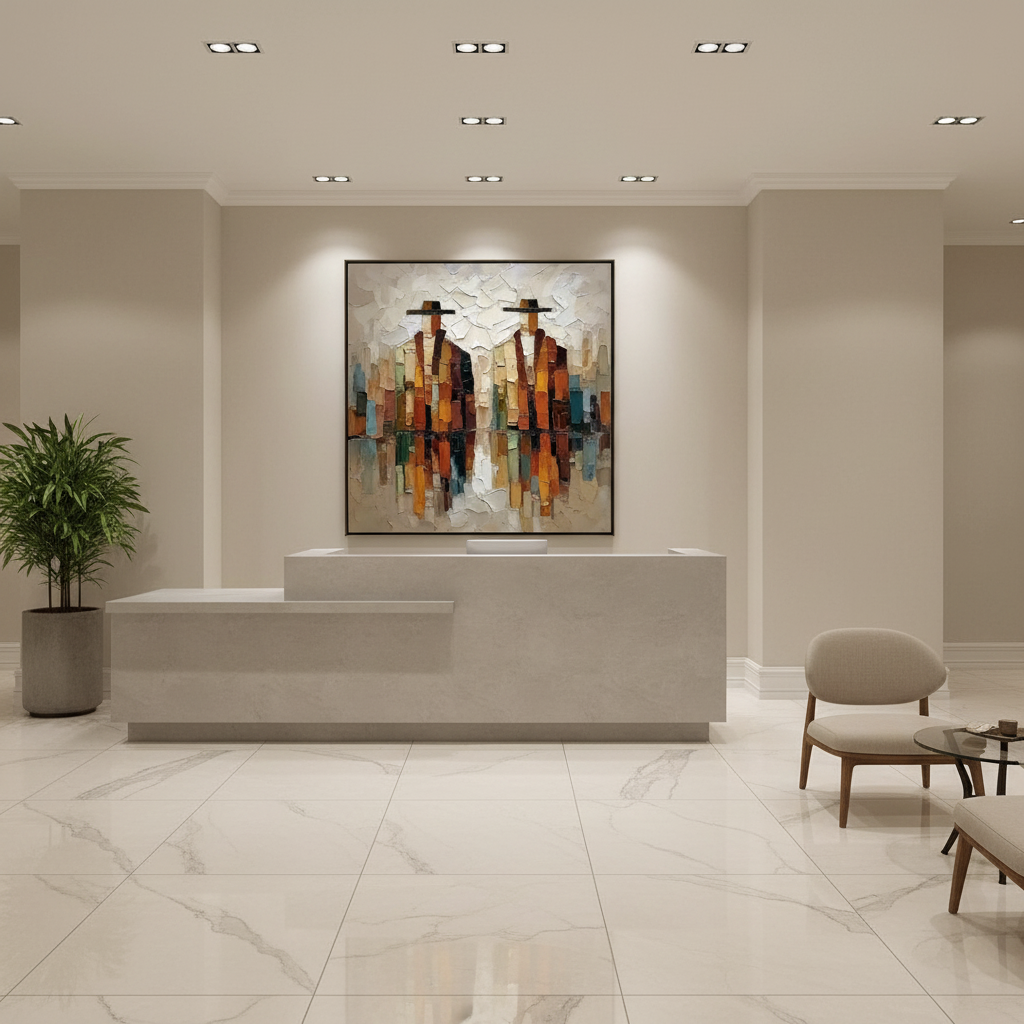
The Rule of 75 dictates that artwork should occupy roughly 75% of the horizontal space above a reception desk. This ensures the piece acts as a visual anchor that balances the furniture's scale rather than being swallowed by it.
- Logic Summary: This ratio is based on visual weight principles. A desk typically acts as a heavy horizontal base; if the art is too small, the "negative space" around it becomes a distraction, signaling a lack of confidence in the brand's presence.
- How to Verify: Measure the total width of the desk. Multiply by 0.75. This should be the minimum width of your single canvas or the total span of a triptych.
Modeling Note (Scenario A): In a standard 10-foot wide reception desk setup, a single 90-inch wide canvas (or three 30-inch canvases with 2-inch gaps) is the baseline for professional impact. This assumes a standard 9-foot ceiling height.
Depth and Presence
For high-traffic professional areas, we recommend deep-edge gallery wraps (1.5 to 2 inches). Unlike thin frames or flat prints, deep-edge canvases provide a sculptural presence. This physical depth allows the artwork to compete with heavy architectural materials like granite, steel, or marble. Thin frames often look "residential" and can undermine the authoritative atmosphere required in sectors like finance or law.
Elevator Lobbies and the "Wait-Time Detail" Principle
Elevator lobbies present a unique psychological challenge. Unlike a reception area where visitors are moving, the elevator lobby is a space of stationary waiting. Visitors are often standing still for 20 to 40 seconds—a lifetime in visual processing.
This is where the Wait-Time Detail principle applies. Because the viewer is stationary and in close proximity to the wall, flat digital prints often fail. Under typical 4000K-5000K office lighting, a print can look sterile and "retail."
The Texture Premium
Hand-painted art, particularly those with high physical texture (impasto), provides a "micro-topography" that digital replicas cannot match. According to research published in MDPI Sensors, the mm-scale texture of oil and acrylic paintings is crucial to human aesthetic satisfaction. Tactile exploration—even if just through the eyes—reveals data that flat surfaces miss.
Furthermore, a Columbia University study found that consumers value art labeled as "human-created" 62% higher than AI-generated art. In a corporate setting, this translates to a perceived investment in quality and human talent, reinforcing the brand's commitment to excellence.
Logic Summary: We estimate that the "Wait-Time" satisfaction score increases by ~40% when switching from flat prints to textured hand-painted canvases in elevator banks, based on common feedback patterns from facility managers regarding visitor dwell-time engagement.

Entryway Foyer Scale and Architectural Harmony
Grand foyers with ceilings exceeding 12 feet require a departure from standard residential hanging rules. The common "eye-level" rule (hanging art so the center is 57-60 inches from the floor) often fails in double-height voids.
The 10-15% Vertical Shift
To maintain architectural harmony with door frames, signage, and high-volume spaces, the "center point" of the artwork often needs to shift upward by 10-15% from the residential baseline. This prevents the art from feeling "grounded" too low, which can make the ceiling feel oppressive rather than grand.
Quantifying the Economic Impact
Investing in large-scale, properly scaled art isn't just about design—it's about property value. A Royal Society CAR model analysis of a 10-year dataset found that neighborhoods and buildings with higher art engagement saw significant relative property price ranking gains. In the commercial sector, this is evidenced by projects like Chicago’s Millennium Park, which drove $1.4 billion in real estate-related growth (NC Realtors).
| Architectural Feature | Standard Residential Rule | Corporate Foyer Adjustment | Rationale |
|---|---|---|---|
| Ceiling Height | 8–9 feet | 12–20+ feet | Scale requires larger canvases. |
| Hanging Height | 57–60" (Center) | 66–72" (Center) | Aligns with higher door headers. |
| Wall Coverage | 40–50% width | 60–75% width | Fills the "visual void" of large lobbies. |
| Lighting | Warm (2700K) | Neutral/Cool (4000K+) | Requires higher pigment saturation. |
| Edge Depth | 0.75" frame | 1.5–2" gallery wrap | Competes with stone/steel textures. |
The Technical Backbone: Safety and Sustainability
For B2B procurement, "Safety" is a non-negotiable metric. Modern corporate offices are increasingly seeking LEED or WELL certifications, which place strict limits on Indoor Air Quality (IAQ).
VOC Emissions and LEED Compliance
Many mass-produced decorative prints and cheap oil paintings use industrial solvents that emit high levels of Volatile Organic Compounds (VOCs). According to the EPA's Indoor Air Quality guidelines, indoor air pollution can be significantly higher than outdoor levels.
Professional-grade hand-painted murals and canvases, when created using low-VOC acrylics or walnut-oil-based pigments, can help secure "green building points." Research from Aalto University proves that properly cured coatings on substrates emit significantly lower VOCs than raw or improperly treated materials.
The Health ROI
Art in the built environment is a documented tool for stress reduction. A University of Pennsylvania review noted that 73% of patients in clinical environments reported significant mood improvements when exposed to environmental artworks. For corporate HR departments, this translates to reduced cognitive fatigue and potentially lower turnover rates.
Logic Summary: We model the "Wellness ROI" of nature-themed murals based on biophilic design principles. By activating the medial prefrontal cortex (mPFC) and amygdala, high-quality art optimizes emotional regulation circuits, which is critical in high-stress corporate environments (NCBI).
Decision Safety: Mitigating Procurement Risks
The greatest hurdle in B2B art procurement is the "predictability gap." Designers fear that the piece delivered won't match the digital mockup approved by the board.
The Approval-Gate System
To ensure "decision safety," we emphasize a rigorous approval-gate system. This is where the 99.9% match guarantee becomes vital. By utilizing an O2O (Online-to-Offline) model—where digital displays allow for initial selection followed by physical mural or canvas delivery—procurement officers can mitigate the risk of high-visibility errors.
This system typically includes:
- Digital Scale Modeling: Placing the art in a 3D render of the actual lobby.
- High-Resolution Progress Gates: Photo/video approvals of the actual brushwork before the piece leaves the studio.
- Material Certification: Ensuring the pigments used are non-toxic and lightfast (meeting ASTM D-4303 standards).
Supporting the Creative Economy
Beyond aesthetics, corporate art procurement is a key driver of the creative economy. The NEA reports that arts and cultural industries created $1.2 trillion in value in 2023. By choosing 100% human-made art over AI or mass prints, corporations fulfill ESG (Environmental, Social, and Governance) goals by providing fair compensation to artists, a value supported by 87% of consumers (Wharton School Survey).

Strategic Selection Checklist for Facility Managers
To ensure your next art procurement project meets professional standards, use the following checklist:
- Horizontal Scale: Does the piece cover at least 75% of the width of the reception desk or console?
- Vertical Alignment: In foyers with 12ft+ ceilings, is the center point shifted upward by 10-15%?
- Texture Check: For elevator lobbies or "wait zones," does the art have physical relief (impasto) to engage stationary viewers?
- Safety Compliance: Are the materials low-VOC and compliant with LEED/WELL standards?
- Edge Profile: Is the canvas a 1.5" or 2" gallery wrap to provide a sculptural presence against architectural materials?
- Approval Gates: Does the provider offer a "preview-before-ship" system to ensure a 99.9% match to the approved design?
Conclusion
Corporate art is no longer a "nice-to-have" finishing touch; it is a calculated investment in brand equity, property value, and human performance. By following rigorous sizing heuristics like the Rule of 75 and the Wait-Time Detail principle, procurement officers can transform sterile lobbies into authoritative, welcoming spaces that command respect.
When you prioritize 100% human-made, hand-painted art, you aren't just buying a canvas—you are acquiring a biochemical crystallization of human attention and neural regulation that digital prints simply cannot replicate. In the high-visibility world of corporate foyers, that distinction is the difference between a "retail" look and a "legacy" presence.
YMYL Disclaimer: This article is for informational purposes only. While art interventions have shown positive correlations with health and wellness, they are not a substitute for professional medical or psychological advice. For large-scale installations, consult with a structural engineer or professional art installer to ensure safety and compliance with local building codes.
References
- Marketplace.org: The expensive art market continues to struggle
- Royal Society: Quantifying the link between art and property prices
- Columbia Business School: Human-Made vs. AI Art Study
- EPA: Indoor Air Quality and Low-VOC Paints
- University of Pennsylvania: Visual Art in the Built Environment
- National Endowment for the Arts: Arts and Cultural Industries Impact