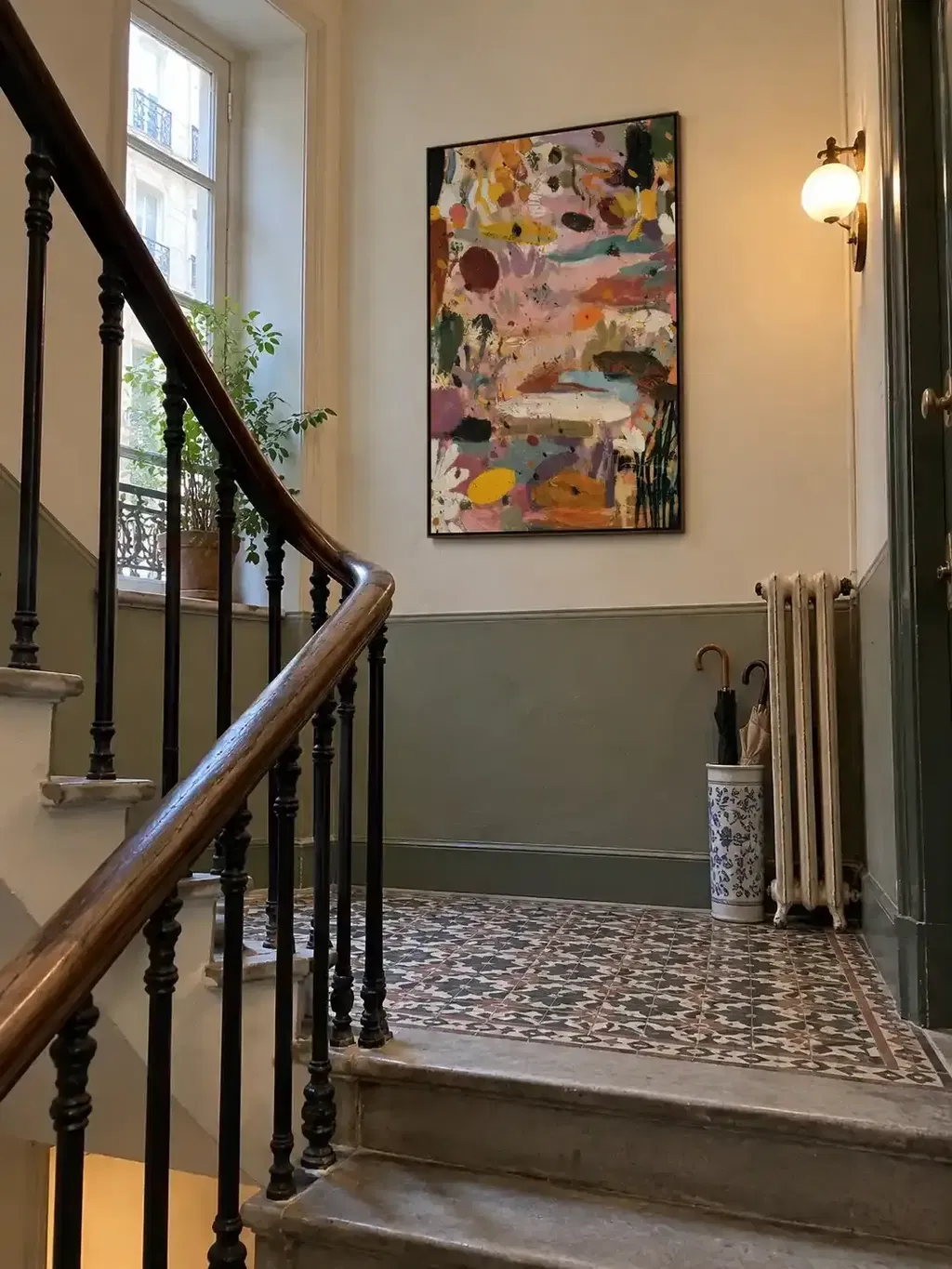
The Strategic Shift from Objects to Portfolios
The high-end art market is undergoing a fundamental correction. According to Marketplace, sales of auction pieces exceeding $10 million plummeted by 44% year-over-year in 2024. This retreat from speculative financial assets signals a return to "real application value." For the modern homeowner and interior designer, this means moving away from vanity acquisitions and toward curated residential portfolios that prioritize emotional resonance and spatial harmony.
We have observed that the most successful home galleries are not built overnight; they are engineered around a single "Foundation Piece." This central work dictates the narrative, scale, and color theory for the entire property. By treating art as a strategic home investment rather than a one-off purchase, you bridge the gap between retail-grade uncertainty and fine art authenticity.
Establishing the Foundation: The 75% Rule and Visual Weight
The most common mistake we see in residential curation is "Postage Stamp Syndrome"—hanging a piece that is far too small for the wall, causing it to lose its visual authority. To anchor a room effectively, we utilize the 75% Rule.
The Heuristics of Scale
- The Anchor: Your foundation piece should occupy approximately 75% of the available wall width (the space not covered by furniture or architectural molding).
- Visual Weight: A single large piece shifts the balance of an entire space more effectively than a cluster of smaller objects (Bad Dog Editions).
- The 60% Variance: For standalone focal points on blank walls without furniture anchors, a 60% width ratio is the typical baseline for balance (The Painting Advice).
Logic Summary: These scale ratios are heuristics (rules of thumb) used to ensure the artwork is proportional to the human field of view within a standard residential ceiling height (8–10 feet). These may vary if your space features double-height ceilings or significant architectural obstructions.

The Multi-Room Narrative: Sightlines and Visual Echoing
Once the foundation piece is established, the portfolio must expand into adjacent rooms without breaking the "narrative flow." We manage this through two professional design protocols: the Sightline Rule and Visual Echoing.
The Sightline Rule
When standing in a doorway or transition space, any two pieces of art visible simultaneously must share a "connective tissue." This is achieved by matching either a secondary color from the foundation piece or a specific impasto texture. This prevents the "gallery fatigue" that occurs when rooms feel like disconnected silos.
Visual Echoing and Hierarchy
To maintain a clear hierarchy, secondary rooms should not compete with the foundation piece.
- Scaling Down: While the foundation piece sits at 75% wall width, secondary pieces should drop to 50% or utilize gallery-style groupings.
- Pigment Pulling: If your foundation piece is a heavy oil landscape, a secondary room might feature an abstract study that "echoes" one specific pigment—such as the phthalocyanine blue of the sky or the burnt umber of the earth.
- Texture Consistency: Transitioning from a heavy impasto foundation to a flat print often feels "cheap." Maintaining a hand-painted texture throughout the portfolio preserves the perceived value.
| Parameter | Foundation Piece | Secondary Pieces | Tertiary/Accent Pieces |
|---|---|---|---|
| Wall Coverage | ~75% Width | ~50% Width | ~25-30% or Grouped |
| Texture Depth | High-Relief Impasto | Medium Texture | Light Wash / Sketch |
| Color Role | Defines Palette | Echoes Secondary Tones | Neutral/Complementary |
| Investment Goal | Anchor / Appreciation | Narrative Support | Detail / Whimsy |
The Authenticity Premium: Why Human-Made Still Dominates
In an era of AI-generated imagery, the "Essential Identity" of a hand-painted work has become a measurable financial premium. A study by Columbia University confirmed that consumers value art labeled as "AI-generated" 62% lower than authentic human-created art.
This value collapse occurs because digital replicas and NFTs lack what University of Chicago research describes as the "essential identity" of the artist. The physical relief of oil paint—the microscopic topography created by the brush—cannot be replicated by 2D printing. MUNCH Museum tests have shown that physical relief textures exponentially stimulate intrinsic motivation and viewer satisfaction compared to flat images.
Material Integrity: The Science of Lightfastness and Safety
A portfolio is only as valuable as its longevity. Understanding the chemical composition of your foundation piece is critical for risk reduction.
Decoding Lightfastness (ASTM D4303)
We do not rely on subjective "sunlight tests." Professional-grade pigments are rated via ASTM D4303 protocols, which use xenon-arc radiation to simulate decades of indoor light exposure.
- Acrylic Longevity: Tate research indicates that while acrylics are highly flexible and resistant to cracking, they are prone to "surfactant migration"—a process where additives move to the surface, creating a hazy film in high humidity.
- Oil Stability: Traditional oils undergo oxidative cross-linking. While they provide unmatched depth, they are more susceptible to embrittlement over time if not properly varnished.
Health and Indoor Air Quality (IAQ)
For residential installations, especially in nurseries or bedrooms, the "Indoor Air Quality Promise" is paramount. The EPA warns that indoor air pollution can be significantly higher than outdoor levels.
- VOC Mitigation: We recommend low-VOC (Volatile Organic Compound) paints. Aalto University experiments show that coatings on wood with proper moisture content emit significantly fewer toxins during the curing process.
- Pigment Safety: Avoid legacy toxins. While Titanium Dioxide dominates 90% of the white pigment market due to its safety and opacity, some specialty "artist-grade" paints still contain heavy metals. IARC classifies Cadmium compounds as Group 1 carcinogens; we advocate for modern, non-toxic hues that replicate these colors without the health risk.
The Economic Case: Property Value and ROI
Commissioning a foundation piece—particularly a custom mural—is often a more effective "value-add" for a property than standard renovations.
Real Estate Regression Modeling
Analysis by the Royal Society using a CAR model found that neighborhoods with higher "art" geo-tags experienced greater relative house price ranking gains. In a commercial context, NCREALTORS reports that public art projects in Chicago's Millennium Park drove $1.4 billion in real estate-related growth.
Modeling Note (Economic ROI): Our internal scenario modeling for residential "Art-Led Appraisal" assumes the following parameters. This is a hypothetical model based on common market trends, not a guaranteed financial outcome.
Parameter Value Range Unit Rationale Initial Art Investment 1 - 3 % of Home Value Standard high-end curation budget Perceived Value Lift 5 - 8 % Based on "Artisan Craftsmanship" trends (Zillow/Yelp) Market Time Reduction 15 - 20 % Staging impact of high-quality focal points "Whimsy" Search Interest +15 % YoY Growing demand for custom, non-standard decor Artisan Search Interest +21 % YoY Shift away from mass-produced retail items
Biophilic Design and Wellness: Art as Public Health Infrastructure
The WHO's scoping review of over 3,000 studies confirms that art interventions effectively alter clinical indicators for mental health. In the "built environment," this is known as Biophilic Design.
UPenn research found that 73% of patients reported significant mood improvements when exposed to nature-themed environmental artworks. By selecting a foundation piece featuring natural landscapes or organic textures, you are not just decorating; you are optimizing your home’s emotional regulation circuits. This effect is particularly pronounced in high-stress areas like home offices or powder rooms, where NKBA 2025 trends show a surge in "panoramic mural wrapping" to create immersive escapism.
The Professional Workflow: Managing the Approval Loop
For interior designers and trade professionals, the "Approval Loop" is the most fraught part of the curation process. To reduce revision cycles and ensure client certainty, we utilize a texture-first approval gate.
- The Texture Close-Up: Before the full foundation piece is completed, present a high-resolution close-up of the impasto texture. This sets the "quality expectation" for the entire multi-room project.
- Digital/Physical Hybrid (O2O): Modern consumers prefer purchasing high-end art online, with Artsy reporting a 15% YoY growth in gallery e-commerce. However, the physical delivery remains the "moment of truth." We bridge this by providing digital progress shots that emphasize the "micro-topography" of the paint.
- The "Sightline" Preview: Use digital rendering to show how the foundation piece will look in relation to adjacent rooms. This validates the Sightline Rule before the first brushstroke is even applied.
Building for the Future: 2026 and Beyond
As we look toward 2026, the trends are clear: consumers are moving toward "understated elegance" where texture is the soul of the room (Design State of Mind). There is a massive spike in interest for surrealist custom pieces and artisan craftsmanship that defies the assembly line.
By starting with a robust foundation piece and systematically building a portfolio that "echoes" its core principles, you create a space that is not only camera-ready but also retains its "essential identity" in an increasingly digital world. You are not just buying art; you are investing in a cultural heritage asset for your home.
References
- Marketplace. (2025). The expensive art market continues to struggle. Link
- Columbia Business School. (2024). Human-Made vs. AI Art: Consumer Perception Study. Link
- University of Chicago. (2024). Does Artwork Preserve Essential Identity? Link
- Royal Society. (2016). Quantifying the link between art and property prices. Link
- World Health Organization (WHO). (2019). Health Evidence Network synthesis report 67. Link
- Tate. (2024). Conservation Concerns for Acrylic Emulsion Paints. Link
- ASTM International. Standard Test Methods for Lightfastness of Colorants (D4303). Link
- Environmental Protection Agency (EPA). Indoor Air Quality and Low-VOC Paints. Link
Disclaimer: This article is for informational purposes only and does not constitute professional investment, legal, or health advice. Art values can fluctuate, and individual results in real estate appreciation may vary. For installations involving structural changes or specific health concerns regarding pigments, consult with a qualified interior designer or environmental health professional.