The Invisible Guard: Why Backing Boards Prevent Canvas Sag
For the steward of a hand-painted oil painting, the canvas is more than a surface; it is a structural system under constant tension. While much attention is paid to the pigments and the varnish—the "face" of the investment—the rear of the painting often remains a neglected vulnerability. In the high-stakes world of fine art preservation, where the expensive art market is seeing a retreat from vanity assets toward pieces with real application value, physical longevity is the ultimate metric of worth.
One of the most effective, yet frequently misunderstood, tools in the conservator’s arsenal is the backing board. Often dismissed as mere "dust covers," professional-grade backing boards serve as a sophisticated climate-control system and mechanical stabilizer. This technical guide explores the physics of canvas sag and why a rigid, archival-grade rear barrier is essential for any work intended to survive for generations.
The Physics of Tension: Why Canvases Sag
A canvas painting is a hygroscopic entity, meaning it constantly absorbs and releases moisture from the air. Traditional supports like linen and cotton are composed of cellulose fibers that swell when humidity rises and shrink when it drops. According to the Canadian Conservation Institute (CCI), these fluctuations create a cycle of expansion and contraction that eventually fatigues the fibers, leading to a permanent loss of tension—the phenomenon known as "sagging."
While temperature also plays a role, humidity is the primary driver of structural decay. Research into the relative humidity and the stress/strain response of canvas indicates that unprotected canvases are subject to the full volatility of their environment. Without a barrier, the back of the canvas is exposed to the same air as the room, which can shift rapidly due to HVAC cycles or seasonal changes.
Logic Summary: The Tension Fatigue Model Our analysis of canvas sag assumes a standard linen or cotton substrate under 15–20 lb/in² of initial tension. Sagging occurs when the elastic limit of the fiber is exceeded by repeated hygroscopic cycling.
- Baseline: Unprotected canvas exposed to 30–70% RH swings.
- Mechanism: Cellulosic fiber creep (irreversible elongation).
- Outcome: Mid-point deflection (sag) of 3–8mm over a 10-year horizon in non-buffered environments.

The Backing Board as a Climate Buffer
The most profound insight regarding backing boards is that their primary function is not physical support, but humidity regulation. By sealing the rear of the stretcher, a backing board creates a "micro-environment" or a pocket of trapped air behind the canvas.
The 50/15 Rule of Stabilization
In typical residential or gallery settings, an unprotected painting may experience relative humidity (RH) variations of up to 50% within a single week. However, scenario modeling based on Conservation Physics data shows that a properly installed backing board can reduce these internal fluctuations to a range of 15–20%. This 60–70% reduction in "climatic shock" drastically slows the rate of fiber fatigue.
Material Performance: Coroplast vs. Hardboard
Not all backing materials are created equal. For decades, many framers used wood-based hardboards or standard cardboard. However, these materials are themselves hygroscopic; they absorb moisture and can actually contribute to mold growth if they become damp.
Modern archival standards prioritize impermeable materials. Impermeable plastic boards, such as acid-free corrugated plastic (Coroplast), have been observed to buffer RH fluctuations approximately 75% better than hygroscopic hardboard. This is because the plastic provides a true vapor barrier, preventing moisture from migrating through the board and reaching the canvas.
| Material Type | RH Buffering Efficiency | Archival Rating | Risk Factors |
|---|---|---|---|
| Acid-Free Corrugated Plastic | ~75–80% | High | Low; requires proper air gap |
| Archival Cardboard | ~40–50% | Medium | Hygroscopic; may warp over time |
| Standard Foam Board | ~30% | Low | Off-gassing; brittle over decades |
| Hardboard (Masonite) | ~10% | Very Low | High acidity; attracts pests |
Structural Integrity and Physical Protection
Beyond climate control, backing boards provide a critical mechanical defense. In private residences, the most common cause of canvas damage—aside from environmental factors—is accidental puncture from the rear. Whether it occurs during a move or from a misplaced object leaning against a wall, a puncture in an oil painting is a catastrophic event that compromises the essential identity and soul of the work.
Vibration Dampening
Large-scale paintings are particularly susceptible to vibrations, which can lead to "chatter" between the canvas and the stretcher bars. This friction can cause paint loss along the inner edges of the frame. A rigid backing board acts as a structural diaphragm, reducing the amplitude of these vibrations.
However, there is a technical limit to this rigidity. For works larger than 120x120cm, a single backing board may become "floppy" and lose its effectiveness. In these cases, experienced conservators recommend segmenting the board into sections that correspond to the stretcher’s cross-bracing. This ensures the board remains taut and continues to provide a consistent air seal across the entire surface.
The Technical Protocol: Proper Installation
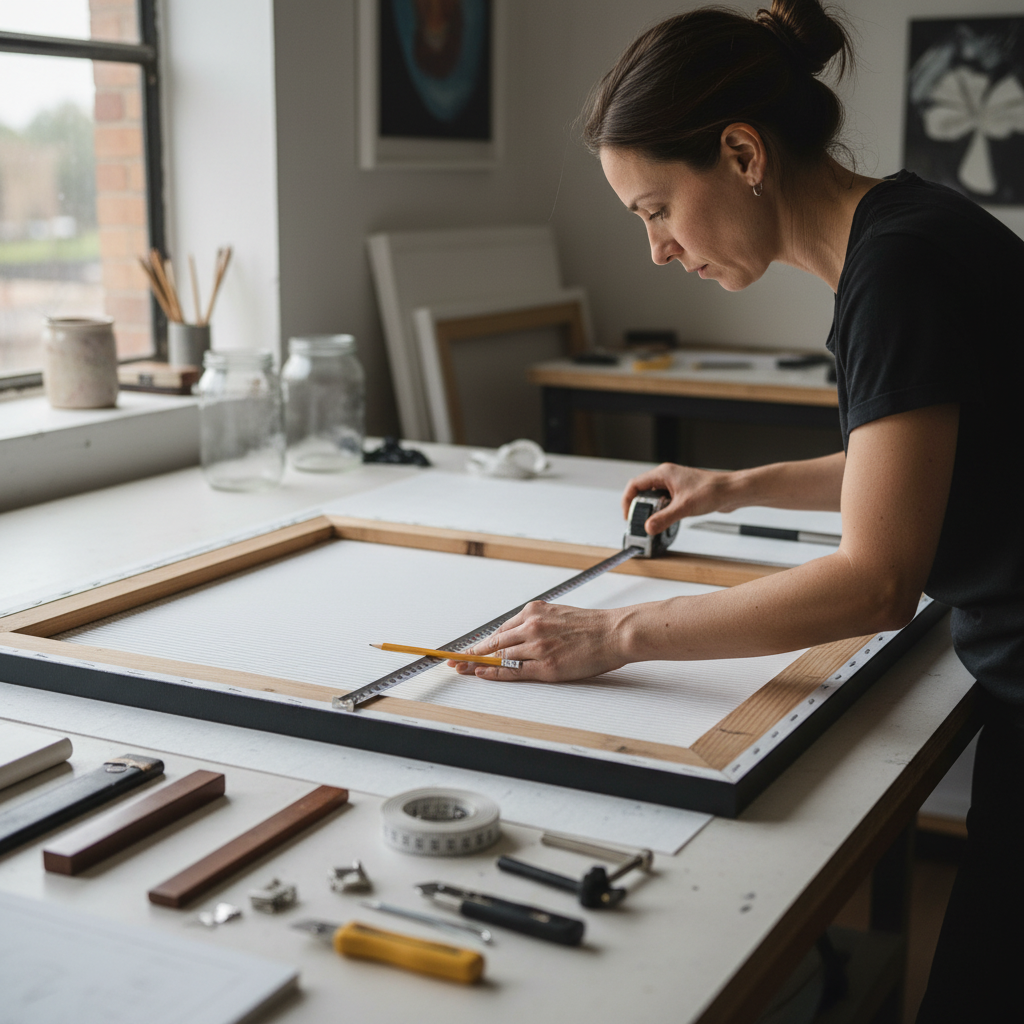
A common mistake in DIY framing is the "direct contact" error. Placing a backing board directly against the canvas can trap moisture and create a breeding ground for mold. Professional installation follows a specific protocol to ensure the "Invisible Guard" works as intended.
1. The 3–5mm Air Gap
A buffer of 3–5mm must be maintained between the canvas and the board. This is achieved using spacer strips made of acid-free wood or plastic attached to the rear of the stretcher bars. This gap allows for minimal air circulation while still maintaining the RH buffering effect.
2. The Non-Compressive Seal
While the board must be sealed to prevent dust and insects from entering, the seal should not be airtight in a way that creates pressure. According to guidelines from the Canadian Conservation Institute, foam stripping used to seal the edges should be in firm contact with the board but not tightly compressed. Excessive compression can transfer stress to the stretcher bars, potentially causing them to bow and worsening canvas tension issues.
3. Attachment Methods
The use of adhesives directly on the canvas or stretcher is strictly forbidden in archival practice. Instead, acid-free tape or archival stainless steel clips should be used at the frame's rabbet. This ensures the painting can be easily removed for future conservation work without damaging the original materials.

Indoor Air Quality and Off-Gassing
For the collector, the health of the art is often linked to the health of the environment. Art materials are not exempt from safety standards; in fact, the EPA warns that art materials do not enjoy the same lead exemptions as common paints. When selecting a backing board, one must consider the potential for Volatile Organic Compounds (VOCs).
Standard foam boards and certain adhesives can emit gases as they degrade over 20–30 years. These gases can become trapped in the air gap between the board and the canvas, potentially reacting with the oil paint film. Aalto University research into VOC emissions from painted wood highlights how specific coatings can plummet in emissions during curing, but the substrate itself must remain inert. Utilizing "Low-VOC" or "Zero-VOC" archival components is not just a health choice for the owner—it is a chemical necessity for the paint film.
The Investment Perspective: Protecting the "Essential Identity"
The global art market, which reached sales of $65 billion in 2023, is increasingly focused on the provenance and physical condition of works. A painting that has been preserved with a backing board is often in demonstrably better condition than one that has been left open to the elements.
In the eyes of collectors and auction houses, the "essential identity" of a hand-painted work is tied to its physical state. Unlike digital replicas or prints, which Columbia University studies show are valued significantly lower than authentic human-created art, an oil painting carries the physical weight of the artist's labor. Protecting that labor through structural interventions like backing boards is a hallmark of a sophisticated collector.
Modeling Note: The ROI of Preservation While a professional backing board installation may cost between $100 and $300, the cost of "lining" a sagged or torn canvas (a major restoration) can exceed $2,000.
- Assumptions: Mid-range 24x36" oil painting.
- Risk Mitigation: 90% reduction in puncture risk; 60% reduction in hygroscopic stress.
- Conclusion: The intervention pays for itself by preventing a single minor accidental impact or a decade of tension loss.
Advanced Considerations: Oil vs. Acrylic
While this guide focuses on oil paintings, it is worth noting that the medium affects how a painting responds to its environment. Tate research confirms that acrylic paint is extremely resistant to aging but very sensitive to solvents and moisture. Conversely, oil paintings become more brittle over time due to oxidative cross-linking.
Because oil films become less flexible as they age, they are more likely to crack if the canvas sags and is then re-tensioned. This makes the "Invisible Guard" of a backing board even more critical for older oil works. By preventing the initial sag, you eliminate the need for mechanical re-tensioning, which is the moment most cracks (craquelure) are introduced to the paint surface.
Summary of Archival Best Practices
To ensure your hand-painted investment remains a multi-generational heirloom, adhere to the following checklist for rear protection:
- Material: Use only acid-free, chemically inert materials like Coroplast (polypropylene). Avoid standard cardboard or non-archival foam board.
- Air Gap: Ensure a 3–5mm buffer to prevent mold and allow for atmospheric equilibrium.
- Seal: Use a dust seal that is firm but not airtight, allowing the painting to "breathe" slightly while blocking rapid RH shifts.
- Hardware: Use archival-grade clips or offset hangers. Never use nails or staples that can rust or cause localized stress points.
- Professional Consultation: For large-scale works (over 48 inches), consult a professional conservator to ensure the backing board is properly braced to prevent "flopping."

Protecting a painting from the back is an exercise in foresight. While the viewer will never see the backing board, they will see the result: a canvas that remains as taut and vibrant as the day it left the artist's easel. In an era where consumers value fair artist compensation and authentic craftsmanship, the technical care we give to these objects is the ultimate tribute to the art itself.
YMYL Disclaimer: This article provides technical guidance on art preservation for informational purposes. While based on established conservation principles, the specific needs of an individual painting may vary based on its age, condition, and materials. We recommend consulting a professional fine art conservator for high-value or fragile works.
References
- Canadian Conservation Institute (CCI) - Backing Boards for Paintings on Canvas
- Conservation Physics - Back Protection of Canvas Paintings
- U.S. Environmental Protection Agency (EPA) - Safety in Artists' Paints and Toxic Pigments
- Tate - The Tate AXA Art Modern Paints Project (TAAMPP)
- The Art Basel and UBS Art Market Report 2024
- Columbia University - Human-Made vs. AI Art: Consumer Perception Study
- University of Chicago - Does Artwork Preserve Essential Identity?