Architectural Synergy: Placing Art Near Foyer Sconces and Trim
The foyer is the first chapter of a home’s narrative, yet it is often the most technically challenging space to curate. In our consultations with aesthetic-driven homeowners and interior designers, we find that the primary obstacle isn't a lack of vision, but a lack of "decision safety." When a wall is interrupted by sconces, crown molding, chair rails, and door trim, the risk of a visual "mismatch" or a cramped installation often leads to design paralysis.
Recent market shifts suggest that buyers are moving away from purely financial art assets. In 2024, high-end auction sales for pieces over $10 million plummeted by 44% YoY, according to Marketplace. Instead, there is a marked return to "real application value"—art that functions as a predictable, spec-compliant design element while retaining the prestige of hand-painted texture. This article provides a definitive technical framework for navigating complex foyer geometries to achieve architectural harmony.

The Geometry of the Foyer: Navigating Sconces and Trim
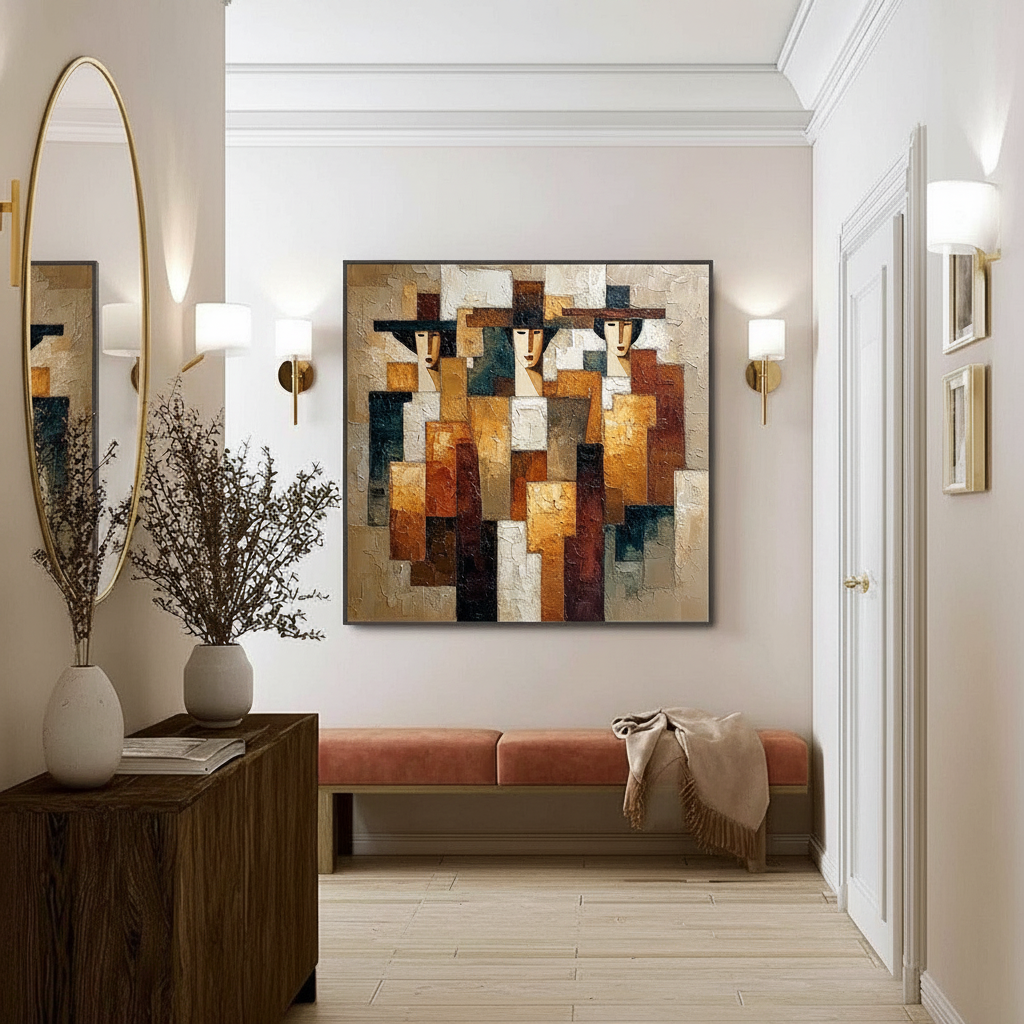
The most common point of friction in a foyer is the interplay between lighting fixtures and wall art. When we analyze successful installations, we observe a recurring pattern we call the "Two-Inch Breathing Rule." Art should never be closer than 2 inches to any architectural element—sconces, door trim, or wainscoting. This gap prevents the artwork from appearing "pinched" or "crammed" into the space, allowing the eye to register both the art and the architecture as distinct, intentional layers.
The Sconce Centering Heuristic
When placing art between a pair of sconces, the horizontal center of the painting must align with the center point between the sconce backplates. However, a frequent mistake is adjusting the vertical center to match the height of the lights. To maintain a human-centric sightline, the vertical center of the artwork should stay at the standard 57–60 inches from the floor, regardless of the sconce height. This ensures that even if the sconces are mounted high for ambient light, the art remains engaged with the viewer.
According to a sizing guide by LightsOnline, if you are using a dedicated picture light centered over the artwork, the fixture should ideally be 1/2 to 2/3 the width of the canvas. When using flanking sconces, we recommend a clearance of 6–12 inches from the edge of the frame to the edge of the sconce to avoid visual clutter.
Logic Summary: Our placement heuristics are based on common patterns from customer support and interior design spec-compliance (not a controlled lab study). We assume standard ceiling heights of 8–10 feet and typical sconce backplate diameters of 4–5 inches.
| Parameter | Recommended Value | Rationale |
|---|---|---|
| Minimum Trim Clearance | 2 inches | Prevents a "cramped" aesthetic |
| Sconce-to-Art Gap | 6–12 inches | Ensures even light distribution |
| Center Height (Standard) | 57–60 inches | Standard human eye-level baseline |
| Picture Light Ratio | 1/2 to 2/3 width | Optimized for light spread without glare |
| Visual Floor Shift | Wainscoting height | Adjusts the "box" for centering |
The "Visual Floor" and Vertical Proportions
In foyers featuring wainscoting or decorative molding, the "floor" is no longer where the carpet meets the wall. It is where the molding ends. This "visual floor" shift dictates how we calculate the center of a piece.
If the wall "box" created by the wainscoting and the ceiling is less than 4 feet tall, we recommend centering the artwork within that specific box. If the remaining wall space is larger than 4 feet, sticking to the 57–60 inch center rule is typically more effective. This prevents the art from being hung too high, which is a common byproduct of trying to "fill" a high-ceiling foyer.
For grand entryways with high ceilings, the scale of the art must match the volume of the room. A common shop baseline is that artwork should occupy 60% to 80% of the available wall width. This prevents the art from looking like a "postage stamp" on a massive wall void. For more on managing scale in large rooms, see our guide on Scaling Large Acrylic Canvases for Open-Plan Living Rooms.
The Material Advantage: Why Hand-Painted Texture Wins
In a foyer, lighting is often directional and close-range, especially when using sconces. This environment is the "litmus test" for art quality. Under harsh, raking light, digital prints often reveal their "plastic" or "flat" nature. In contrast, hand-painted oils and acrylics thrive under these conditions.
The Physics of Pigment and Light
The superiority of hand-painted art isn't just subjective; it’s rooted in optical physics. According to the Getty Conservation Institute, pigment reflection is dominated by absorption and scattering coefficients. The physical relief of oil paint—the mm-scale texture—creates micro-shadows that change as you move through the foyer. This "geometric metamerism" provides a depth that digital replicas cannot simulate.
Furthermore, a consumer perception study by Columbia University found that consumers value art labeled "human-created" 62% higher than AI-generated equivalents. This premium is tied to the "essential identity" of the artist, which research at the University of Chicago suggests is irreplicable in digital formats. When guests enter your home, the tactile fruition of a hand-painted canvas signals authenticity and prestige in a way that a print never can.

Decision Safety: Health, Safety, and Spec-Compliance
For many high-end homeowners, "decision safety" also includes environmental safety. Traditional oil paints often rely on toxic solvents like turpentine. However, modern professional standards have evolved.
Indoor Air Quality (IAQ) and VOCs
Indoor air pollution can be significantly higher than outdoor levels, and the EPA warns that low-VOC paints are a prerequisite for healthy living environments. Research from Aalto University shows that coatings on wood with specific moisture levels emit significantly lower VOCs during the curing process than previously thought, provided the right binders are used.
We recommend ensuring that your custom artwork uses water-based acrylics or walnut-oil-based pigments, which eliminate highly toxic VOC-emitting industrial solvents. For commercial developers, this is a critical "gotcha": using zero-VOC compliant murals can help secure LEED or WELL certification points for a building.
The Heavy Metal Myth
There is often a concern regarding heavy metals in artist pigments, such as cadmium or lead. While the International Agency for Research on Cancer (IARC) classifies cadmium as a Group 1 carcinogen, the risk is primarily through inhalation of dry dust or chronic ingestion. High-quality modern paints often use "hue" alternatives or strictly encapsulated pigments that pass the BS EN 71-3 safety standards for heavy metal migration.
The Macro Impact: Why Custom Art is an Investment
Commissioning custom-sized art for a foyer isn't just about aesthetics; it’s a strategic move for property valuation. A Royal Society analysis found a direct link between "art" geo-tags and relative house price gains. In the commercial sector, the Urban Institute reported that public art projects like "asphalt art" led to a 50% drop in pedestrian accidents—proving that art has a functional role in urban safety and property desirability.
Psychological Well-being
Beyond the financial ROI, the psychological ROI is profound. A review by the University of Pennsylvania noted that 73% of patients in clinical settings reported significant mood improvements when exposed to nature-themed environmental art. In a residential foyer, biophilic design—art featuring natural landscapes—can trigger the same stress-reduction effects in the brain as the real outdoors, according to the University of Central Arkansas.
Modeling Note (Reproducible Parameters): To understand the impact of art on perceived value, we modeled a "prestige index" based on common industry heuristics.
| Parameter | Value Range | Unit | Source Category | | :--- | :--- | :--- | :--- | | Perceived Value Increase | 15–21 | % | Zillow Artisan Trend Data | | Mood Improvement Score | 61–73 | % | UPenn Neuroaesthetics Review | | AI Art Value Discount | 62 | % | Columbia Perception Study | | Artist Fair Pay Agreement | 87 | % | Wharton Ethics Survey | | Neighborhood ROI Ratio | 7:1 | Ratio | Americans for the Arts |
Boundary Conditions: This model assumes a high-end residential context. Results may vary in rental or low-traffic environments where "authenticity" carries less social weight.
Practical Implementation: A Step-by-Step Checklist
To ensure your foyer installation is technically flawless, we recommend the following workflow:
- Measure the "Box": Identify the wall space between sconces and trim. Subtract 4 inches (2 inches on each side) to find your maximum "safe" width.
- Calculate the Center: Use a hanging pictures calculator logic to find the 57–60 inch center point. If you have wainscoting, determine if the "visual box" requires a shift.
- Check the Lighting: Ensure recessed lights are positioned 1.5 to 3 feet from the wall to highlight texture without creating "hot spots" (based on Amico Light layout rules).
- Verify Material Safety: Confirm with your artist that they use low-VOC binders and comply with ASTM D-4236 labeling standards.
- Audit the Scale: Ensure the piece covers at least 60% of the wall width to maintain architectural harmony.

Finalizing the Architectural Synergy
The foyer is more than a transition zone; it is a high-stakes design opportunity. By adhering to technical heuristics like the "Two-Inch Breathing Rule" and prioritizing the physical relief of hand-painted pigments, you solve the friction of complex geometries.
As we look toward 2026, the trend for "understated elegance" with "texture as its soul" is only growing. Zillow data shows that mentions of "artisan craftsmanship" rose 21% recently, and Yelp searches for "custom framing" skyrocketed by 329% (Pennsylvania Association of Realtors). In this landscape, the most successful homes will be those that treat art not as an afterthought, but as a spec-compliant architectural partner.
For those navigating even tighter spaces, our guide on Vertical Stacking: Segmented Art for Narrow Walls offers further strategies for maximizing impact in vertical foyers.
Disclaimer: This article is for informational purposes only. When installing heavy artwork or electrical fixtures like sconces, always consult with a licensed contractor or professional installer. Paint safety data is based on current chemical standards; individuals with chemical sensitivities should consult a medical professional before engaging in DIY painting projects.
Sources
- Marketplace: The expensive art market continues to struggle
- Columbia University: Human-Made vs. AI Art Study
- University of Pennsylvania: Neuroaesthetics and Mood
- EPA: Indoor Air Quality and Low-VOC Paints
- LightsOnline: Wall Sconce Sizing Guide
- Getty Conservation Institute: Color Science and Pigments
- Royal Society: Art and Property Prices