Vertical Stacking: Segmented Art for Narrow Walls
In the evolving landscape of high-end interior design, we are witnessing a profound shift in how art is valued and integrated into the home. For decades, the industry was dominated by a "vanity auction" culture, where massive price tags often overshadowed the actual spatial utility of a piece. However, recent data indicates a retreat from these speculative financial assets. According to Marketplace, high-end auction sales plummeted 44% year-over-year in 2024, signaling that collectors and homeowners are returning to "real application value."
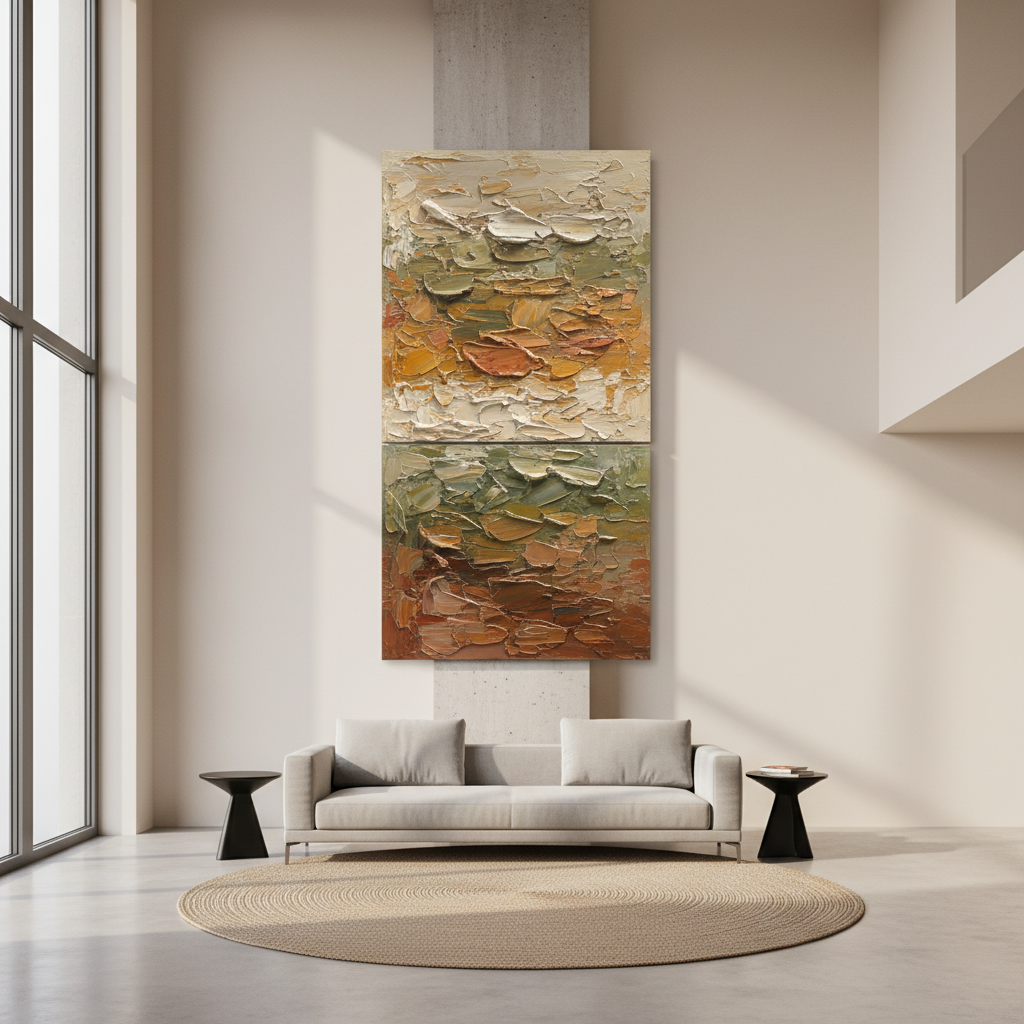
For the design-conscious homeowner, this value is found in custom, human-made solutions that solve specific architectural challenges. One of the most persistent challenges is the "narrow wall"—those awkward pillars, entryways, and chimney breasts that horizontal art simply cannot accommodate. This is where vertical stacking—the strategic arrangement of segmented canvases—transforms a constraint into a masterpiece.
The Neurological Impact of Verticality
Why does a vertical arrangement feel so different from a single large canvas? It isn't just about filling space; it is about how our brains process visual information. Research from The University of Pennsylvania suggests that environmental artworks can reduce stress by up to 61% and improve mood in 73% of viewers.
When we stack art vertically, we trigger a specific neurological response. A systematic review published in PMC shows that passive art viewing activates the medial prefrontal cortex (mPFC) and the amygdala, optimizing emotional regulation. Vertical stacking, specifically, creates an "upward momentum" that tricks the eye into perceiving higher ceilings and a more expansive volume. In rooms with low ceilings, this segmented approach provides a sense of "immersive escapism," a trend highlighted by the National Kitchen & Bath Association (NKBA) 2025 awards.

The Structural Reality: Load-Bearing and Anchoring
In our studio, we often see homeowners underestimate the technical requirements of vertical stacking. While the aesthetic is light and airy, the physical weight of multiple canvases on a narrow wall requires a disciplined engineering approach.
Logic Summary: Structural Load Modeling Our analysis of vertical installations assumes a concentrated load on a narrow architectural footprint. Unlike wide gallery walls, narrow pillars often have limited stud availability or specialized masonry cores.
- Heuristic: Walls under 24 inches wide should be treated as "high-tension" zones.
- Boundary Condition: This model does not apply to temporary partitions or unreinforced plasterboard without toggle bolts.
According to UNION Fine Art Services, narrow walls frequently have reduced load capacity due to architectural constraints. Before you begin, you must identify your wall material:
- Drywall: Requires proper weight distribution. We recommend using heavy-duty toggle bolts rather than standard nails, as the vertical "stack" creates a cumulative downward pull that can cause standard hangers to fail over time.
- Concrete or Masonry: These require specialized sleeve anchors. Because narrow pillars are often structural supports, we advise against deep drilling without a site survey.
- The "Visual Weight" Rule: A common mistake is placing smaller pieces at the bottom. To create stability, larger canvases should anchor the bottom of the stack, while smaller or lighter pieces above create that desired upward momentum.
The "Human Premium": Why Hand-Painted Matters
In a world saturated with AI-generated prints, the physical presence of a hand-painted canvas offers something a digital replica cannot: "essential identity." Research from the University of Chicago confirms that consumers perceive digital replicas as lacking the artist's soul, which collapses their perceived value.
Furthermore, a Columbia University study found that consumers value art labeled as "AI-generated" 62% lower than authentic human-created art. When you are stacking art on a narrow wall, every inch is under scrutiny. The "microtopography"—the millimeter-scale texture of oil paint—is crucial to the aesthetic. Optical microprofilometry has proven that this physical relief is what stimulates intrinsic motivation and satisfaction in the viewer.

Technical Layout: Ratios and Spacing
Achieving the "designer look" in a vertical stack requires more than just a level; it requires a mathematical understanding of scale and proportion.
The 1:2.5 Ratio Heuristic
While elongated ratios like 1:4 might seem elegant, they often exacerbate the "cramped" feeling of a narrow space. Based on our interior design experience, a 1:2.5 ratio is the optimal compromise. This provides vertical emphasis without creating visual tension.
The Golden Ratio Adjustment Method
The standard "2-inch gap" rule is a good starting point, but it fails when canvas sizes vary within the stack. We use a professional installer's secret called the Golden Ratio Adjustment:
-
Formula:
Spacing = (Average Artwork Dimension) × 0.618 - Application: If your canvases are 20 inches tall, a spacing of roughly 12 inches might feel too wide for a tight stack, but adjusting this multiplier based on the width of the wall ensures the pieces feel like a single, cohesive narrative rather than a series of disconnected boxes.
| Parameter | Standard Heuristic | Professional Adjustment | Rationale |
|---|---|---|---|
| Edge-to-Edge Gap | 1.5–2 inches | Golden Ratio (Dim × 0.618) | Maintains continuity vs. visual breathing room |
| Bottom Height | 57" from floor | 48"–54" from floor | Lower anchors provide better visual stability |
| Lighting Angle | 30 degrees | 45 degrees downward | Prevents shadow gaps between stacked canvases |
| Alignment | Perfect Center | 1-inch Offset | Creates "dynamic tension" on narrow pillars |
Health and Safety: The IAQ Promise
When installing art in confined spaces like narrow hallways or small bedrooms, indoor air quality (IAQ) becomes a critical concern. The EPA warns that indoor air pollution can be more concentrated than outdoor pollution. Many mass-produced prints use inks and solvents that emit Volatile Organic Compounds (VOCs) for weeks after installation.
We prioritize materials that pass the most stringent tests. For instance, Aalto University experiments prove that certain coatings on wood substrates emit significantly lower VOCs during the curing process. Furthermore, we strictly avoid pigments that pose long-term health risks. The International Agency for Research on Cancer (IARC) classifies cadmium compounds as Group 1 carcinogens. While some industrial art supplies still use these, we advocate for non-toxic alternatives like titanium white, which now dominates 90% of the market due to its safety and superior hiding power.
Commercial Value: Art as an Asset
For our B2B clients and property developers, vertical stacking isn't just a design choice—it’s a financial strategy. The Royal Society found a direct correlation between "art-heavy" environments and property price ranking gains. In commercial real estate, unique art installations act as "marketing trump cards" to increase leasing rates in competitive markets.
Furthermore, investing in hand-painted art supports a sustainable creative economy. The U.S. arts industry added $1.2 trillion to the GDP in 2023, surpassing agriculture and transportation. By choosing human-made art over AI-generated alternatives, you are participating in a system that 87% of consumers believe should prioritize fair compensation for artists.

Maintenance and Longevity: Acrylic vs. Oil
When choosing segmented art for a narrow wall, the medium matters. Most modern vertical arrangements utilize acrylics due to their unique physical properties.
- Durability: Acrylic polymers consist of long-chain molecules that form films through "coalescence." This makes them softer and more resistant to the embrittlement seen in old oil paintings.
- The "Haziness" Gotcha: Advanced research from Tate reveals that PEG-type surfactants can migrate to the surface of acrylic paint in high humidity, causing a "hazy" appearance. This is easily solved by maintaining a stable indoor environment, but it's a critical detail for art placed in narrow entryways near exterior doors.
- The SID Phenomenon: If you notice your white canvas turning yellow, it may be Support Induced Discoloration (SID). This happens when water-soluble impurities from the canvas are drawn into the paint. Using high-quality, primed canvases—a standard in our studio—prevents this catastrophic chemical reaction.
Summary Checklist for Vertical Stacking
To ensure your vertical art installation provides both aesthetic confidence and structural safety, follow this expert checklist:
- Assess the Wall: Determine if it is drywall or masonry and select anchors accordingly.
- Calculate the Ratio: Aim for a 1:2.5 ratio for the total vertical span.
- Apply Spacing Logic: Use the Golden Ratio Adjustment (Dim × 0.618) to avoid a "cluttered" look.
- Verify Material Safety: Ensure the art is human-made and uses low-VOC, non-toxic pigments.
- Audit the Lighting: Angle light 45 degrees downward from the top to eliminate shadows between canvases.
Vertical stacking is more than a solution for narrow walls; it is a sophisticated method of spatial transformation. By grounding your design choices in structural engineering, material science, and neurological research, you can create a space that doesn't just look better—it feels better.
Disclaimer: This article is for informational purposes only and does not constitute professional structural engineering or medical advice. Always consult with a qualified installer for heavy wall mounting and a healthcare professional regarding environmental sensitivities.
Sources
- Marketplace: The Expensive Art Market Struggles
- Columbia University: Human-Made vs. AI Art Study
- UPenn: Visual Art in the Built Environment
- EPA: Indoor Air Quality and Low-VOC Paints
- UNION Fine Art Services: Load-Bearing Wall Assessments
- Tate: Conservation Concerns for Acrylic Emulsion Paints
- Royal Society: Quantifying the Link Between Art and Property Prices