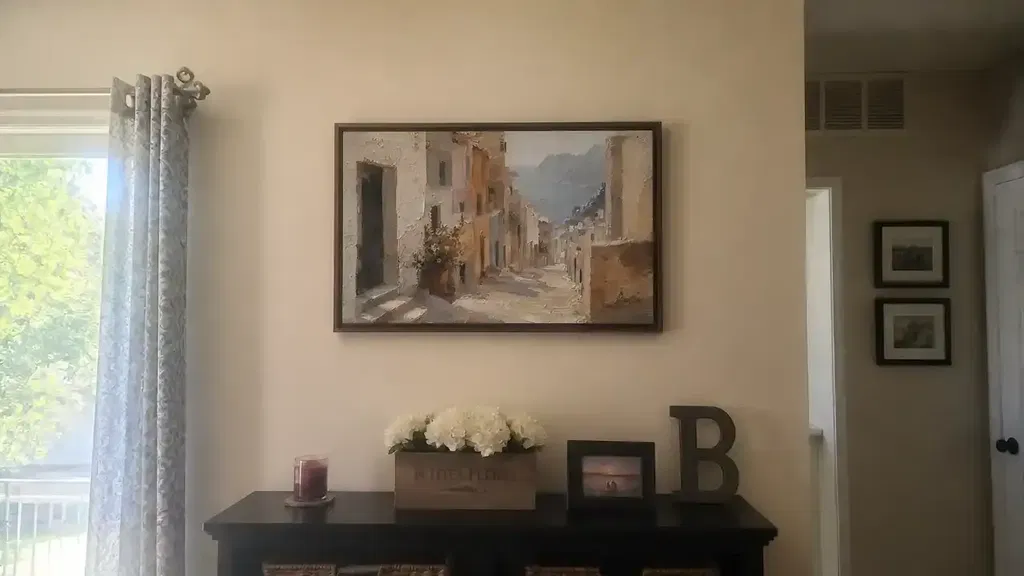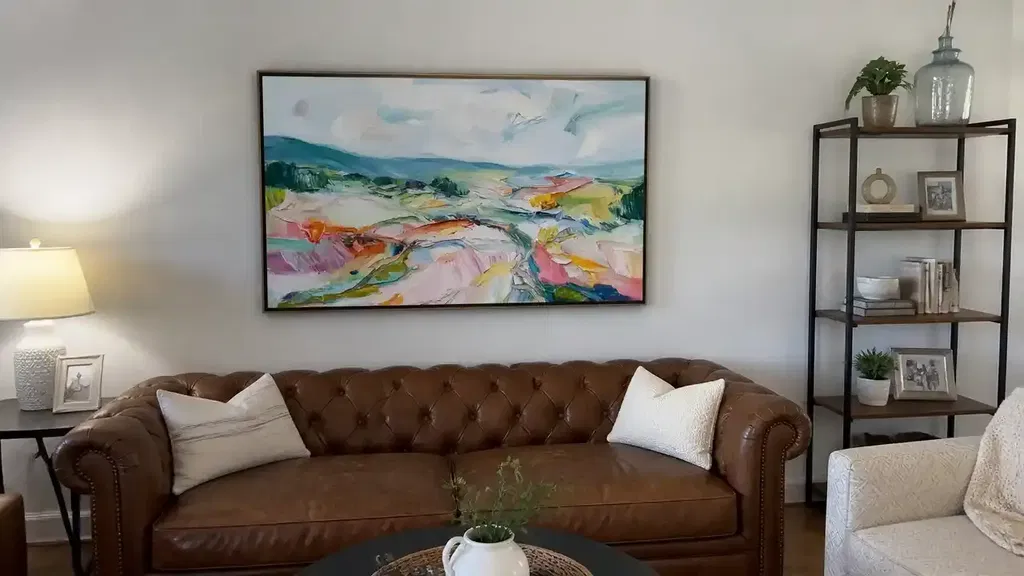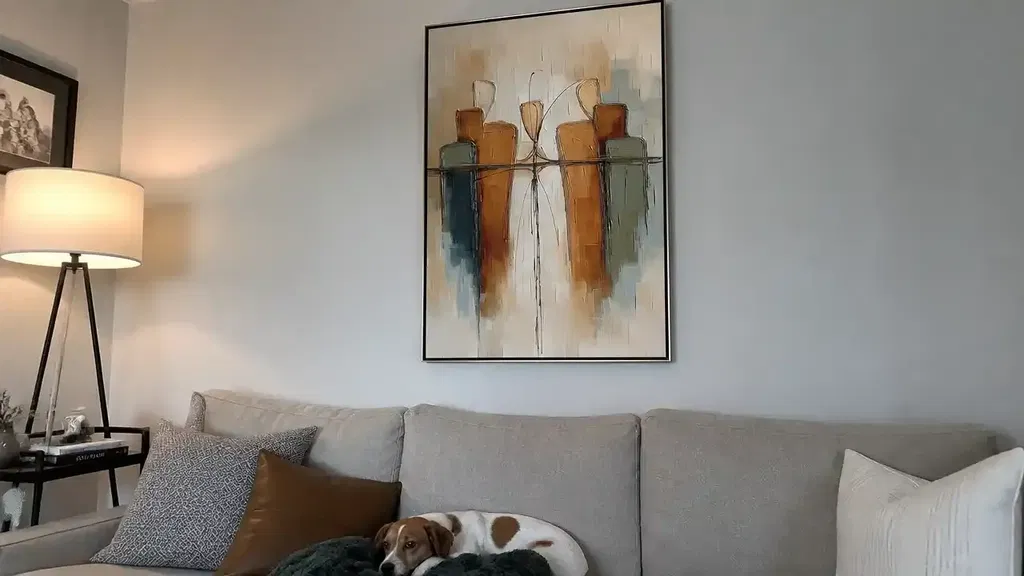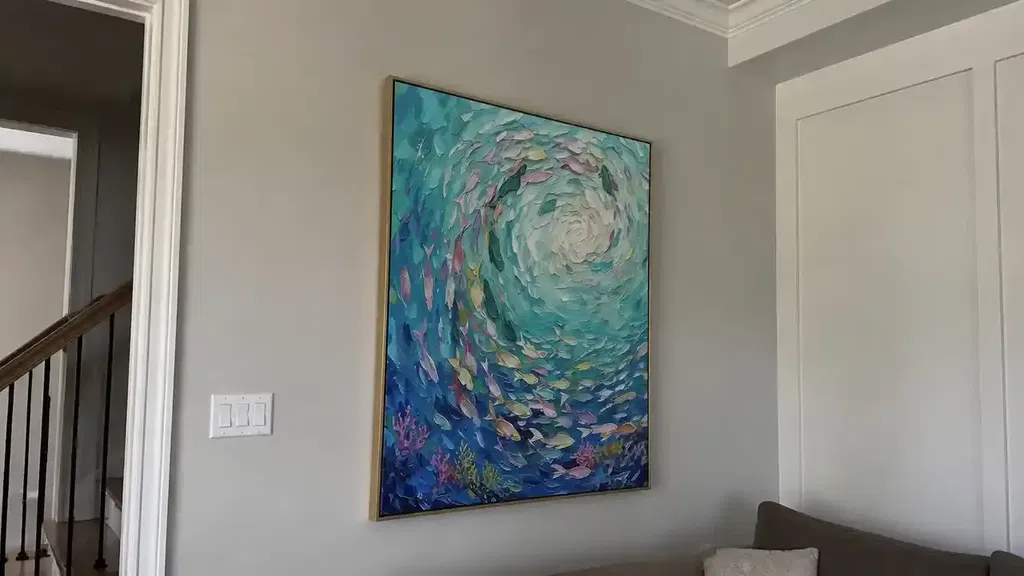
The package arrives. You open it. The color reads more orange than the warm cream you saw on your screen, or the canvas is larger than the wall you had in mind. These frustrations come up constantly with buying paintings online. Most of them are preventable. They trace back to a few pieces of information that are easy to check before you order.
| Before You Buy | How to Check |
|---|---|
| Color accuracy | Ask the seller for an unedited natural-light photo |
| True size on your wall | Tape the exact dimensions on your actual wall with painter's tape |
| Whether it's a true original | Look for a named artist, in-progress photos, and real buyer images |
| Surface texture | Look for side-angle photos that show raised paint ridges |
| Return terms | Read the full return policy before purchasing, not after |
Why the Color on Your Screen Is Not the Color on Your Wall
Three Variables That Shift What You See
A product photo rarely shows a painting's exact color. Three variables sit between the paint on canvas and the image on your screen.
- The shooting light source. A painting photographed under warm tungsten lighting looks yellower than it does in person. The same painting shot under cool daylight LEDs reads bluer or grayer. Each version is a faithful record of a specific lighting condition, not of the painting's inherent color.
- Post-processing. Sellers routinely boost brightness and contrast to make photos look clean and vivid on a small screen. The edit improves the photo's commercial appeal. It also shifts your color read.
- Your monitor. Most consumer displays are not color-calibrated. The same image looks different on a MacBook, a budget laptop, and a phone screen. None of them is showing you identical information.
How to Get a More Accurate Read
Look for Multiple Lighting Photos
Product pages that show the painting in daylight, under interior light, and at a side angle give you a real sense of how the color shifts. A single polished hero image does not.
Try the White Paper Test
Ask the seller to photograph the painting with a sheet of plain white printer paper next to it. If the paper looks yellowish in the photo, the lighting is warm and the painting reads warmer than it actually is. If the paper looks bluish, the opposite is true.
Request an Unedited Daylight Photo
If neither of the above is available, ask for a photo taken in natural daylight with no post-processing. A quick and confident response from a seller is a useful signal in itself.

How to Read a Product Photo Without Being Misled by Scale
Why Scene Photos Are Unreliable for Sizing
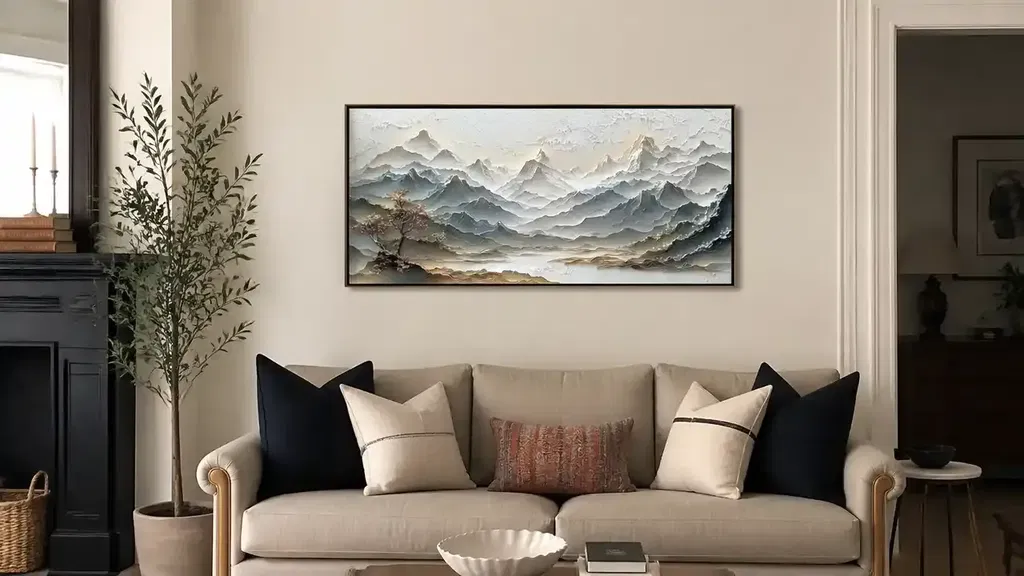
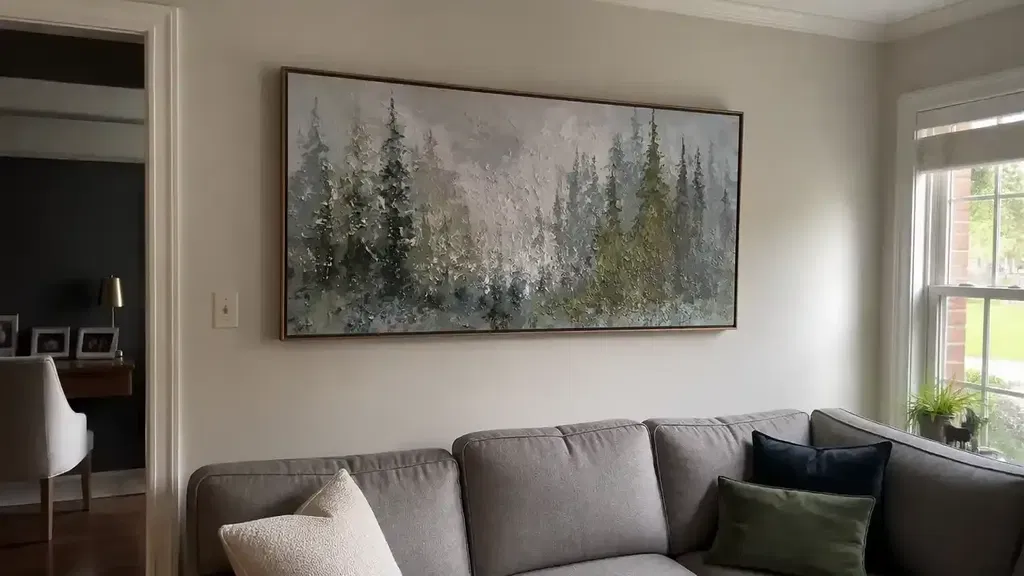
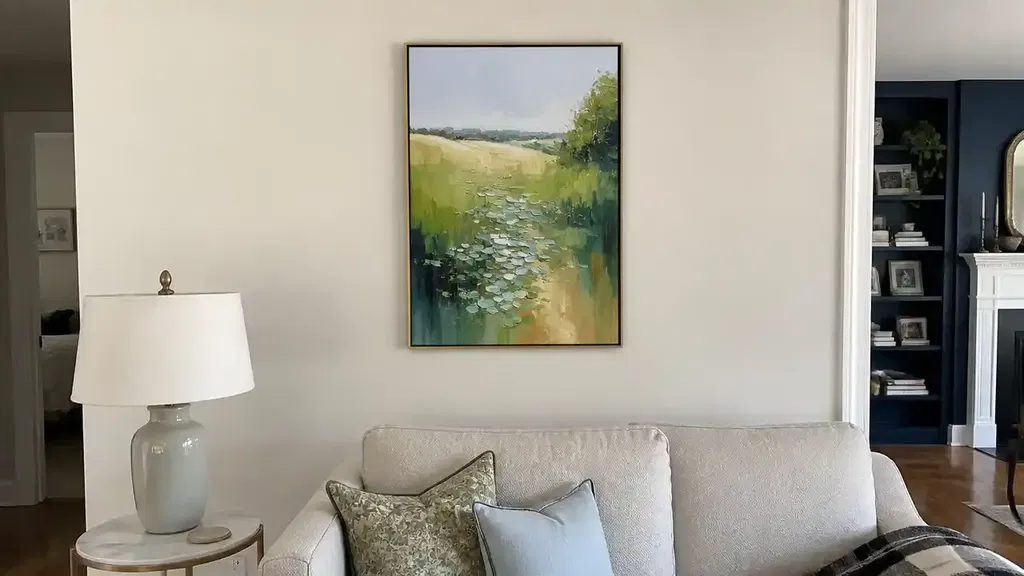
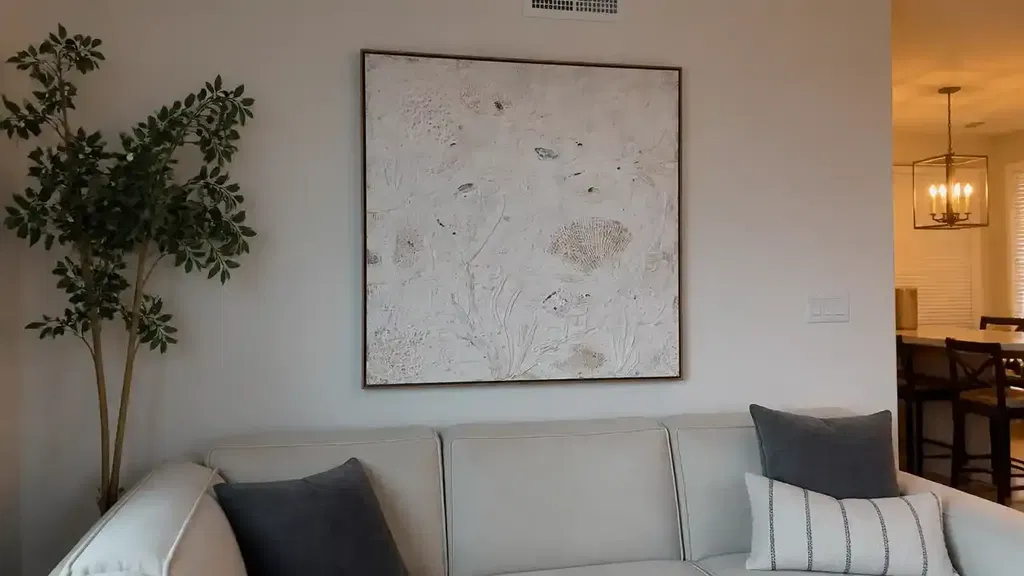
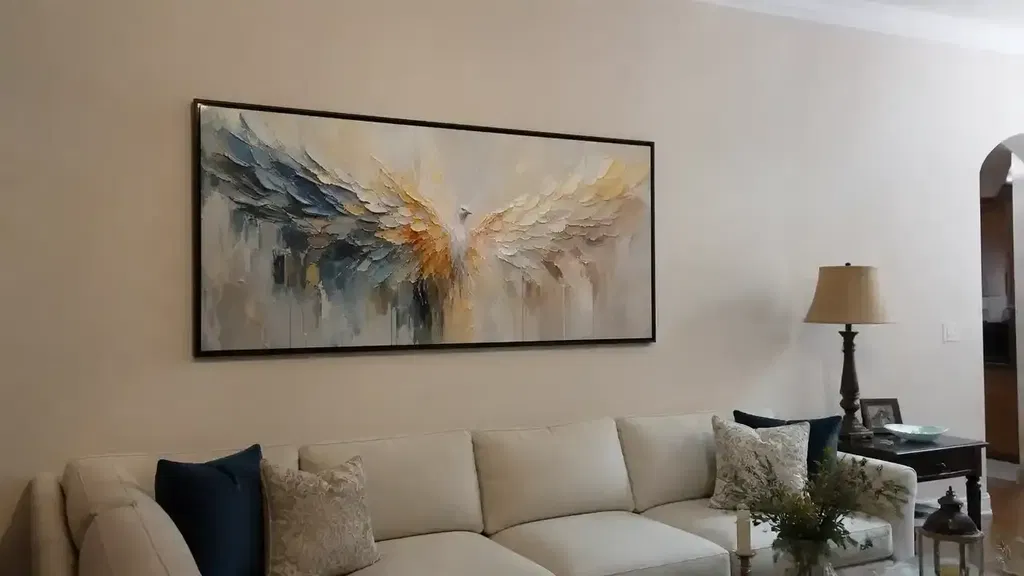
Almost every painting listing includes a scene photo: the work above a sofa, above a bed, against a feature wall. These photos communicate style and mood. They do not communicate accurate scale.
Wide-angle lenses exaggerate depth, making rooms look larger and furniture look more proportionate. A painting that reads balanced in a scene photo might be 40 inches (100 cm) wide, staged against a 110-inch (280 cm) sofa in a large studio. If your sofa is 75 inches (190 cm), that same painting above yours would dominate the wall in a way the photo never hinted at.
Canvas Size vs Framed Size
These are not the same number. A frame adds 1 to 3 inches (3 to 8 cm) on each side, depending on the style. A 30 x 40 inch canvas in a 2-inch frame becomes 34 x 44 inches on your wall.
If the scene photo shows a framed piece but the listing only states canvas dimensions, the painting arriving at your door will be noticeably larger than you expected.
Test With a Tape
Set the scene photo aside for sizing. Take the listed dimensions and mark them on your actual wall with painter's tape. Stand back at the distance you'd normally view that wall. Five minutes of work removes the biggest source of sizing regret, and it costs nothing.
What "Original Hand-Painted" Actually Means Online
Factory-Painted vs Individually Conceived
"Hand-painted original" describes a wide range of production models, and online art listings rarely spell out which category they fall into.
At one end: a workshop with dozens of painters reproducing the same design from a template. Each canvas gets painted by a human hand, so the label is technically accurate.
At the other end: a single artist who conceives and executes a piece from start to finish, with no two works exactly alike. Both appear online under the same "hand-painted original" label. The price gap between them can reach tenfold.
Signals That Help You Tell the Difference
Look for these on any listing page:
- The product names a specific artist with a short bio or creative background. Generic listings say "our artists" with no further detail.
- In-progress or studio photos show the work at different stages of completion. Workshop productions usually show only the finished piece, at scale, in near-identical versions.
- Buyer review photos show variation between pieces. Individual works always differ in small ways; template-based works rarely do.
- Multiple size and color variants of the same design are listed as ready-to-order options. That structure is a reliable indicator of a production-model painting.

How to Check Texture Before You Buy
Texture defines how an original oil or acrylic painting reads in a room. A flat product photo erases it.
What to Look For in Photos
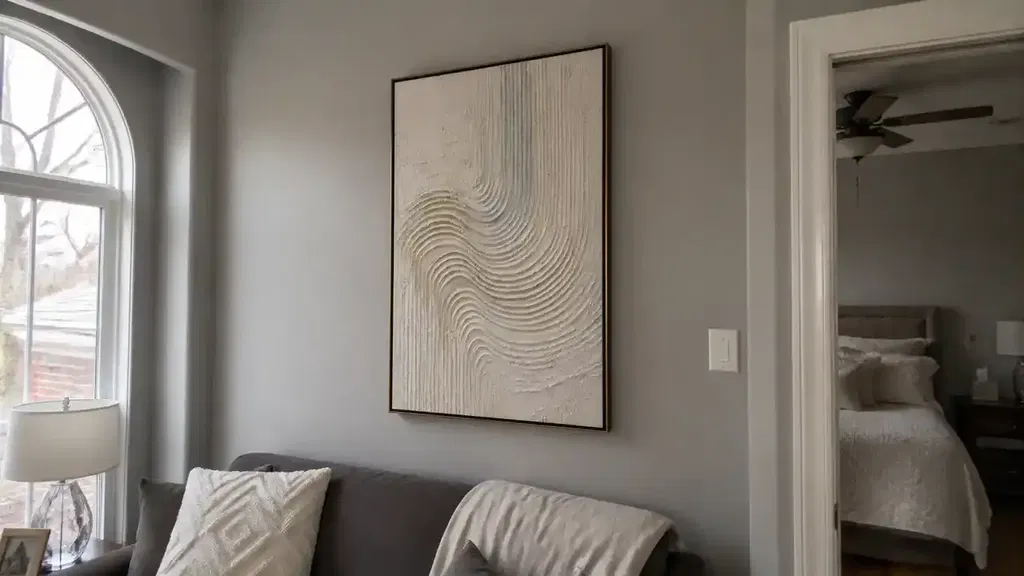
The only way to see real surface texture in a photo is through side lighting. When light hits painted canvas at an oblique angle, raised brushstrokes and palette knife ridges cast small shadows. Those shadows reveal the texture. Without that angle, a heavily impasto surface and a flat print can look identical in a photo.
Look for a side-angle or close-detail shot alongside the main image. If every photo on the product page is straight-on and evenly lit, you're not seeing the surface. You're seeing a flattened record of it.
Specific terms in the product description also point toward real surface depth: "palette knife," "impasto," "layered texture," "3D texture." These describe techniques that build physical variation into the painting rather than visual pattern alone.
What to Ask the Seller
If there's no side-angle photo in the listing, ask for one. Note how fast the seller responds and check that the photo actually shows what you requested. Both are useful signals about what the seller knows about their own product.
What a Return Policy Tells You About a Seller's Confidence
Most buyers read a return policy to find out if they can get a refund. It also signals how much confidence the seller has in their product's accuracy.
Three Policy Types and What They Signal
| Policy Type | What It Signals |
|---|---|
| Unconditional returns (30 days, no reason needed) | The seller expects the product to match its description closely enough that returns stay manageable |
| Damage-only returns | Confidence in physical build quality, but color or appearance differences are not covered |
| No returns / final sale | Reasonable for true one-of-a-kind originals; a caution flag for volume-produced "hand-painted" pieces |
One detail most buyers overlook: who pays return shipping. For large paintings, especially international orders, return freight can be significant. Confirm this before purchasing.
Ask the seller directly: if the color looks noticeably different from the photos, does that qualify for a return? A seller with a reliable product answers that question without hesitation. Sellers who hedge or redirect are telling you something too.

Buy with Your Eyes Open, Not Only Your Heart
Liking a painting is the right reason to buy it. Running a few checks first is how you make sure what arrives matches what you chose. Color accuracy, scale, texture, the production model, and return terms are all verifiable before any money changes hands. Montcarta's paintings are handcrafted originals, photographed in multiple real-light conditions, with a 30-day return window. You can see how these checks hold up against Montcarta's handcrafted originals.
FAQs
Q1: What is the difference between an original painting and a print?
An original painting is made directly on canvas with physical paint. The surface has real brushstrokes and raised texture that shift visually under different light. A print is mechanically reproduced: the surface is flat and changes very little between lighting conditions. Hold a side light up to both and the difference is immediate.
Q2: How do I know if a painting I buy online is authentic?
Look for three things: a named artist with verifiable background information, slight visible differences between pieces (no two true originals are identical), and real surface texture visible in side-angle photos. Reliable sellers also offer unconditional returns. They don't need buyers to take authenticity on faith.
Q3: How much should I spend on a painting for my home?
No fixed number applies to everyone, but a useful frame: a piece you'll look at every day for ten to twenty years is worth budgeting for the way you would a piece of furniture you use daily. Hand-painted originals in that context tend to feel appropriately priced rather than expensive.
Q4: Is it safe to buy art from an online store I have not heard of before?
Check three things: buyer reviews that include real photos of the received work, a responsive contact channel (send a question before purchasing and note how they reply), and an explicit return policy. An unfamiliar name is not a reason to avoid a seller. Skipping those checks is.
Q5: What size painting should I buy for a wall I have never measured?
Measure first. On iPhone, the built-in Measure app gives a quick estimate of wall dimensions. On Android, free AR measurement apps like AR Ruler do the same. For the best accuracy, confirm with a physical tape measure. Note the wall width, wall height, and the distance from the top of any furniture to the ceiling. Then mark the painting's dimensions on your wall with painter's tape and stand back. Do not order without this step.