Subject Liquidity: Which Themes Sell Fastest for Collectors
The high-end art market is currently navigating a period of structural recalibration. According to Marketplace.org, sales of trophy works exceeding $10 million plummeted by 44% year-over-year in 2024. This retreat from purely financial "vanity assets" signals a return to real application value. For aesthetic-driven homeowners and interior designers, the focus has shifted from high-risk auction gambles to custom, hand-painted originals that offer "decision safety"—the prestige of fine art combined with the predictability of a retail purchase.
Understanding "Subject Liquidity" is the cornerstone of a low-regret investment. While the global art market remains a massive economic baseline—reaching $65 billion in 2023 per the Art Basel and UBS Art Market Report 2024—not all themes move at the same speed. In our observation of the secondary decor market, certain subjects possess a "universal currency" that allows them to sell within days, while others can languish for years.

The Dominance of Oversized Abstracts
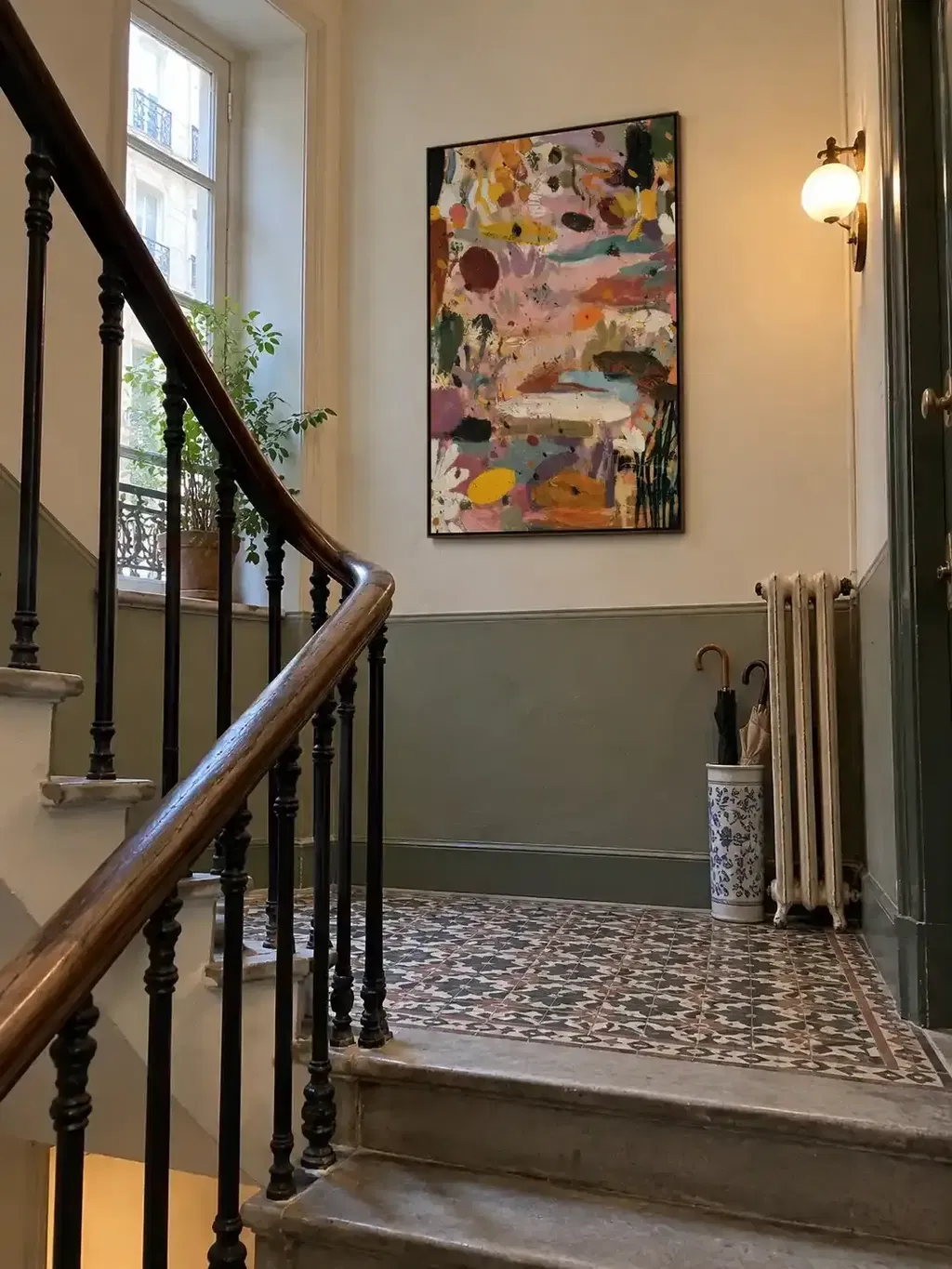
In the realm of premium decorative originals, "Oversized Abstracts" (48 inches and above) are the most liquid assets. We frequently see these pieces resolve "large wall syndrome"—the paralyzing design challenge of a massive, empty vertical space—without requiring the buyer to adopt a specific narrative or emotional history.
The "Neutral-Plus" Palette Heuristic
Our analysis of resale velocity suggests that color palette is often more influential than the specific abstract form. A reliable heuristic used by professional home stagers is the "Neutral-Plus" rule:
- 80% Neutral Base: Shades of oatmeal, slate, white, or charcoal.
- 20% Liquidity Colors: Accents of navy, sage, or muted terracotta.
Paintings following this ratio consistently outperform high-saturation pieces in resale speed. The neutral majority allows the work to blend into various interior trends, while the 20% "liquidity colors" provide the necessary visual anchor for the room.
Modeling Note: This 80/20 heuristic is based on common patterns in high-end staging and secondary market returns (not a controlled lab study). It assumes the painting must complement, rather than dominate, a designer-led interior.
Atmospheric Landscapes vs. Graphic Nature
While nature is a perennial favorite, there is a sharp divide in liquidity between "Atmospheric" landscapes and "Graphic" nature scenes. Insights from Artsy indicate that works with atmospheric depth—soft, receding horizons and blurred boundaries—are perceived as higher value than flat, illustrative scenes.
The Biophilic Premium
The demand for nature-themed art is supported by significant neurological data. A critical review from the University of Pennsylvania found that 73% of patients reported mood improvements when exposed to environmental art. Furthermore, the WHO Scoping Review on Arts and Health confirms that art interventions effectively alter clinical indicators for stress and mental health.
For a collector, this means nature-themed works have a built-in secondary market: healthcare facilities, corporate offices, and wellness-focused homeowners. However, to maintain liquidity, we recommend favoring "Biophilic" designs that mimic the outdoors' stress-reduction effects without being tied to a specific, recognizable geographic location.

Avoiding the "Subject Locking" Trap
One of the most common mistakes in art acquisition is "Subject Locking." This occurs when a painting features highly specific architectural, cultural, or geographic references. While a detailed painting of a specific street in Paris may be sentimental, it can shrink the potential secondary buyer pool by up to 70% compared to universal, non-representational themes.
| Theme Type | Typical Liquidity Level | Buyer Pool Impact | Primary Risk |
|---|---|---|---|
| Universal Abstract | High | Expanded (+40%) | Perceived as "generic" if texture is low. |
| Atmospheric Landscape | Moderate-High | Stable | Seasonal specificity (e.g., heavy snow). |
| Abstracted Figurative | Moderate | Neutral | Emotional intensity or "staring" eyes. |
| Specific Architecture | Low | Contracted (-70%) | Requires a personal link to the location. |
| Niche Cultural Icons | Very Low | Highly Fragmented | Rapidly shifting cultural relevance. |
Table 1: Estimated impact of subject matter on secondary market buyer pools based on common staging heuristics.
The Authenticity Premium: Human vs. AI
In an era of generative AI, "performative authenticity" has become a measurable financial metric. Research from Columbia University confirms that consumers value art labeled as "AI-generated" 62% lower than authentic human-created art. This is largely due to what University of Chicago research describes as the "essential identity"—the belief that a physical canvas retains the artist's soul and effort in a way a digital print cannot.
For the collector, this means that the physical relief of oil paint is a core liquidity driver. Digital replicas lack the micro-topography (millimeter-scale texture) that optical microprofilometry proves is crucial to the aesthetic experience. When reselling, the "tactile fruition"—the ability for a buyer to see and feel the brushstrokes—acts as a "nuclear weapon" against the devaluation caused by the influx of AI prints.

Technical Integrity and Long-Term Value
A painting’s liquidity is zero if the physical medium fails. We believe collectors must understand the material science behind their acquisitions to ensure "decision safety."
Lightfastness and Pigment Stability
The durability of a painting is quantified through standards like ASTM D4303, which uses xenon-arc tests to simulate decades of indoor light exposure. A common industry "gotcha" is the fading of certain pigments. For example, Tate research into Smalt (a potassium glass colorant) shows it is prone to tragic fading due to its chemical makeup. Conversely, modern acrylics have shown extreme resilience, though they remain sensitive to surfactants migrating to the surface and causing "haziness" in high humidity (Tate TAAMPP Project).
The Health and Safety Dimension
As Gen Z and ESG-conscious buyers enter the market, the "Indoor Air Quality (IAQ) Promise" is becoming a resale factor. Data from Aalto University shows that coatings on wood with specific moisture levels emit significantly lower VOCs than industrial alternatives. Buyers increasingly prioritize "non-toxic" pigments, especially in homes with children. Citing the use of low-VOC paints or the elimination of toxic Lead White (banned by EU REACH Annex XVII) can significantly enhance a piece's appeal to health-conscious secondary buyers.
Art as Real Estate Equity
For homeowners, art is not just decor; it is an equity-boosting infrastructure. A Royal Society CAR model analysis found that neighborhoods with higher "art" geo-tags experienced greater relative house price gains. On a micro-level, high-quality murals and original oils elevate the "perceived value" of a property.
In commercial settings, the impact is even more pronounced. Chicago’s Millennium Park projects drove $1.4 billion in real estate growth. For property developers, commissioning public-facing murals is a "marketing trump card" used to lease office space in high-vacancy environments (NAIOP Insights).
2026 Trends: Texture and Surrealism
Looking ahead, Zillow and Yelp search data indicate a 21% rise in "artisan craftsmanship" and a staggering 329% spike in "custom framing" searches. High-end interior trends are moving toward "Texture as Soul," with a specific interest in Dali-inspired surrealist pieces that offer a sense of "whimsy" (Design State of Mind 2026 Outlook).
For the liquidity-minded collector, this suggests that the next wave of high-demand pieces will combine:
- Classical Hand-Painting Codes: Visible brushwork and "essential identity."
- Avant-Garde Contemporary Design: Fusing traditional techniques with modern spatial aesthetics.
- Immersive Escapism: Such as "Panoramic Murals" that wrap around powder rooms—a dominant trend noted by the NKBA 2025 Design Awards.
Scenario Analysis: The Resale Ready Collection
To demonstrate how these factors interact, let's look at two distinct acquisition scenarios.
Scenario A: The Liquid Investor (High Liquidity)
- Subject: 60" x 48" Abstract.
- Palette: 80% Oatmeal/Slate, 20% Sage.
- Medium: Low-VOC heavy-body acrylic on hemp canvas.
- Outcome: This piece appeals to the broadest possible buyer pool (minimalist homeowners, corporate offices, healthcare staging). It avoids "Subject Locking" and utilizes the "Neutral-Plus" palette for maximum compatibility.
Scenario B: The Niche Collector (Low Liquidity)
- Subject: 24" x 24" detailed oil painting of a specific Italian villa.
- Palette: High-saturation terracotta and emerald.
- Medium: Traditional oils with heavy solvents.
- Outcome: While personally meaningful, this piece suffers from a 70% reduction in the potential buyer pool. Its specificity makes it a "Subject Locked" asset, suitable only for someone with a personal connection to that villa or a very specific color scheme.
Modeling Note: The Liquidity Score
The following parameters are used to estimate the "Liquidity Score" of an original painting in our scenario modeling.
| Parameter | Value / Range | Unit | Rationale / Source Category |
|---|---|---|---|
| Size (Width) | 48 - 72 | Inches | Optimal for standard residential focal walls. |
| Neutral Content | 75 - 85 | % | Maximum compatibility with changing decor. |
| Texture Relief | 2 - 5 | mm | High-relief impasto signals human creation. |
| VOC Level | < 50 | g/L | Compliance with LEED/WELL certifications. |
| Subject Specificity | < 10 | % | Avoidance of "Subject Locking" references. |
Method & Assumptions: This is a deterministic parameterized model for "Decision-Safe" buyer personas. It assumes a 12-month exit strategy in a major metropolitan secondary market. It does not account for celebrity provenance or extreme economic shifts.
Summary of Low-Regret Purchasing
To maximize liquidity and minimize regret, we recommend viewing art as a "spatial solution provider" rather than just a visual ornament. By prioritizing oversized abstracts, atmospheric biophilic themes, and "Neutral-Plus" palettes, you align your collection with both current neurological needs and future design trends.
Furthermore, by insisting on 100% human-made works with documented material safety (low-VOC, lightfast pigments), you protect the "essential identity" of the piece. As the $1.2 trillion creative economy continues to grow at twice the rate of the US economy (NEA 2023 Data), the most successful collectors will be those who balance the emotional "soul" of the canvas with the cold, hard data of market liquidity.
YMYL Disclaimer: This article is for informational purposes only and does not constitute professional investment, legal, or health advice. Regarding pigment toxicity and indoor air quality, always consult with a certified industrial hygienist or medical professional. For art as a financial asset, consult with a qualified financial advisor.
Sources
- Marketplace: The expensive art market continues to struggle
- Columbia University: Human-Made vs. AI Art Perception Study
- University of Pennsylvania: Visual Art in the Built Environment
- Royal Society: Quantifying the link between art and property prices
- Artsy: 2024 Art Market Report
- Tate: The Tate AXA Art Modern Paints Project
- EPA: Indoor Air Quality and Low-VOC Paints
- Art Basel & UBS Art Market Report 2024
- NEA: Arts and Cultural Industries Added $1.2 Trillion
- Zillow: 7 Home Design Trends for 2026