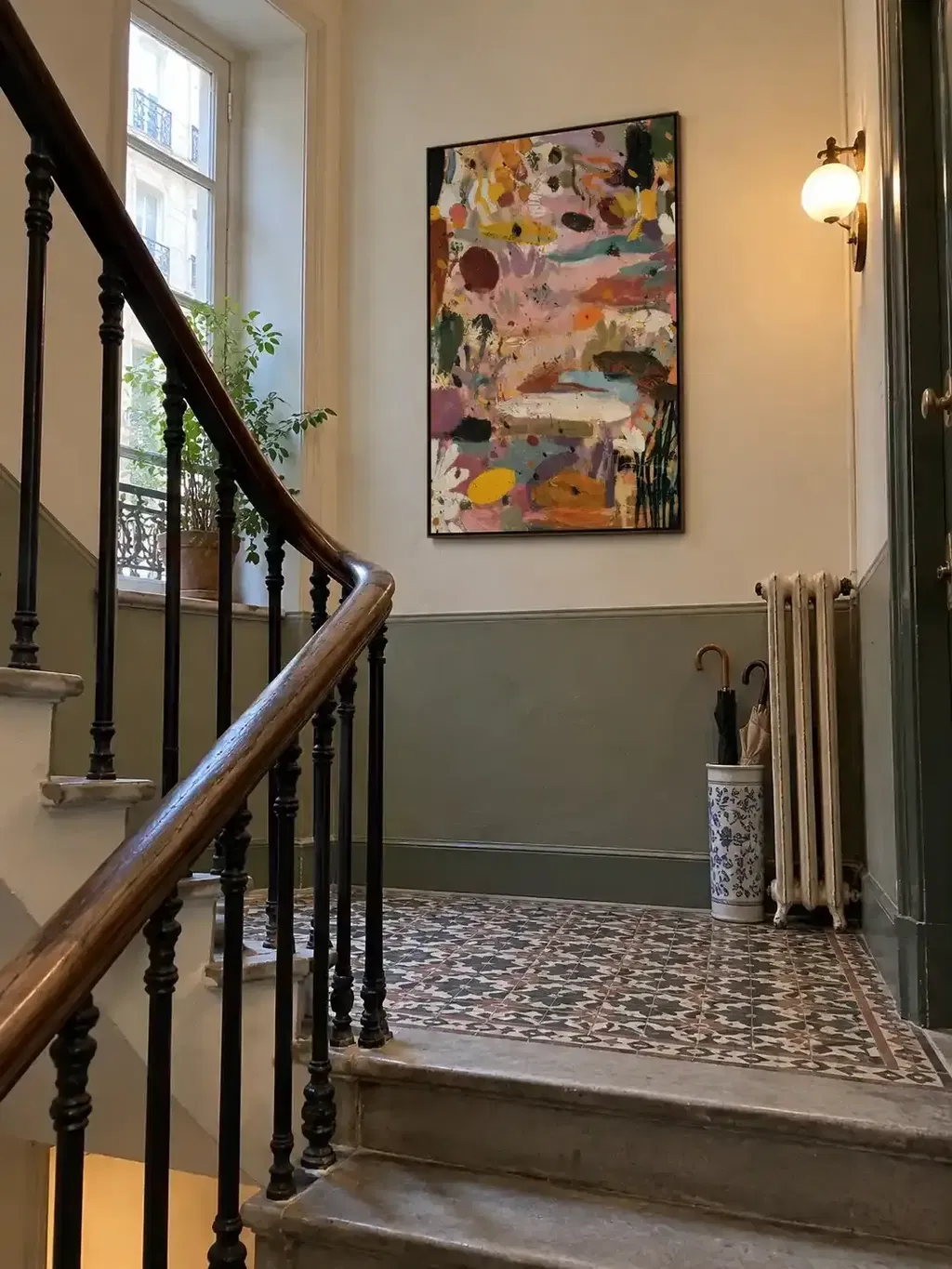
The Shift from Decoration to Curation
For years, the acquisition of art for the home was viewed primarily through the lens of "filling space." A homeowner would buy a piece because the colors matched a rug or the dimensions fit a specific alcove. However, we are currently witnessing a structural shift in how aesthetic-driven individuals approach their walls. The transition from buying isolated decorative objects to building a curated art portfolio marks a maturation of taste—one that values the prestige of hand-painted oils and the long-term emotional "yield" of a cohesive collection.
This evolution is occurring against a fascinating macroeconomic backdrop. According to the Marketplace.org report on the struggling art market, high-end auction sales for pieces over $10 million plummeted 44% year-over-year in 2024. This suggests a retreat from purely financial, speculative art assets. In its place, collectors are returning to "real application value"—investing in custom, hand-painted works that provide immediate psychological and environmental benefits rather than just existing as a line item on a balance sheet.
Building a portfolio is not about buying more art; it is about buying art more systematically. By moving toward a curated model, you reduce the risk of aesthetic mismatch and increase the "essential identity" of your home. Research from the University of Chicago indicates that consumers perceive a significant collapse in value for digital replicas and NFTs because they lack the artist’s "essential identity." A hand-painted canvas, by contrast, retains a physical soul—a biochemical crystallization of human attention that digital prints simply cannot replicate.
The 70/30 Rule: The Logic of Visual DNA
Professional curators often rely on what we call the 70/30 Rule of Cohesion. When scaling from a single piece to a portfolio, the goal is to create a "visual DNA" that ties disparate rooms together without making the home feel like a sterile, one-note showroom.
- The 70% Core: Approximately 70% of your collection should share a common thread. This might be a consistent impasto technique, a shared color temperature (e.g., warm ochres and teals), or a specific narrative intensity. This "rhyme" ensures that as you move from the foyer to the living room, the transition feels deliberate.
- The 30% Friction: The remaining 30% should provide "visual friction." These are the pieces that break the rules—a surrealist Dali-inspired custom piece in an otherwise minimalist room, or a high-contrast monochrome work in a space dominated by earth tones. This friction prevents the collection from becoming "background noise."
Logic Summary: The 70/30 Rule is a heuristic derived from common practitioner-level curation patterns. It assumes that human visual processing requires a balance of pattern recognition (safety/cohesion) and novelty (engagement). This is not a scientific law but a robust baseline for residential interior design.

Understanding Visual Volume and Negative Space
A common mistake we see in early-stage collections is the failure to account for "visual volume." A heavy, textured oil painting occupies more "psychological space" than a flat print of the same physical dimensions.
Based on our scenario modeling of high-end residential interiors, a heavily textured impasto work typically requires up to 1.5x more negative space than a flat reproduction. If you crowd a textured original, the shadows created by the physical paint ridges (the microtopography) begin to compete with the surrounding architecture, leading to visual fatigue.
Modeling Art Scale: The 60-75% Heuristic
When placing your anchor pieces—the foundation of your portfolio—proportionality is paramount. We utilize a standard scaling guideline often cited in high-end interior design research:
| Parameter | Recommended Value | Unit | Rationale |
|---|---|---|---|
| Art-to-Furniture Ratio | 60–75 | % | Ensures the work anchors the furniture without eclipsing it |
| Negative Space Buffer | 15–20 | cm | Minimum "breathing room" between art and architectural edges |
| Sightline Height | 145–150 | cm | Center-point height for optimal neurological engagement (eye level) |
| Texture-to-Light Offset | 30–45 | degrees | Ideal lighting angle to emphasize impasto microtopography |
Method & Assumptions: This model assumes a standard ceiling height of 2.7 meters and furniture depth of 90cm. These are "rules of thumb" intended for quick selection; variations in ceiling height or "grand-scale" rooms may require downward or upward adjustments of ~10%.
To ensure your collection feels like a fluid experience, we recommend the Sightline Test. Stand at the threshold between two rooms. If the works visible in both spaces do not "rhyme" in their narrative intensity, the portfolio lacks continuity. You can learn more about managing these transitions in our guide on Zoning with Art in Multi-Use Spaces.
The Neurological Impact of Hand-Painted Surfaces
Why do we feel a deeper connection to a hand-painted wall than a mass-produced wallpaper? The answer lies in our neurobiology. A systematic review of 85 records published in PMC shows that passive art viewing consistently activates the medial prefrontal cortex (mPFC) and the amygdala. These areas are responsible for emotional regulation and self-referential thought.
Furthermore, the "micro-physical texture" of oil paint is crucial to its aesthetic value. Optical microprofilometry has proven that the millimeter-scale texture of ancient oil paintings provides "vision-missed data" that the brain processes subconsciously. When you buy a hand-painted work, you are acquiring the "biochemical crystallization of apex human visual attention." This is why consumers in a Columbia University study valued art labeled as "AI-generated" 62% lower than authentic human-created art. The brain can sense the lack of "bottom-up neural control" that a master painter uses to suppress perceptual illusions.

Economic Leverage: Art as a Property Asset
For the portfolio-minded collector, art is not just a cost; it is a "catalytic asset." Quantitative analysis from the Royal Society found that neighborhoods with higher "art" geo-tags experienced greater relative house price ranking gains.
In the commercial sector, this "art effect" is even more pronounced. The Chicago Millennium Park public art projects drove an estimated $1.4 billion in real estate-related growth. For homeowners looking to sell, creative placemaking—such as a custom mural—can reverse feelings of "blight" in older properties and make them attractive to long-term buyers. We've explored this "flipping hack" in our analysis of Luxury Staging with Hand-Painted Art.
Health, Safety, and the "IAQ Promise"
As you scale your collection, indoor air quality (IAQ) becomes a critical consideration. Many traditional oil paints and solvents contain volatile organic compounds (VOCs) that can be hazardous. The CDC and NIOSH warn that chronic inhalation of low-level compounds in certain paints can lead to central nervous system neuropathy.
However, modern professional studios are shifting toward safer alternatives:
- Low-VOC Acrylics: These are often a prerequisite for large healthcare facilities to achieve LEED certification, as noted by the EPA.
- Natural Solvents: Walnut oil is increasingly replacing toxic turpentine.
- Bio-based Substrates: Hemp and flax canvases consume half the water of traditional cotton, appealing to the 87% of cultural audiences who are deeply concerned about the climate crisis.
When curating for sensitive environments, such as children's rooms or clinics, it is vital to look beyond the "ASTM D-4236" label. As the EPA points out, this label only means the warning labels comply with regulations—not that the pigment is inherently non-toxic. For a deeper dive into creating a healthy home gallery, see our report on Market Perception and Professional Success.
Specialized Curation: Biophilic Design and Wellness
The most sophisticated portfolios today are integrating Biophilic Design—the practice of connecting occupants to nature through visual cues. Research from the University of Pennsylvania found that 73% of patients reported significant mood improvements when exposed to environmental artworks.
In the modern workspace, where cognitive fatigue and burnout are rampant, biophilic murals act as "public health infrastructure." A nature-themed mural by a workstation can reduce turnover and fatigue by activating the same stress-reduction circuits as the real outdoors. This is particularly effective for Gen Z professionals who value "authenticity" and "whimsy" over mass-produced office decor.

Technical Mastery: The Science of Longevity
A portfolio is a long-term investment, which means you must understand the chemistry of longevity. One of the most common issues we see with advanced collections is Support Induced Discoloration (SID). According to technical bulletins from Golden Artist Colors, water-soluble impurities in cotton canvases can be drawn into transparent acrylic layers, causing a yellow or brown tint over time.
To prevent this, collectors should ensure their artists use:
- High-Quality Primers: To block the migration of impurities.
- Lightfast Pigments: Tested under ASTM D4303 standards. This uses xenon-arc tests to simulate years of indoor light exposure, ensuring the vibrant teals and ochres of your "visual DNA" do not fade.
- UV Protective Varnishes: These block harmful light waves at the molecular level, slowing the photochemical aging of the polymer film.
Building Your Home Gallery
The journey from a single piece to a portfolio is a transition from being a consumer to being a guardian of culture. By applying the 70/30 Rule, respecting visual volume, and prioritizing the "essential identity" of hand-painted works, you turn your home into a deliberate, fluid experience.
As the Art Basel and UBS Art Market Report 2024 proves, the global art market remains a $65 billion powerhouse. While the "vanity auction" market may fluctuate, the value of human-centric, hand-painted art in the built environment continues to grow. Whether you are scaling for personal enjoyment or as a "marketing trump card" for a luxury listing, a systematic approach to curation ensures your collection remains a source of prestige and emotional well-being for decades to come.
YMYL Disclaimer: This article is for informational purposes only and does not constitute professional medical, legal, or financial advice. The safety of art materials, including VOC emissions and pigment toxicity, should be verified with manufacturers and qualified safety professionals. When installing large-scale art or murals in public or medical facilities, always consult local building codes and health regulations.
Sources
- Marketplace: The expensive art market continues to struggle
- University of Chicago: Does Artwork Preserve Essential Identity?
- Columbia Business School: Human-Made vs. AI Art Perception Study
- Royal Society: Quantifying the link between art and property prices
- UPenn: Visual Art in the Built Environment Review
- EPA: Indoor Air Quality and Low-VOC Paints
- ASTM International: Standard Test Methods for Lightfastness
- Golden Artist Colors: Support Induced Discoloration (SID) Technical Bulletin
- Gallery Climate Coalition: Art Fairs Toolkit for Environmental Responsibility