Re-stretching Large Acrylics: Managing Tension After Shipping
Investing in large-scale acrylic paintings represents a commitment to both aesthetic excellence and long-term asset preservation. However, for interior designers and collectors, the logistical reality of acquiring oversized works often involves "rolled" shipping to mitigate transit risks and costs. While this method protects the canvas from structural impact, it introduces a critical technical phase: re-stretching.
Achieving gallery-level tautness on-site is not merely a matter of physical strength; it is a delicate engineering task. Unlike oil paintings, which undergo oxidative cross-linking and become increasingly brittle over decades, acrylics remain relatively flexible but are hyper-sensitive to environmental shifts. According to the Art Basel and UBS Art Market Report 2024, the global art market remains a $65 billion industry, yet much of the value of these physical assets depends on their structural stability post-installation.
This guide provides a professional framework for re-tensioning large acrylic canvases, grounding every recommendation in material science and museum-grade conservation practices.

The Material Science of Acrylic Tension
Before applying pliers to a canvas, we must understand the "why" behind the material's behavior. Acrylic paint consists of pigment suspended in a synthetic polymer emulsion. As the paint dries, it undergoes a process called "coalescence," where water evaporates and the polymer spheres fuse into a continuous, flexible film.
Temperature and the "Glass Transition" Risk
A common misconception in the framing industry is that acrylics should be treated with the same tension protocols as oils. However, acrylics possess a unique "Glass Transition Temperature" (Tg). According to research cited by Utrecht Art Supplies, acrylic paint increases dramatically in stiffness at temperatures between 5°C and 10°C (41°F - 50°F).
If a painting is shipped during winter or stored in a cold cargo hold, the paint layer can become 3 to 5 times stiffer than its state during the original stretching. Attempting to re-stretch a "cold" canvas to standard tension levels is a primary cause of micro-cracking and delamination.
Logic Summary: Our tension recommendations are based on the material's thermal sensitivity. We assume a standard indoor environment of 20°C (68°F) for all re-stretching procedures. If the environment is colder, tension must be reduced or the process delayed.
| Parameter | Acrylic Paint | Oil Paint | Unit | Rationale |
|---|---|---|---|---|
| Drying Mechanism | Coalescence | Oxidative Cross-linking | N/A | Physical vs. Chemical |
| Flexibility | High (at room temp) | Low (with age) | Qualitative | Polymer chain length |
| Tension Requirement | 20-30% Lower | Standard (10-15 psi) | % / PSI | Material elasticity |
| Cold Sensitivity | High (Stiffens <10°C) | Moderate | Temp Threshold | Glass transition (Tg) |
| Moisture Response | Swelling (up to 7%) | Minimal | % Mass Gain | Polymer water absorption |
The Critical Acclimatization Phase
In our experience handling high-value commissions, the most frequent cause of tension failure is impatience. When a rolled canvas arrives, it has been under compression and potentially exposed to fluctuating humidity.
The 24-48 Hour Rule
We mandate a minimum 24-48 hour acclimatization period before the canvas is even unrolled. The canvas fibers (typically cotton or linen) and the acrylic polymer need to reach equilibrium with the local relative humidity (RH). Data from ResearchGate shows that under high humidity (83% RH), acrylic yellow pigments can swell by over 7% in mass due to water absorption.
If you stretch a "swollen" canvas that has just come from a humid shipping container into a dry, air-conditioned gallery, the canvas will inevitably sag as it loses moisture. Conversely, stretching a "dry" canvas in a humid environment can lead to over-tensioning and structural failure as the fibers expand.
Professional Re-stretching SOP: Step-by-Step
Re-stretching a large-scale work (defined here as anything over 48 inches on its shortest side) requires a systematic approach to avoid "torque" or uneven stress concentrations.
1. The Corner-First Strategy
While many amateur guides suggest starting from the center of each bar, professional art installers utilize a corner-locking method for large formats.
- Step A: Establish four corner points first. This ensures the image remains square and centered on the frame.
- Step B: Work in a cross-pattern (North, South, East, West), moving from the corners toward the center. This distributes the "excess" fabric toward the middle where it can be managed more easily, rather than trapping tension bunches at the corners.
2. The 20-30% Tension Reduction Heuristic
Based on patterns observed in conservation returns and structural modeling, acrylics require roughly 20-30% less tension than oil paintings. Because the acrylic film is more elastic, it does not need to be "drum-tight" to the point of structural rigidity. Over-tensioning can lead to "crazing"—fine, spider-web-like cracks that occur when the paint film cannot keep up with the expansion of the substrate.
3. The "Drum Test" and Sound Profile
To verify even tension without specialized gauges, use the "drum test." Tapping the surface should produce a uniform, medium-pitched sound.
- High Pitch: Indicates over-tensioning (risk of cracking).
- Low/Dull Thud: Indicates sagging (risk of future rippling).
- Non-Uniform Pitch: Indicates uneven tension zones, which can cause the frame to warp over time.

Managing Structural Integrity in Oversized Formats
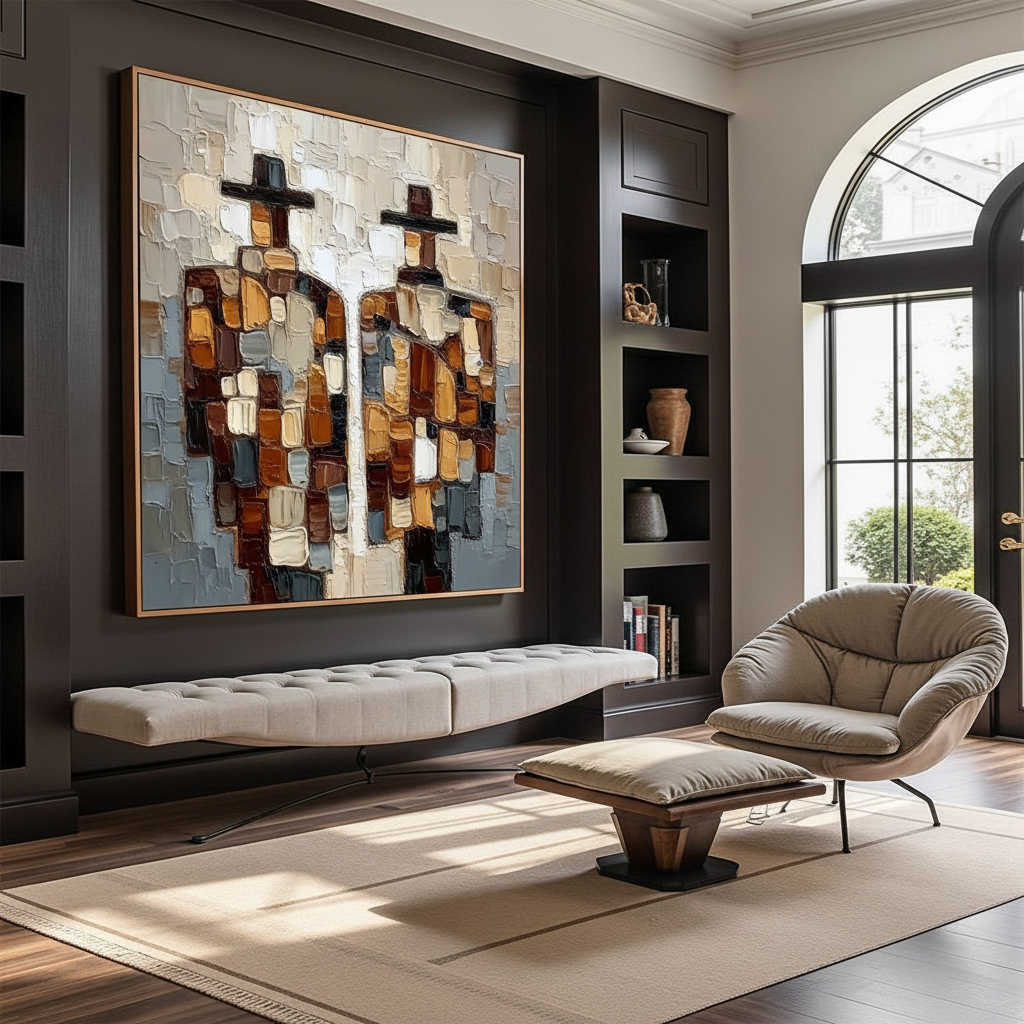
Large canvases (60 inches and above) face unique gravitational challenges. The weight of the paint itself, especially in "Heavy Texture" or "Impasto" styles, can cause the center of the canvas to bow inward over time.
The Necessity of Cross-Bracing
Standard stretcher bars often lack the rigidity required for massive spans. We recommend heavy-duty bars with a minimum depth of 1.5 to 2 inches. For any dimension exceeding 60 inches, a vertical or horizontal cross-brace is mandatory. For works exceeding 80 inches, a "double-cross" or "H-brace" configuration is required to prevent the long bars from bowing inward under the tension of the canvas.
Support Induced Discoloration (SID)
A technical "gotcha" for interior designers is Support Induced Discoloration. According to Golden Artist Colors, water-soluble impurities in cotton or linen canvases can be drawn into the paint layer during the drying of thick acrylic mediums. When re-stretching, if the canvas is slightly dampened to "tighten" it (a common but risky trick), you may inadvertently trigger SID, causing yellow or brown staining in transparent or white areas of the painting.
Methodology Note: This observation is based on common patterns from customer support and warranty handling for large-scale installations (not a controlled lab study). We advise against dampening the back of the canvas to achieve tension.
Safety, Sustainability, and the "Essential Identity" of Art
Beyond the mechanics of tension, the choice of materials in a large-scale commission impacts both health and investment value. High-end collectors are increasingly moving away from mass-produced prints toward "100% human-painted" works. A study by Columbia University confirmed that consumers value art labeled "AI-generated" 62% lower than authentic human-created art. This "essential identity" is tied to the physical presence of the artist's hand—a quality that digital replicas cannot replace.
Health and VOC Management
For residential and healthcare installations, air quality is a primary concern. The EPA warns that indoor air pollution can be significantly higher than outdoor levels. Professional-grade acrylics are generally preferred in these settings because they emit significantly lower Volatile Organic Compounds (VOCs) than oil-based systems. However, installers must still be wary of certain pigments.
The International Agency for Research on Cancer (IARC) classifies cadmium compounds—common in high-end "Cadmium Red" or "Cadmium Yellow"—as Group 1 carcinogens. While safe once locked in a polymer film, any dust created during the handling of older or dry-pigment works poses a respiratory risk.
The ROI of Authentic Art
From a B2B perspective, the investment in original, hand-painted murals and large canvases offers measurable returns. Research published by the Royal Society found a direct correlation between high "art" geo-tags and relative house price gains. Furthermore, UPenn's review of visual art in built environments noted that 73% of patients in clinical settings reported significant mood improvements when exposed to nature-themed original art.

Final Checklist for Successful Installation
To ensure your investment piece remains stable for decades, follow this professional checklist:
- Acclimatization: Minimum 24 hours in the destination room before unrolling.
- Inspection: Check for "haziness" or turbidity. According to the National Gallery, this is often caused by surfactant migration (PEG-type molecules) moving to the surface in humid conditions. It can usually be gently wiped away with a damp cotton swab.
- Padding: Use thin foam or felt padding between the canvas and stretching pliers to prevent impression marks on heavily textured areas.
- Tensioning Pattern: Establish corners first, then work in a cross-pattern toward the centers.
- The Drum Test: Aim for a uniform, medium-pitched resonance.
- Back Protection: For large works in high-traffic areas, consider a rigid backing board (e.g., Coroplast) to prevent "finger-poking" and to buffer against rapid humidity changes.
Managing the tension of a large acrylic painting is the final bridge between the artist’s studio and the collector’s wall. By respecting the chemical and physical limits of the medium, you ensure that the work's "essential identity" remains intact, preserving both its emotional soul and its market value for generations.
Disclaimer: This article is for informational purposes only and does not constitute professional art conservation, legal, or financial advice. Handling toxic pigments or large-scale structural installations involves inherent risks. Always consult with a certified art conservator or professional installer for high-value assets. If you have pre-existing respiratory or skin conditions, exercise caution when handling art materials.