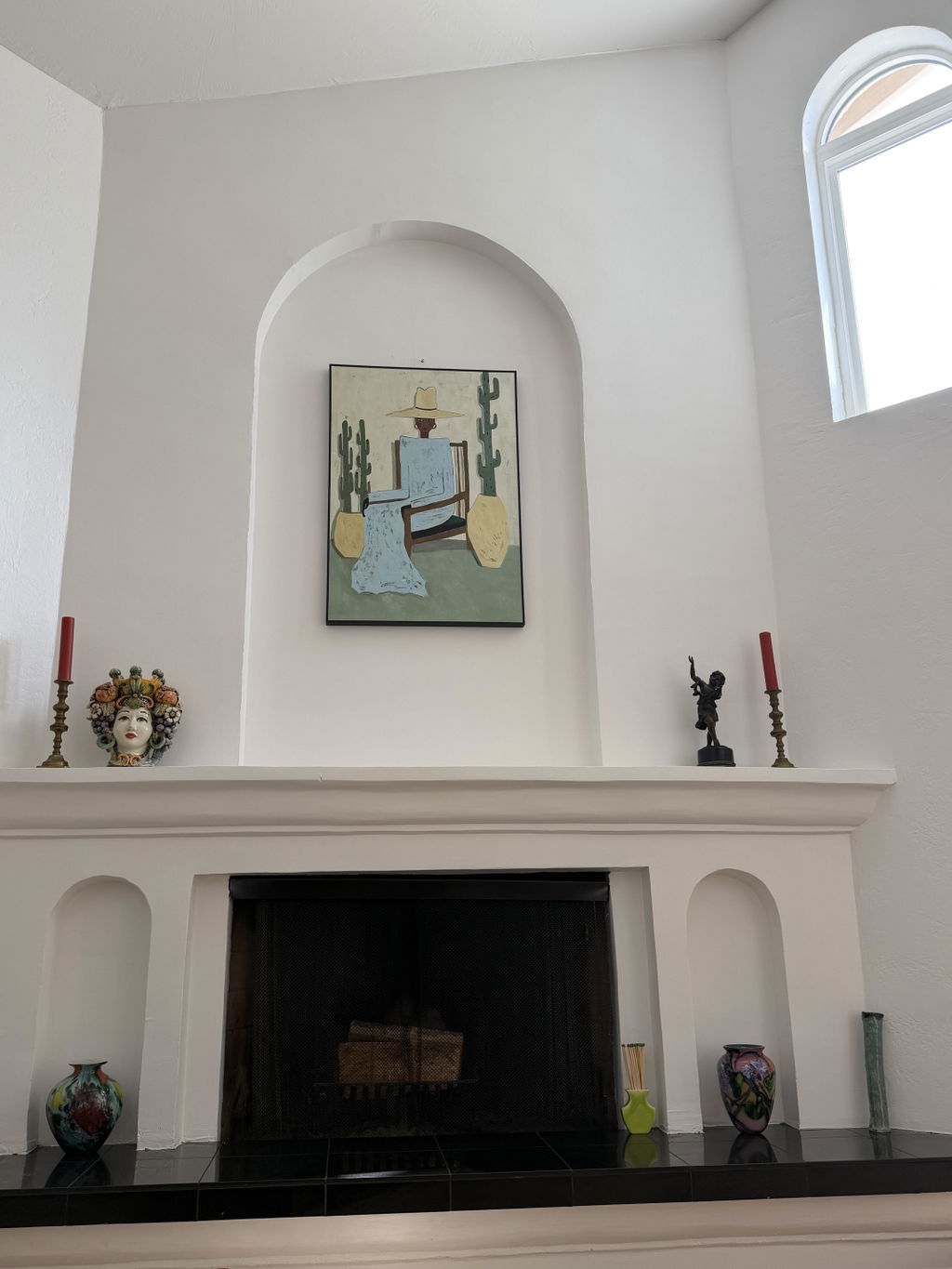
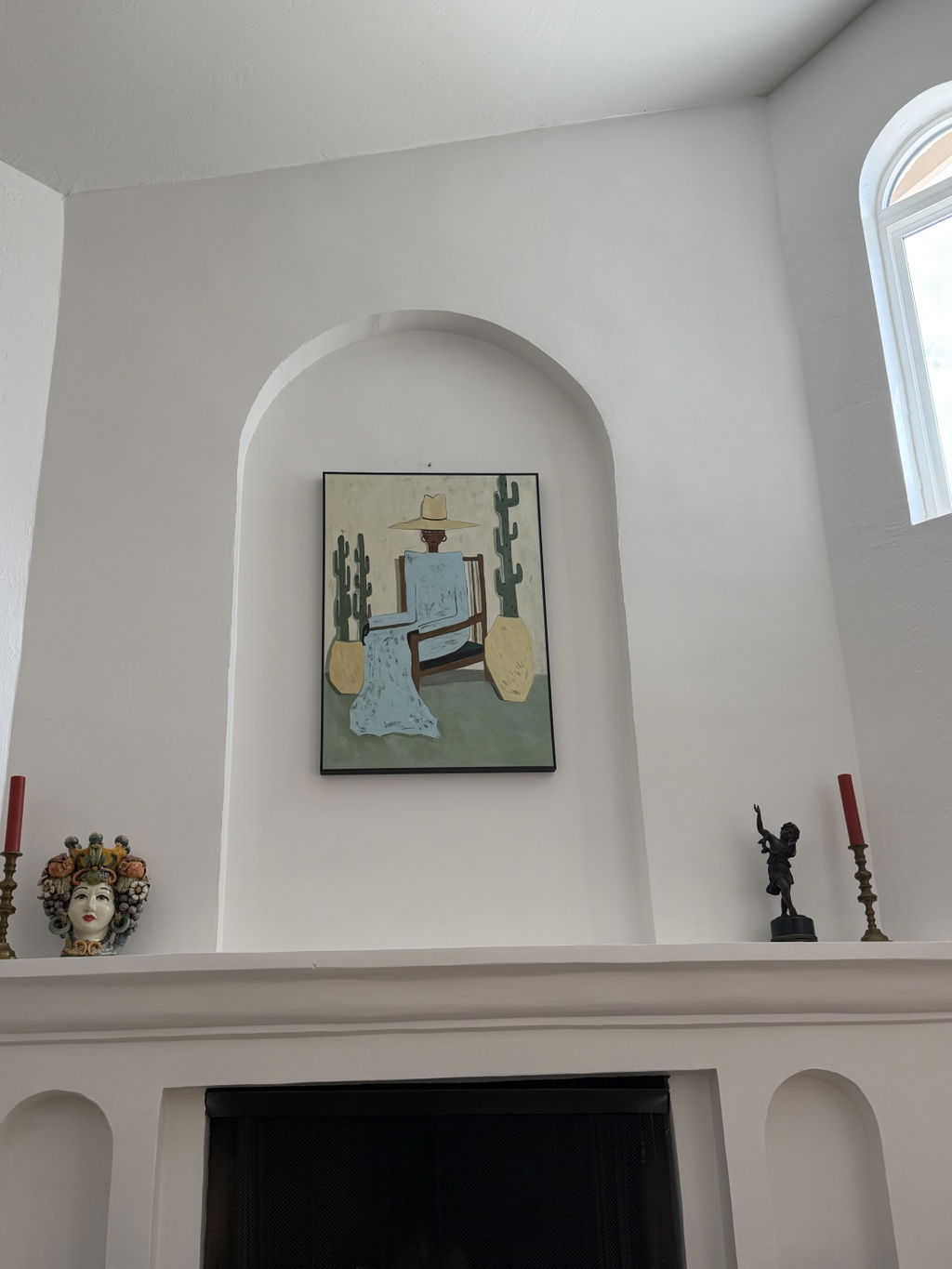
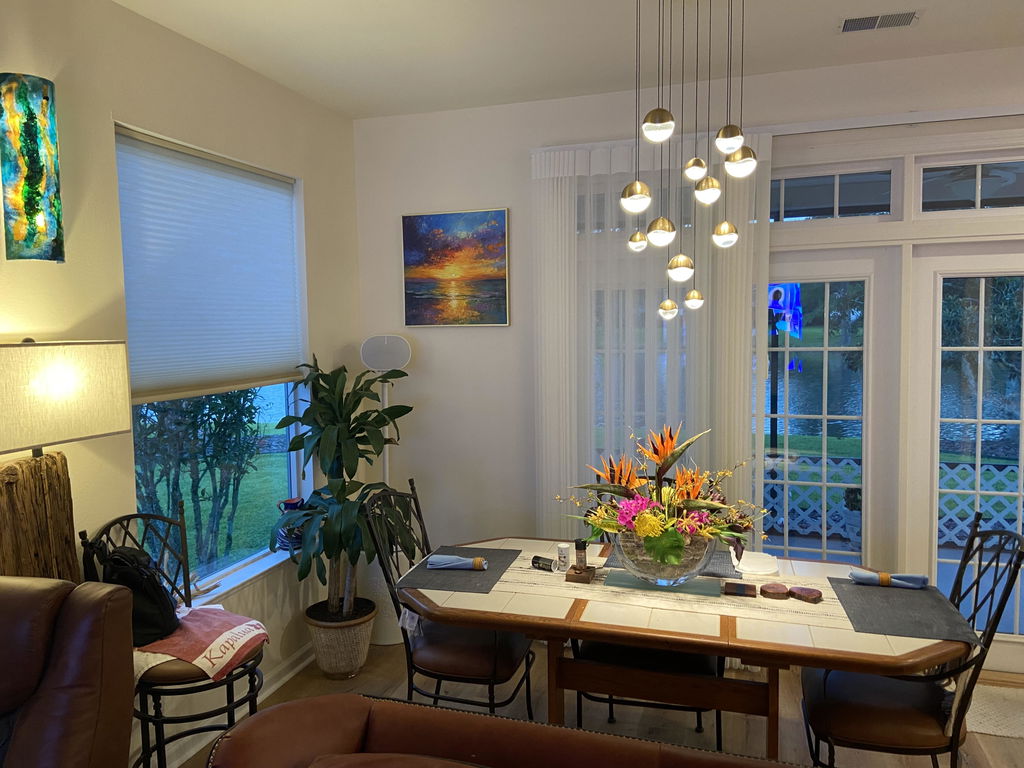
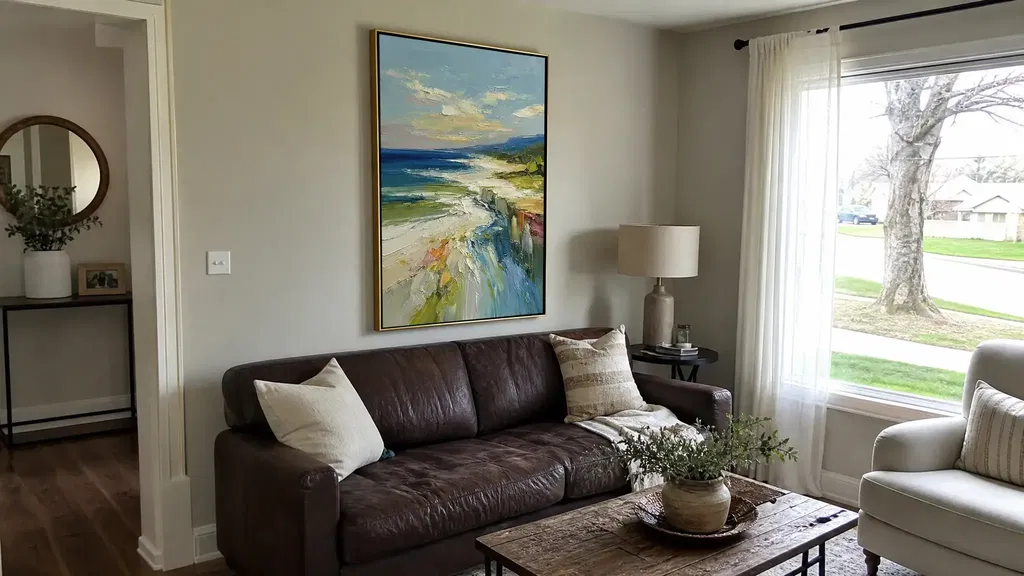
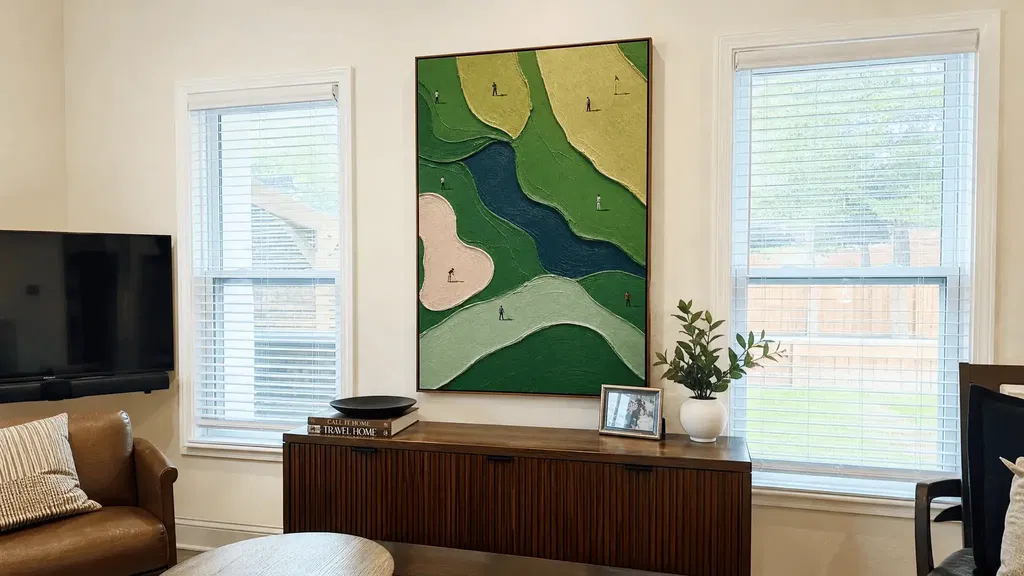
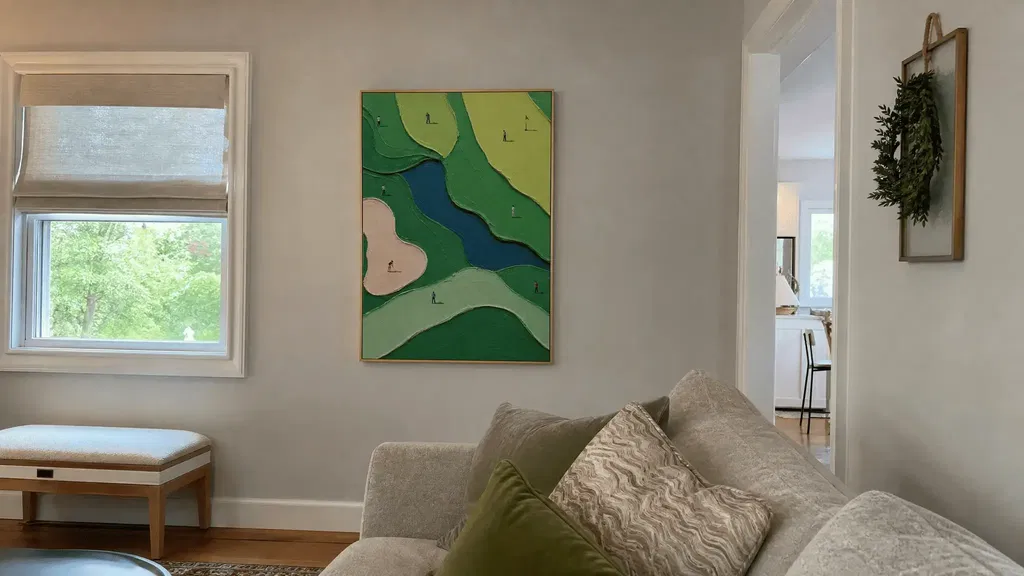
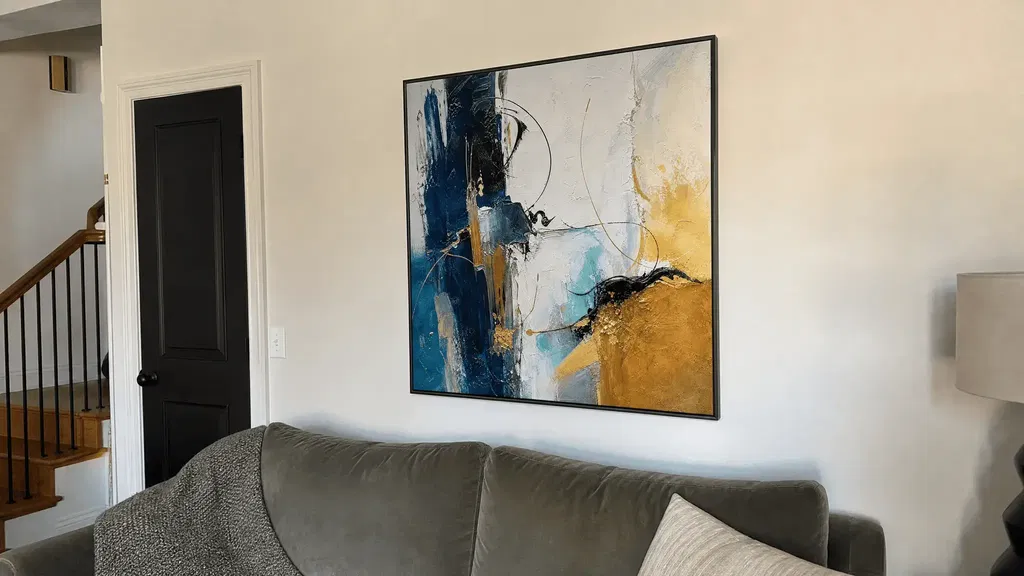
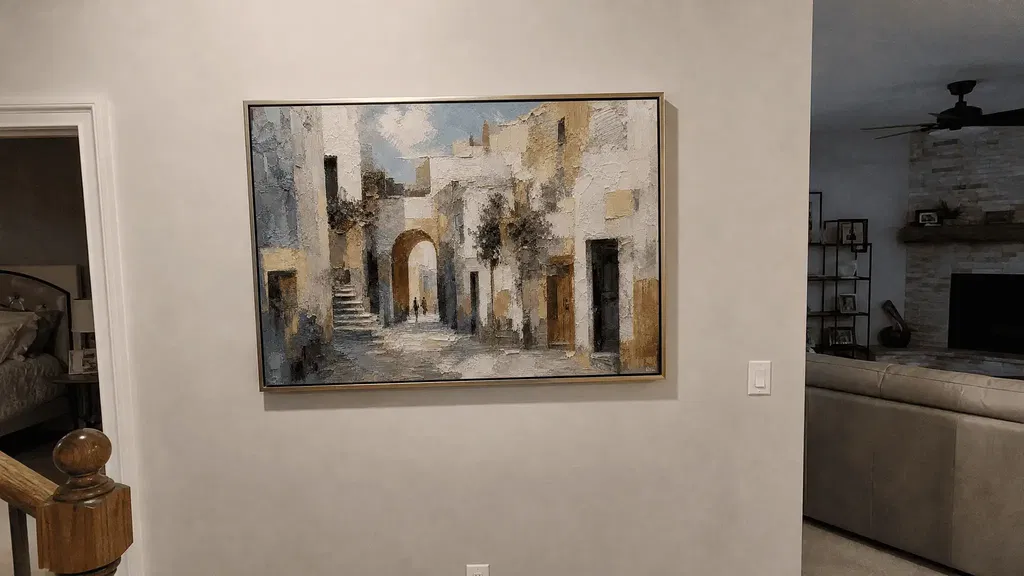
A painting is more likely to move successfully with you when it fits your current wall and at least one realistic backup location. Before you buy paintings for home, compare the piece's complete installed footprint, orientation, palette, visual intensity, frame, condition, and handling requirements—not just how it looks in one staged room. That approach gives you better odds of reusing the artwork after a move without promising that it will fit every future home.
Choose Paintings for Home by Future Wall Scale
The most adaptable paintings for home are not defined by a universal size. They have a credible fit across more than one plausible wall context, including the wall's dimensions, nearby furniture, clearance, viewing distance, and room function.
Test the Artwork Against Three Wall Scenarios
Use three scenarios before you commit: the wall where the piece will hang now, one likely backup wall, and a second plausible future location. A bedroom, hallway, office, or future living area can all serve as backup scenarios if they are realistic for your household. Editorial guidance on choosing art for interiors can provide context, but it cannot guarantee a fit in your rooms.
- Record the current conditions. Measure the usable wall width and height, note the furniture below or beside it, and record the clearance available around the artwork. Include the likely viewing distance and whether the piece will be seen head-on or from an approach angle.
- Sketch two backup locations. Measure them when possible. If you do not have access to a future home, use plausible wall types rather than inventing certainty: a narrower bedroom wall, a hallway, or an office with different furniture proportions.
- Compare the full footprint. Use the listed finished or framed dimensions when available, not only the canvas or image size. Rank each placement as strong, acceptable, or unsuitable based on wall scale, the relationship to nearby furniture, clearance, and viewing context.
- Remove single-layout candidates. If the painting works only when one exact wall, sofa, bed, or console remains unchanged, treat it as a higher-regret choice for a buyer expecting to move.
If you are still comparing proportions, browse large wall artwork only after recording the wall conditions you need to solve. A collection page can help you shop by category, but it cannot verify the fit or construction details of an individual piece.

Match Orientation to More Than One Room Type
Orientation is a useful comparison point, but no format is automatically flexible. Choose the shape that has a strong current placement and a credible backup rather than assuming that horizontal, vertical, or near-square art will work everywhere.
| Orientation | Stronger placement possibilities | Main constraint to check |
|---|---|---|
| Horizontal | Sofas, sideboards, beds, and broad walls | Whether the available wall width and furniture below it are sufficient |
| Vertical | Narrow walls, entry areas, stair-adjacent spaces, and tall furniture relationships | Whether the ceiling height, viewing distance, and vertical clearance support it |
| Near-square | Flexible wall sections and layouts that may change furniture direction | Whether its equal proportions compete with nearby furniture or leave awkward unused space |
 For a long wall, compare large horizontal art with the actual width of the furniture and wall—not with a generic room-size rule. For a narrow or taller location, vertical wall decor may be a useful browsing path, but the listing's exact dimensions still determine whether the candidate works.
Use Palette and Visual Intensity to Keep Placement Flexible
A painting may offer more placement options when its colors form workable relationships with several rooms, but palette and intensity are context-dependent design judgments. Compare the work with fixed furnishings, changing light, room function, contrast, texture, and open wall area rather than searching for a universally neutral formula.
Compare the Painting With Fixed Room Elements
Start with elements that are expensive or impractical to replace after a move. Exact matching is unnecessary; the goal is to find several relationships that remain plausible when accessories or room functions change.
- Compare the painting with the flooring and large furniture upholstery, such as a sofa, sectional, bed, or headboard.
- Check wood and metal finishes, window treatments, rugs, and other materials that may remain in place longer than decorative accessories.
- View the artwork in daylight and evening light when possible. A color relationship that feels balanced in bright natural light may read differently under warm lamps.
- Use a photo or digital mockup to test the piece against the current room and a plausible backup room.
- Note whether the painting can support either a focal role or a quieter supporting role without the room feeling visually crowded.
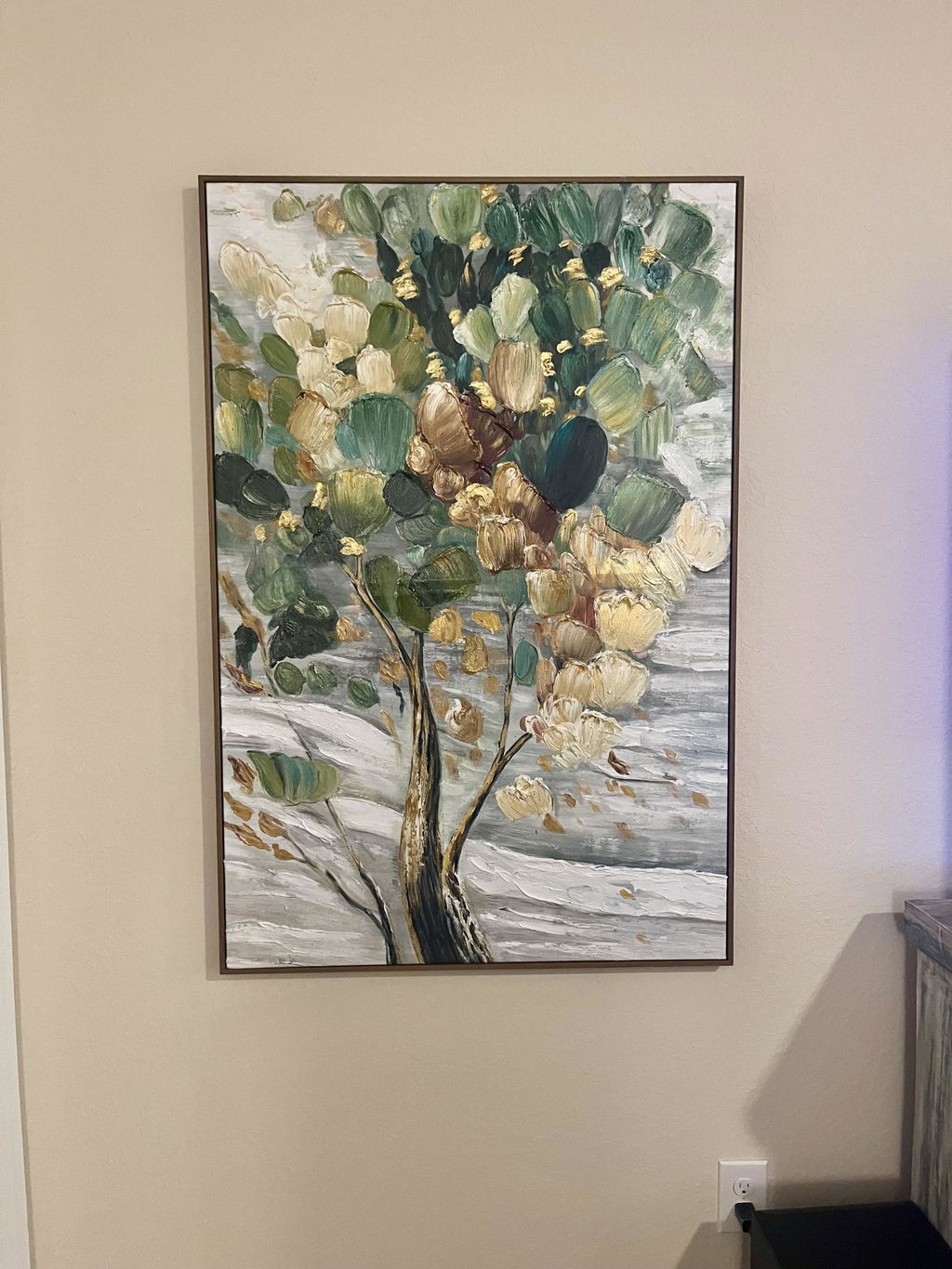
A palette with several colors that relate to likely furnishings may give you more options than a piece dependent on one exact accent color. That is a repositioning heuristic, not a promise of universal compatibility. For example, you can compare a beige, white, and gold painting with fixed finishes, but the product page does not establish that it will suit your rooms or provide artwork-specific dimensions.
Choose a Visual Volume You Can Rebalance
Visual intensity describes how strongly a piece competes for attention through contrast, texture, scale, and frame presence. High contrast or heavy texture may dominate a quieter or smaller backup room, while a less forceful work may be easier to shift between focal and supporting roles; either result depends on the surrounding space.
Assess intensity beside the complete footprint and open wall area. A richly textured work may feel balanced above substantial furniture in one room but crowded above a small console in another. Conversely, a restrained piece may need enough surrounding contrast or furniture presence to avoid feeling visually lost. Compare the actual candidate in both contexts instead of treating texture, low contrast, or a neutral palette as automatic flexibility.
Select Framing and Construction for the Next Move
Whether a piece is ready to move is partly a logistics question, not just a decorating question. Verify the exact artwork's finished dimensions, depth, frame, condition, weight, hardware, packaging, destination access, and installation needs before assuming it will be practical to remove and rehang later.
Separate Artwork Size From Framed Size
The object you install can occupy more space than the canvas or image alone. GSA artwork-care guidance on finished and framed dimensions distinguishes the artwork from its frame and hanging arrangement, so use the seller's artwork and finished dimensions separately when judging future placement.
| Dimension or detail | Why it matters after a move | Buyer action |
|---|---|---|
| Artwork or image size | Describes the painted or printed area, not necessarily the installed object | Ask which measurement the listing provides |
| Finished or framed size | Determines the wall footprint, visual weight, and clearance | Confirm the complete installed width and height |
| Depth or projection | Affects nearby circulation, furniture relationships, and packing | Ask for depth when the frame or construction projects from the wall |
Also confirm whether the listing includes a frame, whether the frame changes the intended orientation, and whether weight or hardware information is available. If a critical detail is missing, mark it as an unresolved seller question rather than estimating from the image.
Plan Removal, Packing, and Rehanging Before Checkout
Transport should be planned around the exact artwork's size, weight, condition, fragility, frame, packaging, and route. NPS guidance on handling, packing, and shipping artwork supports treating those variables as part of the plan, while large or heavy pieces may need qualified installation or framing help. Installation depends on the artwork and wall rather than dimensions alone.
- Confirm exact-piece details. Ask about finished dimensions, depth, weight, frame inclusion, hanging hardware, packaging, shipping method, and handling instructions.
- Document the object before installation. Photograph the front, back, dimensions, frame, and hardware, and keep the product information with those records.
- Plan packaging before moving day. Retain suitable original packaging when appropriate, or identify a replacement plan with the seller, mover, framer, or conservator. Do not assume ordinary household wrapping is adequate for a large or vulnerable piece.
- Check condition. Look for loose paint, flaking, tears, an unstable frame, or other visible concerns. A fragile, damaged, or vulnerable painting may warrant professional advice before transport. NPS condition guidance for easel paintings is useful background, not a claim that every household painting requires museum handling.
- Recheck the destination. Confirm the wall type, route through doors and stairs, elevator or hallway access, hardware, and rehanging method before the piece arrives. NARA transport guidance also illustrates why route and handling conditions should be considered rather than assumed.
For a purchase tied to a renovation, lease end, or move date, art buying by a deadline can help you think through timing and contingencies. It does not replace confirmation of the exact artwork's shipping or handling terms.
Shortlist Pieces by Their Best Backup Placement
Turn future-home flexibility into a written comparison before checkout. Keep the candidate with the strongest current fit, one realistic backup placement, and the fewest unresolved questions about dimensions, style relationships, construction, handling, and installation.
- Record the current placement. Write down the wall, nearby furniture, viewing context, and why the piece works there.
- Name two backup placements. Use realistic rooms or wall types, not an imagined future layout that depends on unknown furniture.
- Record visual criteria. Note orientation, palette relationships, contrast, texture, frame presence, and whether the piece could act as a focal or supporting element in each location.
- Record physical criteria. Add the complete installed footprint, depth, weight if supplied, condition, frame details, hardware, packaging, and destination-access concerns.
- Mark seller confirmations and decide. Remove candidates with no credible backup placement or unknown details that are critical to fit, handling, or installation. If uncertainty remains, review the seller's confirmation and return terms before buying.
This is a decision aid, not a prediction of future suitability. Once your criteria are written down, you can browse large wall art more efficiently and compare individual listings against the same questions instead of relying on a single staged-room photograph.
Frequently Asked Questions
Use these questions to check timing, gifting, large-art measurements, and cross-room comparisons before you commit to a piece.
Should I Buy Art Before or After Moving?
Buy before moving only when you know the current wall, have a credible backup placement, can confirm delivery timing, and understand the return terms. Wait when the destination's dimensions, furniture, access route, or room function remain uncertain.
How Can I Choose a Gift Painting Without the Wall Size?
Use clues from the recipient's home, furniture, colors, and existing art. Favor a scale and orientation that do not depend on one narrow wall shape, and check gift or return terms. A photo of a wall or a rough furniture measurement can reduce guesswork without revealing the full gift choice.
What Should I Measure Before Buying Large Wall Art Online?
Measure usable wall width and height, furniture width, clearance, viewing distance, doorways, stairs, elevators, hallways, and the destination route. Compare these with the listing's artwork and finished dimensions separately; confirm weight, depth, frame, hardware, packaging, and shipping details.
Can One Painting Work in a Living Room and Bedroom?
It can if the piece has a plausible scale and viewing relationship in both rooms. Compare the living room's furniture, open wall area, lighting, and focal demands with the bedroom's bed or dresser scale, quieter function, palette, contrast, and texture. Use side-by-side photos or mockups before treating the fit as credible.