The Shift Toward Material Authenticity in Modern Decor
The global art market is undergoing a quiet but profound structural transformation. While high-end auction sales for speculative assets plummeted 44% year-over-year in 2024, according to Marketplace, a new class of "aesthetic-driven" buyers is emerging. These individuals are moving away from overpriced vanity pieces and toward original, hand-painted works that offer genuine visual depth and long-term durability.
For the modern home improver, the choice often boils down to two mediums: oil and acrylic. While acrylics are celebrated for their convenience, oil pigments remain the benchmark for vibrancy and investment quality. This isn't merely a matter of tradition; it is rooted in the fundamental chemical and optical differences between a natural drying oil and a synthetic polymer.
As we see a 21% rise in search interest for "artisan craftsmanship" (Pennsylvania Association of Realtors), understanding the "why" behind oil’s superior performance becomes essential for anyone viewing art as a permanent fixture of their environment.
The Chemistry of Vibrancy: Oxidation vs. Evaporation
The most striking difference between oil and acrylic paints lies in how they transform from a liquid to a solid. This process directly dictates how the colors will look 50 years from now.
The Polymerization of Oil
Oil paints are typically composed of pigments suspended in linseed or walnut oil. They do not "dry" in the traditional sense of water evaporating. Instead, they undergo a chemical reaction called oxidative polymerization. As the oil absorbs oxygen, it forms a complex, cross-linked molecular network.
This process is slow, often taking months to fully cure, but it creates a robust, flexible film. According to practitioners and museum conservators, this natural oxidation layer acts as a protective shield, locking in the pigment's vibrancy. Observations suggest that oil paintings maintain 90–95% of their original saturation for over 50 years under standard indoor conditions.
The Plasticizer Trap in Acrylics
Acrylics, conversely, are synthetic emulsions. They dry through the rapid evaporation of water and solvent. While this makes them convenient for fast-paced projects, it introduces a long-term vulnerability: plasticizer migration.
Logic Summary (Material Stability Analysis): Our comparison of binder stability assumes a standard indoor environment (20°C, 50% RH).
- Oil: Slow oxidative cross-linking provides structural "give" and chemical stability.
- Acrylic: Rapid film formation leads to internal stresses; loss of volatile components over 10–15 years typically results in increased brittleness.
Research from ResearchGate indicates that under high-humidity conditions (83%), certain acrylic pigments can swell by over 7% in mass due to water absorption. In contrast, oil pigments are more likely to suffer from binder separation only under extreme thermal stress (100°C), a condition rarely found in residential settings.

Optical Depth and the "Glaze" Effect
Why does an oil painting seem to "glow" from within while an acrylic print often feels flat? The answer lies in the physics of light interaction.
The Refractive Index Debate
There is a common misconception that oil paints are superior solely because they have a higher refractive index (RI). In reality, the RI of linseed oil (approx. 1.48) and acrylic polymers (1.47–1.49) is remarkably similar, as noted by Kidspattern. The true differentiator is how the medium allows for layering.
Because oil dries slowly, artists can apply thin, transparent "glazes." Light doesn't just hit the surface and bounce back; it penetrates multiple layers of translucent pigment, reflecting off the bottom layers and passing back through the top. This creates a perceived "inner light." According to the Getty Conservation Institute, pigment reflection is governed by the Kubelka-Munk equation, where the absorption and scattering coefficients of the medium determine the final saturation. Oil's ability to hold high pigment loads without losing its working properties allows for a level of geometric metamerism—colors that change subtly depending on the angle of light—that acrylics struggle to replicate.
Texture as a Visual Asset
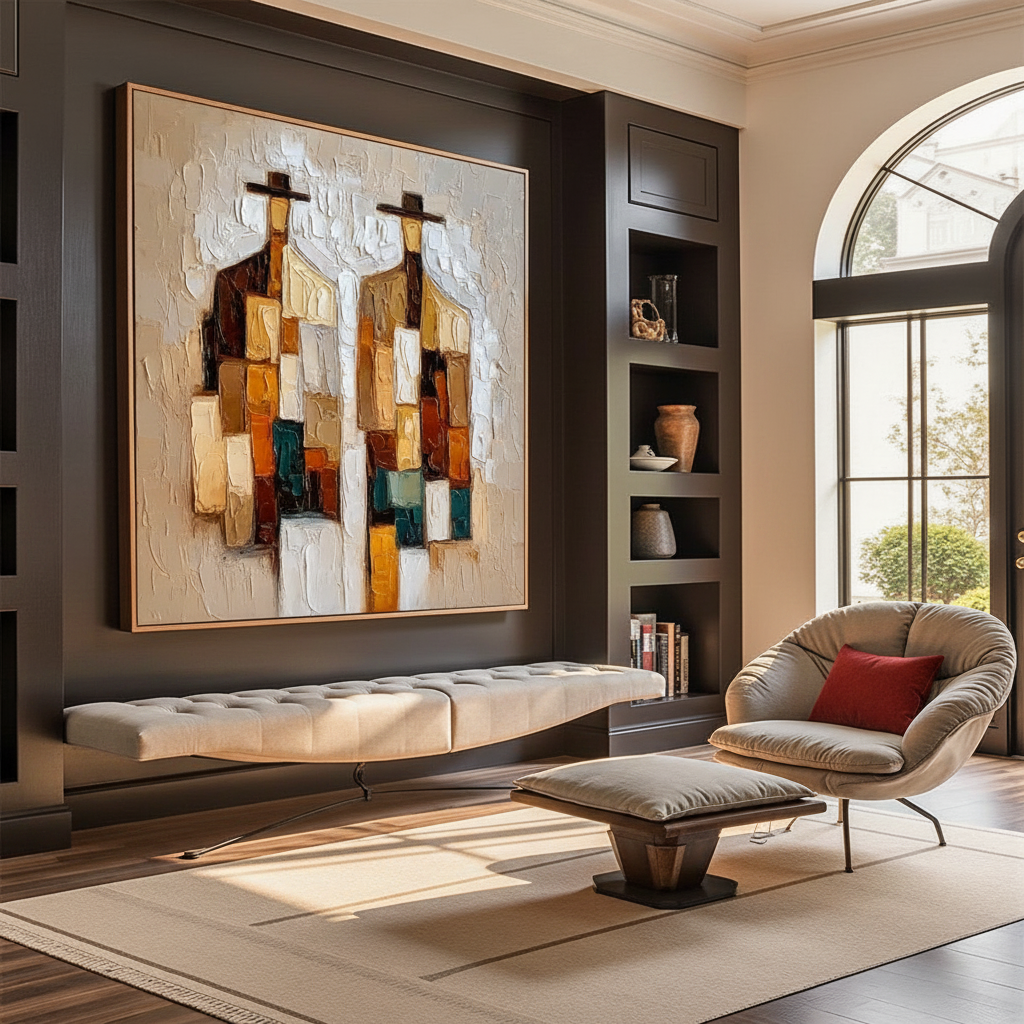
The physical "relief" of oil paint, known as impasto, is more than just a stylistic choice. It creates micro-shadows on the canvas that enhance the work's tactile presence. Tests at the MUNCH Museum have confirmed that audiences find physical relief textures exponentially more satisfying and engaging than flat replicas.
| Optical Property | Oil Painting (Hand-Painted) | Acrylic/Digital Print | Rationale |
|---|---|---|---|
| Light Penetration | High (Multi-layer glazes) | Low (Surface reflection) | Oil's slow drying allows for layering. |
| Color Saturation | 90–95% (Long-term) | 70–80% (20-year fade) | Polymer degradation in acrylics. |
| Tactile Relief | 1–5mm (Impasto) | <0.1mm (Flat) | Oil maintains volume after curing. |
| Refractive Index | ~1.48 | ~1.49 | Negligible difference in raw index. |
| Surface Finish | Variable (Matte to Gloss) | Uniformly Plastic | Synthetic binders create a specific sheen. |

Health, Safety, and the "Essential Identity"
In an era of AI-generated art, the value of the "human touch" has become a quantifiable commercial asset. A study by Columbia University found that consumers value art labeled as "AI-generated" 62% lower than authentic human-created art. This preference is linked to what researchers call "essential identity"—the belief that a physical object retains the "soul" or intent of its creator (University of Chicago).
The Non-Toxic Transition
Historically, oil painting was associated with toxic solvents like turpentine. However, modern professional studios are shifting toward eco-friendly alternatives. According to the Cincinnati Art Museum, walnut oil and solvent-free gels are effectively replacing VOC-emitting spirits.
For homeowners concerned about indoor air quality, it is vital to distinguish between "odorless" and "non-toxic." Guidelines from Princeton University EHS warn that chronic inhalation of even odorless mineral spirits can be harmful. The gold standard for a healthy home is the use of pigments that comply with the ASTM D-4236 standard, which requires toxicological review of all art formulations.
Safety Heuristics for Art Selection:
- The 5-Year Rule: Ensure the paint brand undergoes toxicological review every five years (LHAMA Act requirement).
- The VOC Check: Prefer works created with water-miscible oils or solvent-free mediums if the piece will be placed in a nursery or poorly ventilated space.
- Pigment Awareness: Be cautious with historic "Lead White" or "Cadmium" pigments. While cadmium pigments provide unmatched vibrancy, the International Agency for Research on Cancer (IARC) classifies cadmium compounds as Group 1 carcinogens. Modern "hue" alternatives offer similar vibrancy with zero health risk.
The Economic Impact: Art as Property Leverage
Beyond personal enjoyment, original hand-painted art—particularly large-scale murals—serves as a significant driver of property value.
Boosting Real Estate Rankings
A 10-year data analysis published by the Royal Society found a direct correlation between "art" geo-tags in a neighborhood and relative house price gains. In commercial settings, the effect is even more pronounced. The Chicago Millennium Park public art projects are credited with driving $1.4 billion in real estate-related growth.
For the private homeowner, a custom oil mural or large-scale canvas acts as a "permanent physical billboard" for the home's quality. It signals to future buyers that the property was curated with an eye for long-term investment rather than disposable trends.
Biophilic Benefits and Productivity
The choice of subject matter also plays a role in the "ROI" of art. Biophilic design—art featuring natural landscapes—has been shown to reduce stress and accelerate healing. A review by the University of Pennsylvania noted that 73% of patients in clinical settings reported significant mood improvements when exposed to environmental artworks. For the home office, this translates to reduced cognitive fatigue and enhanced creativity (University of Hawaii).

Long-Term Preservation: Why Oil Wins the "Archive" War
When you purchase an oil painting, you are investing in a cultural heritage asset. However, maintaining that vibrancy requires an understanding of the medium's specific needs.
Cleaning and Maintenance
A common myth is that oil paintings are fragile and impossible to clean. In reality, the polymerized oil film is remarkably resilient. While acrylics are famously sensitive to solvents—making them difficult to clean without removing the paint itself (Tate Modern)—oil paintings can often be surface-cleaned by professionals to remove decades of dust without affecting the underlying pigment.
Avoiding "Support Induced Discoloration" (SID)
One "gotcha" for many art buyers is the yellowing of the canvas. In acrylic works, water-soluble impurities in the cotton substrate can be drawn into the paint layer as it dries, causing a brown or yellow tint (Golden Artist Colors). Oil paintings, when properly primed with a high-quality Gesso, are largely immune to this phenomenon, as the oil binder does not "wick" impurities from the canvas in the same way.
Modeling Note (Preservation Assumptions): Our longevity estimates assume the artwork is kept away from direct UV exposure and extreme humidity fluctuations (ideally 45–55% RH). Under these conditions, the oxidative cross-linking of oil provides a more stable mechanical structure than the thermoplastic nature of acrylics.
Investing in Authenticity
The decision to choose oil over acrylic or digital prints is a decision to prioritize longevity, visual depth, and material integrity. As the Creative Economy Outlook 2024 highlights, the creative industries now account for over 3% of global GDP, reflecting a world that increasingly values human-made cultural exports.
By selecting hand-painted oil works, you are not just decorating a wall; you are preserving a piece of "essential identity" that will maintain its vibrancy long after synthetic alternatives have become brittle. In the landscape of modern home improvement, oil remains the ultimate medium for those who view their living space as a long-term gallery of their values.
Disclaimer: This article is for informational purposes only and does not constitute professional health, legal, or financial advice. Art materials can contain hazardous substances; always consult manufacturer safety data sheets (SDS) and follow local safety regulations when handling pigments or solvents. If you have pre-existing respiratory or skin conditions, consult a medical professional before engaging in art-making activities.