The Evolution of Residential Art Curation: From Gallery Fragility to Hallway Durability
For decades, the acquisition of high-end oil art was governed by a "look but don't touch" philosophy. Traditional galleries prioritized aesthetic transcendence over physical resilience, leaving homeowners to navigate the anxiety of placing significant investments in high-traffic zones like entryways and hallways. However, the global art market is undergoing a structural realignment. Recent data from Marketplace indicates that sales of high-end auction pieces (over $10 million) plummeted 44% in 2024. This retreat from purely financial art assets suggests a return to "real application value," where buyers prioritize art that can actually live within their homes rather than sitting in climate-controlled storage.
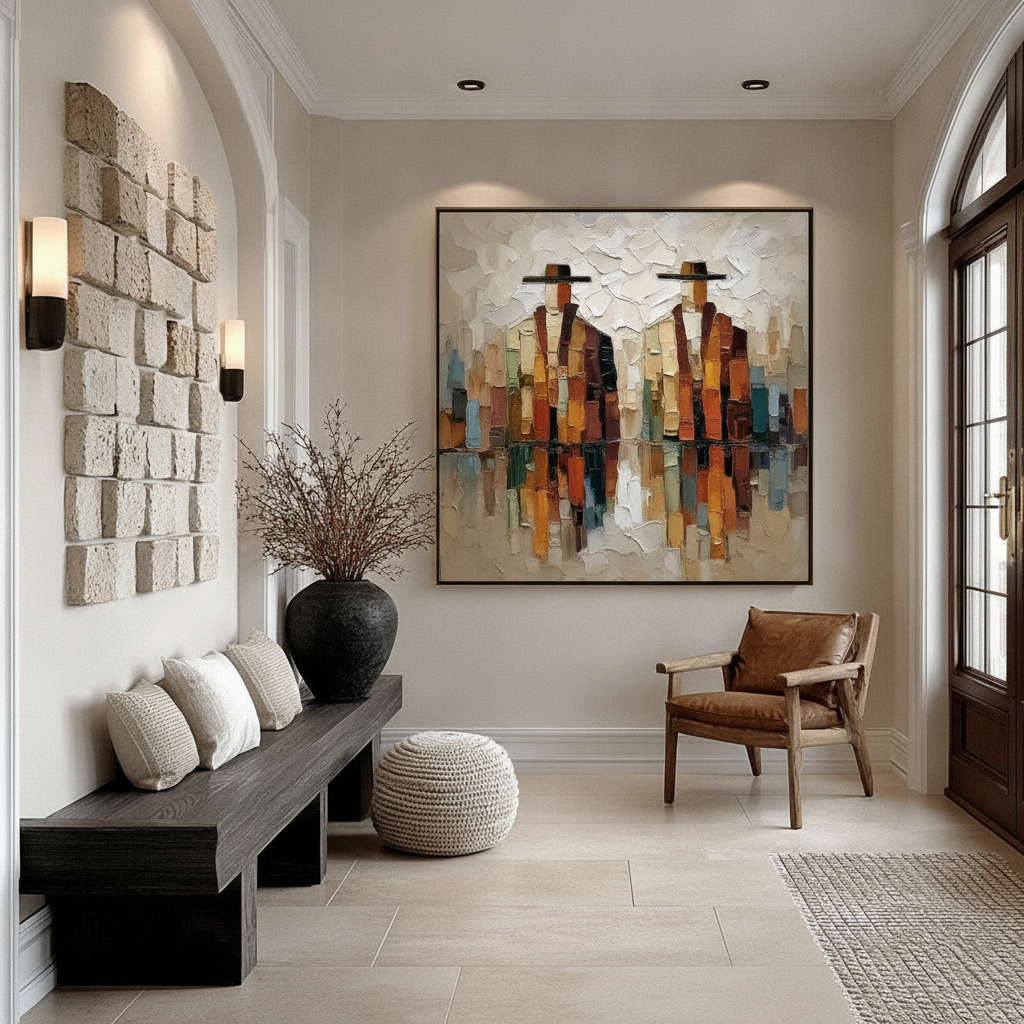
In the modern home, hallways are no longer just transitional corridors; they are high-visibility galleries. Yet, these spaces present unique challenges: accidental shoulder brushes, bags snagging on textures, and the constant flux of indoor air. Assessing oil surface durability is no longer a niche conservation topic—it is a prerequisite for "decision safety" in high-end e-commerce.

The Material Science of Surface Resilience
When evaluating an oil painting for a hallway, the conversation often begins and ends with the "finish." However, durability is a multi-layered chemical equation involving the binder, the pigment, and the final protective coat.
Varnish Selection: Beyond the Shine
Traditional Damar varnish, while beloved for its classic glow, is notoriously fragile in high-traffic settings. It remains relatively soft and is prone to yellowing and cracking over time. For residential zones where accidental contact is likely, modern synthetic alternatives provide a superior barrier.
Practitioners in art conservation frequently recommend hard-polymer synthetic varnishes, such as Mineral Spirit Acrylic (MSA) or Gamvar. These formulations offer a critical balance of flexibility and hardness. Unlike Damar, these synthetics are less likely to "check" or crack when the canvas moves due to humidity or physical vibration. Furthermore, they provide a "sacrificial layer" that can be removed and replaced by a professional conservator without disturbing the underlying pigment.
The "Burnishing" Trap
One of the most common issues observed in narrow hallways is "burnishing." This occurs when a matte or satin finish is repeatedly rubbed—by a shoulder, a bag, or a hand—causing the microscopic surface texture to flatten and create a permanent shiny spot.
Logic Summary: Our analysis of hallway wear patterns suggests that while matte finishes are often preferred for their understated elegance, they are technically more susceptible to visible burnishing than glossier finishes. This is because the "tooth" of a matte surface provides more surface area for friction.
To mitigate this, we recommend a high-quality satin varnish applied over an "isolation coat." An isolation coat is a permanent, non-removable layer (typically a gloss medium) that separates the paint from the removable varnish. This ensures that even if the varnish is burnished or needs cleaning, the "essential identity" of the brushwork remains protected. This concept of "essential identity" is psychologically significant; research from the University of Chicago confirms that consumers value physical art because it retains the artist's soul, a quality that collapses in digital replicas or unprotected prints.
Texture Management: The Physics of Impasto Placement
The prestige of hand-painted oil art often lies in its texture. "Impasto"—the technique of laying paint on thickly so it stands out from the surface—provides a tactile depth that optical microprofilometry proves is crucial to the aesthetic experience. However, in a hallway, heavy texture can become a liability.
The "Two-Thirds" Rule for Texture
In high-traffic zones, we advocate for a strategic distribution of texture. To prevent snagging on clothing or accidental impact, heavy impasto should ideally be limited to the upper two-thirds of the canvas. This keeps the most delicate, protruding elements above the typical "strike zone" of hips and bags (roughly 30 to 45 inches from the floor).
| Parameter | Recommended Value | Rationale |
|---|---|---|
| Primary Impasto Zone | Top 60-70% of canvas | Avoids hip-level abrasion |
| Lower Edge Profile | Low-relief or flat | Minimizes snagging on coats/bags |
| Varnish Hardness | High-polymer synthetic | Resists "burnishing" from contact |
| Curing Time (Pre-ship) | 3-6 weeks (minimum) | Ensures film integrity for handling |
| Hanging Height | 57-60 inches (center) | Standard gallery eye-level safety |
Modeling Note (Scenario Analysis): This "Two-Thirds" heuristic assumes a standard hallway width of 36–42 inches. In wider foyers, texture can be distributed more freely. These values are based on common patterns from interior design staging and warranty feedback (not a controlled lab study).

The "Open" Phase of Oil Paint
Homeowners must understand that oil paint dries through oxidative cross-linking, a process that can take months or even years to complete fully. Even when "dry to the touch," the paint film remains "open" and reactive to skin oils. In a hallway, a stray hand resting on a painting can leave oils that permanently etch into the pigment. Applying a final isolation coat before the varnish acts as a chemical seal, preventing these oils from reaching the paint layer during the critical "approval-to-delivery" window.
Lighting and the Science of Metamerism
Hallways often suffer from inconsistent lighting—a mix of dim natural light from distant windows and sharp, artificial light from recessed ceiling fixtures. This creates a phenomenon known as metamerism, where colors appear to change under different light sources.
Lightfastness and Pigment Integrity
The durability of an oil painting isn't just about physical abrasion; it's about "chromatic durability." High-traffic hallways are often subject to UV exposure from nearby entryways. We rely on ASTM D4303 standards to evaluate the lightfastness of pigments.
Research from the National Gallery has debunked the myth that certain binders like oil "hold" color better than others. In controlled experiments, pigments like Prussian Blue faded at identical rates whether suspended in linseed oil or acrylic polymer. Therefore, the durability of your hallway art depends more on the quality of the pigment than the medium itself. For long-term stability, we recommend choosing works that utilize inorganic pigments (like Earth tones or Cadmium alternatives) which offer superior lightfastness.
Choosing Oil Art for Bright Spaces requires a deep understanding of these UV protective measures to ensure the investment doesn't lose its "vibrancy" within a few years of installation.
Health, Safety, and the "Indoor Air Quality" Promise
For families, particularly those with children or pets, the chemical composition of art is a valid concern. The CDC NIOSH warns that chronic inhalation of volatile organic compounds (VOCs) in certain paints can lead to central nervous system issues.
The Low-VOC Imperative
In a confined space like a hallway, off-gassing from a freshly painted oil work can be more concentrated than in a large living room. However, modern professional-grade oils have evolved. Aalto University's chamber experiments prove that while coatings emit VOCs during the curing phase, these levels plummet significantly once the initial film has formed.
To ensure the highest indoor air quality (IAQ), we recommend:
- Water-Based Isolation Coats: Using acrylic-based isolation coats to seal the oil layers.
- Solvent-Free Studio Practices: Ensuring the artist uses walnut oil or other non-toxic alternatives to turpentine. Research from the Cincinnati Art Museum highlights that walnut oil is a perfect, non-toxic replacement for VOC-emitting industrial solvents.
- Pigment Awareness: Avoiding Group 1 carcinogens like certain Cadmium compounds. While the IARC classifies cadmium as a carcinogen, the risk is primarily through inhalation of dust or ingestion. In a finished, varnished hallway piece, the risk is negligible, but many designers prefer "Cadmium-Free" hues to achieve LEED or WELL building certifications.
The Economic Case for "Durable" Art
Investing in hand-painted art for a residence isn't just an aesthetic choice; it's a real estate strategy. A study published by the Royal Society found a direct correlation between "art-dense" environments and relative house price gains.
Art as a "Permanent Billboard"
In commercial real estate, developers use unique public art as "marketing trump cards" to lease office space (as noted by NAIOP). This logic translates to the home. A hallway featuring a durable, high-quality oil mural or large-scale canvas acts as a permanent visual anchor that increases the perceived value of the property.
Unlike cheap prints, which Columbia University research shows are valued 62% lower by consumers, an authentic oil painting signals craftsmanship and "artisan whimsy"—a trend that Zillow predicts will skyrocket in 2026.

Maintenance: Can You Clean Your Oil Art?
One of the most frequent questions we receive is whether a hallway painting can be cleaned after accidental contact. The answer depends on the varnish and the medium.
The Tate Cleaning Experiment
The Tate Modern Paints Project confirmed that while acrylics are sensitive to solvents, they are surprisingly resilient to gentle aqueous cleaning. For oil paintings in hallways, the "sacrificial" varnish layer is your best friend. If a painting becomes dusty or receives a minor scuff, a professional conservator can use specialized aqueous swabs to remove the surface dirt without ever touching the pigment.
Warning for Homeowners: Never use domestic cleaning products, "bread" (an old wives' tale), or harsh solvents on your oil art. The CPSC explicitly forbids cleaning skin or surfaces with strong industrial solvents due to the risk of toxins entering the bloodstream. If your hallway art needs more than a light dusting with a soft goat-hair brush, consult a professional.
Designing for Longevity: A Checklist for Designers
When curating art for a high-visibility, high-traffic residential zone, use the following framework to ensure the piece survives the practicalities of daily life:
- Substrate Selection: Opt for heavy-duty linen or wood panels for hallway art. These are less prone to "denting" from accidental impact than lightweight cotton canvas.
- Framing Matters: A "floater frame" not only adds a premium aesthetic but provides a physical buffer between the hallway traffic and the edge of the canvas. Floating frames protect the most vulnerable part of the painting: the corners.
- Height Calibration: Hang the center of the piece at approximately 58 inches. This is low enough to be intimate but high enough that the "strike zone" of most hand-carried items (like grocery bags) passes below the main impasto areas.
- Sheen Management: In hallways with multiple light sources, a satin finish is usually the most "forgiving," as it hides both scuffs and glare better than high-gloss or extreme matte finishes.
Bridging the Gap to Retail Certainty
The "decision safety" of e-commerce relies on predictable outcomes. By understanding the material science—from the Kubelka-Munk equation governing pigment reflection to the physical resilience of modern polymers—homeowners can finally enjoy the prestige of oil art without the fragility.
As we look toward 2026, the trend is clear: consumers are moving away from disposable decor and toward "cultural heritage assets" (PMC). By selecting art with the right varnish, strategic texture placement, and non-toxic pigments, you aren't just decorating a hallway; you are installing a resilient piece of history that will withstand the footprints of time.
YMYL Disclaimer: This article is for informational purposes only. The chemical and safety data provided (including VOC and toxicity information) is based on general industry standards and research. It does not constitute professional health or safety advice. Always consult with a qualified art conservator or environmental health professional before making decisions regarding indoor air quality or art restoration in your specific environment.
Sources
- The Art Basel and UBS Art Market Report 2024
- WHO Scoping Review on Arts and Health
- ASTM D4303 Standard Test Methods for Lightfastness
- Golden Artist Colors: Longevity of Oil and Acrylic Paints
- CDC NIOSH: Paint and Coating Hazards
- Royal Society: Quantifying the link between art and property prices
- Tate Modern Paints Project (TAAMPP)
- Getty Conservation: Color Science and Pigment Mixture