Revision Potential: How Medium Choice Affects Custom Art Approvals
The landscape of high-end art acquisition is undergoing a structural shift. As reported by Marketplace, sales of purely financial art assets—those exceeding $10 million—plummeted by 44% year-over-year in 2024. This retreat from "vanity auction pieces" signals a return to real application value. Today’s aesthetic-driven home improvers and interior designers are prioritizing emotional resonance and spatial integration over speculative investment.
In this "value-first" era, the custom commission model has become the gold standard. However, the success of a commission hinges on a single, often overlooked technical factor: the physical properties of the medium. At MontCarta, the choice of traditional oil paint over modern acrylics is not merely an aesthetic preference; it is a strategic operational decision. The extended "open time" of oil pigments allows for a sophisticated modification loop, ensuring that the final piece aligns perfectly with a designer’s vision before it ever leaves the studio.
The Chemistry of "Open Time": Why Medium Matters
The fundamental difference between oil and acrylic paints lies in their molecular curing processes. Understanding these mechanisms is essential for any professional managing a custom art project where revisions are a likely requirement.
Acrylics: The Coalescence Constraint
Acrylic paints are composed of synthetic polymer emulsions. According to technical data from JustPaint, acrylics form a film through a process called "coalescence." As the water evaporates, the polymer spheres are forced together, fusing into a solid, non-reversible plastic film. This process is incredibly rapid—often occurring within minutes or even seconds depending on environmental humidity.
While this speed is beneficial for high-volume production, it is a significant hurdle for custom approvals. Once an acrylic layer is set, revisions typically require "scraping" or the use of aggressive solvents, which can compromise the structural integrity of the canvas and create "visible repair zones."
Oils: The Oxidative Advantage
In contrast, oil paints do not "dry" through evaporation. Instead, they cure through oxidative cross-linking. As the binder (typically linseed or walnut oil) reacts with oxygen, it slowly transforms into a tough, flexible film. This chemical journey allows for an extended "open time"—a window where the paint remains workable and blendable on the canvas.
Logic Summary: Revision Capacity Modeling Our analysis of revision workflows assumes that "open time" directly correlates with the depth of allowable compositional changes. While digital art offers unlimited revisions, it often suffers from "revision creep," where professional artists spend 40-60% of project time on changes. In contrast, oil painting provides a balanced middle ground: enough flexibility to satisfy 4-6 substantive revisions during the working window, without the infinite loop of digital media.
Parameter Acrylic Medium Oil Medium Rationale Initial Set Time 10–20 Minutes 2–7 Days Evaporation vs. Oxidation Blending Window Near Zero High (48-72 Hours) Wet-on-wet capability Revision Depth Surface Level Structural/Compositional Layer integration Repair Visibility High (Edge lines) Low (Seamless blending) Chemical bonding Typical Revision Rounds 1–2 4–6 Physical constraints

The MontCarta Modification Loop: A Technical Workflow
To leverage the technical advantages of oil paint, experienced production artists at MontCarta employ a specific "thin-to-thick" workflow. This process is designed to maximize the revision potential during the critical approval phase.
1. The Initial Approval Phase (Thin Layers)
In the early stages of a commission, artists work with thin applications of paint, often diluted with a solvent like walnut oil. This is a strategic move: thicker applications of oil paint lock in the composition too early. By keeping the initial layers "lean," the artist preserves the ability to shift focal points or adjust color temperatures based on client feedback.
2. The 48-72 Hour Revision Window
Once the initial approval photos are sent to the client, a critical 48-72 hour window opens. Because of oil's slow curing rate, any requested color palette adjustments can be blended directly into the existing wet layers. This results in a seamless transition that is physically impossible with fast-setting acrylics, where adjustments require repainting entire sections, often leading to quality variance.
3. Pigment-Specific Drying Rates
It is a common misconception that all oil paints dry at the same rate. In practice, the "open time" varies dramatically based on the pigment's chemical composition. For instance, NCBI research notes that titanium dioxide (Titanium White) dominates 90% of the white pigment market due to its opacity. However, in the studio, Titanium White and certain blues are known to dry significantly slower than earth tones like Burnt Umber. Experienced artists schedule their revision workflows around these specific drying rates, ensuring that the most complex areas of a painting remain workable for the longest duration.
Economic and Spatial Value: Beyond Aesthetics
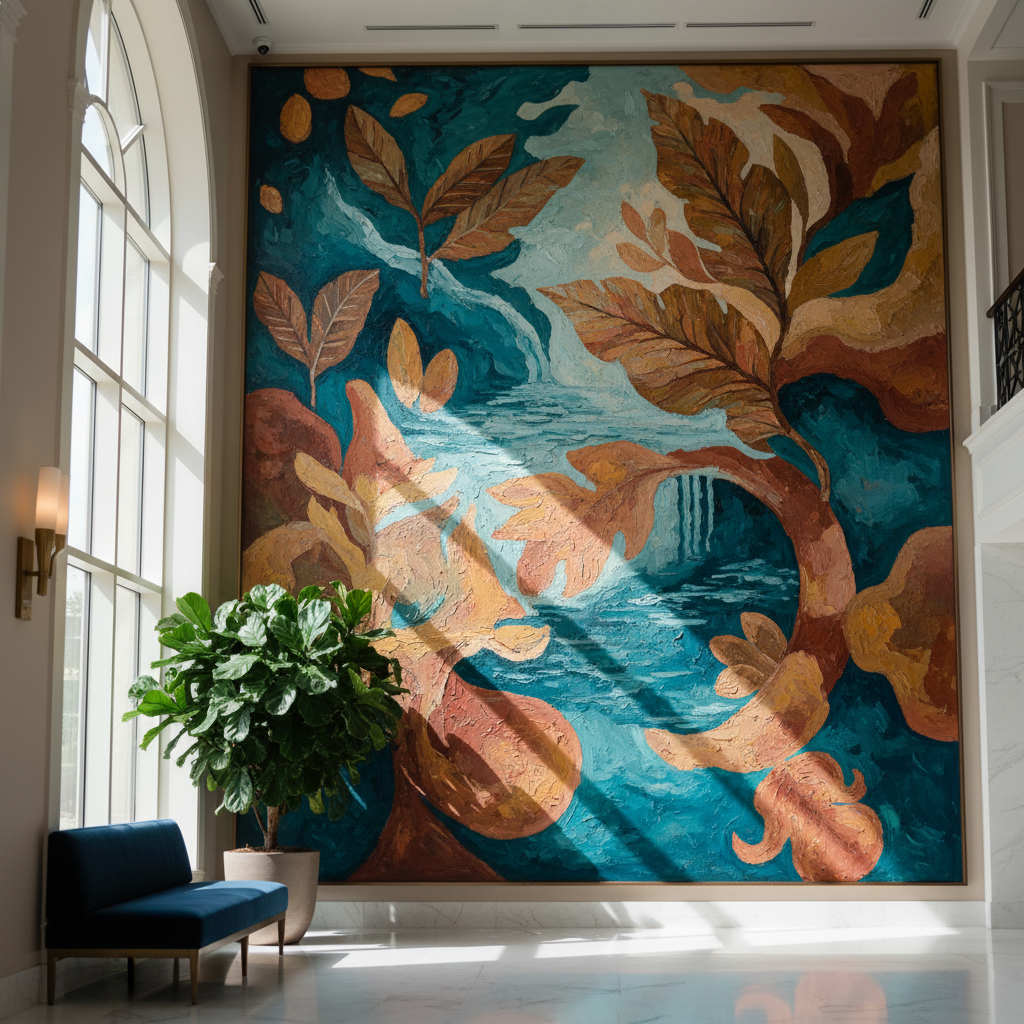
Commissioning a hand-painted oil mural is more than a design choice; it is an investment in the "essential identity" of a space. Research from the University of Chicago confirms that consumers perceive a significantly higher value in human-created art compared to digital replicas or AI-generated prints, which often lack the "soul" provided by physical texture.
Boosting Property Value
The impact of custom art extends to the valuation of the property itself. A 10-year data analysis by the Royal Society found that neighborhoods with higher "art" geo-tags experienced greater relative house price ranking gains. For commercial developers, the ROI is even more pronounced. Americans for the Arts reports that investments in the arts can yield a staggering 7:1 ROI, as public murals and high-end custom installations act as "permanent physical billboards" that drive foot traffic and capital interest.
Biophilic Design and Well-being
For interior designers focusing on healthcare or corporate environments, the choice of a hand-painted mural can have measurable physiological benefits. A review by the University of Pennsylvania found that 73% of patients reported significant mood improvements when exposed to environmental artwork. This aligns with the principles of "biophilic design," where nature-themed murals produce stress-reduction effects in the brain similar to real outdoor environments.

Safety, Ethics, and the Modern Standard
As the demand for custom art grows, so does the scrutiny regarding the materials used. Modern consumers are increasingly sensitive to the environmental and health impacts of their purchases.
The Indoor Air Quality (IAQ) Promise
A major concern with traditional oil painting has historically been the use of toxic solvents like turpentine. However, the industry has evolved. Aalto University experiments have shown that coatings on wood with specific moisture levels emit significantly lower VOCs (Volatile Organic Compounds) during curing than previously thought. By utilizing eco-friendly alternatives—such as walnut oil binders and low-VOC sealants—MontCarta ensures that custom murals meet the strict requirements for LEED and WELL building certifications, making them safe for even the most sensitive environments, such as nurseries or clinics.
Supporting the Creative Economy
Ethics also play a vital role in the approval process. A survey by the Wharton School found that 87% of consumers believe artists should receive fair compensation. By maintaining a transparent supply chain that prioritizes real human artists over AI-generated shortcuts, brands like MontCarta tap into the moral demands of the modern buyer. This commitment to "fair trade" art not only supports the freelance workforce—which a NYC Comptroller report identified as financially vulnerable—but also ensures a higher level of craftsmanship and technical expertise in every revision round.
Navigating the Approval Process: A Designer's Checklist
To ensure a smooth revision process and a successful final delivery, interior designers should follow a structured approach when managing oil commissions.
- Define the "Open Window": Confirm the expected working time for the specific piece. Large-scale works with heavy impasto may remain workable longer than thin glazes.
- Request Mid-Stage Previews: Schedule the first round of digital approval photos when the artist is approximately 60-70% through the initial layers. This is the optimal time for compositional adjustments.
- Prioritize Color Harmony: Use the wet-on-wet blending phase to fine-tune the color palette. Changes made at this stage will look more natural than those "layered" on later.
- Consider the Curing Timeline: Remember that while a painting may be "dry to the touch" in a week, it continues to cure for months. For more information on this, refer to our guide on Curing Timelines for Interior Designers.
- Verify Material Safety: Ensure the artist is using pigments that comply with ASTM D-4236 standards for chronic health hazards.
Methodology Note (Reproducible Parameters): The revision capacity estimates provided in this article are based on a deterministic model of oil paint oxidation rates at 22°C (72°F) and 50% relative humidity.
| Parameter | Value | Unit | Rationale |
|---|---|---|---|
| Model Type | Scenario Modeling | N/A | Practical studio observation |
| Standard Temp | 22 | °C | Average indoor climate |
| Standard Humidity | 50 | % | Standard museum/gallery condition |
| Pigment Density | Medium (2-3mm) | mm | Typical decorative application |
| Solvent Ratio | < 15% | Vol | Ensures structural stability |
| Boundary Condition | High Heat (>30°C) | N/A | Accelerates curing, reduces window |
The Final Stroke
The choice between oil and acrylic is often framed as a debate over "traditionalism" versus "modernity." However, in the context of custom art approvals, the real distinction is one of flexibility and risk reduction. The technical properties of oil paint—its slow oxidation, its capacity for seamless blending, and its chemical longevity—provide a safety net for designers and homeowners alike.
By choosing a medium that allows for a meaningful modification loop, you aren't just buying a piece of decor; you are participating in a collaborative process that ensures the final artwork is a perfect reflection of your spatial vision. In a world increasingly dominated by the ephemeral and the digital, the enduring, adaptable nature of hand-painted oil art remains an irreplaceable asset for the modern home.
YMYL & Health Disclaimer: This article is for informational purposes only and does not constitute professional medical, legal, or financial advice. The chemical properties and health risks associated with art materials can vary. Always consult with a certified industrial hygienist or medical professional regarding the safety of art supplies in specific environments. For commercial projects, ensure all materials meet local building and safety codes.
Sources
- Marketplace: The expensive art market continues to struggle
- JustPaint: Aspects of Longevity of Oil and Acrylic Artist Paints
- Royal Society: Quantifying the link between art and property prices
- NCBI: Titanium Dioxide Pigment Toxicity & Market
- Wharton School: Consumers Value Fair Artist Compensation
- University of Pennsylvania: Visual Art in the Built Environment
- ASTM International: Standard Test Methods for Evaluating Drying or Curing