
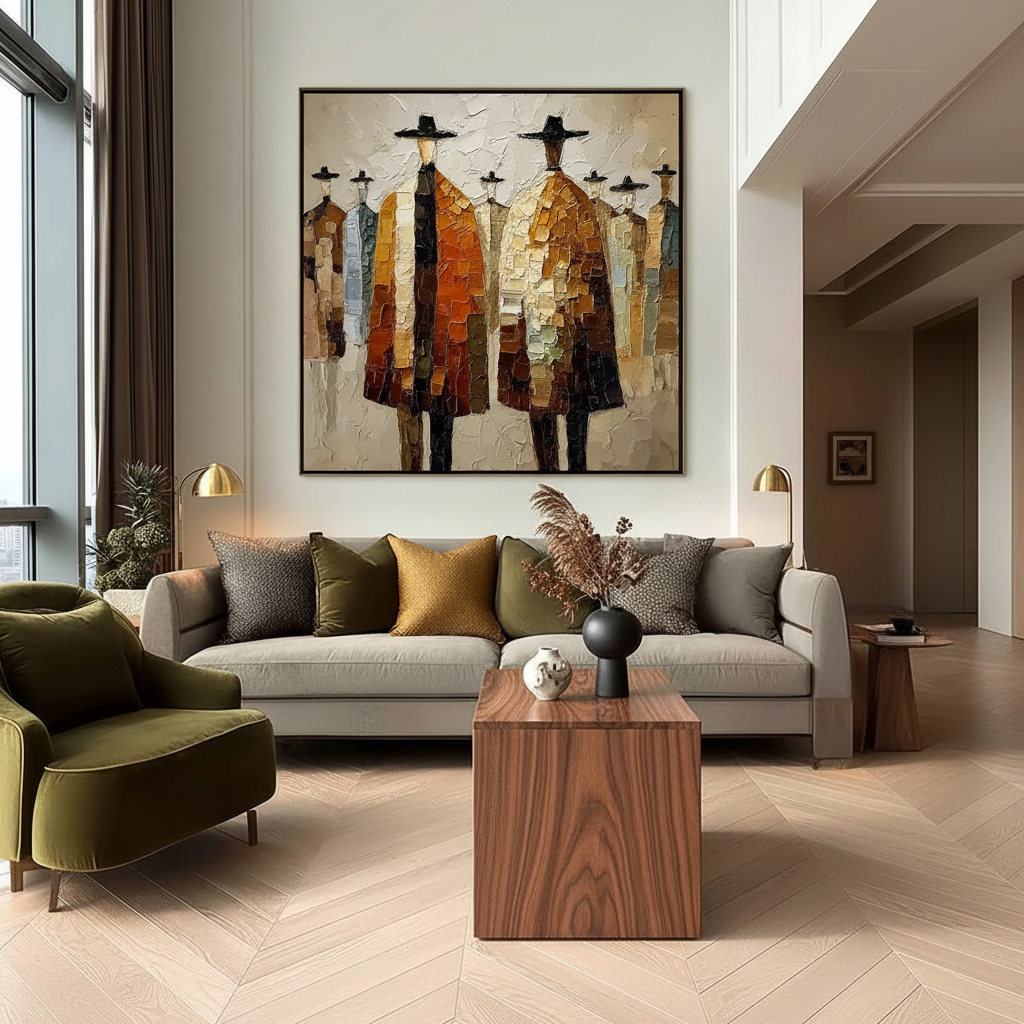
The Shift from Vanity Assets to Applied Aesthetic Value
For decades, the high-end art market was dominated by "vanity assets"—overpriced auction pieces purchased more for financial speculation than for spatial harmony. However, we are witnessing a structural pivot. According to data from Marketplace, high-end auction sales for pieces over $10 million plummeted 44% year-over-year in 2024. This retreat from purely financial assets signals a return to "real application value." Homeowners and designers are no longer seeking a name to hang on the wall; they are seeking "essential identity."
This "essential identity" is something digital prints and AI-generated art simply cannot replicate. A study by the University of Chicago found that consumers perceive digital replicas as lacking the artist’s soul, causing a collapse in perceived value. Furthermore, Columbia University experiments confirm that art labeled as "AI-generated" is valued 62% lower than authentic human-created work.
In our experience working with premium interiors, the greatest fear for a homeowner isn't the price—it’s the risk of a "visual clash." When you’ve invested in high-character walnut paneling or mid-century teak furniture, a large-scale canvas that doesn't harmonize with the wood’s natural undertones can make the entire room feel unanchored. This guide breaks down the technical mechanics of matching oil pigments to wood grains to ensure "decision safety" and camera-ready results.

The Physics of Texture: Wood Chatoyancy vs. Oil Impasto
The primary challenge in pairing art with premium wood is a phenomenon called chatoyancy. Derived from the French "œil de chat" (cat's eye), chatoyancy refers to the light-reflecting depth found in certain wood grains. In woods like Tiger Oak or high-character Walnut, the grain doesn't just sit on the surface; it appears to move as you walk past.
Prints fail in these environments because they are "optically flat." To compete with the three-dimensional depth of wood grain, you need the microtopography of hand-painted oil. Research utilizing optical microprofilometry has proven that the millimeter-scale texture (impasto) of oil paintings is crucial to their aesthetic impact. The physical relief of the paint creates its own shadows and highlights, allowing the artwork to "speak the same language" as the wood.
Logic Summary: We recommend hand-painted oils for high-grain environments because their physical relief (microtopography) provides a visual counterweight to wood chatoyancy. This prevents the art from looking like a "sticker" on a high-value wall.
The "Confidence" Heuristic for Busy Grains
In our studio, we follow a specific rule of thumb: Grain Complexity vs. Brushstroke Confidence.
- High-Character Woods (Tiger Oak, Burl Walnut): These woods have "busy" visual noise. To avoid a cluttered aesthetic, we specify art with broader, more confident brushstrokes. Fine, detailed art will often "compete" with the grain, leading to visual fatigue.
- Tight-Grained Woods (Maple, Cherry): These provide a calmer backdrop, allowing for more intricate, detailed oil work without overwhelming the eye.
The Secondary Tone Match: Decoding Wood Undertones
The most common mistake we see is trying to match the primary color of the wood. If you have a walnut table, do not look for a "brown" painting. Instead, utilize the Secondary Tone Match. This involves identifying the subtle "flicker" color found in the grain's shadows or the wood's natural highlights.
1. Walnut: The Grey and Purple Nexus
Walnut is prized for its cool, often purplish-grey undertones. While the primary surface looks chocolate brown, the "shadow flicker" is frequently a muted charcoal or a deep violet.
- The Match: Look for oil paintings that utilize Payne’s Grey or Ultramarine Violet in their deepest shadows. This creates a sophisticated, "locked-in" look that makes the furniture and art appear as a single, curated installation.
2. Teak: The Reddening Factor
Teak is a "living" material. Due to its natural oils (tectoquinones), teak chemically reacts to light and air, reddening significantly as it ages.
- The Match: Professional designers often specify a slightly cooler palette for art intended for teak-heavy rooms. By introducing muted teals or sage greens, you provide a complementary contrast that prevents the space from feeling overly "hot" or orange as the wood matures.
3. Oak: The Ambering of Linseed vs. Tung
The undertone of oak depends heavily on the finish used. According to woodworking research, linseed oil causes significant yellowing over time, while tung oil provides a more stable, amber warmth.
- The Match: If your oak has been finished with linseed oil, avoid "clean" blues in your art. The yellowing of the wood will make the blues look muddy. Instead, lean into earthy ochres and burnt sienna to harmonize with the ambering process.

Modeling the Interaction: Wood, Oil, and Light
To achieve "decision safety," we must account for the environment. Lighting is the "silent partner" in any art-wood pairing. A standard 2700K LED (the "warm white" found in most homes) has a high yellow output that can "muddy" blue pigments in oil art when placed near golden oak.
For accurate undertone assessment, we utilize a 90+ CRI (Color Rendering Index) light source. Lighting experts emphasize that standard home lighting (70-80 CRI) can distort undertone perception by up to 40%. When the CRI is high, the R9 (red spectrum) allows the true depth of both the wood grain and the oil pigment to be visible.
Method & Assumptions: The Harmony Model
We modeled the visual compatibility of common wood/oil pairings based on the following parameters:
| Parameter | Value/Range | Unit | Rationale |
|---|---|---|---|
| Light Source CRI | 90 - 98 | Ra | Required for R9 spectrum fidelity |
| Viewing Angle | 45 | Degrees | Optimal for observing impasto relief |
| Wood Moisture | 12 - 16 | % | Impact on VOC emission and color depth |
| Pigment Load | 40 - 60 | % | Ratio of pigment to binder for saturation |
| Gloss Level | 15 - 25 | GU | Semi-matte to avoid "specular glare" |
Modeling Note: This is a deterministic scenario model based on common designer heuristics. It assumes a neutral wall color (LRV 60-70) to ensure the wood and art remain the primary visual drivers.
Health, Safety, and the "Healing Wall"
Beyond aesthetics, the choice of hand-painted oil art has profound psychological and physical implications. A University of Pennsylvania review found that 73% of patients reported significant mood improvements when exposed to environmental artworks. Passive art viewing consistently activates the medial prefrontal cortex (mPFC) and the amygdala, optimizing emotional regulation circuits.
However, "hand-painted" does not always mean "healthy." In our practice, we prioritize Indoor Air Quality (IAQ). Chronic inhalation of volatile organic compounds (VOCs) in traditional oil solvents like turpentine can lead to central nervous system issues. The CDC NIOSH warns that certain metal-containing pigments can even penetrate the bloodstream if handled improperly.
To secure "green building points" (LEED/WELL certification) for our commercial clients, we specify low-VOC, walnut-oil-based pigments. Research from Aalto University proves that coatings on wood with proper moisture content emit significantly lower VOCs during the curing process than industrial alternatives. This makes custom murals a viable "public health infrastructure" tool, as endorsed by the World Health Organization (WHO).
The Technical Longevity of Your Investment
When you purchase a hand-painted oil, you aren't buying "decor"—you are investing in a non-renewable cultural heritage asset. However, oil paintings are chemically complex. One specific phenomenon we monitor is Support Induced Discoloration (SID).
As noted by Golden Artist Colors, water-soluble impurities in cotton or linen canvases can be drawn into the paint layer, causing a catastrophic yellow tint. This is why we insist on high-quality priming and the use of lightfast pigments. We adhere to ASTM D4303 standards, which utilize xenon-arc tests to simulate decades of indoor light exposure, ensuring the colors you see today are the colors you see in twenty years.
Protecting the Surface
For pieces placed in high-traffic or sun-drenched areas, we recommend a UV-protective varnish. This acts as a sacrificial layer, blocking harmful light waves at the molecular level and preventing the "chalking" effect often seen in unprotected acrylics or lower-quality oils.
Ethics and the Human Element
The premium for hand-painted art also supports a sustainable creative economy. While the global creative services export hit a record $1.4$ trillion (according to the Creative Economy Outlook 2024), many freelance artists remain financially vulnerable.
We align our practice with fair trade principles. A Wharton School survey found that 87% of consumers believe artists should receive fair compensation, especially in the age of generative AI. By choosing hand-painted works, you are directly supporting the "invisible labor" that goes into every brushstroke—a process Stockton University researchers describe as the "biochemical crystallization of apex human visual attention."
Creating a Camera-Ready Sanctuary
Ultimately, matching oil undertones to natural wood is about creating a space that feels intentional. It is the difference between a room that looks "furnished" and a room that looks "designed."
By following the Secondary Tone Match and respecting the Chatoyancy-Impasto balance, you mitigate the risk of visual clashing. You transform your walls into a "healing environment" that, as University of Michigan research suggests, can even increase social cohesion and community trust.
Whether you are a homeowner looking for that one "perfect" piece or a designer planning a high-visibility commercial space, remember: the most beautiful results occur where the organic soul of the wood meets the intentional hand of the artist.
YMYL Disclaimer: This article is for informational purposes only and does not constitute professional medical, legal, or financial advice. Regarding indoor air quality and chemical sensitivities, always consult with a certified industrial hygienist or medical professional. For structural or high-value furniture alterations, consult a professional woodworker or conservator.











