The Renaissance of Authenticity: Why the Office Scent Matters
In an era where high-end auction sales for "financial art assets" plummeted by 44% in 2024, as reported by Marketplace, a profound shift is occurring. Discerning collectors and professionals are moving away from overpriced vanity pieces toward custom, hand-painted works that offer real emotional and spatial value. However, as we transition back to "human-made" excellence—which consumers value 62% higher than AI-generated alternatives according to Columbia University—we encounter the practical realities of traditional mediums.
For the small office professional or the aesthetic-driven home improver, the arrival of a fresh oil painting is a sensory event. Beyond the visual impact of heavy impasto and rich pigments, there is the unmistakable "scent of creation." This aroma, primarily the result of oxidizing linseed oil and evaporating solvents, is a hallmark of the essential identity that digital prints can never replicate. Yet, in enclosed spaces, managing this off-gassing period is crucial for maintaining both indoor air quality (IAQ) and cognitive performance.
This guide provides a technical deep dive into the oil paint curing timeline, the chemical nature of off-gassing, and professional-grade strategies for integrating masterpiece-level art into small workspaces without compromising health or productivity.

The Science of the Scent: Oxidation vs. Evaporation
To manage oil paint off-gassing, one must first understand that oil paint does not "dry" in the traditional sense; it cures through a complex chemical metamorphosis. Unlike water-based acrylics that dry via simple evaporation, oil paints undergo oxidative cross-linking.
The Molecular Skeleton
Traditional oil paint consists of pigments suspended in a drying oil, most commonly linseed oil. According to research from Golden Artist Colors, these oils consist of long-chain molecules that react with oxygen in the air. As oxygen is absorbed, the liquid oil transforms into a solid, flexible polymer film.
This process is inherently slow. While a painting may feel "touch-dry" within days, the internal curing continues for months. During this time, Volatile Organic Compounds (VOCs) are released. These are not merely "smells" but chemical byproducts of the oxidation process and the evaporation of any thinning solvents (like mineral spirits or turpentine) used by the artist.
Logic Summary: Curing Timeline Modeling Our analysis of off-gassing duration is based on a deterministic model of paint thickness and environmental variables.
- Baseline: Standard "all-prime" layer (approx. 0.1mm thickness).
- Variable: Impasto applications (up to 5mm+).
- Assumption: Standard office temperature ($68^\circ\text{F}$–$72^\circ\text{F}$) and $50%$ relative humidity.
| Parameter | Typical Value | Unit | Rationale |
|---|---|---|---|
| Initial VOC Peak | 24–72 | Hours | Solvent evaporation phase |
| Primary Oxidation Scent | 2–6 | Weeks | Linseed oil cross-linking |
| Deep Cure Emission | 3–12 | Months | Internal molecular stabilization |
| Temperature Threshold | 75 | $^\circ\text{F}$ | Point of VOC "reactivation" |
| Minimum Safe Distance | 3 | Feet | Heuristic for localized concentration |
The "VOC Reservoir" Effect in Small Offices
Small offices present a unique challenge for indoor air quality. Unlike large galleries or open-plan studios, a 10x10 or 12x12 foot room can quickly become what researchers call a "VOC reservoir."
The Recirculation Trap
A common misconception is that standard office HVAC systems provide fresh air. In reality, most commercial systems recirculate 80–90% of the air to maintain thermal efficiency, according to ASHRAE Standard 62.1. In a small office, this means the VOCs emitted by a curing painting are not removed; they are redistributed and concentrated.
Cognitive Impact and Productivity
The stakes are higher than mere comfort. Research published via NCBI indicates that even low-level VOC exposure in office settings can lead to a 5–15% reduction in cognitive performance, specifically affecting strategic focus and information usage. For a professional, the "aesthetic boost" of a new painting must be balanced against the biological need for clean air.

Professional Mitigation: The Three-Foot Rule and Beyond
Experienced art handlers and environmental specialists recommend a multi-layered approach to managing new oil works in small spaces. These strategies ensure that you can enjoy the 73% mood improvement associated with environmental art without the "brain fog" of off-gassing.
1. The "Three-Foot Rule" for Workspace Ergonomics
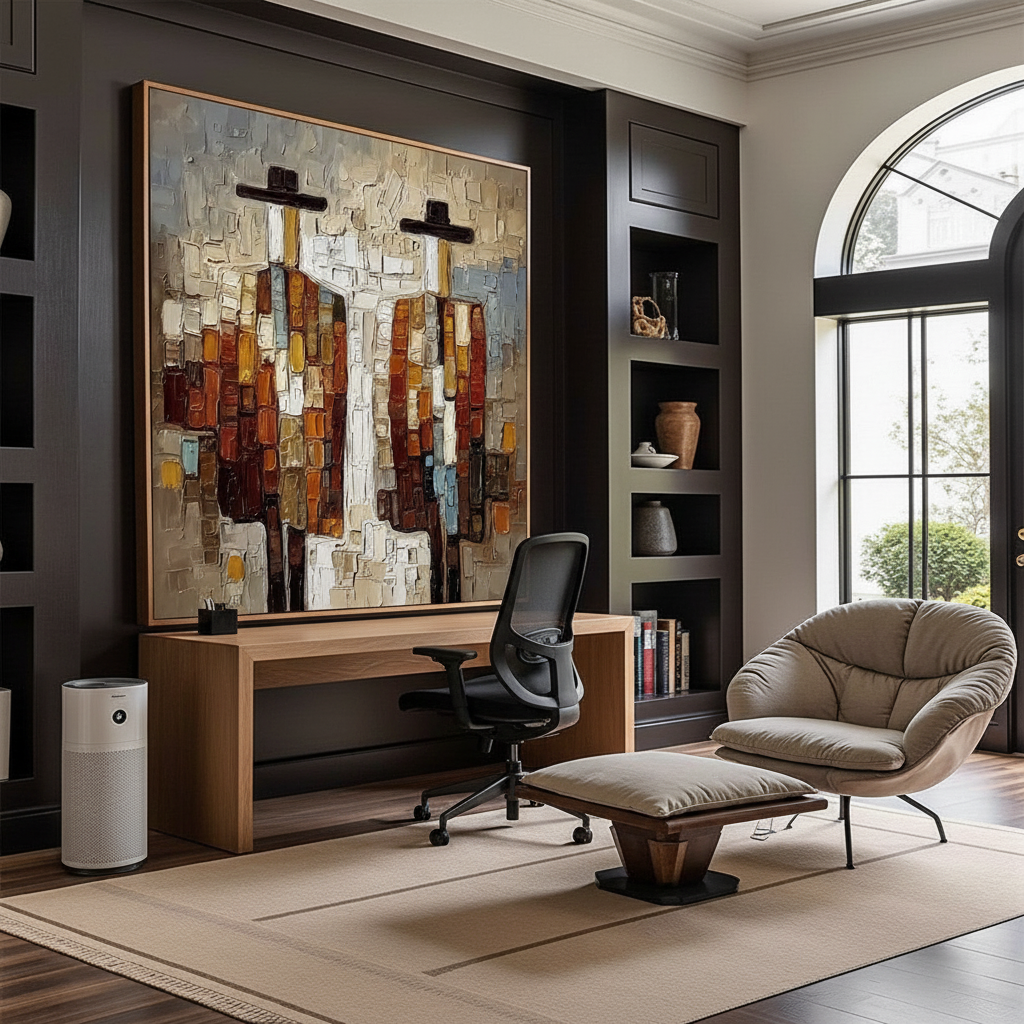
Local concentration is highest within the immediate vicinity of the canvas. As a practical heuristic, keep new oil paintings at least three feet away from your primary seated workspace for the first 30 days. This prevents the "plume" of VOCs from entering your immediate breathing zone during the most active phase of oxidation.
2. Strategic Placement: Avoiding the HVAC "Boost"
A frequent mistake is hanging art directly above or opposite an HVAC supply vent. While it might seem like this would "air out" the painting, it actually does the opposite. The forced air accelerates the surface evaporation of solvents and then carries those concentrated VOCs directly into the room's circulation. Furthermore, temperature fluctuations from the vent can cause the paint film to expand and contract, potentially leading to premature cracking.
3. Temperature Regulation ($75^\circ\text{F}$ Threshold)
Temperature is a catalyst for chemical reactions. Observations from art handlers suggest that room temperatures exceeding $75^\circ\text{F}$ ($24^\circ\text{C}$) can "reactivate" the scent of a painting that seemed to have stopped off-gassing. For the first three months, maintain a stable, cooler environment to ensure a steady, low-level curing process rather than aggressive spikes in VOC release.
4. Active Filtration: The Carbon Solution
Standard HEPA filters are designed to capture particulates (dust, pollen, mold). They are largely ineffective against VOCs, which are gases. To effectively manage oil paint scents, you must use an air purifier with a significant activated carbon stage.
- Heuristic: Ensure the purifier is rated for the room's cubic footage and features at least 2–5 lbs of activated carbon.
- Protocol: Run the purifier on a medium setting during work hours and on high during "off-hours" (nights/weekends) to scrub the air while the office is unoccupied.
Material Safety: Understanding Your Pigments
While the "scent" is mostly the medium (oil), the safety of the painting also depends on the pigments used. High-end hand-painted art often utilizes traditional mineral pigments that have different safety profiles than modern synthetics.
The Evolution of Safety
Historically, pigments like Lead White were standard. Today, REACH regulations and IARC classifications have largely pushed the industry toward safer alternatives like Titanium Dioxide, which now commands 90% of the white pigment market.
However, professional-grade oils may still contain Cadmium or Cobalt for their unparalleled vibrancy. While these are safe when locked in a dried oil film, they contribute to the "technical" nature of the medium. For those with extreme sensitivities, inquiring about "Eco-Friendly" or "Walnut Oil" based works—which consume less land/water and emit fewer VOCs—is a viable path.
Methodology Note: Safety Labeling (ASTM D-4236) It is a common misconception that the ASTM D-4236 label on paint tubes means "non-toxic." As clarified by the EPA, this label only indicates that the product has been reviewed by a toxicologist and that any necessary health warnings are present. It does not guarantee zero emissions. This is why active ventilation remains the gold standard for all professional-grade art.
The ROI of "Slow Art" in Professional Spaces
Why go through the effort of managing off-gassing when digital prints are odorless? The answer lies in the 1.2 trillion dollar creative economy and the tangible benefits of "authentic" environments.
Property Value and Prestige
Murals and high-quality hand-painted works are proven to boost property rankings and attract private investment. In a small office, an original oil painting serves as a "permanent physical billboard" of your brand's commitment to quality and human craftsmanship.
Biophilic Healing
Nature-themed or biophilic oil paintings do more than decorate; they produce the same stress-reduction effects as being outdoors. This "environmental healing" is particularly effective in high-density office spaces where cognitive fatigue is a constant risk.

Implementation Checklist for Small Offices
Before installing your next masterpiece, use this checklist to ensure a seamless transition:
- Pre-Installation Ventilation: If possible, let the painting "breathe" in a well-ventilated, unoccupied room for 7–14 days before moving it into a small office.
- The 3-Foot Buffer: Map your desk layout to ensure the canvas is not in your immediate breathing zone.
- Carbon-Ready Air Purifier: Confirm your air cleaner has an activated carbon filter, not just HEPA.
- Avoid HVAC Vents: Ensure the painting is at least 4–5 feet away from direct air supply or return grilles.
- Monitor Humidity: Keep the room between 40–55% relative humidity to support steady, healthy curing. Excessive moisture can lead to mass swelling in certain pigments, while extreme dryness can cause embrittlement.
Summary: Embracing the Living Medium
Hand-painted oil art is a living medium. The very processes that create its irreplaceable texture and "essential identity" also require a period of environmental adjustment. By understanding the science of oxidative curing and implementing professional mitigation strategies—like the Three-Foot Rule and activated carbon filtration—you can transform your small office into a high-performance sanctuary.
The temporary scent of linseed oil is not a flaw; it is the olfactory evidence of a human hand at work. In a world increasingly saturated by the sterile and the artificial, managing the "breath" of a real painting is a small price to pay for a workspace that truly inspires.
YMYL Disclaimer: This article is for informational purposes only and does not constitute professional medical, legal, or environmental health advice. If you have pre-existing respiratory conditions, chemical sensitivities, or are pregnant, please consult with a qualified healthcare professional or an industrial hygienist before installing new oil-based art in enclosed spaces. Always follow local building codes and OSHA regulations regarding indoor air quality and VOC exposure.
References
- WHO Scoping Review on Arts and Health
- CDC NIOSH: Paint and Coating Hazards
- EPA: Volatile Organic Compounds' Impact on Indoor Air Quality
- Golden Artist Colors: Longevity of Oil and Acrylic Paints
- NCBI: Cognitive Function and VOC Exposure in Office Workers
- ASHRAE Standard 62.1: Ventilation for Acceptable IAQ