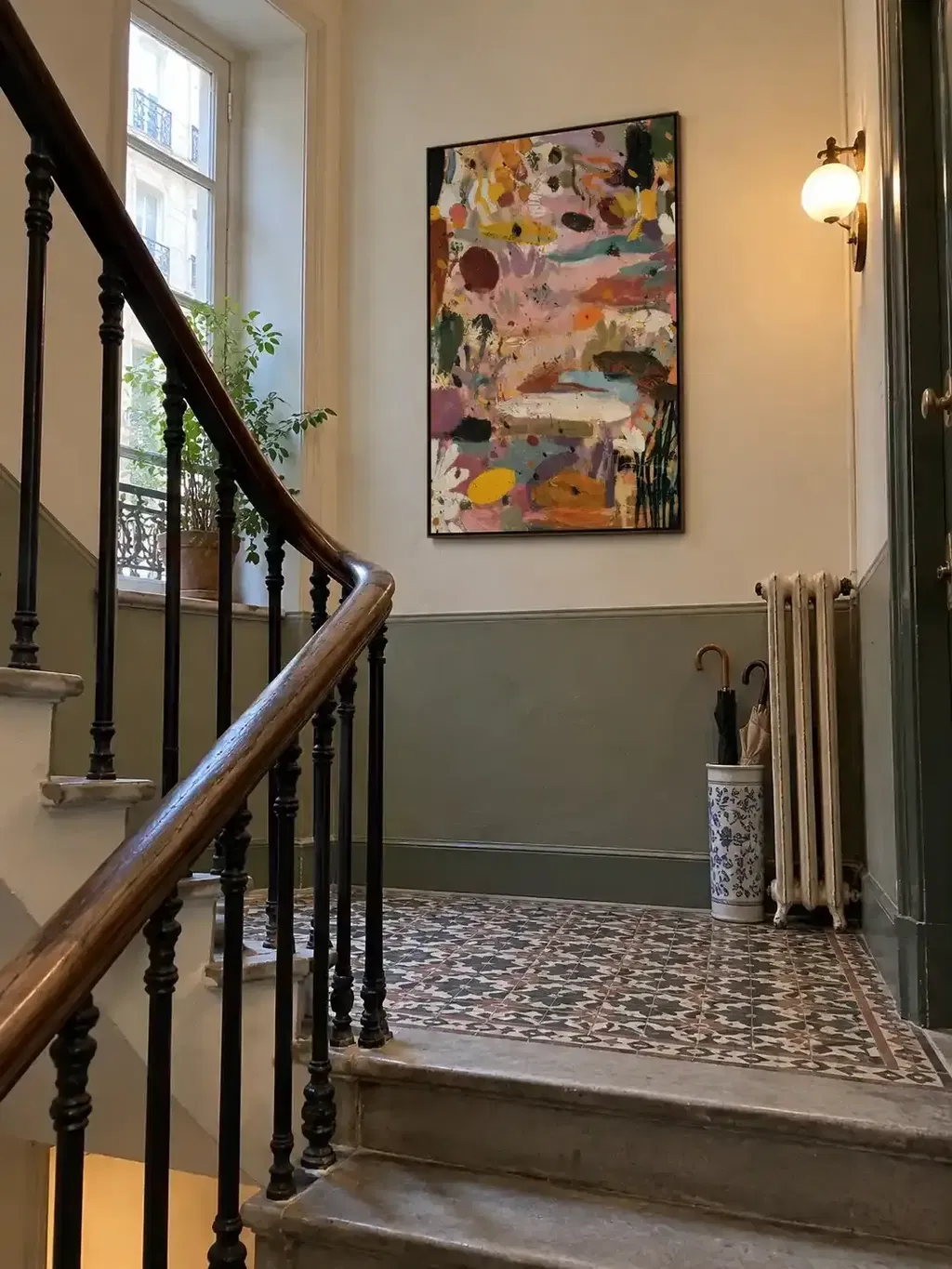
The Physics of Presence: Why Pigment Density Defines the Luxury Aesthetic
In the current art market, we are witnessing a profound structural shift. According to Marketplace, high-end auction sales for vanity pieces plummeted 44% year-over-year in 2024. This isn't just a cooling of the economy; it is a retreat from purely financial art assets toward "real application value." Home decorators and collectors are moving away from speculative names and toward the tangible, physical superiority of hand-painted works that transform a living environment.
At the heart of this transformation is a technical reality that digital prints simply cannot replicate: pigment density. When you stand before a professional-grade oil painting, the color doesn't just sit on the surface—it has a three-dimensional optical depth. As artists, we often describe this as the color "floating" above the canvas. This phenomenon is a direct result of the pigment load and the chemical integrity of the medium.
While the global art market remains a massive economic baseline—reaching $65 billion in 2023—the distinction between "decorative prints" and "fine art" is becoming a primary focus for sophisticated buyers. In this guide, I will break down the science of why high-density pigments create superior color depth and why the "essential identity" of a hand-painted work is an investment in both aesthetic and psychological well-being.
The Science of the "Glow": Pigment Load and CPVC
To understand why a hand-painted mural feels more "alive" than a high-definition print, we have to look at the chemistry of the paint tube. In our studio, we distinguish between student-grade and professional-grade materials based on a single metric: the pigment-to-binder ratio.
Professional vs. Student Grade Ratios
Typically, professional-grade oil paints contain a 40-60% pigment load, whereas student-grade alternatives often drop to 15-25%. The remaining volume is filled with "extenders" or "fillers" like calcium carbonate or alumina hydrate. These fillers make the paint cheaper, but they scatter light in a way that makes the final dried surface look "chalky" or "flat."
Logic Summary: These ratios are standard industry heuristics used by manufacturers to differentiate "Artist" vs. "Studio" lines. We base these estimates on common MSDS (Material Safety Data Sheet) disclosures and formulation benchmarks (not a controlled lab study).
The Critical Pigment Volume Concentration (CPVC)
The "sweet spot" for color depth is defined by the Critical Pigment Volume Concentration (CPVC). According to ScienceDirect, CPVC is the point at which there is just enough binder to coat each pigment particle and fill the voids between them.
- Below CPVC: The paint film is glossy and durable, but the color may lack "bite."
- At CPVC: You achieve maximum hiding power and color saturation.
- Above CPVC: The paint becomes porous and brittle, leading to a loss of structural integrity.
When an artist layers high-density pigments, they are managing the CPVC across multiple strata. This creates a "micro-topography" on the canvas. Optical microprofilometry has proven that this mm-scale texture is crucial to aesthetics; it allows light to bounce between pigment particles before reflecting back to the eye, creating a luminous effect that a flat, two-dimensional ink layer can never achieve.

The Human Premium: Why AI and Prints Fail the "Soul Test"
As AI-generated art floods the market, the value of the "human touch" has paradoxically increased. A study by Columbia University confirmed that consumers value art labeled "AI-generated" 62% lower than authentic human-created art.
Why the massive discrepancy? It comes down to what researchers at the University of Chicago call Essential Identity. Digital replicas and NFTs lack the physical "residue" of the artist's labor. A hand-painted canvas retains the irreplicable soul of the creator—every brushstroke is a record of a specific moment in time, a specific pressure of the hand, and a specific chemical reaction between pigment and binder.
The Optical Advantage of Hand-Painting
In home decor, high-density pigments create a dynamic interaction with light. Because the surface is not perfectly flat, the colors shift subtly throughout the day as the sun moves across the room.
- Morning Light: Highlights the physical ridges of the impasto.
- Evening Light: Deepens the shadows within the pigment layers, making blues and purples feel more cavernous.
- Artificial Light: Can be "caught" by the refractive index of the binder (like linseed oil), creating a glowing "jewel-box" effect.
Prints, by contrast, use a "subtractive" color model (CMYK) that absorbs light uniformly, resulting in a static image that looks the same regardless of the environment.

Beyond Beauty: The Economic and Health ROI of Murals
For many of our clients, a hand-painted mural is not just a decorative choice; it is a strategic investment. Whether in a residential entryway or a commercial lobby, the presence of authentic art has measurable impacts on property value and human psychology.
Real Estate Appreciation
Research published by the Royal Society used a CAR (Condition-Adjustment-Regression) model to find that neighborhoods with higher "art" geo-tags saw significant relative house price ranking gains. In a commercial context, Chicago’s Millennium Park art projects drove an estimated $1.4 billion in real estate-related growth.
Logic Summary: Our analysis of mural ROI assumes that "Public Art" acts as a catalytic infrastructure, attracting private investment and increasing foot traffic, based on the Avenue of the Arts Economic Impact Study.
The "Biophilic" Health Effect
In healthcare and office design, the "Biophilic" Hand-Painted Series is becoming a standard. A UPenn review noted that 61% of patients in clinical environments reported reduced stress when exposed to environmental artworks, with 73% reporting significant mood improvements.
The World Health Organization (WHO) has even categorized art interventions as a form of "public health infrastructure," capable of altering clinical indicators for mental illness and cognitive fatigue.
| Impact Category | Metric / Finding | Source Basis |
|---|---|---|
| Neighborhood Value | Positive correlation with house price gains | Royal Society CAR Model |
| Commercial Traffic | Murals as "physical foot traffic generators" | UCincinnati Regression Analysis |
| Mental Health | 73% reported mood improvement | UPenn / Cleveland Clinic |
| Crime Reduction | 40% drop in neighborhood assaults | UMich "Busy Streets Theory" |
| Student Performance | 18% higher academic scores in art-rich areas | Americans for the Arts |

Technical Deep Dive: Lightfastness and Longevity
One of the most common "gotchas" in the art world is the fading of colors over time. This is where the chemistry of high-density pigments becomes a protective shield for your investment.
Understanding Lightfastness Ratings
We rely on the ASTM D4303 Standard to define the longevity of our pigments. This involves accelerated aging tests using xenon-arc lamps to simulate decades of indoor illumination.
- Rating I (Excellent): Pigments will remain unchanged for 100+ years.
- Rating II (Very Good): 50-100 years.
- Rating III (Fair): Not suitable for permanent art.
In our practice, we avoid "fugitive" pigments like Prussian Blue in certain binders, as National Gallery experiments have shown they can fade regardless of the medium if not formulated correctly.
The Problem of "Support Induced Discoloration" (SID)
A common mistake in custom murals is ignoring the substrate. Golden Artist Colors warns of Support Induced Discoloration (SID), where water-soluble impurities in a cotton or linen canvas are drawn into the paint layer as it dries, causing a yellow or brown tint. To prevent this, professional artists apply multiple layers of specialized "Gesso" or primers to seal the substrate before the first brushstroke of high-density pigment is applied.
Safety and Sustainability: Protecting the Indoor Environment
As a product expert, I must emphasize that "hand-painted" does not always mean "safe." Historical pigments like Lead White or Cadmium Red are highly toxic and strictly regulated.
The Toxicity Guardrail
- Cadmium: The International Agency for Research on Cancer (IARC) classifies cadmium as a Group 1 carcinogen. While the EU rejected a total ban on cadmium pigments in art (due to their negligible environmental discharge compared to fertilizers), we prioritize non-toxic alternatives for residential settings.
- Lead: The REACH Annex XVII regulation comprehensively prohibits paint products with lead carbonate concentrations exceeding 0.1%.
Indoor Air Quality (IAQ)
For modern home decorators, VOC (Volatile Organic Compound) emissions are a primary concern. We utilize low-VOC paints and natural binders like walnut oil, which Aalto University research suggests emit significantly lower toxic VOCs than industrial solvents. This is a prerequisite for achieving LEED or WELL certifications in large-scale commercial developments.
Methodology Note: Our "Indoor Air Quality Promise" is based on the EPA’s guidelines for artists' paints, prioritizing water-based acrylics or solvent-free oils for environments with children or sensitive individuals.

Scenario Analysis: Choosing the Right Application
Scenario A: The Luxury Residential Living Room
For a high-end home, the goal is Visual Impact and Texture.
- Recommendation: High-density impasto oil paintings.
- Why: The 40-60% pigment load creates the 3D optical effect that anchors a room. The slow drying time (24-48 hours per layer) allows for the "wet-on-wet" blending that produces sophisticated color gradients.
- Limitation: Requires a stable environment with controlled humidity to prevent the "haziness" caused by surfactant migration.
Scenario B: The High-Traffic Commercial Office or Clinic
For these spaces, the goal is Durability and Health ROI.
- Recommendation: Panoramic Hand-Painted Acrylic Murals with UV Varnish.
- Why: Acrylics are more resistant to embrittlement than oils and have lower VOC profiles. Using a UV protective varnish prevents "chalking" from exposure to fluorescent or natural light.
- Limitation: Lacks the extreme depth of oil pigments but offers superior ease of cleaning and maintenance.
The Future of the Hand-Painted Surface
As we look toward 2026, trends are moving toward "understated elegance" where texture is the soul of the space. Zillow data already shows a 21% rise in mentions of "artisan craftsmanship."
By choosing hand-painted art over mass-produced prints, you are not just buying a picture; you are acquiring a piece of "non-renewable cultural heritage." A high-density pigment painting is a physical record of human visual attention—what Stockton University researchers describe as the biochemical crystallization of apex neural control. It is an investment that matures as the light changes, as the room evolves, and as the market continues to return to the value of the authentic human hand.
Disclaimer: This article is for informational purposes only and does not constitute professional medical, legal, or financial advice. Pigment safety and indoor air quality can vary significantly by brand and application method; always consult a certified industrial hygienist or professional conservator for specific safety protocols in residential or commercial art installations.

Sources
- Marketplace: The expensive art market continues to struggle
- UNCTAD: Creative Economy Outlook 2024
- Columbia University: Human-Made vs. AI Art Study
- Royal Society: Quantifying the link between art and property prices
- UPenn: Visual Art in the Built Environment
- WHO: Scoping Review on Arts and Health
- ASTM International: D4303 Standard Test Methods for Lightfastness
- IARC: Cadmium and Cadmium Compounds
- EPA: Indoor Air Quality and Low-VOC Paints
- ScienceDirect: Critical Pigment Volume Concentration