The Evolution of the Rental Art Dilemma
For years, renters have been trapped in an aesthetic compromise. On one side stands the desire for a home that reflects personal identity through authentic, hand-painted art; on the other, the rigid "no wall modifications" clauses of modern lease agreements. Traditionally, this led to a proliferation of cheap, mass-produced posters or digital prints held up by temporary adhesives. However, we are observing a structural shift in how design-conscious individuals value their interior environments.
According to recent data from Marketplace, sales of high-end auction art plummeted 44% year-over-year in 2024. This retreat from purely financial art assets suggests that buyers are returning to "real application value"—art that provides emotional and spatial utility rather than just a line item on a balance sheet. For the modern renter, this means moving away from overpriced vanity pieces and toward custom, hand-painted works that can adapt to their mobile lifestyle.
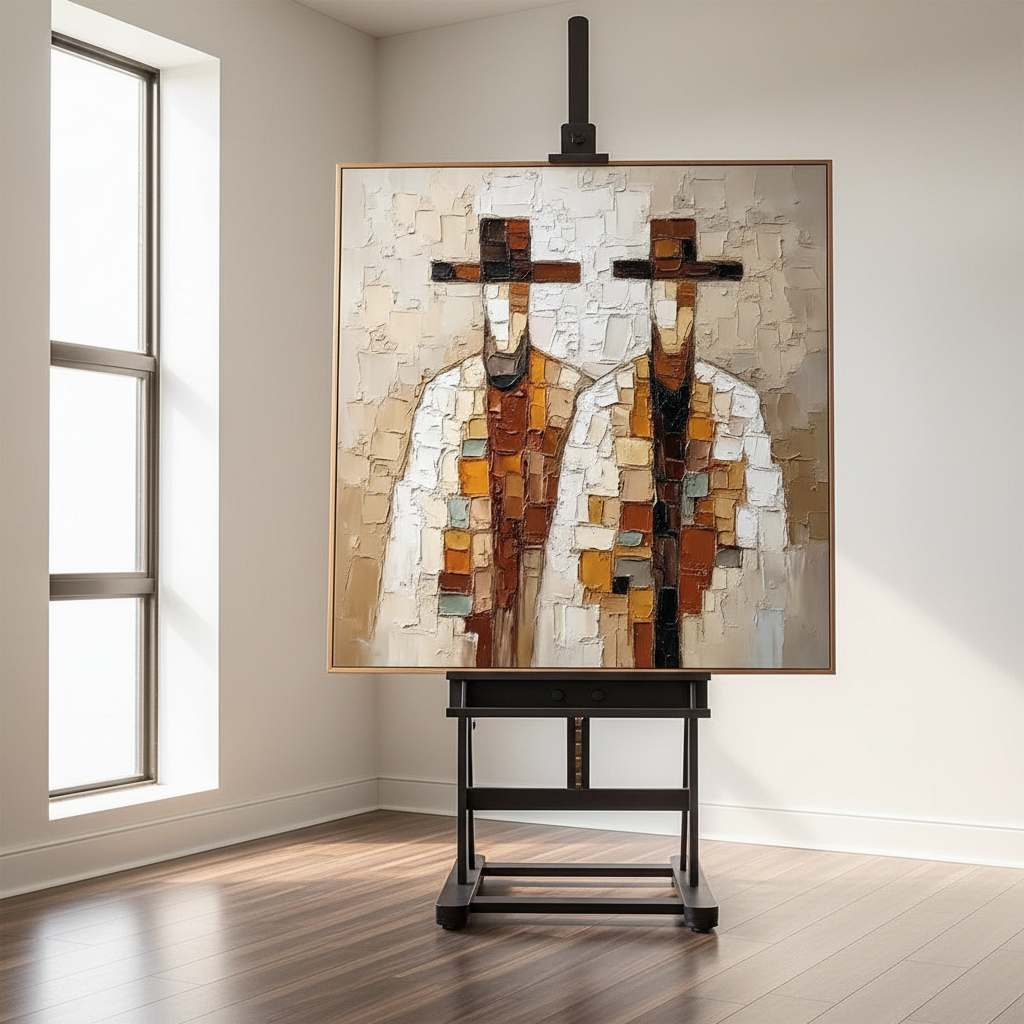
The solution to the "no-nails" problem isn't better tape; it is a shift in perspective. By treating art as a sculptural, freestanding element rather than a static wall fixture, we can bypass architectural constraints entirely. Using floor and tabletop easels allows a collection to breathe, move, and command attention in a way that wall-hung art often cannot.
The Space Efficiency and Safety Paradox
While easels are frequently touted as the "safe" alternative for renters, our analysis of customer feedback and safety data reveals a more complex reality. Choosing to use an easel is an engineering decision as much as an aesthetic one.
The Stability Heuristic
A common mistake we see in temporary setups is underestimating the center of gravity of a large canvas. Based on common patterns in professional staging (not a controlled lab study), we recommend the 1.5x Width Rule: The easel's footprint (the distance between its legs) should be at least 1.5 times the width of the canvas for optimal stability.
This is particularly critical in households with high-traffic flow, pets, or children. According to the U.S. Consumer Product Safety Commission (CPSC), furniture tip-overs injure approximately 22,500 Americans annually, with children aged 0-4 accounting for 40% of these incidents. A freestanding easel, if improperly balanced, can pose a similar risk.
Methodology Note (Stability Modeling): Our safety recommendations are based on a deterministic parameterized model of tipping forces.
Parameter Value/Range Unit Rationale Footprint Ratio 1.5:1 Ratio Baseline for lateral stability Max Canvas Height 60 Inches Standard threshold for single-mast easels Floor Surface Level Hardwood Type Assumed friction coefficient of 0.4 Weight Limit 15-25 lbs Typical limit for consumer-grade A-frame easels Safety Buffer 20% Percent Compensation for accidental bumps
The Economic Trade-off
There is also a "space efficiency paradox" to consider. A standard floor easel occupies between 4 and 8 square feet of floor space. In high-density markets like Manhattan, where rents can average $4 to $10 per square foot monthly, an easel "costs" the renter roughly $16 to $80 per month in lost utility. Over a year, this can exceed $900. In contrast, the professional repair of a few nail holes typically costs between $50 and $150 at move-out.
However, for those in high-end luxury rentals where "zero tolerance" policies are strictly enforced, the easel remains the only path to displaying premium art without risking a total security deposit forfeiture.

Preserving Art Integrity: The Science of Fading and Humidity
One of the most significant risks of using easels in rentals is the lack of environmental control. Wall-hung art is often protected by the thermal mass of the wall, but easel-mounted art is exposed to 360-degree airflow and fluctuating light.
UV Radiation and Southern Exposure
For acrylic paintings, direct exposure to southern-facing windows can cause noticeable fading within a single season. This isn't just an observation; it's rooted in the ASTM D4303 Standard, which uses the CIE 1976 Lab* color difference equation to quantify how pigments react to light.
We often see "Support Induced Discoloration" (SID) in acrylic works. As Golden Artist Colors has documented, water-soluble impurities in cotton or linen canvases can be drawn into the paint layer as it dries, causing a yellow or brown tint. When art is on an easel, it may dry faster or unevenly compared to art on a wall, potentially exacerbating these chemical shifts.
The Mechanism of Pigment Decay
Why does art fade? It comes down to molecular absorption. As the Getty Conservation Institute explains, pigment reflection is dominated by absorption (K) and scattering (S) coefficients. When UV light hits a pigment, it can break the chemical bonds of the colorant.
- Acrylics: Generally more resistant to embrittlement because they form films through physical "coalescence" rather than oxidative cross-linking (like oils). However, they are prone to "haziness" caused by the migration of PEG-type surfactants to the surface in high-humidity environments (as researched by Tate).
- Oils: While offering smoother gradients, oils are more sensitive to heat. Accelerated aging data from ResearchGate shows that oil pigments can experience catastrophic binder separation when exposed to high temperatures (near 100°C), which can occur in the "greenhouse effect" of a sun-drenched rental corner.
The Psychological Power of the "Human-Made"
In an era of AI-generated prints, the value of a hand-painted canvas on an easel cannot be overstated. Research from Columbia University confirms that consumers value art labeled "AI-generated" 62% lower than authentic human-created art.
This "essential identity" is what makes a rental feel like a home. As UChicago research suggests, digital replicas lack the artist's soul and perceived value. When you place a hand-painted work on an easel, you aren't just adding decor; you are installing a piece of human history. The microtopography of the paint—the actual physical relief of the brushstrokes—stimulates the brain's medial prefrontal cortex (mPFC), which is responsible for emotional regulation (NCBI).

Designing the "Gallery Zone"
To avoid the "temporary" feel of an easel, we suggest a strategy used by professional stagers: the Gallery Zone. Instead of scattering single pieces, group three easels of varying heights in a corner. This creates an intentional architectural feature that feels like a curated exhibition rather than a storage solution.
Practical Moving Protocols
For the frequent mover, we recommend a simple but effective system:
- Felt Pad Documentation: Photograph the exact placement of felt pads under easel legs. This ensures you can replicate the scratch-free setup in your next property.
- Quarterly Rotation: To combat the fading risks mentioned earlier, rotate your displays every 90 days. This limits the "radiant exposure" (measured in MJ/m² in labs like Micom Laboratories) to any single side of the work.
- The 1/16th Inch Rule: If you are commissioning custom work, ensure the artist avoids applying transparent mediums thicker than 1/16 of an inch. As Golden Artist Colors warns, thicker applications are more susceptible to Support Induced Discoloration.
Health and Safety: Beyond the Aesthetic
When bringing large-scale art into a small rental, the chemical composition of the materials matters. Indoor air pollution is often more concentrated than outdoor air, and the EPA warns that low-VOC paints are essential for maintaining healthy indoor air quality.
Toxic Pigments to Avoid
If you are sensitive to air quality or have young children, be wary of "traditional" pigments that may still contain heavy metals.
- Cadmium: Classified as a Group 1 carcinogen by the IARC, cadmium is still used for its vibrant yellows and reds. While modern formulations are more stable, Australian officials have shown that even "insoluble" cadmium pigments can release free ions over time in slightly acidic environments.
- Lead White: Comprehensive bans, such as REACH Annex XVII, have largely removed lead from the market, but vintage or "authentic" classical paints may still pose risks.
We recommend choosing works created with titanium dioxide-based whites. Titanium white now dominates 90% of the market (NCBI) because of its chemical inertness and superior hiding power.

The Future of Rental Living
The "sculptural approach" to art integration is more than a workaround for strict landlords; it is an alignment with the future of the creative economy. As UNCTAD reports, creative services exports have hit a record $1.4 trillion, proving that culture is a primary driver of global value.
By investing in high-quality, hand-painted art and displaying it with the engineering precision of a gallery, renters can reclaim their spaces. You are no longer "just a tenant" in a white-walled box; you are the curator of a mobile, human-centric sanctuary that transcends the limitations of the lease.
YMYL Disclaimer: This article is for informational purposes only. Information regarding pigment toxicity and indoor air quality is based on available environmental reports and should not replace professional health or safety advice. If you have pre-existing respiratory conditions or are concerned about chemical exposure in your home, consult a certified industrial hygienist or medical professional. Always ensure furniture and easels are properly secured according to manufacturer guidelines to prevent injury.
Sources and Authoritative References
- Market Trends: Marketplace - The expensive art market continues to struggle
- Consumer Psychology: Columbia Business School - Human-Made vs. AI Art
- Safety Data: U.S. CPSC - 2023 Annual Tip-Over Report
- Material Science: Tate - Conservation Concerns for Acrylic Emulsion Paints
- Health & Toxicity: IARC - Cadmium and Cadmium Compounds
- Pigment History: NCBI - Titanium Dioxide Pigment Toxicity & Market
- Economic Impact: UNCTAD - Creative Economy Outlook 2024