
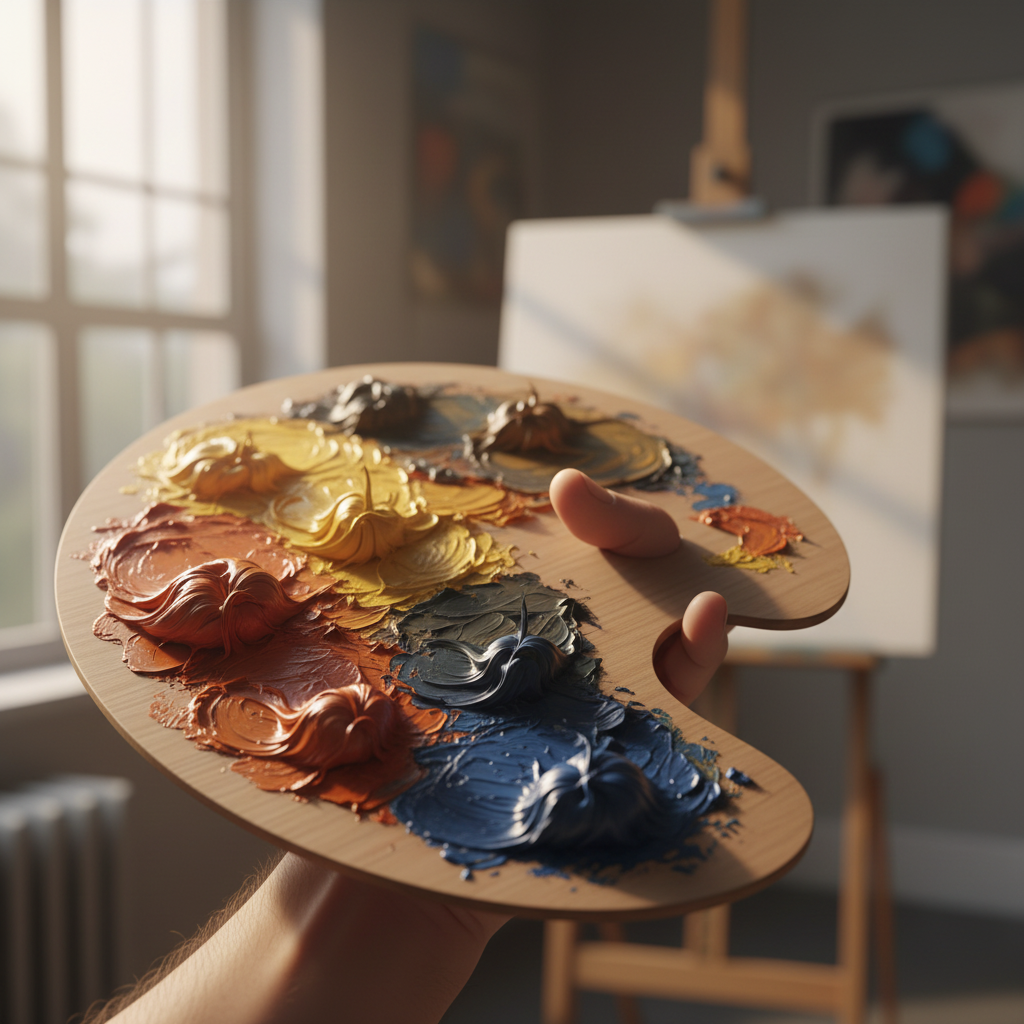
Pigment Chemistry: Why Earth Tones Dry Faster Than Blues
In our studio, we often witness a peculiar phenomenon that puzzles many of our clients: a desert landscape rendered in siennas and ochres might be ready for its final varnish weeks before an ocean scene dominated by deep phthalocyanine blues. To the untrained eye, it seems like a quirk of the artist’s mood, but to those of us who live among the scent of linseed oil and mineral spirits, it is a matter of cold, hard molecular chemistry.
The global art market is currently undergoing a significant shift. While high-end auction sales for purely financial art assets plummeted 44% in 2024, according to Marketplace, there is a renewed return to "real application value." Buyers are moving away from overpriced vanity pieces and toward custom, hand-painted works that offer emotional resonance and tactile authenticity. This "human-made" premium is quantifiable; a study by Columbia University confirmed that consumers value art labeled "AI-generated" 62% lower than authentic human-created art.
However, choosing the human path—specifically the path of oil-on-canvas—requires an understanding of the medium’s physical life cycle. In this guide, we will peel back the layers of pigment chemistry to explain why certain colors "behave" better than others and how these chemical realities dictate the production timelines of your custom commissions.

The Molecular Clock: How Oil Paint Actually "Dries"
Before we dive into specific colors, we must clarify a common misconception: oil paint does not "dry" through evaporation like water-based acrylics. Instead, it cures through a process called oxidative polymerization. When linseed oil (the most common binder) is exposed to oxygen, it undergoes a series of chemical reactions that transform the liquid oil into a solid, cross-linked polymer film.
According to research from the National Gallery, this process is remarkably consistent across different binders, yet the pigments suspended within that oil act as either accelerators or inhibitors of this reaction.
Logic Summary: Our analysis of drying timelines assumes a standard studio environment (21°C, 50% humidity) and a standard film thickness of ~0.1mm to 1.0mm. We categorize "dry to the touch" as the point where the paint film no longer transfers pigment to a clean finger under light pressure, aligned with ASTM D1640 standards.
Earth Tones: The Natural Catalysts
If you have ever wondered why a portrait's underpainting is almost always done in Raw Umber or Burnt Sienna, the answer lies in the iron. Earth pigments are essentially refined dirt—clays and minerals rich in iron oxides ($Fe_2O_3$).
The Catalytic Effect
Iron is a transition metal, and in the world of chemistry, transition metals are legendary catalysts. In an oil paint film, the iron ions in pigments like Yellow Ochre or Raw Umber actually speed up the absorption of oxygen into the linseed oil. This creates a faster polymerization network, allowing the paint to reach a "dry to touch" state in as little as 24 to 48 hours.
The Oil Absorption Factor
Beyond catalysis, there is the matter of "oil absorption." Every pigment requires a specific amount of oil to become a workable paste. Earth pigments are relatively "thirsty" but efficient. According to data from Just Paint, earth pigments typically have oil absorption values between 15 and 35 grams of oil per 100 grams of pigment. Because they require less oil to reach a stable state, there is simply less oil that needs to oxidize, leading to a faster overall cure.
| Pigment Category | Common Examples | Typical Dry Time (Touch) | Oil Absorption (g/100g) |
|---|---|---|---|
| Natural Earths | Raw Umber, Burnt Sienna | 1–2 Days | 15–35 |
| Synthetic Earths | Mars Black, Mars Red | 2–4 Days | 30–45 |
| Inorganic Blues | Cobalt Blue, Cerulean | 3–5 Days | 40–55 |
| Organic Blues | Phthalo Blue | 7–10 Days | 50–70 |
Note: These are estimated ranges based on standard studio observations and manufacturer technical data sheets.

The Blues: Why Cool Tones Stay Tacky
In stark contrast to the cooperative earths, blue pigments are the "divas" of the studio. Whether it is a vibrant Phthalo Blue or a classic Ultramarine, these colors frequently remain tacky for a week or more.
The Complexity of Aromatic Structures
Modern blues, like Phthalocyanine, are organic synthetic pigments. Their molecular structures are large, complex "aromatic" rings. These bulky molecules act as physical barriers, slowing down the diffusion of oxygen into the oil layers. If oxygen cannot penetrate the film, the cross-linking reaction stalls.
High Oil Absorption
Blues often have incredibly high oil absorption rates. Ultramarine Blue, for instance, can require nearly twice as much oil as an equivalent weight of Raw Umber. This creates a "fat" paint film that takes significantly longer to cure. Furthermore, many commercial manufacturers add stabilizers and antioxidants to blue paints to prevent them from skinning over in the tube, which further inhibits the drying process once the paint is on the canvas.
The Cobalt Paradox
You might notice that Cobalt Blue contains cobalt—another transition metal and a powerful drying catalyst. In theory, Cobalt Blue should dry as fast as an earth tone. However, in practice, the particle morphology (the shape and size of the pigment particles) often overrides the chemical catalysis. The particles are so fine that they create a dense, non-porous surface that limits oxygen intake.
The Artist’s Strategy: Underpainting and Layering
Experienced painters don't fight the chemistry; they use it to their advantage. This is a core part of the "Expertise" we bring to every MontCarta commission.
- The "Fat Over Lean" Rule: To prevent cracking, we ensure that faster-drying, "lean" layers (those with less oil, like earth tones) are placed at the bottom of a painting.
- Strategic Underpainting: We often use earth tones for the initial "blocking in" of a composition. By the time we are ready to apply the final, blue-heavy glazes, the foundation is already rock-solid.
- Queue Management: For our clients, this means that an "Ocean Sunset" painting might require a 10-day buffer for drying before it can be safely packed, whereas a "Tuscan Landscape" might be ready in five.
Methodology Note: Our production scheduling is based on a deterministic model that weights the "dominant pigment" of a work. If a canvas area > 60% is covered in organic blues or cadmiums, we automatically add 4 days to the shipping estimate to ensure the impasto layers have reached sufficient Shore A hardness for transit.
Health, Safety, and the Environment
When you bring a hand-painted work into your home, the chemistry of the pigments affects more than just the drying time; it affects your indoor air quality (IAQ).
At MontCarta, we prioritize low-VOC (Volatile Organic Compound) environments. While the oil itself is natural, the solvents used to thin the paint can be hazardous. According to the EPA, indoor air pollution is often more concentrated than outdoor pollution. This is why we utilize walnut oil-based mediums and VOC-compliant pigments whenever possible, ensuring our murals can even contribute to LEED certification points for commercial developers.
Furthermore, we strictly avoid pigments that pose long-term health risks. For example, the International Agency for Research on Cancer (IARC) classifies cadmium as a Group 1 carcinogen. While cadmium reds and yellows are beautiful, we often recommend high-quality synthetic alternatives that provide the same vibrancy without the heavy-metal footprint.

Modeling the Drying Process (Technical Appendix)
For our more technically-minded clients, we have developed a scenario model to estimate "Safe-to-Ship" timelines based on pigment chemistry and layer thickness.
Modeling note (reproducible parameters):
- Model Type: Sensitivity analysis based on pigment-to-oil weight ratios.
- Boundary Conditions: Assumes non-absorbent primed canvas; excludes use of alkyd drying accelerators.
| Parameter | Value Range | Unit | Rationale |
|---|---|---|---|
| Layer Thickness | 0.5 – 3.0 | mm | Standard impasto depth |
| Ambient Temp | 20 – 24 | °C | Climate-controlled studio |
| Relative Humidity | 45 – 55 | % | Optimal polymerization range |
| Pigment Load | 40 – 75 | % | Concentration of solid matter |
| Oxygen Diffusion Rate | ~0.02 | $cm^2/s$ | Estimated through oil film |
Why This Matters for Your Home
Investing in art is about more than just aesthetics; it is about the "essential identity" of the work. As research in the Journal of Aesthetic Education suggests, digital replicas lack the soul of the artist’s hand because they lack the physical relief and micro-topography of real paint. When you touch a hand-painted mural, you are touching a three-dimensional structure of polymerized oil and mineral crystals.
The wait for a custom oil painting is not an administrative delay; it is a biological and chemical necessity. By allowing the "molecular clock" to finish its work, we ensure that your investment will remain stable, vibrant, and crack-free for generations.
Whether you are a homeowner looking for a "whimsical" custom gallery wall—a trend that saw a 15% spike in interest recently according to Zillow data—or a commercial developer aiming to boost property values through public art, understanding the "why" behind the "when" is the first step in a successful partnership.
Disclaimer: This article is for informational purposes only. While we discuss the chemical properties and safety of various art materials, always consult with a professional conservator or environmental health specialist for specific concerns regarding indoor air quality or material toxicity in your specific environment.











